Your Site Is Ranking in Google But Is SEO Actually Working?

If your site ranking in Google is improving, it is tempting to call the SEO program a success. For many teams, that is still the default proof point: more keywords in the top 10, a few pages climbing, and steady organic traffic. But that view is increasingly incomplete. A site can hold or improve Google positions while losing visibility in the places that now shape discovery, comparison, and recommendation.
That gap matters because search behavior is no longer confined to ten blue links. Buyers still use Google, but they also encounter AI-generated answers, summaries, product comparisons, and brand mentions that influence whether a click happens at all. That is why more teams are asking not just how to check website rank for a keyword, but how to tell whether rankings are translating into qualified discovery, trust, and revenue. The real question is not “Is my site ranking in Google?” It is “Are the pages that rank actually producing business value across both classic search and answer surfaces?”
This guide offers a compact proof framework for in-house marketers, growth leads, and lean SEO managers. The core idea is simple: rankings still matter, but they are only one signal. To judge whether SEO is working now, you need a monthly scorecard that combines ranking movement, click quality, conversion behavior, branded search lift, and answer-surface visibility.
Why rankings can look healthy while discovery is weakening
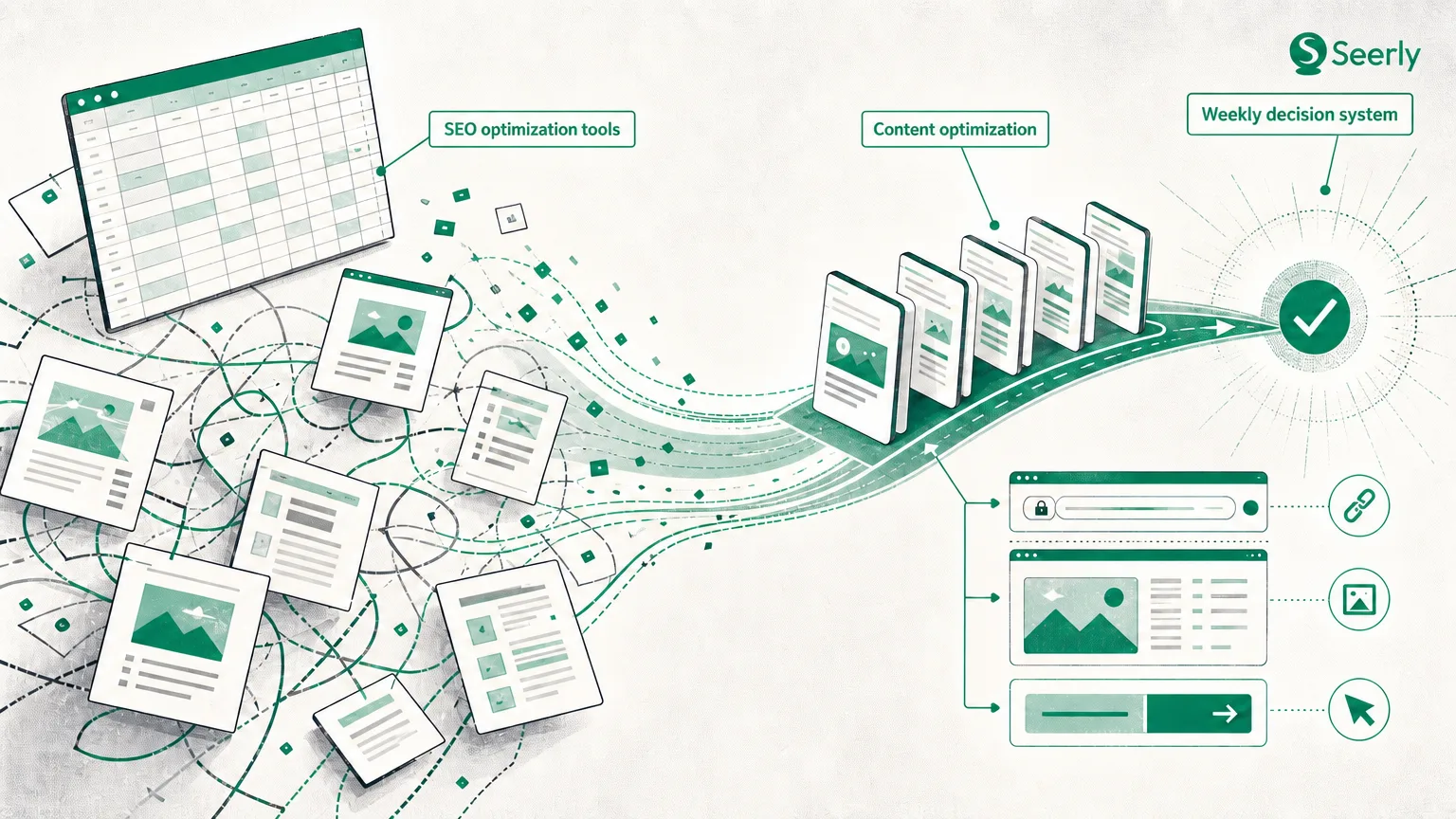
The easiest SEO metrics to see are usually the least complete. Position tracking tools show upward movement. Google Search Console shows impressions rising. A few non-brand terms reach page one, and the report appears positive. Yet teams often feel a disconnect because pipeline does not move at the same pace, sales calls do not reference the same content, or brand mentions in AI search discovery remain inconsistent.
Part of the problem is that rankings measure availability, not performance. A page may rank because it matches a term semantically, but still fail to earn the click, satisfy the visit, or get reused in AI-generated summaries. That is especially important now that trust signals, structure, and clarity affect whether content is not only indexed but also surfaced as something worth citing or recommending. Seerly has covered this shift in what marketers should measure now as Google AI search changes trust signals, and the implication is practical: strong rank alone does not prove strong discovery quality.
There is also a reporting issue inside many teams. SEO is often evaluated in channel silos, while buyers experience the brand across multiple search interfaces. A landing page can hold a top-five ranking, but if competitors are consistently summarized, cited, or named in answer engines and AI chats, your relative visibility may still be falling. That is why the old question of site ranking Google performance needs a broader review standard. You are no longer measuring only whether a page appears. You are measuring whether it earns attention, trust, and action.
The five proof signals that matter now
A useful SEO scorecard does not need to be large. In fact, the smaller the team, the more disciplined the framework should be. These five signals give you a practical way to judge whether SEO is really working.
1. Ranking position for target queries
Start with rankings because they still indicate whether Google understands your page as a credible result for a given topic. Track a focused set of commercial, high-intent, and supporting informational keywords rather than an oversized list. A rise from position 18 to 7 matters because it changes eligibility for meaningful clicks. A rise from 62 to 41 usually does not.
What matters here is not just average position, but ranking alignment. Are the pages you want to rank actually the ones appearing? If a blog post is ranking for a transactional query that should be served by a product or service page, the number may look healthy while intent matching remains weak. A site ranking in Google is only useful when the correct page is earning the visibility.
2. Organic clicks and click quality
Impressions and positions do not guarantee traffic. Review Search Console clicks and CTR at the query-page level to see whether ranking gains are producing actual visits. If rankings improve while CTR declines, the issue may be title clarity, SERP competition, changing search features, or weaker perceived relevance.
Click quality matters even more than raw click volume. A page attracting broad informational traffic may inflate your organic totals without bringing in visitors who are likely to evaluate or buy. This is where many teams misread success. They see traffic stability and assume on-page and off-page SEO work is paying off, when the visit mix is actually drifting away from valuable intent.
3. Conversion quality from organic landing pages
The third signal is where SEO becomes a business function rather than a publishing function. Look at conversion behavior on the pages that receive organic traffic: demo requests, contact form submissions, trial starts, qualified leads, assisted conversions, or whatever downstream event matters in your model. If rankings rise but conversion quality stays flat or worsens, the SEO program may be increasing visibility without improving fit.
This is the most common break in the chain. Teams succeed at getting found but fail at helping users take the next step. Sometimes the offer is unclear. Sometimes the page answers the query but not the buying question. Sometimes the traffic comes from the wrong audience entirely. As discussed in why rankings and visits still fail to turn into pipeline, traffic without meaningful business response is not proof of SEO success.
4. Branded search lift
When non-brand SEO is working well, it often creates downstream brand demand. People discover a page, leave, then return later by searching your company name, product name, or team members. That is why branded search lift is a useful lagging indicator. It suggests your content is not just being found, but remembered.
This signal is especially valuable for lean teams because it captures a form of influence that direct last-click attribution often misses. If non-brand rankings grow but branded queries remain flat over several review cycles, your visibility may be too shallow to build recall. Good SEO improves discoverability; great SEO improves recognizability.
5. Presence in AI-generated answers and recommendation surfaces
The fifth signal is the one many traditional SEO scorecards still ignore. Check whether the pages ranking in Google are also the pages that AI systems can summarize, cite, or recommend consistently. If your site appears in standard search results but rarely shows up in AI-generated answers, you may have an answer-readiness problem rather than a ranking problem.
This often comes down to structure, specificity, and trust signals. Pages with vague claims, thin differentiation, weak entity clarity, or poor formatting may rank adequately but still be hard for AI systems to reuse confidently. A helpful companion framework is Seerly’s guide on monitoring brand presence in Google AI chats versus search rankings, which explains why visibility rankings and answer-surface visibility should be reviewed together.
What rankings can hide
A site ranking Google report can tell you that something is visible. It cannot tell you whether that visibility is healthy. The table below shows three common failure cases.
| Looks healthy | Actually healthy |
|---|---|
| A page ranks top 5 for a target keyword | The page ranks top 5 and matches the searcher’s likely next step, earning qualified clicks and conversions |
| Organic traffic is steady month over month | Organic traffic is steady and the mix of visits still includes high-intent users who engage and move forward |
| The brand still appears in Google results | The brand appears in Google results and is consistently represented in answer surfaces, summaries, and recommendations |
The first failure case is ranking for the wrong intent. This often happens when an educational article outranks a service page for a term with mixed commercial intent. The site appears to be winning, but the page is not built to convert that demand. As a result, the report shows visibility growth while the business sees little change.
The second failure case is holding traffic but losing recommendation visibility. This is becoming more important as users rely on generated summaries before clicking. A company can maintain legacy traffic from existing rankings while becoming less present in the comparative or advisory layers that influence future demand. In practice, that means your organic baseline may stay intact while your discoverability among new buyers weakens.
The third failure case is attracting visits that do not convert. This usually points to one of three issues: mismatched keyword targeting, weak landing-page structure, or low message clarity. In some cases, the problem is not the traffic source but the page itself. Seerly’s perspective on featured snippet rules versus AI answer rules for Google ranking is useful here because it highlights how content can satisfy old ranking rules without being formatted for modern answer extraction.
A lightweight monthly review workflow
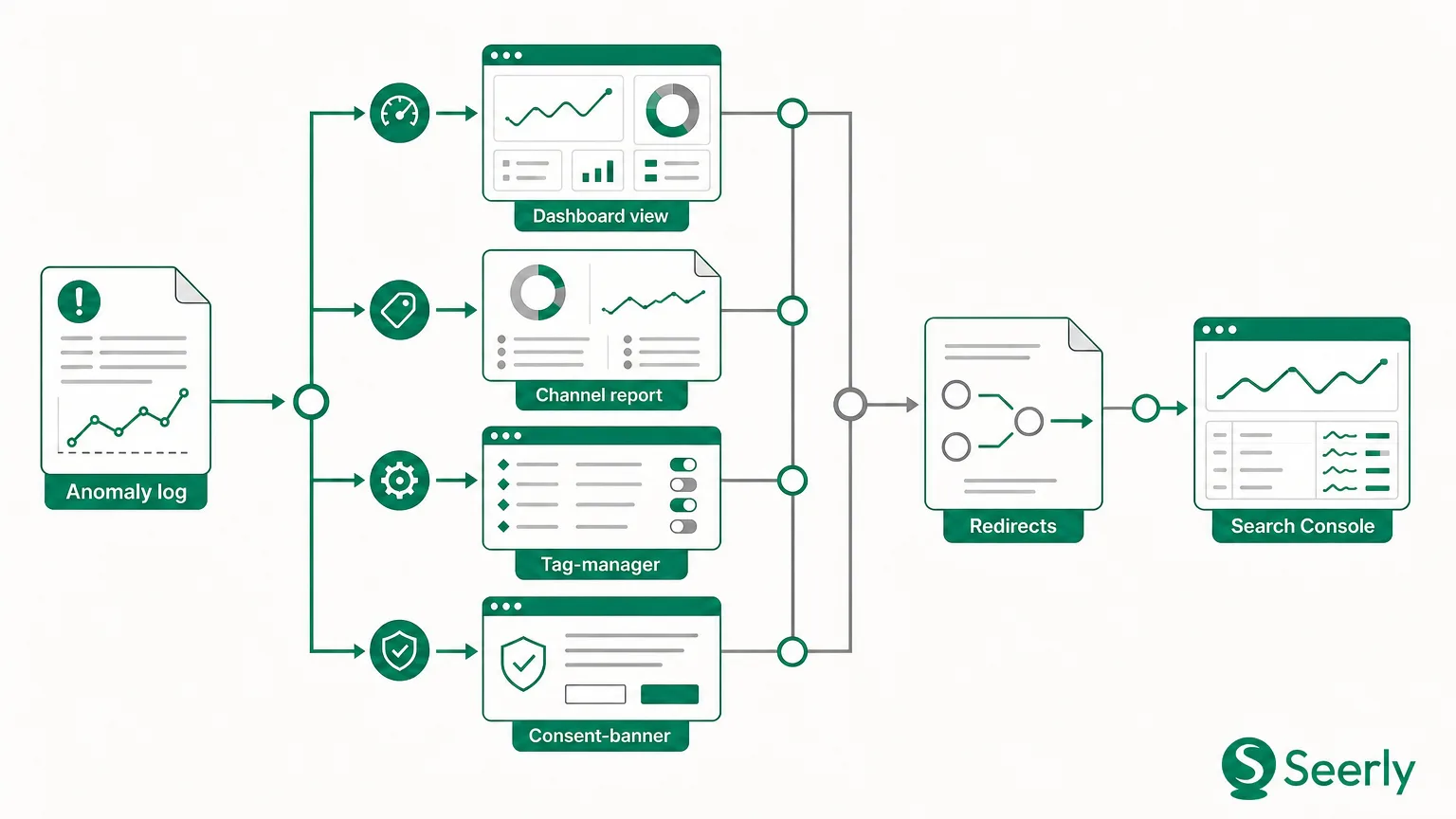
Most teams do not need more dashboards. They need one reliable review loop. The workflow below is intentionally compact so a marketer or SEO manager can run it every month without turning it into a reporting project.
Step 1: Review your core keyword set
Pull a small group of strategic terms: a handful of commercial keywords, a few high-value informational queries, and your major brand terms. Note ranking changes, but also record which URL is ranking. The point is to confirm that the right pages are earning visibility, not merely that some page from the domain is present.
Step 2: Check query-to-page click performance
In Search Console, compare impressions, clicks, and CTR for the same set of pages. Look for disconnects. If impressions rise but clicks do not, investigate title framing, SERP competition, or intent mismatch. If one URL is receiving traffic from many loosely related queries, it may be too broad to convert well.
Step 3: Evaluate landing-page conversion behavior
Move from search data into analytics and CRM outcomes. For each high-visibility page, check engagement quality and conversion actions. If you can, review assisted conversion paths rather than only last-touch results. This helps you distinguish between content that contributes to demand and content that merely attracts visits.
Step 4: Inspect answer-surface visibility
Pick a short list of prompts and commercial questions related to your category, brand, and high-value use cases. Check whether your brand, pages, or claims appear in AI-generated answers and summaries, and whether the representation is accurate. This is where many teams uncover a hidden gap: the page that ranks in Google is not the page being cited, summarized, or trusted elsewhere.
Step 5: Audit page clarity and structure
For any page with strong rankings but weak outcomes, do a fast on-page review. Is the main claim obvious in the first screen? Are sections easy to parse? Does the page answer the primary question directly before expanding? Are proof points, comparisons, FAQs, or next steps clearly labeled? Often, small structural improvements do more for performance than publishing another article.
Step 6: Review supporting signals
Before concluding that the page is the problem, scan the support system around it. Internal links, topical context, trust markers, and originality all affect sustained visibility. If rankings are softening or the wrong page keeps surfacing, review page support, not just page copy. Seerly’s guidance on how to find ranking losses caused by weak internal links, not just weak content is especially relevant for this step.
Step 7: Record one action per page
Do not end the review with observations only. For each priority page, assign one action: improve title and meta framing, tighten intent match, add proof, restructure headers, strengthen internal linking, or clarify CTA. A monthly process works because it creates repeated improvements, not because it produces perfect diagnosis in one sitting.
Worked example: rankings improved, outcomes did not
Imagine a B2B software company targeting “inventory forecasting software.” Over three months, its main comparison guide moves from position 11 to position 4. Organic clicks increase by 38 percent, and the SEO dashboard looks strong. On the surface, this seems like clear proof that the site ranking in Google is improving and the strategy is working.
But when the team looks deeper, lead quality has barely changed. The guide attracts students, consultants, and early-stage researchers, while product-qualified demo requests remain flat. At the same time, when users ask AI systems which tools are best for mid-market retail forecasting, competitors are summarized more often than the company’s page. The ranking gain is real, but the commercial value is limited.
The team audits the page and finds three issues. First, the article opens with a broad educational explanation instead of a direct answer for buyers evaluating vendors. Second, proof signals are buried halfway down the page, including implementation details and customer-fit guidance. Third, the content is loosely structured, making it harder for AI systems to extract concise, trustworthy claims.
After revising the page, the company adds a clearer opening definition, a buyer-focused comparison block, explicit “best for” language, cleaner heading structure, a concise product selection framework, and stronger internal links from related pages. Rankings hold roughly steady, but conversion rate from that landing page increases, branded search volume begins to rise, and the page starts appearing more consistently in answer-style summaries. The lesson is straightforward: ranking improvements matter, but they become meaningful only when the page is discoverable, understandable, and persuasive across both search and AI surfaces.
FAQ
How long should you wait before judging whether SEO is working?
For most programs, three to six months is a reasonable window for judging direction, but not every metric moves at the same speed. Rankings and impressions usually shift first. Click behavior and landing-page performance often follow. Branded search lift and pipeline impact usually take longer. The mistake is judging too early on revenue alone or too late on rankings alone. Use multiple signals so you can tell whether the program is progressing before business outcomes fully mature.
What should you do if rankings rise but leads do not?
Start by checking intent match at the page level. The most common issue is that the ranking page answers a related question but not the buyer’s actual decision need. Then review conversion structure, CTA clarity, and whether the traffic is coming from the right audience. If those look sound, inspect answer-surface visibility and page formatting. The problem may be less about Google visibility and more about how the page is represented and trusted in modern discovery workflows.
What should you review first when metrics conflict?
Begin with the query-page relationship. If a page ranks well but CTR is weak, diagnose the SERP and title framing. If clicks are healthy but conversions are poor, review intent and landing-page quality. If conversions are stable but branded lift or answer-surface visibility is weak, investigate trust signals and representation outside classic search. Conflicting metrics are not noise; they are clues about where the breakdown sits in the funnel.
Are rankings still worth tracking in an AI-shaped search environment?
Yes, absolutely. Rankings remain one of the clearest indicators that Google sees your content as relevant and credible. The change is not that rankings stopped mattering. The change is that rankings are no longer enough on their own. They should be treated as an entry signal inside a broader proof framework, not as the final verdict on SEO performance.
Conclusion
If your site ranking in Google is improving, that is a positive sign, but it is not the whole story. Real SEO proof now comes from a compact set of connected signals: ranking movement, click quality, conversion behavior, branded search lift, and visibility in AI-generated answers. When those move together, you have stronger evidence that SEO is creating business value rather than just better-looking dashboards.
A practical next step is to audit three to five important pages and compare their Google ranking performance with how well they can be summarized, cited, and recommended. If you want a system for tracking whether the pages that rank are also building AI-ready visibility and trusted authority, explore Seerly.