Comparison
Seerly vs Writesonic for GEO: Tracking-First vs Content-First
Last updated July 2026
Last updated: July 2026
Seerly and Writesonic make the same promise, SEO and GEO in one platform, with content that closes the gaps, from opposite starting points. Writesonic began in 2020 as an AI writing tool and layered visibility tracking on top; its strength is content production volume, and its tracking is gated by tier, with Claude and Perplexity coverage reserved for Enterprise. Seerly was built visibility-first: tracking across Google plus five AI engines, including Claude and Perplexity, on standard plans, with a Content Agent that drafts what the gap analysis calls for. If you need high-volume content production with visibility tracking attached, Writesonic fits. If you need visibility depth with content drafting attached, Seerly does, from $99/month with no expiring credits to manage.
Seerly vs Writesonic at a glance
| Dimension | Seerly | Writesonic |
|---|---|---|
| Product DNA | Visibility-first, content loop built in | Content-first (2020 AI writer), GEO added later |
| Engines on standard plans | 5: ChatGPT, Perplexity, Google AI Overviews, Claude, Gemini | ChatGPT only on Starter; Basic/Growth add Gemini + Google AI Overviews |
| Claude & Perplexity tracking | Included | Enterprise-only |
| Google organic (classic SEO) tracking | Yes | Yes (SEO Checker, audits, GSC integration) |
| Content production | Content Agent drafts gap-closing pages | 80+ templates, article writer, brand voice: highest volume in this comparison |
| Billing model | Flat plans | Credit-based; unused credits expire each cycle |
| Prompt-demand data | Standard | 120M+ proprietary AI chatbot conversations (AI Search Volume) |
| AI crawler analytics | Standard | Cloudflare-based bot analytics: a genuine differentiator |
| Starting price | $99/mo (Basic) | ~$79/mo annual (Starter, ChatGPT-only tracking); ~$199/mo (Basic) |
| Free start | Free 60-second audit, 7-day trial, 30-day guarantee | Free trial of writing tools; GEO gated to paid tiers |
Pricing figures are as of mid-2026. Writesonic re-tiered its plans during 2026 and gates features differently by tier, verify against its live pricing page before deciding.
What each platform is
Writesonic is one of the most established names in AI content. It launched in 2020 as a writing assistant, expanded into SEO workflows, and by 2026 has repositioned as an AI search growth platform: GEO tracking across up to 10 AI surfaces on Enterprise, an Action Center that prioritizes fixes, citation gap analysis with outreach templates, and, uniquely, an AI Search Volume dataset built from 120 million real AI chatbot conversations, plus Cloudflare-based analytics showing which AI bots crawl your pages. Its heritage shows in production capacity: 80+ templates, brand voice training, and article volumes no dedicated visibility tool matches. It serves 20,000+ teams with enterprise logos including Amazon and Unilever.
Seerly is an organic traffic and AI search visibility platform built the other way around. The core is the loop, audit, identify gaps, draft and publish content, track and compound, run by three agents: a Visibility Agent tracking Google rankings and AI mentions across five engines, a Trend Agent surfacing emerging prompts, and a Content Agent drafting the pages that close each gap, all funneled into a recommended-actions queue.
The DNA difference is the whole comparison. Writesonic added tracking to a writing tool; Seerly added drafting to a tracking platform. Which one you want depends on which half is your bottleneck.
Engine coverage: the gated versus the included
This is the sharpest practical difference. On Writesonic's public tiers, the Starter plan tracks ChatGPT only, and the Basic and Growth tiers extend coverage to Gemini and Google AI Overviews. Claude, Perplexity, Grok, DeepSeek, Copilot, Meta AI, and Google AI Mode all require the Enterprise tier. The "10 AI platforms" headline is real, but it describes the top of the ladder, not what most subscribers get.
Seerly tracks ChatGPT, Perplexity, Google AI Overviews, Claude, and Gemini as its standard engine set, with no engines held back for an enterprise quote. If Perplexity or Claude citations matter to your brand, and for technical and B2B audiences they increasingly do, that difference alone can settle the choice at the mid-market price point.
Pricing and the credit question
Writesonic's entry pricing looks lower, roughly $79/month on annual billing for Starter, but two things complicate the sticker. First, the tier gating above: meaningful multi-engine tracking starts around the ~$199/month Basic tier. Second, the credit model: features draw from a shared credit pool at different rates, and unused credits expire at the end of each billing cycle. Reviewers consistently flag this as the platform's biggest friction point, because real monthly cost depends on usage patterns and is hard to plan, and inconsistent months waste paid capacity.
Seerly's plans are flat: Basic at $99/month (1 engine, 25 prompts, 800-page site audit) and Pro at $399/month (3 engines, 100 prompts, all three agents), with a 7-day free trial and a 30-day money-back guarantee. What you pay is what it costs, whatever your usage rhythm.
Content: volume versus targeting
Writesonic wins on raw production. If your operation publishes at high volume across formats, articles, ads, landing pages, social, its template library, brand voice training, and editor are mature, and nothing in the visibility category matches that throughput. The honest caveat from its own reviewers: long-form output needs meaningful human editing before it is publish-ready, and outputs are not citation-ready by default.
Seerly's Content Agent is narrower by design: it drafts the specific pages, FAQs, and comparison content that its own gap analysis identifies, so production is targeted at visibility outcomes rather than volume. Because brands cited in AI Overviews earn 35% higher organic click-through than those that are not (Seer Interactive, 2025), that targeting is the point, the queue tells you what to publish and the agent drafts exactly that.
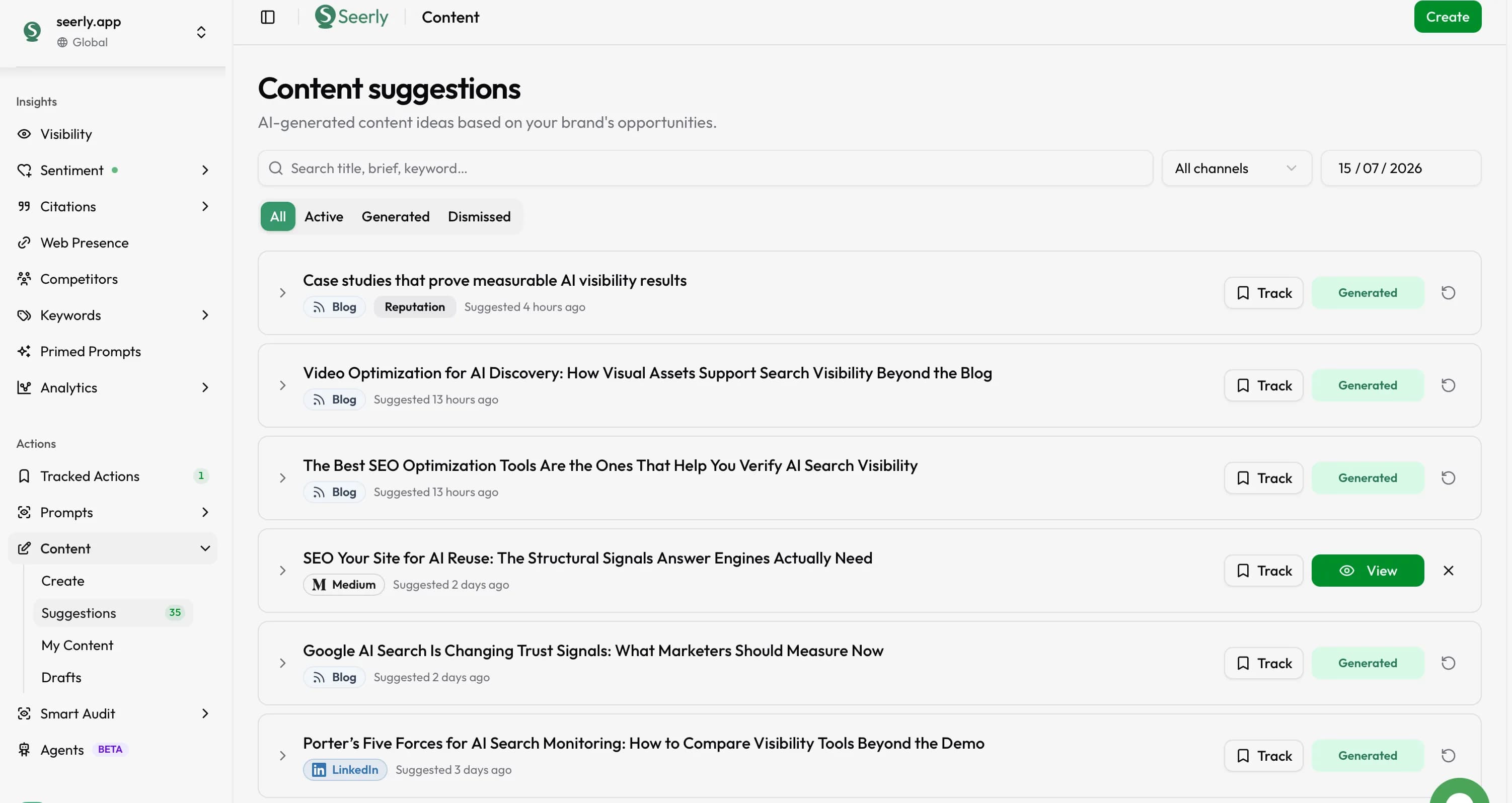 Screenshot: Seerly's content suggestions queue on the seerly.app workspace itself. Each visibility gap becomes a drafted content task with a channel and a one-click generate action. July 2026.
Where Writesonic is genuinely better
Four things. Production volume and format breadth, if you actually use the article credits each month. The AI Search Volume dataset, 120M real AI conversations for prompt-demand research is unique in the category. Cloudflare-based crawler analytics, showing which AI bots hit which pages, server-side data few competitors offer. And enterprise packaging: SOC 2, HIPAA, SSO, and a 10-engine ceiling for organizations that will pay for it. If those describe your needs, Writesonic is a credible pick.
Where Seerly is genuinely better
Visibility depth where it counts, at self-serve prices. Claude and Perplexity tracking on standard plans instead of behind an Enterprise quote, flat pricing with no expiring credits, a free 60-second audit before any commitment, and a content layer that exists to close tracked gaps rather than to maximize output. Teams whose bottleneck is knowing where they're invisible and fixing it, not producing more content generally, get a tool shaped exactly for that job.
Verdict: which should you choose?
Choose Writesonic if content production is your primary need and visibility tracking is the add-on, you publish at volume, you'll consume the credits, and ChatGPT/Gemini/AI Overviews coverage is enough, or you're an enterprise ready to pay for the full 10-engine tier.
Choose Seerly if visibility is the primary need and content is the means, you want five engines including Claude and Perplexity from the start, predictable flat pricing, and drafting that's targeted at the gaps your tracking finds, from $99/month.
FAQ
Is Writesonic good for GEO?
Yes, with caveats. Its Action Center, citation gap analysis, and crawler analytics are genuinely useful, but reviewers note the tracking is shallower than purpose-built visibility tools, and engine coverage is heavily tier-gated, Claude and Perplexity require Enterprise. It is strongest for teams that primarily need its content production.
Does Writesonic track Claude and Perplexity?
Only on its Enterprise tier as of mid-2026. Public Starter, Basic, and Growth tiers cover ChatGPT, with Gemini and Google AI Overviews added from Basic. Seerly includes Claude and Perplexity in its standard five-engine set.
Is Seerly or Writesonic cheaper?
Writesonic's Starter (~$79/month annual) is cheaper than Seerly's Basic ($99/month), but it tracks only ChatGPT and uses expiring credits, so effective cost depends on usage. Multi-engine tracking on Writesonic starts around $199/month. Confirm current pricing on both sites, Writesonic re-tiered during 2026.
How do Writesonic's credits work?
Features draw from a shared credit pool at different rates, longer drafts and higher quality settings consume more, and unused credits expire at the end of each billing cycle. Seerly uses flat plans without an expiring-credit system.
Can Writesonic replace an SEO tool?
Partially. It includes an SEO Checker, site audits, and Google Search Console integration, which reviewers describe as useful baseline guidance rather than a full SEO stack. Both Writesonic and Seerly cover SEO and GEO together, which is what separates them from monitoring-only tools like Peec or Otterly.
More AI visibility tool alternatives
- Scrunch AI alternatives
- Rankscale alternatives
- Otterly.AI alternatives
- Peec AI alternatives
- Profound alternatives
See the gap for yourself
Run the free 60-second Seerly audit to see how your brand appears across Google and the major AI engines. No credit card required. Start your free audit.
Sources: Seer Interactive AI Overviews CTR study (2025), Writesonic pricing, and independent Writesonic GEO reviews (Slate, FrictionAI, eesel), as of mid-2026.