How to Find SEO Ranking Losses Caused by Weak Internal Links, Not Just Weak Content

When a page slips in search results, most teams assume the page itself is the problem. They revise the intro, expand the copy, add FAQs, and refresh the title tag. Sometimes that works. But often, it treats the symptom rather than the cause.
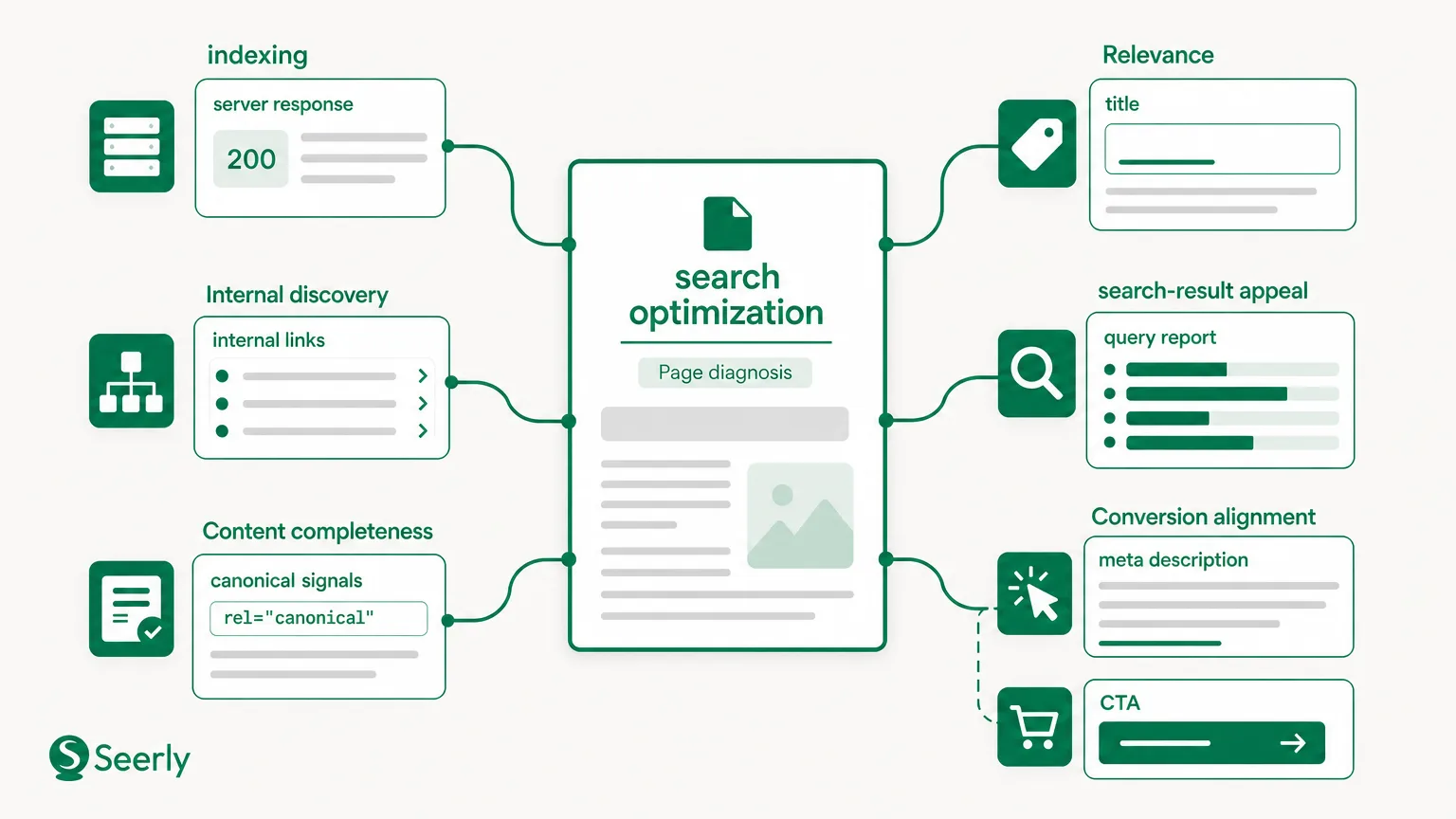
If you want to find SEO ranking problems accurately, you need to look beyond the draft and into the page’s internal context. Search engines evaluate far more than isolated copy quality. They use signals tied to relevance, link relationships, and site structure, and internal links still help search engines discover pages and understand topical connections. That matters because a ranking drop may reflect weakening support from the surrounding cluster, not a sudden collapse in page quality.
This tutorial shows how to diagnose that difference. Instead of jumping straight into a rewrite, you’ll learn how to investigate whether ranking loss is tied to anchor text, page relationships, and support-page architecture.
Why teams misread ranking drops
A weak page and a weakly supported page can look similar in rank tracking tools. In both cases, positions fall, impressions soften, and traffic may flatten. The mistake is assuming every decline is a content problem. In reality, SEO performance depends on multiple signals, and links remain a meaningful ranking factor even if they are no longer the only dominant one.
That distinction is especially important for lean SEO teams. If a commercial page loses visibility because the site keeps pointing to it with vague anchors, revising the page copy alone may do very little. You may improve readability and still leave the ranking issue untouched. A better workflow is to compare on-page quality issues with internal-context issues before prioritizing the fix.
Content problems usually show up as thin evidence, shallow coverage, weak examples, or poor alignment with intent. Internal-link problems tend to show up differently: the page has few supporting mentions, anchors are repetitive or generic, and neighboring pages fail to reinforce the category language that helps search engines classify the destination. If you want to check site SEO ranking more intelligently, that is the first split to make.
A practical framework to diagnose ranking loss
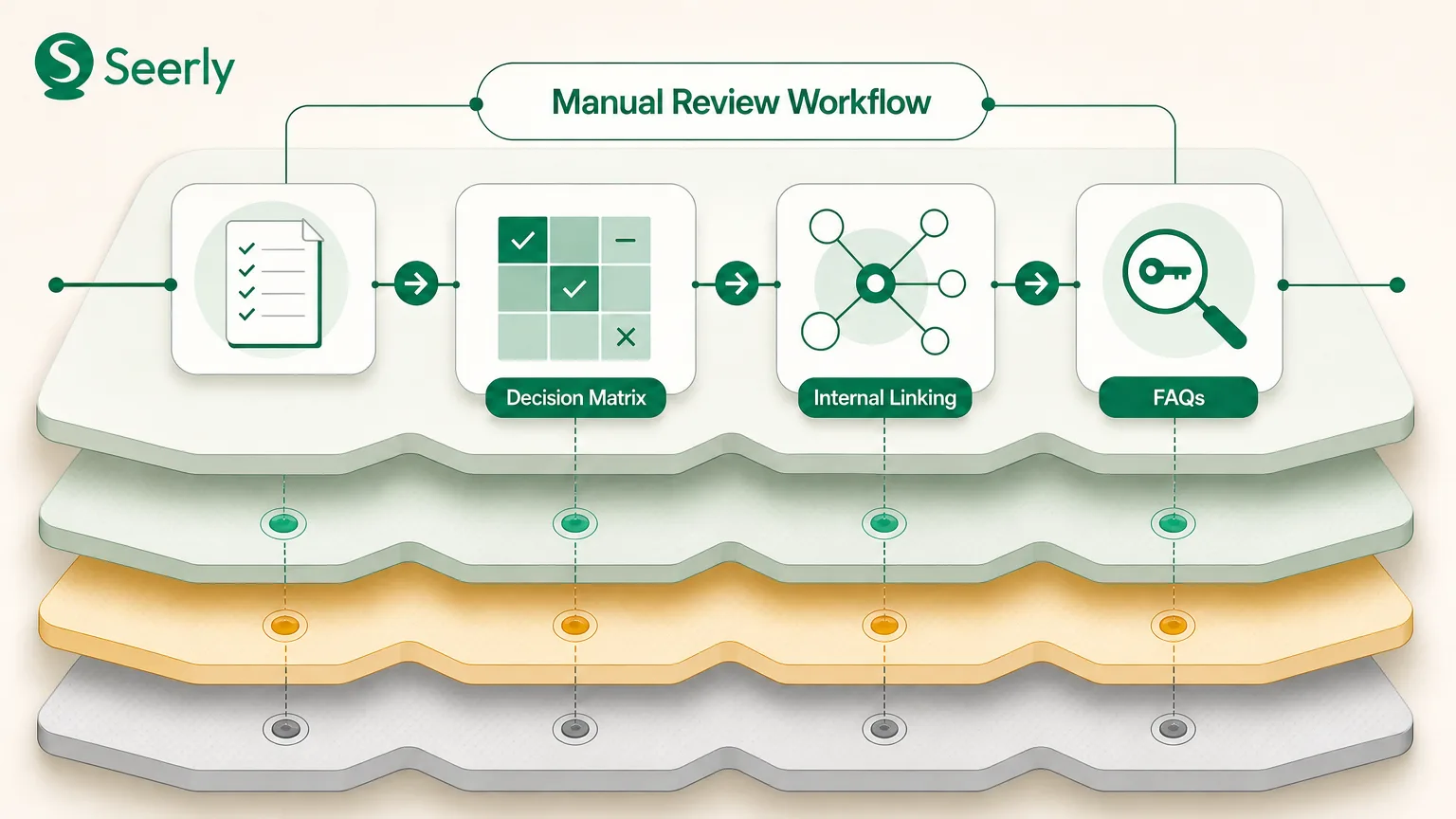
1. Confirm the pattern of the drop
Start by asking whether the decline is isolated, category-wide, or template-specific. If one page slipped while close peers remained stable, the issue may be local to that URL. If an entire category declined, the problem may involve internal architecture, cannibalization, or changes in how the cluster is connected. If all pages using one template fell, investigate navigation, page layout, and repeated anchor patterns.
This step matters because search engines do not rank pages in a vacuum. They evaluate how pages fit into a wider site structure, and ranking systems use a broad mix of relevance, quality, and link-related signals. A single-page rewrite is much less likely to solve a category-level signal problem.
2. Map every internal link pointing to the page
Next, pull a list of all internal links to the underperforming page. Include links from articles, hub pages, navigation, footer modules, product pages, and related-resource blocks. Your goal is not just to count links, but to inspect the language used around them.
Look for three patterns. First, are most anchors generic, such as “read more,” “learn more,” or “see details”? Second, are all anchors identical, with no variation tied to adjacent subtopics? Third, do the linking pages themselves belong to the same category, or are they weak contextual matches? Internal links help define relationships, and vague anchors limit the amount of useful context they pass.
3. Check for orphaned or weakly supported supporting pages
A page may lose ranking support because the cluster around it has thinned out over time. Supporting content gets removed, buried, or left unlinked from relevant hubs. When that happens, the target page may still exist, but the ecosystem reinforcing its topic weakens.
This is where teams often confuse authority with actual diagnostic evidence. Metrics like Domain Authority are popular, but search engines do not use Domain Rating or Domain Authority as direct ranking factors. Those numbers can be useful shorthand for comparison, yet they should not distract from page-level support signals such as internal pathways, anchor specificity, and topical adjacency.
4. Review navigation and category labels
Many ranking issues start higher up the structure. A page may be linked in the main nav or category pages using labels that are too broad to clarify its role. For example, a category labeled “Resources” tells users something, but it tells search engines very little about the subtopic relationships inside that section.
Review whether your nav, hub pages, and breadcrumbs use the same category-defining language that appears on the destination page and its support pages. This is one of the most overlooked ways to find SEO ranking issues that are structural rather than editorial.
Worked example: the page was fine, the anchors were not
Imagine a SaaS company with a commercial page targeting “customer data platform.” The page is comprehensive, has strong product detail, and answers buyer questions well. Yet rankings slide from positions 7-8 to 11-13 over two months.
The team first suspects weak copy. But when they inspect internal links, they find that blog posts and feature pages mostly link to the commercial page with anchors like “learn more,” “our platform,” and “read more.” Only a handful of links actually use category language related to customer data platforms.
Here is the problem in practice:
- Before: “To unify campaign data across channels, learn more.”
- Before: “Our product helps teams centralize profiles. Read more.”
Those anchors do not reinforce what the destination page is about. Now compare revised versions:
- After: “To unify campaign data across channels, compare our customer data platform capabilities.”
- After: “Our product helps teams centralize profiles with a customer data platform built for B2B teams.”
The principle is simple: descriptive anchors help define the topical relationship between source and target. That does not mean stuffing exact-match phrases into every link. It means replacing empty phrasing with useful, category-reinforcing language.
This also aligns with a broader SEO reality: a backlink is fundamentally a link from one page to another that can pass signals about relevance and authority. While that definition is usually discussed in the context of external links, the same interpretive logic makes internal linking strategically important for clarifying page relationships.
A checklist for support-page architecture
Once you identify weak anchors, zoom out and evaluate the cluster itself. A page rarely performs at its best when it stands alone.
First, ask whether there are enough adjacent pages supporting the main topic. A commercial page targeting a high-value term usually needs nearby educational, comparative, and use-case content. If the site has only one target page and no surrounding support, search engines have less evidence that the site covers the topic in depth.
Second, check whether links point both up and down the cluster. Supporting articles should link to the main commercial or hub page, but the main page should also guide users toward relevant supporting assets. Strong clusters are navigable in both directions, not just one.
Third, review whether support pages reinforce the same category vocabulary. If one article uses “customer data platform,” another uses “data unification tool,” and the nav says “solutions,” the language may be too fragmented. Some variation is healthy, but the core category needs to stay legible across the cluster. If your team is already working on semantic relationships between related topics, this is where that work pays off operationally.
Finally, assess whether the page is being mentioned from high-visibility internal locations. A buried mention inside one old blog post is not the same as repeated, relevant support from recent articles, hubs, and commercial pages. Teams that want AI-driven SEO workflows without losing visibility into supporting signals should treat internal-link audits as part of routine diagnosis, not just site cleanup.
When content really is the problem
Internal linking is often underdiagnosed, but it is not the answer to every ranking drop. Sometimes the page itself is weak, and no amount of anchor refinement will fix that.
Look for thin evidence. If the page makes claims without proof, examples, screenshots, original insight, or differentiated expertise, it may simply be less useful than competing results. Also check the opening section. If the page takes too long to answer the searcher’s question, it may fail to satisfy intent quickly enough.
Weak examples are another common issue. A page can be long and still underperform if it stays abstract. The same goes for poor differentiation. If your page says roughly what every competitor says, with no stronger framing or clearer utility, rankings may reflect that reality. Since SEO metrics are only proxies for how pages perform in search ecosystems, diagnosis should always return to what the page actually offers users.
FAQ
How often should we review internal link patterns?
For commercial and category pages, review them monthly or at least once per quarter. Link patterns change gradually as teams publish new content, retire old pages, and update templates. A regular review helps you catch support decay before rankings fall sharply.
What if rankings are flat but traffic is stable?
That usually means the page may be holding its position mix while demand shifts, or it may be winning more qualified clicks from similar rankings. Do not force a rewrite just because positions are not moving. Investigate impressions, query mix, and internal support before assuming the page is underperforming.
Which pages should we re-link first?
Start with pages that have commercial value, slipped recently, and already have decent on-page quality. Those are the best candidates for internal-context fixes because you can isolate the effect of anchor and support changes. If your team also tracks visibility beyond classic blue links, it helps to connect those ranking patterns with how brand presence differs between AI chat surfaces and traditional search results.
Conclusion
If you need to find SEO ranking losses more accurately, do not begin with a rewrite by default. Start by asking whether the page lost topical support from the rest of the site. Weak anchors, thin internal pathways, vague category labels, and underbuilt clusters can all reduce a page’s ability to hold position even when the copy is still solid.
A practical next step is to choose one underperforming commercial page, map every internal link pointing to it, rewrite the weakest anchors, and then monitor rankings before committing to a full content overhaul. If you want a clearer way to connect ranking signals with broader visibility outcomes, Seerly can help you turn that diagnostic work into more informed decisions.