Google AI Search Is Changing Trust Signals: What Marketers Should Measure Now

Google AI search has changed a core assumption behind SEO reporting: being visible in rankings is no longer the same thing as being visible in the answer a user actually reads. For in-house marketers and SEO leaders, that shift creates a new trust problem. A brand can still rank, still earn impressions, and still lose influence if AI-generated answers summarize the category incorrectly, omit the brand, cite weak sources, or present misleading claims with high confidence.
That concern is no longer theoretical. Public discussion around AI Overviews and answer quality has become a measurable market signal in its own right. A widely circulated Reddit thread on Google AI Overview accuracy drew 31.4K upvotes and 743 comments in response to examples of unreliable outputs, while X posts criticizing strange or incorrect AI results - including phrases like “google ai system weird” and “google ai overview wrong” - have attracted 257.7K views in one case and 147.4K views in another. Even where those examples are anecdotal, the pattern matters: users are actively questioning reliability, and that affects how brands should think about measurement.
At the same time, Google is making AI a larger part of the search experience. The company says its new search experiences are driving more queries and higher-quality clicks, and it continues to expand AI-driven interfaces through products such as AI Mode, which Google describes as helping users ask longer and more exploratory questions. That means the answer layer is becoming more important, not less. If your team only reports on keyword ranks and page traffic, you are probably missing the place where trust is now won or lost.
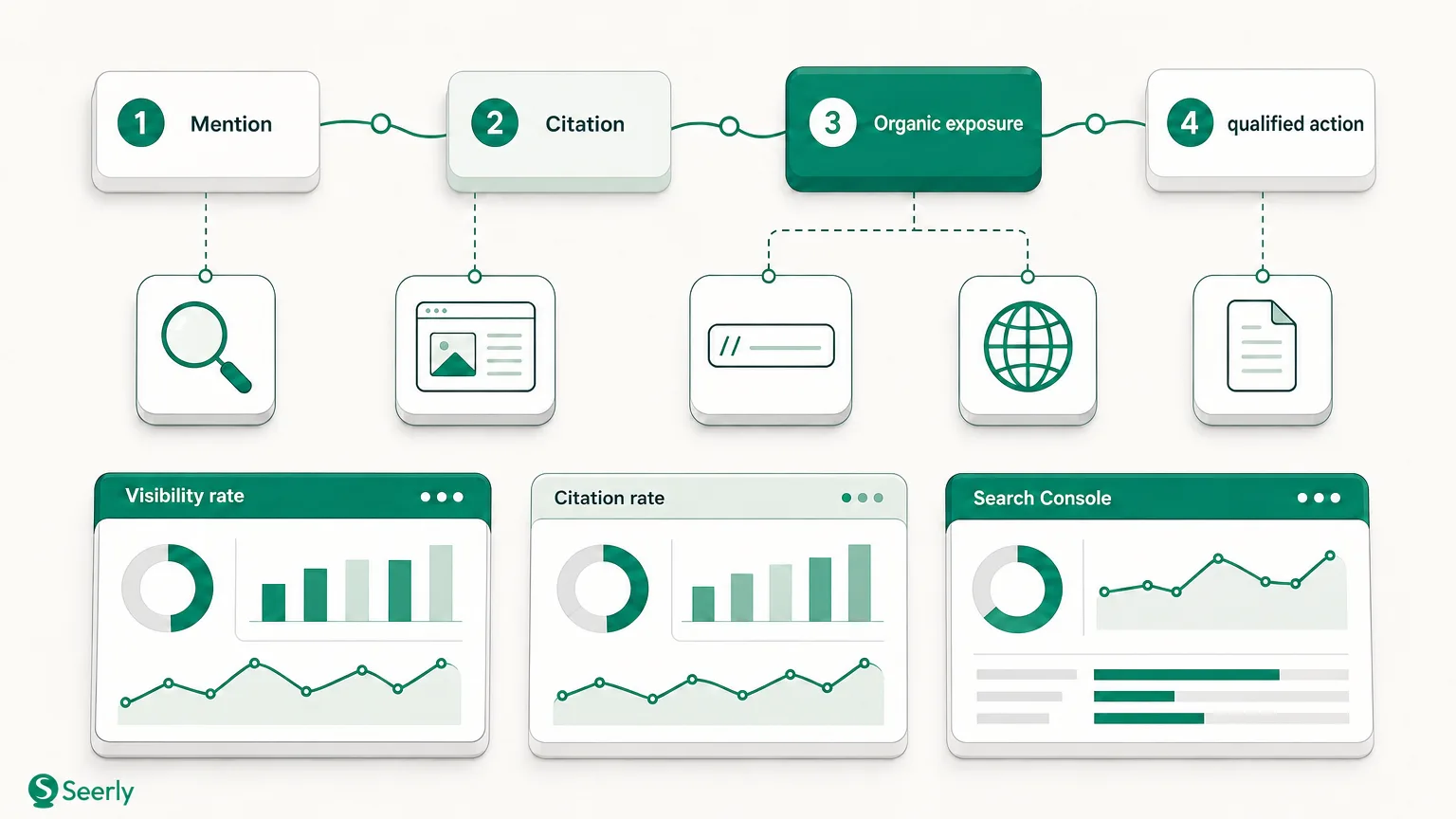
The practical takeaway is simple: traditional rankings are still useful, but they are no longer enough. Marketing teams need a repeatable system to track answer presence, citation quality, verification risk, and reporting readiness in Google AI search.
The trust problem in Google AI search is now measurable
The trust issue around AI-generated answers often gets discussed as a brand perception problem, but it is increasingly an operational measurement problem. Once Google begins generating synthesized answers, the user’s first interaction may be with a machine-produced summary rather than your page title, meta description, or featured snippet. If that summary is incomplete or wrong, the brand impact happens before the click.
Research supports the idea that AI-mediated search changes how users evaluate information. Studies examining generative search and answer systems have found persistent concerns around factual consistency, source attribution, and answer reliability, especially when systems compress multiple documents into one authoritative-sounding response. Recent work on generative search evaluation highlights that citation behavior and answer faithfulness remain active research problems, while related research shows that hallucination and unsupported claims are still central risks in AI-generated outputs. For marketers, that translates into a concrete reporting need: you cannot assume that visibility equals accuracy or that inclusion equals trust.
User behavior is also shifting in ways that make answer-layer monitoring more urgent. Reporting on Google search sessions has shown that users increasingly pause, scroll, and reconsider before clicking, which suggests the path from query to visit is becoming less linear. If AI Overviews satisfy part of the question, reshape the question, or frame the available options, they can influence the outcome without sending immediate traffic. That is one reason many teams are seeing situations where rankings hold steady while performance becomes harder to explain.
This is also consistent with the broader pattern behind modern traffic volatility. Even in traditional search, there are well-documented reasons why sites can see SEO rankings rise while traffic declines. AI interfaces intensify that disconnect because they introduce a new layer between ranking and click behavior. In other words, the trust crisis around Google AI search is measurable not only through public complaints, but also through the widening gap between old reporting inputs and real user decision points.
Why old SEO dashboards miss the new problem
Classic SEO dashboards were built for a simpler search environment. They answer questions like: What do we rank for? How many impressions did we earn? What pages gained clicks? Which keywords moved up or down? Those remain useful metrics, especially for diagnosing crawlability, content coverage, and demand capture.
What those dashboards do not show is whether your brand appeared inside an AI-generated answer, how often your site was cited, whether the cited page was actually the best proof source, or whether the answer itself was accurate. That is the blind spot. A brand can rank in the top three organic results and still be absent from the answer users consume first. A brand can also be mentioned in the answer layer, but in the wrong context, with a weak source, or next to inaccurate competitor comparisons.
This is why artificial intelligence search engine optimization needs its own reporting logic. Traditional rank tracking is URL-centric. Answer-layer monitoring is response-centric. One measures how pages perform in a list of links; the other measures how brands and sources perform inside generated synthesis. These are related systems, but they are not interchangeable.
A useful way to frame the difference is this:
What rankings still show well
Rank tracking remains good at showing discoverability, page-level competitiveness, and trend direction over time. It can help teams identify whether content is eligible to compete, whether technical issues are suppressing visibility, and whether optimization work is creating movement. It is still foundational, especially because AI systems often draw from the same web ecosystem that rewards authoritative, well-structured content.
What rankings do not show
Rankings do not tell you whether Google conversational AI surfaces your brand in direct answers, whether your cited pages are actually visible to users, whether another publisher is being treated as the primary explainer of your category, or whether an AI overview has introduced a factual error that changes user perception. Those are answer-layer problems, not ranking problems.
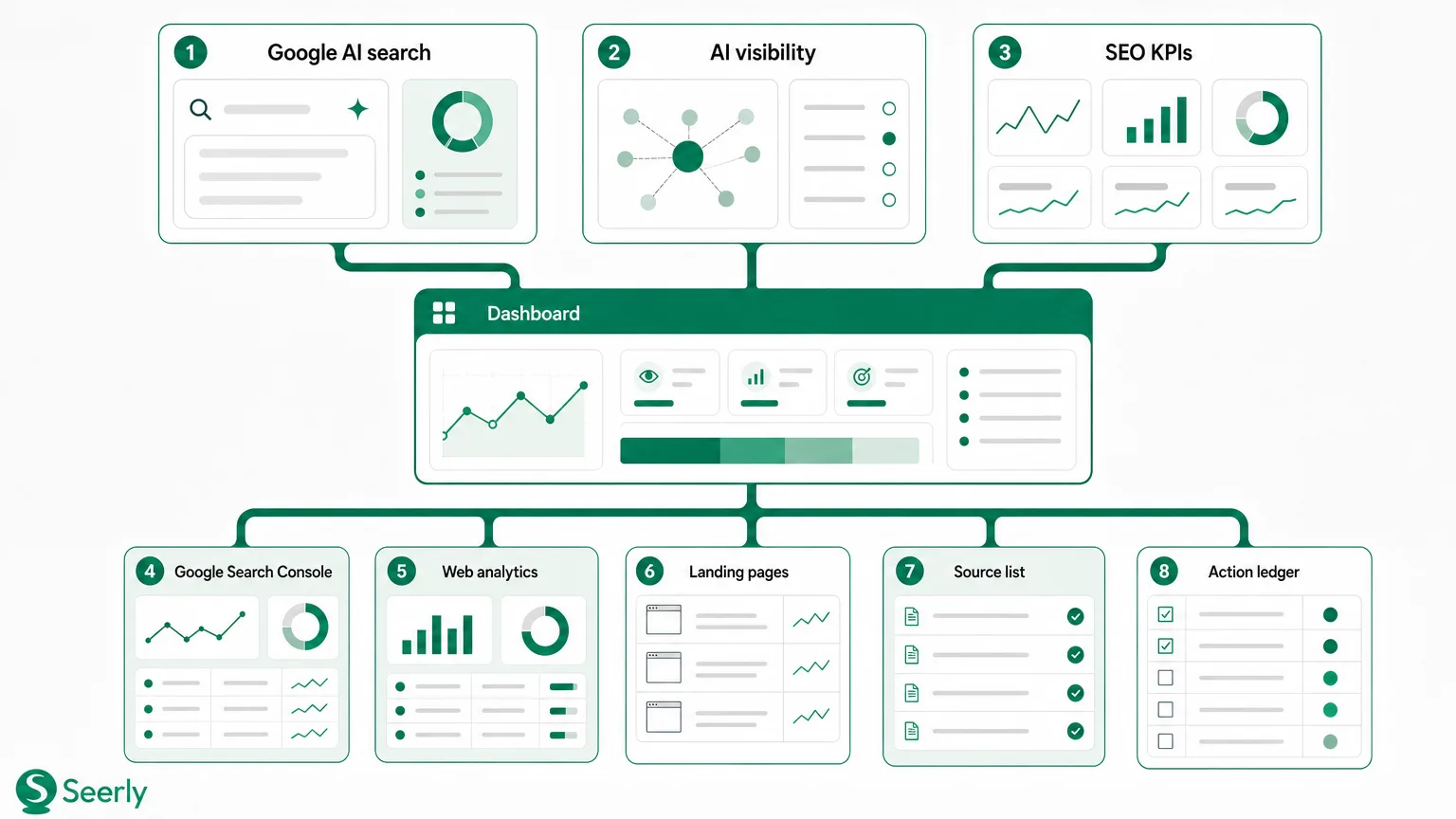
For teams adapting to this shift, the best next step is to treat AI visibility as an adjacent reporting stream rather than a replacement for SEO. Seerly has written more about that gap in its guide to monitoring brand presence in Google AI chats versus search rankings, and the core idea is straightforward: you need parallel visibility systems for links and answers.
The four trust signals marketing teams should track weekly
If you want a practical framework for Google AI search reporting, start with four trust signals. These can be reviewed weekly for priority prompts and summarized monthly for leadership.
1. Answer inclusion
The first question is simple: does your brand appear in the answer at all? Track inclusion across branded queries, category queries, comparison prompts, and problem-solution prompts. In many cases, this is the new top-of-funnel visibility check. If your brand is absent from high-intent prompts, rankings alone will not explain the missed influence.
Inclusion should be logged at the prompt level. Note whether the brand appears in the main answer, a follow-up answer, a cited list, or not at all. Over time, this gives you an answer-presence rate that is much more useful than checking a few screenshots ad hoc.
2. Citation frequency
The second signal is how often your domain is cited across tracked prompts. Presence without citation can still matter for awareness, but citation gives stronger evidence of source-level authority in the answer layer. It also helps teams understand whether their content is repeatedly being used to support claims or only appearing occasionally.
This is where trend reporting matters. One isolated citation is less meaningful than a steady pattern across prompts and weeks. If citation frequency rises after content updates, that can indicate better alignment between your pages and the kinds of evidence AI systems prefer to summarize.
3. Citation source quality
Not all citations carry equal trust value. A mention sourced from an outdated blog post, a low-context directory page, or a weak third-party summary is not the same as a citation from a clear product page, help center article, research asset, or well-maintained comparison page. Teams should review not just whether they are cited, but what page is doing the work.
This matters because source quality affects both credibility and controllability. If Google AI search repeatedly cites your least strategic page, you may be visible but poorly represented. Seerly’s article on content that gets cited in AI answers is useful here: the operational goal is not generic visibility, but citation from pages that express your positioning clearly and accurately.
4. Answer accuracy checks
The fourth signal is the most important for trust: is the answer correct? This requires periodic human review. For priority prompts, compare the generated answer against your approved brand claims, product facts, pricing logic, category definitions, or compliance language. Flag material inaccuracies, missing qualifiers, and misleading comparisons.
You do not need to manually audit everything. What you need is a repeatable sampling method. Review the highest-risk prompts weekly, broader prompt sets monthly, and trigger additional checks when launches, pricing changes, product updates, or major press events occur. Research on generated answer quality continues to show that source-grounding does not fully eliminate verification risk, which is why human review belongs in the reporting loop.
A worked example of a verification workflow
A useful AI search reporting workflow does not have to be complex, but it does need discipline. The goal is to move from scattered spot checks to an auditable process.
Step 1: Define your prompt set
Start with 20 to 50 prompts divided into buckets: branded, non-branded category, competitor comparison, use case, and objection-handling. For example, a SaaS team might track prompts around best tools in category, alternatives, pricing questions, implementation concerns, and “is X good for Y?” style queries. This creates a stable panel you can review over time.
Step 2: Capture answers across providers or interfaces
Review how Google AI search responds to those prompts, and where useful compare outputs from other major answer systems. The point is not to chase every platform equally; it is to understand whether the brand’s representation is consistent or drifting. Capture the full answer, cited sources, date, device or location if relevant, and any notable formatting differences.
Step 3: Score the output
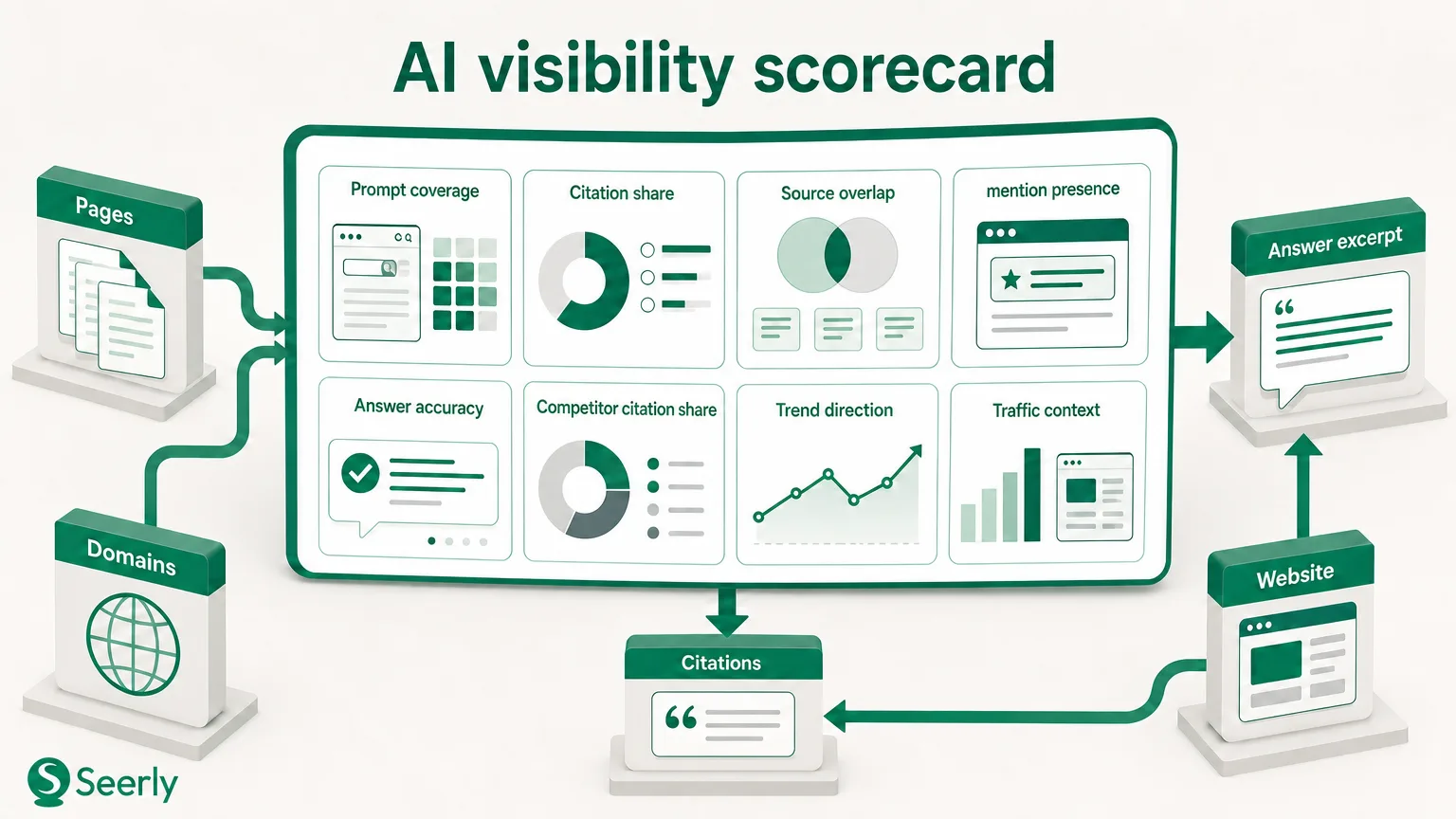
For each prompt, assign a simple scorecard:
- Brand included: yes or no
- Brand cited: yes or no
- Citation quality: high, medium, or low
- Accuracy risk: low, moderate, or high
- Sentiment or framing: positive, neutral, mixed, or negative
This turns anecdotal review into structured monitoring. It also makes trends visible when leadership asks whether the situation is improving or becoming riskier.
Step 4: Document risky outputs
If an answer contains a wrong claim, misleading comparison, or harmful omission, save the exact output and explain why it matters. Risk is rarely about one funny screenshot. It is about repeated misrepresentation in commercial or reputation-sensitive prompts. A comparison query that consistently understates your capabilities, for instance, can affect pipeline quality long before it shows up in attribution data.
Step 5: Summarize changes and likely causes
At the end of each review cycle, summarize what changed. Did answer inclusion rise after a content refresh? Did citations shift from product pages to third-party reviews? Did a newly published competitor comparison page improve presence? This is where AI search reporting becomes strategic rather than reactive.
Teams looking to operationalize this more broadly may also want to review Seerly’s guidance on tracking AI search visibility over time, especially if they are trying to connect answer-layer monitoring to existing reporting routines.
What to show leadership when AI answers are volatile
Executive reporting on Google AI search should be concise, decision-oriented, and separate from rank-only reporting. Leadership does not need a transcript of every prompt review. They need a view of visibility, trust, and risk.
A strong monthly executive summary should include four sections.
Visibility
Report the percentage of tracked prompts where the brand appears in the answer, the percentage where the brand is cited, and the change versus the prior period. This tells leadership whether answer-layer presence is expanding or shrinking.
Citation quality
Show which source types are being cited most often: product pages, blog articles, documentation, reviews, third-party publishers, or outdated assets. If low-value pages dominate, note the content implication. If high-authority pages are earning more citations, call that out as a positive signal.
Sentiment and verification risk
Summarize how often answers frame the brand favorably, neutrally, or negatively, and how many prompts triggered moderate or high verification risk. One wrong answer may not justify alarm, but repeated inaccuracies in commercial prompts absolutely deserve attention. Research on human trust in AI-mediated information environments suggests that perceived credibility can shift quickly when systems present uncertain or conflicting outputs confidently.
Change over time
The last section should show trend movement, not just a snapshot. Month-over-month shifts in inclusion, citation share, source quality, and risk flags are what make the report useful for decision-making. Google’s own messaging about AI search points to a future of more exploratory search behavior and deeper query refinement, so volatility should be expected. The job of reporting is not to eliminate volatility; it is to make it understandable.
FAQ
Does AI visibility replace SEO?
No. SEO still matters because rankings, crawlability, site quality, and content authority remain part of how the web is discovered and interpreted. But AI visibility adds a second measurement layer. The right approach is to track both. Seerly’s perspective in how AI search optimization helps SaaS buyers find the right product aligns with this: traditional search signals still matter, but answer-layer representation now affects buying journeys earlier.
How often should teams review Google AI search answers?
For most in-house teams, weekly review of priority prompts is a practical baseline. Higher-risk industries or fast-moving brands may need more frequent checks around launches, pricing changes, legal updates, or active reputation issues. The goal is consistency, not constant manual checking.
Is one incorrect answer a real business risk?
Sometimes no, sometimes yes. A single low-stakes mistake on an obscure informational prompt may not matter much. But one incorrect answer can be significant if it appears on a high-intent branded prompt, repeats over time, or concerns product capability, pricing, safety, or trust. Risk should be assessed based on prompt importance, recurrence, and likely business impact.
How should brands respond when AI answers are wrong?
First, document the issue clearly. Second, identify whether your own best source is missing, weak, outdated, or unclear. Third, improve the pages most likely to be cited with cleaner claims, stronger evidence, and clearer positioning. Finally, keep monitoring whether the answer changes. AI search is dynamic, so response should be systematic rather than emotional.
Google AI search is changing what marketers need to measure because it changes where trust is formed. The old model assumed visibility was mostly about rankings and clicks. The new reality is that answer presence, citation quality, and verification risk can shape perception before any visit happens. That does not make classic SEO obsolete, but it does make rank-only reporting incomplete.
If your team is still checking AI answers manually in scattered screenshots and Slack threads, the next step is to turn that habit into a reporting workflow. To explore a more structured approach to monitoring answer-layer visibility and communicating it clearly to leadership, visit Seerly.