How lean teams turn content optimization into a weekly decision system
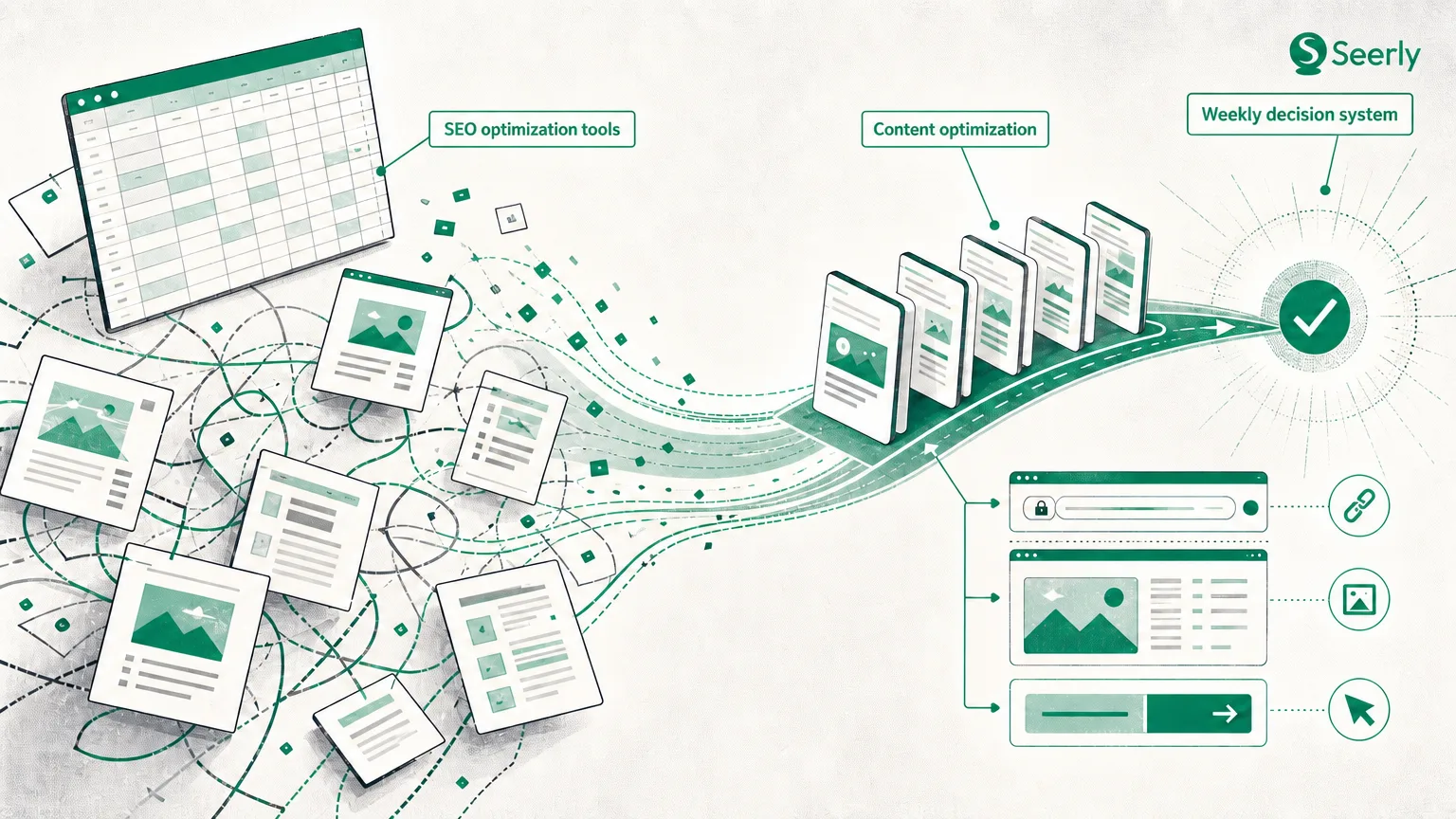
Most SaaS content teams do not lack SEO optimization tools. They lack a reliable way to decide whether this week’s highest-value task is improving a product page, refreshing an aging comparison article, fixing a technical discovery issue, or removing content that dilutes a buyer’s path to action.
That distinction matters because a long optimization backlog can create the appearance of progress while producing little commercial impact. A team may update title tags, add internal links, and publish requested articles every week - yet still fail to improve visibility for meaningful buyer questions or earn stronger conversions from existing traffic. The solution is not to treat every page as equally urgent. It is to use evidence from SEO optimization tools to classify the problem, score the opportunity, and assign one specific action with an expected outcome.
Why a large optimization backlog produces low-impact work
Consider a lean SaaS team with 80 published pages and a spreadsheet containing 60 “SEO tasks.” The list includes rewriting meta descriptions, adding keywords, refreshing screenshots, improving Core Web Vitals, creating new use cases, and responding to sales requests for comparison pages. Every item may be reasonable on its own, but without a decision system, the team tends to choose work that is easy to start rather than work that is most likely to improve discovery, trust, or pipeline contribution.
A useful optimization task must answer three questions: which buyer question does this serve, which page is responsible for answering it, and what measurable signal should change after the work is complete? For example, “improve the integrations page” is not an actionable decision. “Clarify the page’s integration coverage for evaluation-stage visitors, then monitor impressions for integration queries and demo starts from that URL” is.
Google Search Console provides performance data by query, page, country, device, and search appearance, allowing teams to investigate where visibility changes are actually occurring rather than relying on a blended traffic figure. Use the Search Console Performance report’s query and page dimensions to connect ranking evidence to a specific URL and buyer need. That creates a closed loop: a page is selected for a commercial reason, changed for a defined reason, and reviewed against an anticipated result.
The most effective SEO optimization tools do not simply surface more alerts. They help marketers reduce ambiguity. A weekly system turns “we should optimize this” into a finite queue of decisions: fix discoverability, improve clarity, strengthen evidence, or repair the conversion path.
Classify every issue into four optimization buckets
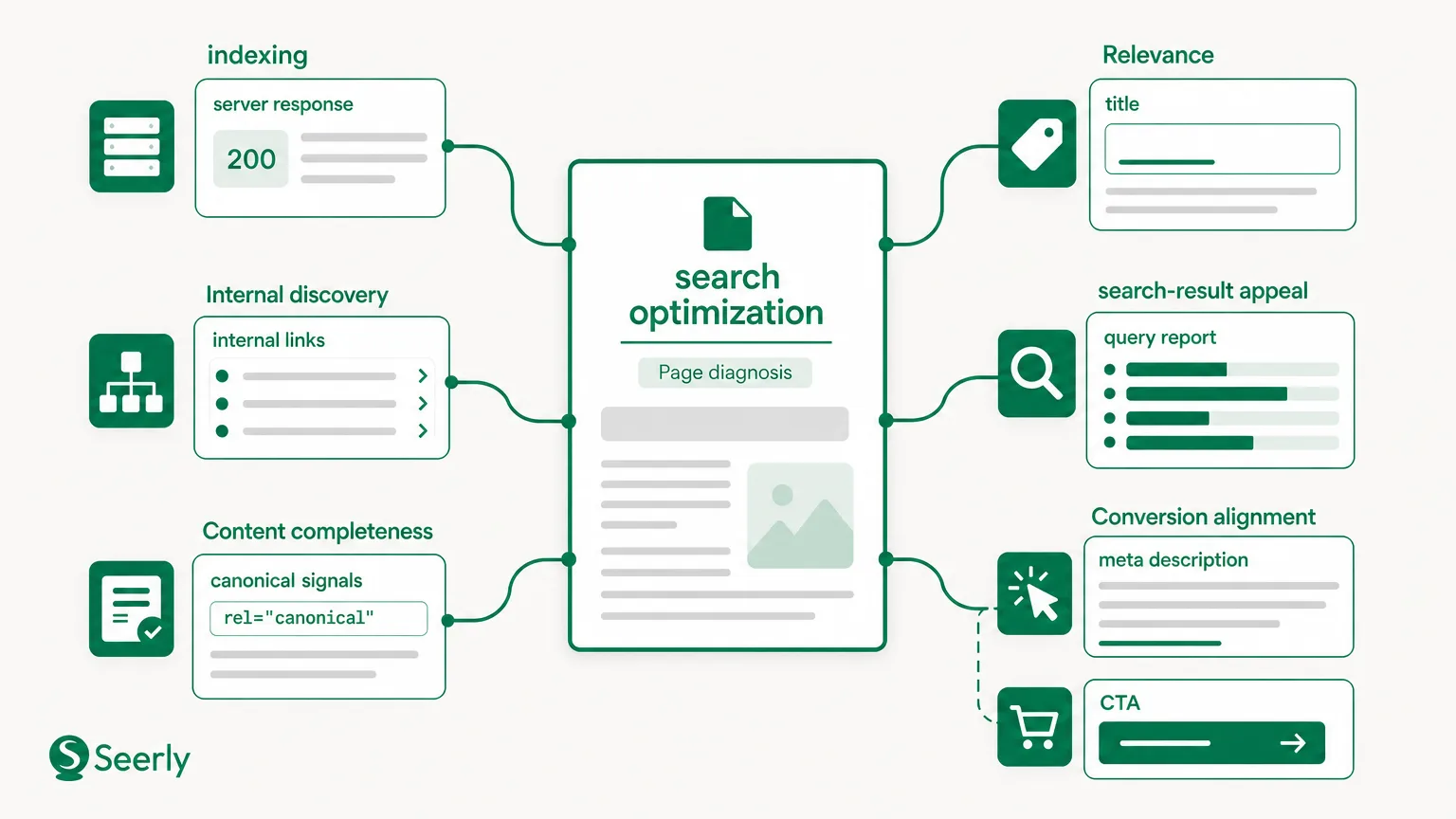
A page can underperform for several reasons, but the first step is identifying the primary constraint. If a team misdiagnoses the issue, it may add copy to a page that is not being indexed correctly, or adjust technical elements on a page that is visible but unconvincing.
Use the following matrix to classify the dominant issue before assigning work.
| Optimization bucket | Typical signals | Likely underlying problem | First action to test |
|---|---|---|---|
| Discoverability | Low impressions, missing indexed URL, weak internal links, slow loading experience | Search engines or users have limited access to the page’s value | Check indexability, internal context, page experience, and structured data eligibility |
| Clarity | Impressions and visits exist, but query intent and page message do not align | The page does not clearly answer the searcher’s question | Rewrite the opening, headings, positioning, and information hierarchy |
| Evidence | Visibility is present but engagement or conversion is weak | Readers do not see enough proof to trust the claims | Add sourced claims, product proof, customer evidence, and current examples |
| Conversion path | Page attracts relevant users but produces few next-step actions | The buyer cannot easily continue their evaluation | Improve contextual CTAs, navigation, use-case links, and offer alignment |
Discoverability issues
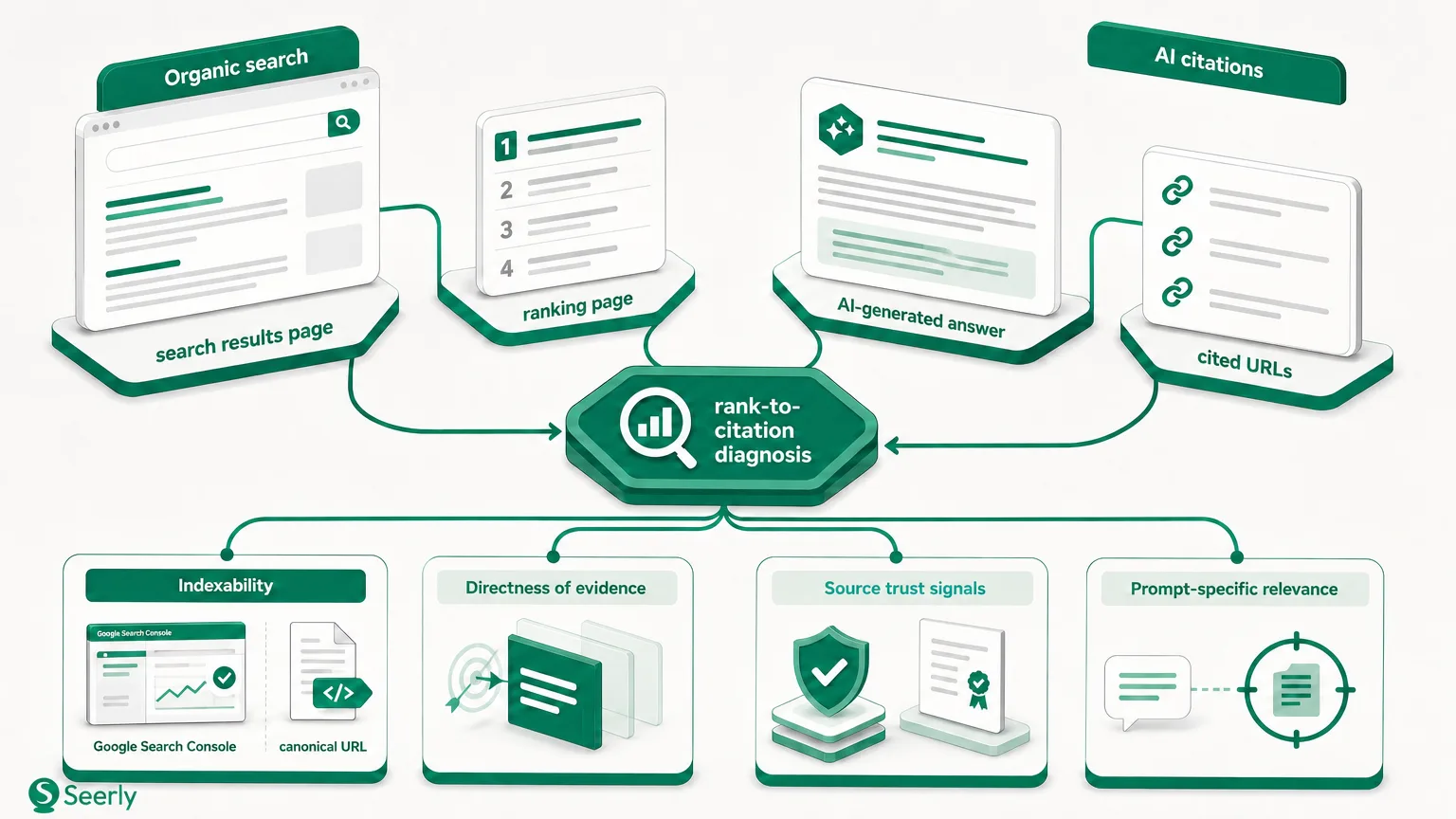
Discoverability problems occur when a page has limited opportunity to appear for relevant searches. The issue may involve indexing, crawlability, weak internal links, or an unclear relationship between the page and the broader site. Google’s URL Inspection tool can show whether a specific URL is indexed and surface crawl or indexing details, making it useful when a page has unexpectedly low search presence. Start with URL-level indexing and crawl information before assuming that the content itself needs rewriting.
Technical quality can also influence the user experience after discovery. Core Web Vitals assess real-world loading, interactivity, and visual stability, and Google recommends treating them as part of a broader page-experience evaluation rather than as isolated scores. Review Core Web Vitals field-data guidance when a commercially important page is slow or unstable, then prioritize changes that remove a genuine user barrier.
Clarity issues
Clarity problems are common on pages that rank for broad terms but fail to satisfy the search intent behind them. A visitor may search for “best workflow automation software,” land on a generic feature page, and leave because the page never states who the product is for, which workflow it supports, or how it differs from alternatives.
These pages need sharper positioning, not necessarily more words. Compare the queries generating impressions with the page’s title, opening section, headings, and primary CTA. If the page is earning visibility around buyer questions it does not answer directly, either revise its message or create a better-matched page.
Evidence issues
Evidence issues emerge when the page makes claims that readers cannot verify. SaaS buyers may accept that a platform “improves efficiency,” but they need to see how, for whom, under what conditions, and with what supporting proof. Screenshots, implementation details, customer outcomes, dates, methodology, product documentation, and expert explanations all function as trust signals.
This also matters for AI search discovery. Clear, well-supported content is easier for systems and readers to interpret, reuse, and evaluate. Teams building AI-ready websites should prioritize pages that explain their claims in direct language and connect them to evidence, rather than relying on promotional assertions.
Conversion-path issues
A conversion-path issue is not the same as a traffic issue. A page may attract qualified visitors and still underperform because its CTA is generic, its next step appears too early, or it sends readers to an unrelated destination. The problem may also be internal: a comparison page that never links to pricing, security, implementation, or product proof leaves an evaluation-stage buyer without the context needed to proceed.
Review how each page fits into the wider journey. A visitor reading a technical integration guide may need a relevant use case, documentation, or product page - not a blanket “book a demo” prompt. For a broader view of connecting visibility to business outcomes, see Seerly’s framework for building an AI visibility and organic traffic reporting model.
Score pages before assigning work
Once pages are classified, score them before putting them into the weekly queue. This prevents high-volume but low-value content from consuming the same attention as pages that influence product evaluation, branded demand, or qualified conversion.
Use a 1-5 score for each factor:
- Audience importance: How closely does the page serve a commercially meaningful buyer, use case, or category?
- Current visibility: Does the page already have impressions, rankings, or relevant traffic that optimization could improve?
- Content confidence: How strong is the underlying product knowledge, proof, and ability to make the page genuinely useful?
- Competitor pressure: Are competing pages clearly better, more current, or more credible for the same buyer question?
- Implementation effort: How much cross-functional work is required? Score high effort as 5, then subtract it.
Calculate:
Priority score = audience importance + current visibility + content confidence + competitor pressure − implementation effort
A product comparison page might score 5 for audience importance, 4 for visibility, 4 for content confidence, 4 for competitor pressure, and 2 for effort. Its score is 15. A legacy thought-leadership article may have substantial traffic but score 2 for audience importance, 3 for visibility, 2 for confidence, 1 for pressure, and 3 for effort - a score of 5. The first page should enter the queue first, even if the second receives more total visits.
This model is intentionally simple. It creates consistency without pretending that every decision can be automated. Free SEO optimization tools, including Search Console, Google Trends, and Lighthouse, can supply useful evidence, but an experienced marketer still has to judge audience value and proof quality. Teams should treat scores as a structured discussion, not a substitute for judgment.
Match the action to the underlying problem
Visible pages that fail to earn trust or action often receive an instinctive response: add more copy. That can worsen clarity by burying the useful answer beneath generic explanations. Instead, choose the smallest meaningful change that addresses the diagnosed constraint.
| If the primary problem is | Change this first | Avoid this default response |
|---|---|---|
| Weak factual support | Add dated sources, customer proof, product details, methodology, and specific examples | Adding unsourced claims or broad superlatives |
| Unclear positioning | State the audience, use case, outcome, and differentiation near the top | Repeating target phrases without changing meaning |
| Limited internal context | Link to the next relevant product, use-case, security, pricing, or implementation resource | Adding unrelated links solely to increase link count |
| Stale information | Replace outdated screenshots, claims, comparisons, and feature descriptions | Updating only the publication date |
| Distracting content | Remove repetitive sections, irrelevant FAQs, and competing CTAs | Expanding every section to make the page longer |
Structured data can support search engines’ understanding of eligible page content, but it should accurately describe visible information rather than act as a workaround for weak substance. Google’s structured data documentation emphasizes using supported markup that reflects the page. Treat it as supporting context after the core content is accurate and useful.
Before publishing, run a concise checklist:
- Does the first screen explain the page’s audience and promise?
- Can every major claim be supported by product evidence, a source, or a concrete example?
- Does the page answer the query implied by its current impressions?
- Are internal links helping a buyer continue their evaluation?
- Have you removed anything that distracts from the page’s primary decision?
- Is the expected measurement clear: impressions, qualified clicks, engagement, assisted conversion, or a next-step action?
For teams comparing platforms and diagnostics, a practical companion is Seerly’s guide to evaluating SEO optimization tools for AI search visibility.
Run a weekly review that produces decisions
A lean team does not need a lengthy meeting. It needs a consistent 30- to 45-minute review with the right inputs. Bring a page-level performance export, annotation log, recent releases, priority buyer questions, technical alerts, and any sales or customer-success feedback that reveals gaps in content.
Start by asking four questions. Which commercially important pages changed materially in impressions, clicks, or conversion behavior? Which changes have a plausible explanation, such as a release, a competitor update, or a content revision? Which pages fit one of the four buckets? Which one to three actions can the team complete and measure before the next review?
Every selected task should have one owner, one due date, one optimization bucket, and one expected evidence signal. For example: “Product marketer: strengthen evidence on the enterprise security page by Friday; expected evidence: improved engagement with security documentation links and stable or improved query impressions.” Engineering should own implementation tasks, content marketing should own messaging and proof, and demand generation should own conversion-path experiments. Shared ownership usually means no ownership.
After publication or a significant site change, annotate the date, URL, change type, hypothesis, and baseline data. This record prevents teams from assigning causation too quickly and helps them learn which actions repeatedly improve trusted visibility. It also makes reporting more credible because the team can connect movement to documented decisions rather than presenting rankings without context.
Frequently asked questions
Should high-traffic pages always come first?
No. High traffic matters only when the traffic is relevant, commercially meaningful, and constrained by a fixable issue. A lower-traffic product, comparison, or use-case page may deserve priority if it serves an active buyer question and has credible potential to improve. Score audience importance alongside visibility rather than using sessions as the only signal.
How many pages can a lean team improve at once?
For most lean teams, one to three meaningful page actions per week is more realistic than attempting ten shallow updates. Limit the queue according to the bottleneck: content review, subject-matter expertise, engineering capacity, or design support. A smaller queue also makes it easier to observe results and refine the system.
When should we stop optimizing a page and create a new one?
Create a new page when the existing URL serves a fundamentally different intent than the query or audience you want to reach. If a feature page is ranking for comparison searches, for example, forcing comparison content into the feature page can weaken both experiences. Keep optimizing when the page’s core purpose is right but its clarity, evidence, discoverability, or conversion path is weak.
Build next week’s queue
Content optimization becomes manageable when each task is tied to a buyer question, a page, an evidence-backed diagnosis, and a measurable outcome. SEO optimization tools provide the signals, but the operating system is the decision process your team applies to those signals.
Start this week by selecting ten commercially important pages. Classify each into discoverability, clarity, evidence, or conversion-path issues; score each page; then create a one-week action queue with a named owner and expected evidence of improvement. For teams strengthening proactive monitoring and trusted AI search discovery, explore Seerly to support a more disciplined approach to visibility and brand authority.