How to Monitor Brand Presence in Google AI Chats Without Confusing It With Traditional Search Rankings
Teams are getting a new kind of executive question: “Are we showing up in Google AI search?” The problem is that many marketing teams answer with old reporting. They pull rank trackers, branded click trends, and page-one keyword wins, then assume those numbers reflect visibility inside conversational AI experiences. They do not. Google’s AI surfaces summarize, compare, and recommend in ways that are related to classic search, but not reducible to it.
That distinction matters more now because user behavior is already shifting. Google shared that AI Mode queries tend to be roughly two times longer than traditional search queries, which signals a move toward more specific, conversational discovery. At the same time, multiple industry analyses point to AI-generated result features taking more screen space and changing click behavior, with one widely cited analysis finding that AI Overviews can reduce clicks to external websites by almost half. For in-house marketers and SEO teams, the takeaway is simple: if your brand wants to be discovered in Google AI chats, you need a separate measurement workflow for AI visibility, not just a refreshed SEO dashboard.
What counts as brand presence in Google AI chats
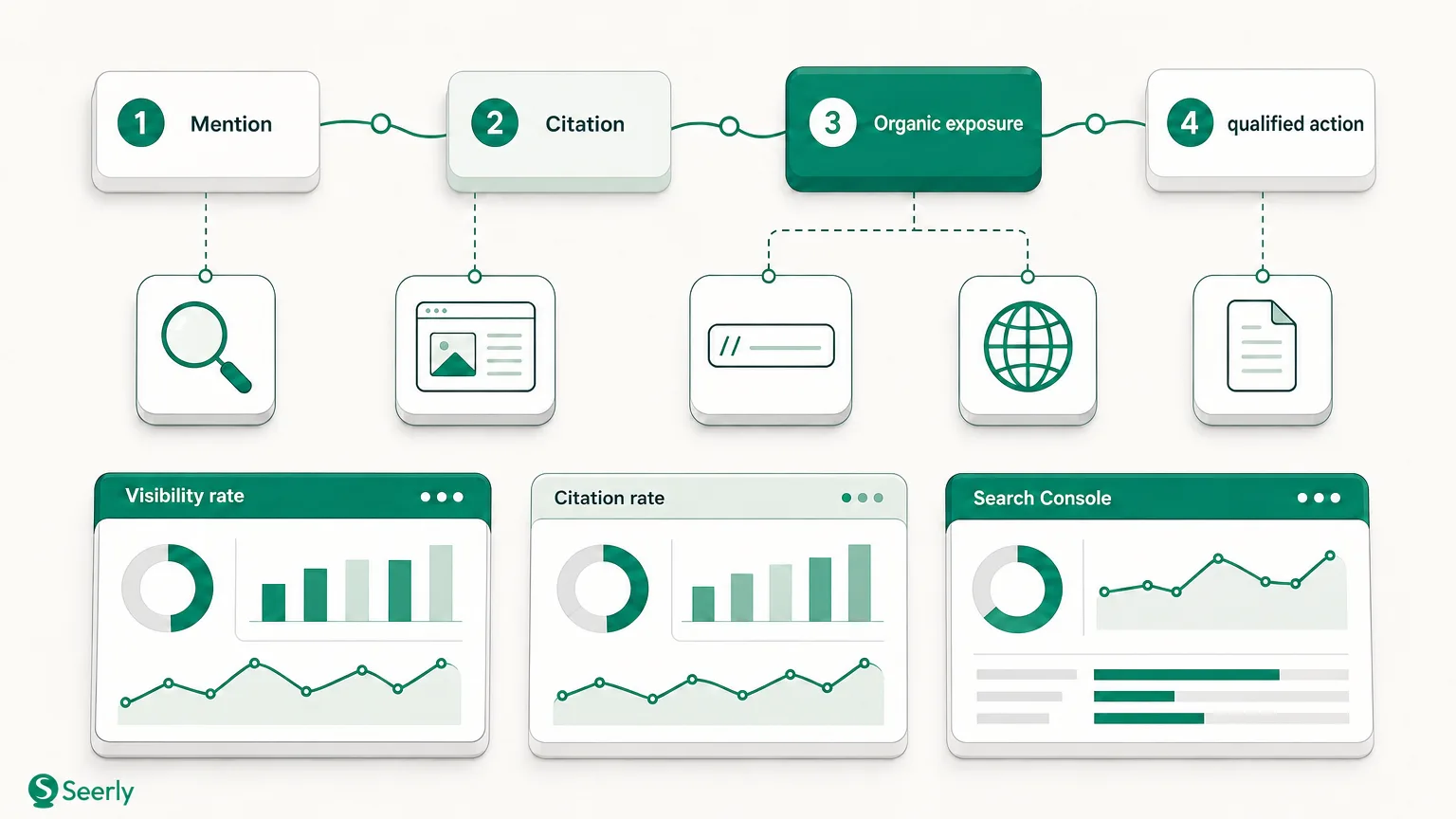
When people talk about visibility in Google AI search, they often mean several different outcomes at once. That makes reporting muddy unless you define the actual forms of presence you care about. In practice, brand presence in AI chats usually falls into five categories: mentions, citations, recommendations, comparison inclusions, and answer-summary inclusion.
Mentions
A mention is the lightest form of presence. Your brand name appears in the answer, but the model is not necessarily endorsing it, linking to it, or using your content directly. For example, a user asks, “What tools help B2B teams monitor AI search visibility?” and Google’s AI answer lists several brands in passing, including yours. That is better than invisibility, but it is not the same as being selected or trusted.
Mentions still matter because they indicate your brand is in the model’s candidate set for a topic. If you are never mentioned across relevant prompts, you are unlikely to earn recommendation-level visibility later. This is one reason teams tracking AI search optimization and visibility as a dedicated discipline are starting to separate “appears in the answer” from “appears as the answer.”
Citations
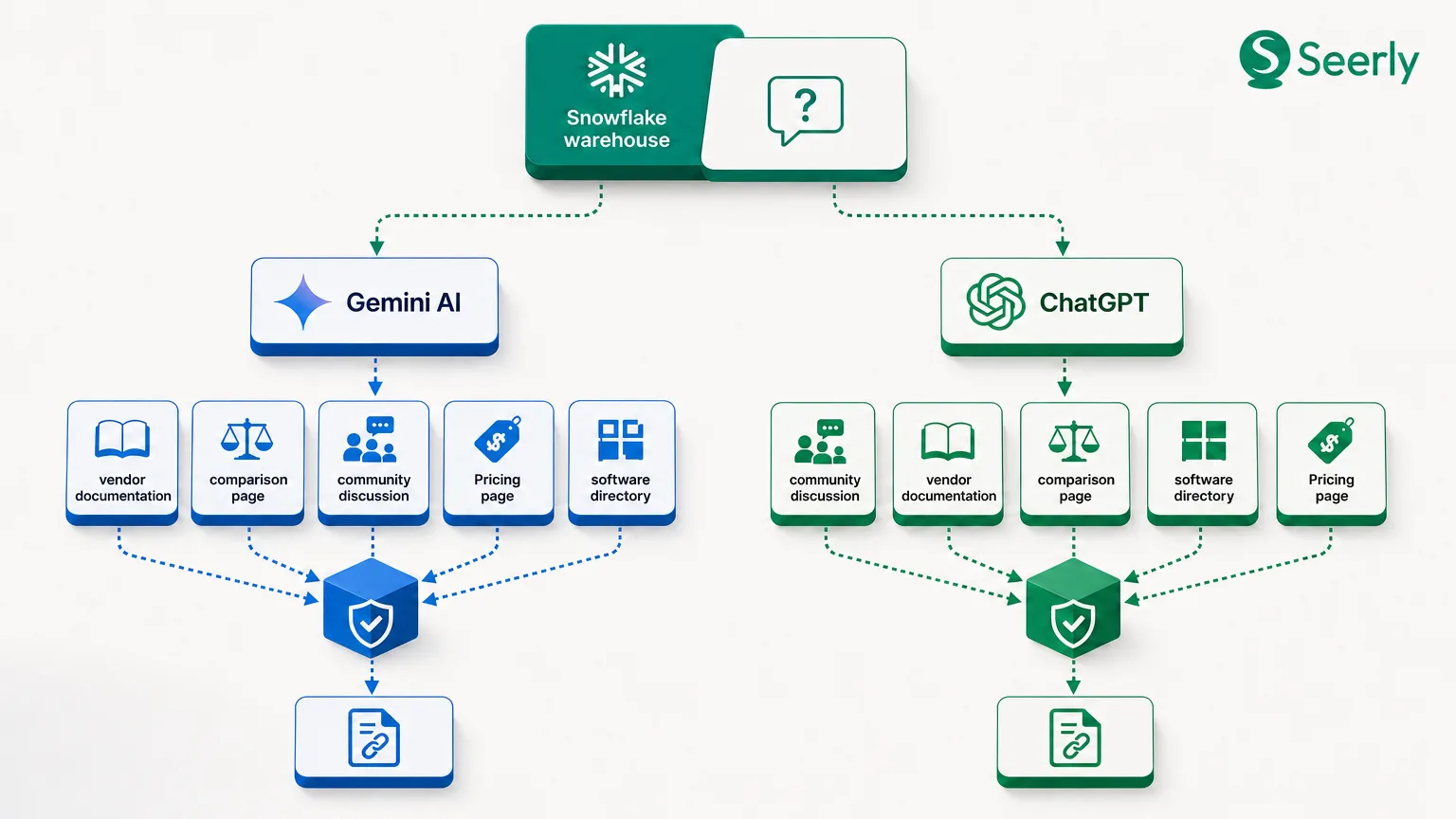
A citation means Google AI search points to a specific page as support for part of its answer. This is much stronger than a mention because it shows your content is being used as evidence, not just recalled as a name. A citation may point to a homepage, blog article, product page, documentation page, or comparison page.
Citations are especially valuable because they reveal which assets are structurally useful to AI systems. If one page gets cited repeatedly for “how to measure AI visibility” and another page with similar rankings never gets cited, the difference is usually in clarity, specificity, and extractable language. That aligns with the broader pattern described in research on content that gets cited in AI answers, where structure often matters as much as authority.
Recommendations
A recommendation is when the AI answer explicitly suggests your brand as a solution. This is the outcome most leadership teams actually care about, because it is the closest equivalent to being “shortlisted” by the machine. If a user asks, “What software should I use to monitor brand visibility in AI search?” and your brand appears as one of the recommended options, that is a different level of value than being mentioned in a generic list.
This distinction matters because recommendation behavior can be uneven. Academic and industry research both suggest AI systems synthesize from multiple signals rather than simply mirroring rank order, and empirical work on generative AI search disruption shows that answer composition changes what users see and select. A page can rank well organically yet fail to produce language the model wants to recommend.
Comparison inclusions
Comparison inclusion means your brand appears when users ask head-to-head or category-choice questions. These prompts are commercially important because they often sit close to purchase intent: “Seerly vs alternatives,” “best platforms for AI search monitoring,” or “tools for tracking AI brand mentions.” If your brand is absent from comparison prompts, you may still have awareness but lose consideration.
This category deserves its own reporting column. Comparison prompts often trigger different answer behavior than educational prompts. A brand may show up for “what is AI search visibility?” but disappear on “best AI visibility tools for SaaS.” If you combine those into one blended metric, you miss where the pipeline risk actually is.
Answer-summary inclusion
Sometimes the brand is not only cited or named; the answer itself reflects language from your pages. That may appear as a summarized definition, a use-case explanation, or a benefit statement that closely matches your content. This is a sign your page is quote-friendly and semantically useful to the model.
That outcome is increasingly important as AI result layers become more central. Current reporting on Google’s AI search features indicates these summaries are becoming a meaningful part of how users gather information before clicking, especially as AI Overview adoption continues to expand across query types. If your language is not making it into summaries, you may be indexed and ranked without being legible to AI-generated answers.
Why rankings alone are not enough
Traditional SEO reporting answers a narrower question: “How visible are our pages in standard search results?” That is still useful, but it does not tell you whether your brand is present in AI-mediated conversations. Google AI search can assemble an answer from ranked pages, cited pages, known entities, and comparative language patterns that do not neatly correspond to your average position in Search Console.
A practical way to understand this is to separate organic metrics from AI visibility metrics:
| Standard organic metrics | AI visibility metrics |
|---|---|
| Average position for a keyword | Share of relevant prompts where the brand appears |
| Impressions and clicks | Mentions, citations, and recommendation rate |
| CTR from search results | Inclusion in summaries and comparison answers |
| Landing page sessions | Prompt coverage across use cases and intents |
| Backlinks and authority | Quote-ready structure and explicit solution language |
| Branded/non-branded traffic | Competitive presence inside AI-generated responses |
A page can rank in the top three for a target keyword and still fail on most AI prompts for three common reasons. First, the content may be optimized for search snippets and human scanning, but not for extractable summaries. Second, the page may discuss the topic broadly without explicitly stating who the product is for, what it does, and how it compares. Third, the query set users type into AI chats is often longer and more situational than classic keyword targeting, matching the pattern that AI Mode queries are materially longer and more exploratory.
There is also a quality-risk angle. Studies and news reporting have shown AI-generated search features can still produce errors, including analyses claiming that Google AI outputs were wrong on 57% of life insurance queries in one study, while health-related rollbacks have highlighted concerns that some AI Overview answers could mislead users. For brands, this means “presence” is not enough by itself; you also need to monitor how your brand is framed.
A monitoring workflow for lean teams
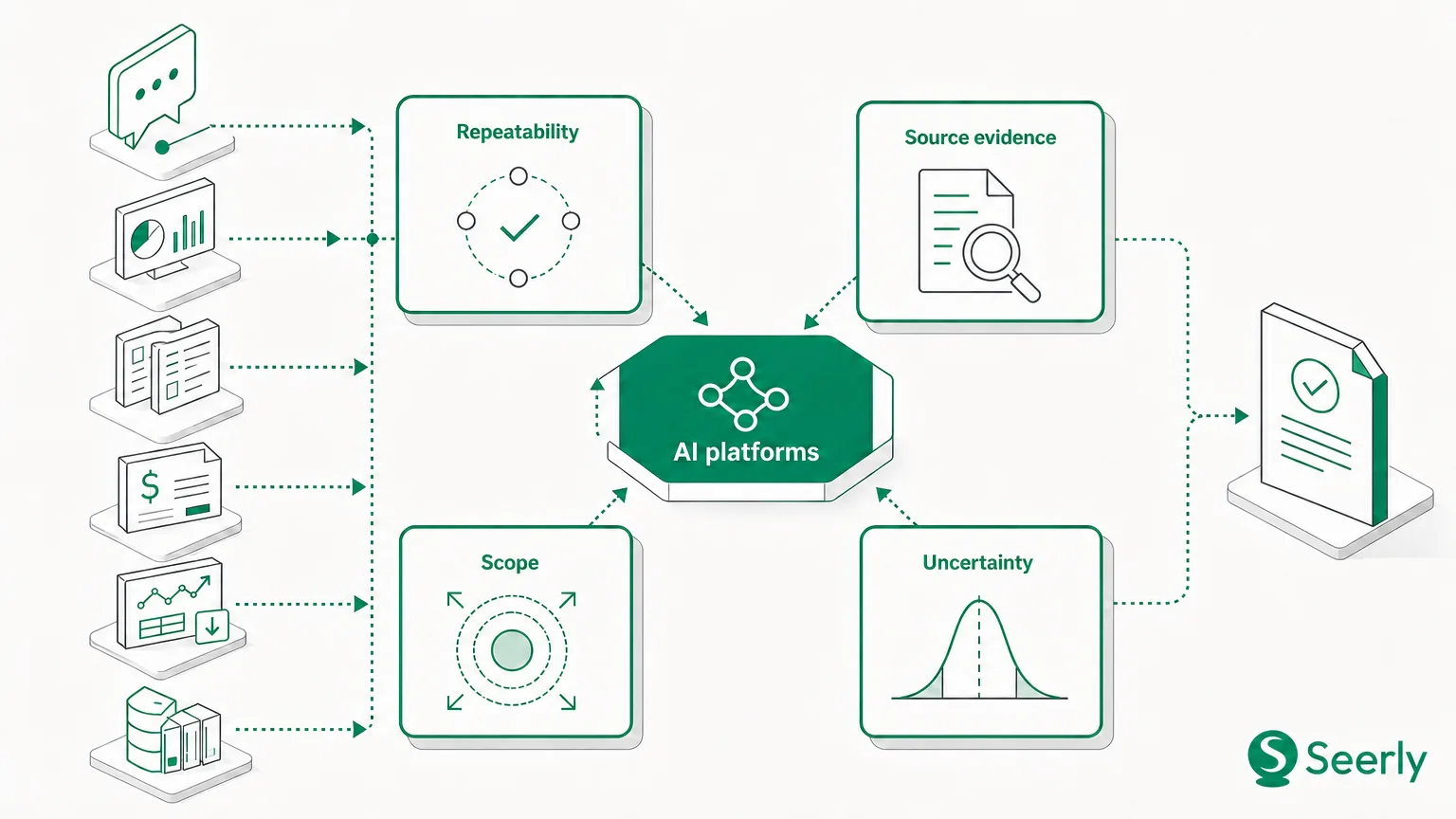
You do not need a large research function to monitor Google AI search. What you need is a repeatable workflow with clear definitions and a small but representative prompt set.
1. Build a prompt set by intent, not just keywords
Start with 20 to 40 prompts organized into informational, comparative, and solution-seeking groups. Include category questions (“What tools monitor AI search visibility?”), buyer questions (“Best platform for demand gen teams tracking AI mentions”), and comparison questions (“Seerly vs alternatives for AI search monitoring”). This is more useful than a simple keyword list because AI chats respond to scenarios, not only terms.
2. Choose a fixed competitor set
Select three to five named competitors that appear in your sales cycle or adjacent category. Keep this set stable for at least one reporting cycle. The goal is not exhaustive market mapping; it is to benchmark whether your brand appears, gets cited, or is recommended relative to the same alternatives over time.
3. Log answers exactly as they appear
For each prompt, capture the full answer, cited sources, date, location, device context if relevant, and whether your brand was mentioned, cited, recommended, compared, or excluded. This is where teams often cut corners, but exact logging matters because AI answers are dynamic. A rough note that “we showed up” is not enough to guide content changes.
4. Review citation patterns page by page
Once you have answer logs, look at which page types get used. Are citations going to product pages, blog content, glossary pages, or third-party reviews? If Google AI search cites competitors’ comparison pages while ignoring your top-ranking article, that is an actionable signal. It usually means the competitor page is easier to summarize or compare.
5. Refine pages based on prompt gaps
Turn repeated misses into content work items. If your brand never appears for “best tool” prompts, you may need clearer solution positioning. If you are cited for definitions but not comparisons, you may need more side-by-side content blocks. If you are mentioned but not recommended, your pages may lack explicit fit statements, use cases, or proof points.
This is also where it helps to connect AI visibility analysis with broader strategy. A useful next step is reviewing how AI search optimization helps SaaS buyers find the right product, because the prompt set should reflect actual buying questions rather than only editorial topics. The highest-value workflow is the one that turns answer gaps into tracked actions.
What content Google AI chats can quote more easily
Not all well-written content is equally usable in AI answers. Google AI search appears to prefer content that is easy to extract, compare, and restate. That does not mean robotic writing; it means clearer information architecture and more explicit language.
A useful checklist includes:
- concise summaries near the top of the page
- use-case sections with named audiences
- direct answers to common buyer questions
- comparison blocks that explain differences plainly
- FAQs with one-question, one-answer formatting
- explicit brand language about what the product does and who it serves
Consider a simple before-and-after example.
Before: “Our platform offers innovative workflows that help modern teams navigate evolving digital visibility landscapes.”
After: “Seerly helps marketing teams monitor where their brand is mentioned, cited, and recommended across AI search experiences, so they can identify missing prompts and improve the pages AI systems use in answers.”
The second version is better because it is concrete, category-defining, and easy to summarize. It also gives the model extractable statements about audience, function, and outcome. That same principle shows up in broader analyses of brand reputation management in AI search: explicit language reduces ambiguity and gives AI systems cleaner material to work with.
FAQ
How often should teams review Google AI chat prompts?
For most software companies, a monthly review is a practical baseline, with biweekly checks for high-value categories or active launches. AI answer behavior can shift quickly as product pages change, competitors publish new comparison content, or Google adjusts answer formats. A fixed cadence matters more than constant checking.
Do Google AI chats use the same pages as traditional search?
Sometimes, but not always in the same way. A page that performs well in standard results may also be cited in AI answers, yet citation and recommendation behavior depend on how clearly the content can be summarized or compared. That is why AI visibility should be reviewed as its own workflow rather than inferred from rankings.
How can you tell whether a brand is being recommended or merely mentioned?
Look at the language of the answer. A mention is simple inclusion: your brand name appears. A recommendation uses stronger framing such as “consider,” “best for,” “good option,” or “recommended for.” Reporting should separate these because they imply very different levels of buyer influence.
Is traffic the best KPI for Google AI search visibility?
Not by itself. AI surfaces can influence awareness and consideration before a click happens, and some studies suggest AI-generated search features are reshaping referral behavior and visibility patterns. Traffic still matters, but it should be read alongside prompt coverage, recommendation rate, citation share, and comparison inclusion.
Traditional SEO rankings are still useful, but they are no longer a complete answer to the question of discoverability. If you want to understand brand presence in Google AI search, measure it separately: track prompt coverage, log mentions and recommendations, review citations, and refine pages for summary-friendly language. If you want a structured way to do that, Seerly can help you turn AI discovery questions into a repeatable visibility workflow before you publish your next round of page updates.