How to turn one buyer question into a decision-stage content map
Many SEO optimization tips begin with a phrase: find a keyword, identify its volume, and create a page around it. That remains useful for understanding demand, but it is incomplete for high-consideration purchases. A buyer deciding on a B2B platform, service provider, or technical solution rarely has one question. They research the problem, compare approaches, assess implementation effort, test objections, and look for proof before committing.
This is especially important when buyers use both traditional search and AI-assisted discovery. A content plan needs to help people verify a decision, not simply encounter a relevant phrase. The result should be a connected set of pages in which every important buyer question has a clear purpose, an appropriate asset, evidence that supports its claims, and a repeatable way to review whether it remains useful.
This framework turns one broad buyer question into a practical decision-stage content map your marketing team can audit, improve, and measure.
Start with the buyer decision, not a single phrase
A topic is an area of interest. A keyword is one way a person may express that interest. A buyer decision is the real-world choice behind both.
For example, “AI search visibility software” is a topic and potentially a keyword theme. But the underlying decision may be: “Should our marketing team invest in a platform to measure how our brand appears in AI search experiences?” That decision creates a wider set of questions: What problem would it solve? Which teams need it? What data does it provide? How difficult is implementation? How does it compare with using separate reporting tools? What evidence supports the vendor’s claims?
One phrase cannot reliably represent all of those needs. Search wording also changes as a buyer learns. Early research may be broad and educational, while later searches become more specific, comparative, and risk-focused. A person who initially asks how to improve AI search visibility may later investigate reporting coverage, data freshness, integrations, pricing structure, or the limitations of a measurement method.
This is why effective website SEO optimization tips should begin with customer decision-making rather than isolated keyword matching. Google’s guidance emphasizes creating content that is helpful, reliable, and designed primarily for people rather than manipulating visibility systems. People-first content should demonstrate first-hand expertise and a clear purpose, which is difficult to achieve when one generalized article is made to answer every possible question.
Define the decision in one sentence before building a map:
Buyer decision: Can a mid-market SaaS marketing team adopt an AI visibility platform that gives credible reporting without creating an unmanageable analytics workload?
That sentence establishes the buyer, context, desired outcome, and constraint. It gives your team a meaningful boundary for deciding which questions deserve pages - and which do not.
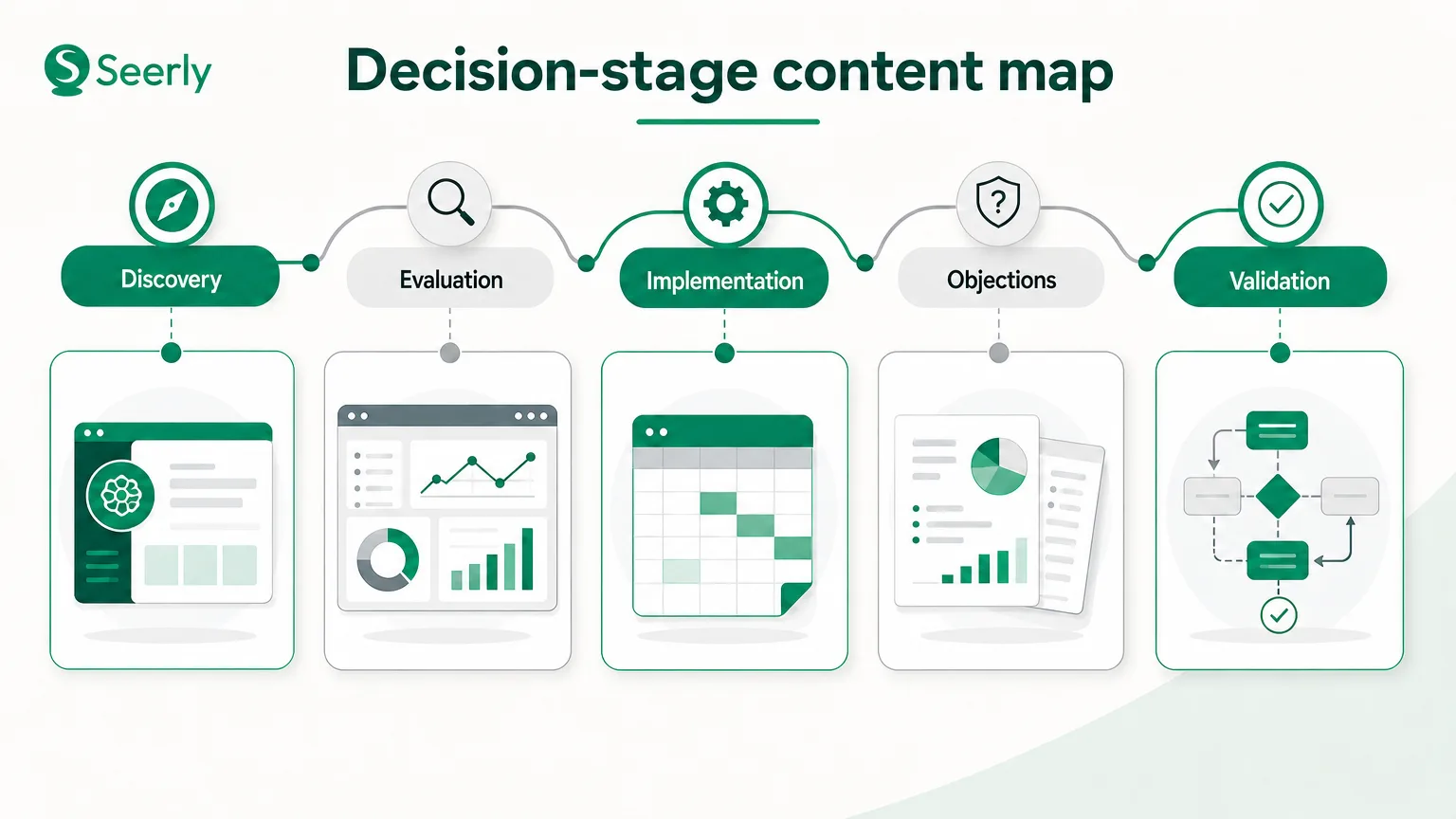
Break the core question into decision stages
A decision-stage model prevents the common mistake of publishing only top-of-funnel guides or only sales-oriented pages. It also makes the relationship between content clearer: each asset should move a buyer toward a more informed decision, rather than competing with similar pages for the same vague intent.
Discovery: define the problem and possible approaches
At discovery, buyers are trying to name a problem or understand the available paths. They may ask, “What is AI search visibility?” “Why do brands appear inconsistently in AI-generated answers?” or “What should an AI-ready website include?”
The right content here is usually explanatory: a guide, glossary, research-backed framework, or diagnostic checklist. The goal is not to force a product conclusion. It is to help readers understand terminology, stakes, and evaluation criteria.
For technical foundations, make sure your educational content is accessible to search systems as well as people. Google explains that its systems discover pages largely through links and recommends using crawlable <a> links with real destination URLs. A useful guide hidden behind a weak navigation structure is less likely to support the rest of your content ecosystem.
Evaluation: compare methods and solutions
During evaluation, the buyer knows the problem and wants to understand the options. Questions become more specific: “What should an AI visibility dashboard measure?” “Can we manage this with spreadsheets?” “Which capabilities matter for an agency?” and “How do tools differ?”
Comparison pages, category pages, feature explainers, and evaluation templates are useful at this stage. The content should name meaningful criteria rather than declare a winner without context. For instance, a team might compare data coverage, market segmentation, monitoring frequency, reporting exports, collaboration workflows, or competitive benchmarking.
A practical comparison should also separate facts from interpretation. Explain what each method or product does, identify who it is best suited to, and disclose where it may not be a fit. Teams building this type of asset can use a structured approach to evaluate an AI visibility dashboard alongside SEO reporting without reducing the decision to a single visibility metric.
Implementation: show what happens after “yes”
Implementation questions often determine whether a buyer proceeds. They include: “What information do we need to provide?” “How long does setup take?” “Who owns the workflow?” “Can the tool fit our reporting process?” and “What does a first month look like?”
These questions need documentation, onboarding explainers, workflow pages, integration references, and realistic process examples. A polished solution page may establish relevance, but it cannot replace precise operational details. Buyers should be able to see what work is required, what outputs they receive, and which dependencies can slow progress.
Implementation content should account for technical quality as well. Google’s documentation notes that mobile-first indexing uses the mobile version of a site for indexing and ranking. Documentation that is difficult to navigate or incomplete on mobile creates friction at the exact point where buyers need confidence.
Objections: address risk directly
Objections are not a sign that content has failed. They are part of responsible decision-making. Common questions include: “Can this data be trusted?” “Will this duplicate our existing SEO tools?” “How should we interpret changes over time?” “What cannot be measured?” and “Does our team have the capacity to act on the findings?”
Address these with FAQs, methodology pages, security or governance documentation, limitation statements, and transparent pricing or scope explanations. Avoid hiding constraints in sales conversations. A buyer who cannot find an honest answer may assume the answer is unfavorable.
Validation: supply evidence for the final decision
Validation is where buyers look for confirmation that a solution works in a context similar to theirs. They may seek customer stories, implementation examples, product demonstrations, independent references, methodology documentation, and evidence of ongoing support.
Proof should be specific. Instead of saying a platform “improves visibility,” explain what was measured, over what period, for which market, and what changed. Video can also support validation when it shows a real workflow; a well-planned product demo video SEO strategy can make those demonstrations easier to discover and understand.
Map each question to the right content asset
Consider a fictional B2B platform called SignalPath, which helps SaaS teams monitor brand representation in AI-assisted search. Its buyers are demand generation leaders at companies with multiple products and markets.
The central decision is: Should we adopt an AI search visibility platform for our 2026 planning cycle? The team could create the following map:
| Buyer question | Decision stage | Best-fit asset | Evidence required |
|---|---|---|---|
| What does AI search visibility mean? | Discovery | Educational guide | Definitions, examples, source dates |
| What should a visibility program measure? | Discovery | Framework or checklist | Metrics rationale, limitations |
| SignalPath vs. manual tracking: what changes? | Evaluation | Comparison page | Workflow comparison, assumptions |
| Which teams can use the platform? | Evaluation | Solution page | Use cases, role-specific outcomes |
| How is data collected and reviewed? | Implementation | Methodology documentation | Process steps, update frequency |
| Can it work across markets and languages? | Objections | FAQ or technical page | Market coverage details, constraints |
| What does success look like after 90 days? | Validation | Case study or proof page | Baseline, actions, results, context |
The format should follow the question, not a publishing quota. A guide is appropriate when the reader needs conceptual clarity. A solution page is appropriate when they need to understand a product’s relevance to their role. Documentation is essential when they need to assess operational reality. A proof asset is necessary when they need confidence that claims are supported by evidence.
No format guarantees inclusion in an AI-generated answer or a top organic result. Search systems use multiple signals, and Google’s overview of how search works makes clear that crawling, indexing, and serving results are distinct processes. The strategic aim is more durable: build pages that answer legitimate questions accurately, can be found and understood, and strengthen the overall decision journey.
Identify the evidence each page needs
A decision-stage content map becomes more useful when every asset has an evidence standard. This is where many content programs lose credibility: they identify questions correctly but answer them with generic claims.
Use this checklist before approving a new page or major refresh:
- Clear definitions: Define specialized terms in plain language, especially where vendors use similar words differently. Explain the boundaries of the concept, not just its benefits.
- First-party product facts: State what the product currently does, who can use it, and what conditions apply. Confirm feature names, availability, configuration requirements, and data coverage with product owners.
- Source dates: Add publication or update dates to time-sensitive claims, benchmarks, pricing, market coverage, and product information. A buyer needs to know whether a claim reflects the current state.
- Implementation details: Explain prerequisites, setup sequence, required inputs, ownership, review cadence, and likely handoffs. Vague “easy setup” language does not answer an implementation question.
- Limitations and trade-offs: Describe what the page, product, or method cannot establish. Transparent constraints make positive claims more credible and reduce misaligned expectations.
- Independently verifiable references: Where available, link to primary documentation, standards, research, or public materials that readers can inspect themselves.
Evidence quality matters for technical claims as well as commercial ones. Google recommends considering page experience as part of a broader people-first approach, while noting that page experience is not a single standalone ranking signal. That distinction is valuable: do not make unsupported claims that a design adjustment guarantees rankings, but do remove friction that prevents users from accessing and trusting the information.
Find gaps and overlaps before producing more pages
Before commissioning content, audit the map. A content inventory should show whether the decision journey is genuinely covered or merely populated with pages.
Create a worksheet with these columns: buyer question, stage, existing URL, asset type, evidence status, owner, last reviewed date, and action. Then apply one of four labels:
- Covered: The page answers the question directly, includes current evidence, and is easy to find from related pages.
- Weakly covered: The topic appears, but the answer is incomplete, unsupported, buried, or aimed at the wrong stage.
- Missing: No credible asset answers the question.
- Outdated: The asset exists but its product facts, sources, examples, or market assumptions need review.
Overlaps become visible when several pages try to answer the same question with minor wording changes. Consolidate those pages where appropriate, or differentiate their purpose. For example, a general guide on measuring AI visibility and a product feature page can coexist if the guide explains the category while the feature page demonstrates a specific workflow. They should not repeat the same claims without adding context.
A claim ledger can make this audit more rigorous. Record every high-stakes assertion, its supporting source, the page where it appears, and its next review date. Teams managing large content portfolios may benefit from a claim-ledger review system for AI content optimization so evidence updates do not depend on memory.
Review the map against real buyer queries
A map is a hypothesis until it is tested against how buyers actually frame decisions. Establish a recurring review process that combines customer research, search data, sales-call themes, and observed AI-search outputs.
For each test, document the exact buyer query, the market and language context, the role or company profile implied by the query, the date, and the answer observed. Record which sources are visibly referenced, whether the response handles the buyer’s core concern, and which objections remain unanswered. Do not treat a single result as a stable benchmark; systems, sources, and query interpretation can change.
Then compare your content map with what you observe. If buyers repeatedly seek implementation proof but your plan is dominated by introductory guides, prioritize documentation or a workflow demonstration. If visible sources frequently emphasize independent definitions, strengthen the references behind your category content. If your brand is mentioned inaccurately, inspect the relevant pages for ambiguous terminology, stale claims, or missing context.
This workflow should also include manual quality checks. Automated audits can surface technical and content patterns, but they may disagree or miss business context. A documented manual review workflow for website audits helps teams decide which findings deserve action and which require further validation.
Build the map one decision at a time
The most useful SEO optimization tips connect visibility work to buyer confidence. Rather than publishing more pages around a broad topic, choose one high-value buyer decision and map ten related questions across discovery, evaluation, implementation, objections, and validation.
For every question, assign an existing or needed asset, define the evidence it requires, and set a review date. Label gaps honestly before you create more content. That turns a keyword-led plan into an evidence-led system - one that can support organic discovery, clearer buying journeys, and more accurate representation as search behavior evolves.