The AI content review system that prevents claims from drifting across your site
AI content optimization works best when drafting speed is paired with a recorded source of truth for every reusable commercial claim.
A product marketer publishes a landing page that says a platform “includes unlimited team seats.” The statement came from an old sales deck, and it was true for one plan at one point. A writer later feeds that landing page into an AI content tool to refresh a comparison page. Then a help-centre editor uses the comparison page as background for an onboarding article.
Six months later, the company has a seat cap on every plan. But the original phrase has spread into four page types, two campaign briefs, and a handful of AI-assisted rewrites. Nobody intentionally lied. The team simply treated a time-sensitive commercial statement as reusable background information.
That is the hidden governance problem in AI content optimization. AI can produce a lot of coherent copy in minutes, but it can also repeat the most confident wording in its inputs, including wording that no longer reflects the product. The faster a team drafts, the more carefully it needs to manage the facts those drafts draw from.
Google’s own guidance on generative AI content puts the emphasis on useful, original, people-first material rather than the method used to create it. Its guidance on using generative AI for content also warns publishers to maintain accuracy and quality. That sounds obvious. In a busy editorial calendar, it is not.
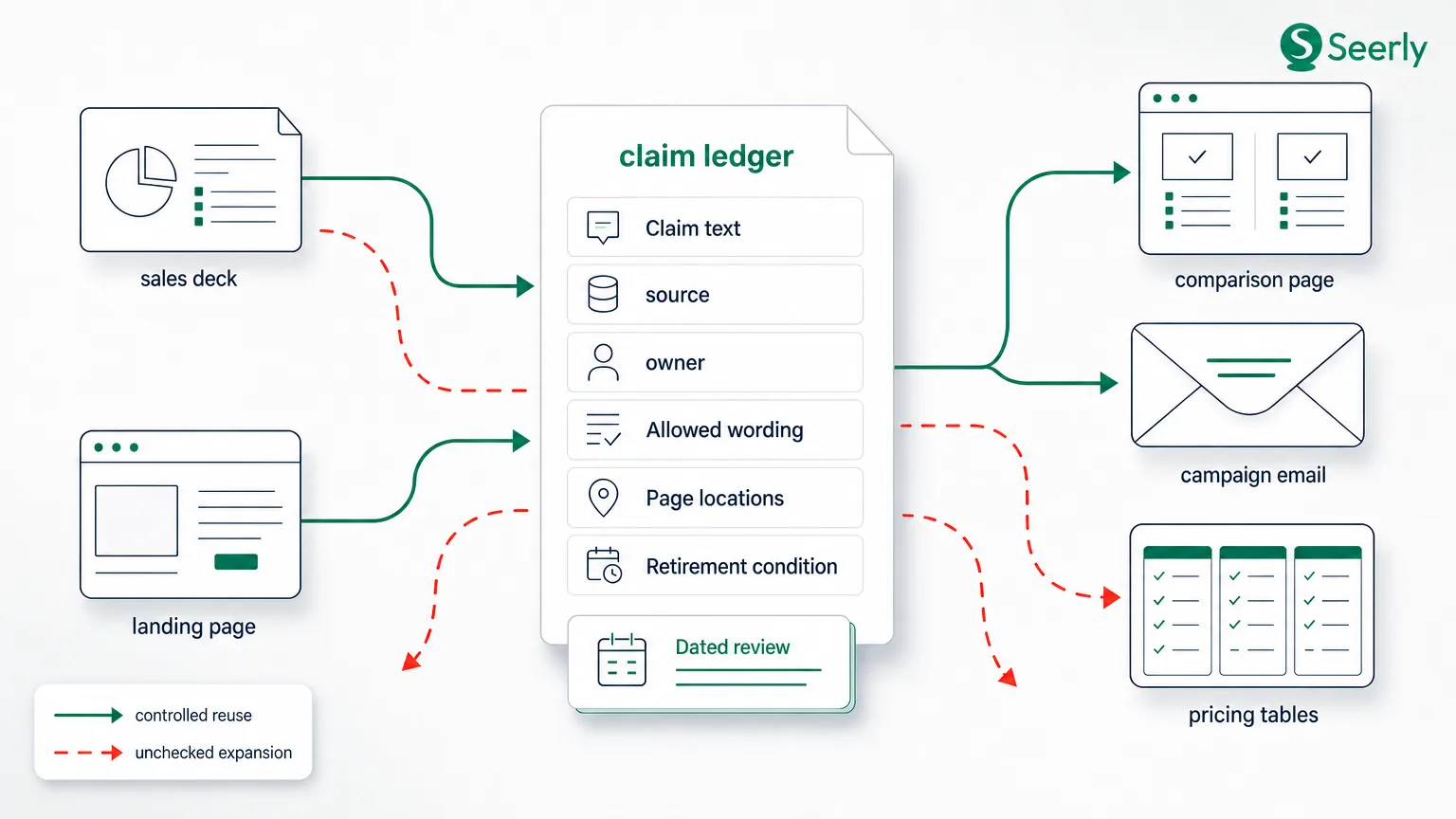
The practical answer is a claim ledger: a shared record of commercial statements, their sources, approved wording, owners, and expiry conditions. Pair it with a clear review path, and AI-assisted writing becomes far easier to scale without treating every published page as a fresh fact-finding mission.
How AI content optimization turns one stale sentence into many
The error usually starts small. A product manager says during a launch meeting, “Customers can connect their workspace in a few clicks.” A writer turns that into “Connect any workspace in minutes.” The distinction looks harmless until someone asks which workspaces, which plan, and what “minutes” means.
Now feed that sentence into an AI writing prompt alongside old product pages, sales collateral, and support articles. The model may turn it into variations like “works with every workspace,” “instant setup,” or “no technical configuration required.” The words shift, but the underlying claim becomes broader each time. That’s claim drift.
I’ve seen this happen most often when teams use a strong page as the source material for several related assets. One capability statement gets copied into a comparison page. The comparison page becomes input for a campaign email. Then a writer asks an AI tool to “make the copy more persuasive.” Suddenly, a narrow capability has become a blanket promise.
The risk grows because published copy looks authoritative. A team member opening five pages in a browser may see the same statement repeated and assume repetition equals proof. It doesn’t. It may only show that the same weak source travelled well.
The issue matters more as AI-referred visits become part of the customer journey. Adobe reported that traffic from generative AI sources to U.S. retail sites rose 1,200% year over year in the period it studied. A brand fact that appears repeatedly can shape a reader’s decision long before they speak with your team.
Which claims need evidence before publication?
Editors need a shared vocabulary. Without one, a product fact, a customer story, and a writer’s interpretation all arrive in the same review queue wearing the same costume.
Claim ledger definition: A claim ledger is a living editorial record for statements that may be reused across pages. It connects each statement to a source, a named owner, approved language, and a date or event that triggers review. Its job is to make “Where did this come from?” easy to answer before publication.
Here is a useful classification model.
| Statement type | Example | Evidence required? | Editorial treatment |
|---|---|---|---|
| Reusable brand fact | “The Business plan includes SSO.” | Yes | Link it to a current product, policy, or pricing source. |
| Interpretation | “SSO can reduce access-management friction for larger teams.” | Usually | Keep it qualified and tie it to the stated feature, not an outcome promise. |
| Customer proof point | “Acme cut reporting time by 30%.” | Yes, always | Require approved case-study evidence, dates, scope, and customer permission. |
| Opinion | “The interface feels calmer than most alternatives.” | No formal proof, but context helps | Label it as editorial judgment and avoid presenting it as consensus. |
The category matters because each carries a different failure mode. A brand fact can expire after a product change. A customer proof point can become misleading when its result came from an unusual implementation. An opinion can become a problem when an AI draft restates it as a universal verdict.
Look closely at superlatives. “Fastest,” “most secure,” “leading,” and “best” are not harmless copy flourishes. They are comparison claims, and they need a defined comparison group, a date range, and a source that can withstand a skeptical reader.
A useful editorial rule is simple: if a buyer could rely on the statement to spend money, switch tools, or judge risk, treat it as a claim requiring evidence. That includes a lot more than pricing tables.
Build a claim ledger before you scale AI content optimization
A spreadsheet works at first. A database works better once several people edit the same material. The tool matters less than the fields and the habit of consulting them before an AI prompt goes out.
Start with one row per atomic claim. “Supports SSO” is one claim. “Supports SSO on every plan” is a different claim. “Supports SSO with Okta and Azure AD” contains at least two claims that may change independently.
Your ledger should record the following:
| Field | What to capture | Why it matters |
|---|---|---|
| Claim ID | A stable internal label, such as INT-014 | Keeps discussion tied to one record rather than slightly different sentences. |
| Claim text | The plain factual statement | Makes it clear what needs approval. |
| Source | Product documentation, contract language, approved case study, or policy page | Gives the editor a direct route to evidence. |
| Owner | The person who can confirm or revise the fact | Stops the content team from guessing. |
| Last reviewed | A date and reviewer name | Shows how fresh the record is. |
| Allowed wording | The exact phrasing writers may use | Limits accidental expansion by people or AI tools. |
| Page locations | URLs, templates, campaigns, and documents using it | Makes corrections faster. |
| Retirement condition | A date, release event, contract change, or policy update | Turns expiry into a planned event. |
The “allowed wording” field deserves more respect than it gets. Product teams often approve a technically true sentence that is too broad for marketing copy. For instance, “Exports CSV files through the reporting screen” should not become “full data portability.” The latter may imply APIs, scheduled exports, historical data access, or migration support that the source never covered.
For recurring AI content work, place approved wording directly in the prompt context. Don’t ask a model to invent product language from a pile of pages. Give it approved claims and tell it to leave placeholders where the ledger has no source. Low-trust AI edits often begin when a draft fills those gaps with polished assumptions.
From AI draft to approved paragraph
Suppose a platform has a current product note stating: “Users on the Pro and Enterprise plans can export a CSV from the report view.” The capability is useful. It is also narrow.
An AI content tool receives a prompt to update a product page and produces this paragraph:
Our platform makes data portable with unlimited exports and simple integrations, so teams can move their information anywhere without technical help.
The prose is smooth. The evidence check is less kind. “Data portable” is too broad. “Unlimited exports” has no source. “Simple integrations” introduces a second product claim. “Without technical help” predicts an outcome that may depend on the customer’s setup.
The ledger should turn the paragraph into something like this:
Pro and Enterprise users can export report data as a CSV from the report view. For supported connections and setup guidance, see our integrations documentation.
That revision may feel less flashy, but it carries a clear scope. It states the plan limitation, names the format, and directs the reader to the page that owns a related claim. Clear copy earns more trust than inflated copy that needs a footnote later.
Then comes the internal-link decision. Link “supported connections” only if the destination has a maintained integration list owned by product or support. Don’t link to a generic resources page because it feels tidy. A link is part of the claim path: it tells readers where the evidence lives.
Content teams reviewing AI-assisted work can borrow related practices from a workflow for resolving disagreements between AI tools and human reviewers. The point is not to make the model prove a claim. The editor still owns that job.
Route high-risk claims to the right reviewer
A content editor shouldn’t need to chase every sentence through legal, product, and customer success. That would turn a one-hour update into a small opera. Risk-based routing keeps review proportionate.
Use this numbered process when a draft contains commercial claims:
-
Mark claim-bearing sentences before editing for style. Pull out statements about price, availability, integrations, performance, compliance, comparisons, or customer results. Keep the sentence next to its claim ID so reviewers can see the original wording.
-
Check the ledger first. If an approved claim and source already exist, use the approved wording or request a minor wording review. If no entry exists, do not treat repeated website copy as proof.
-
Send the claim to the functional owner. Product should review capabilities, supported integrations, and plan limits. Legal should review compliance, guarantees, contractual language, and competitor comparisons. Customer success should review outcome stories and confirm that results remain representative.
-
Record the decision, not only the approval. Capture what changed, why it changed, who approved it, and the next review date. A Slack “looks good” message disappears fast when someone needs to correct twenty pages.
-
Publish only the approved scope. A reviewer may confirm that a feature exists while rejecting the adjective around it. Respect that distinction. “Available” and “effortless” are different claims.
A review path should be short enough that people actually use it. Put expected response times next to each claim type, with an escalation route when a launch date is close. Honestly, unclear ownership causes more stale copy than bad intent.
Retire a claim before it becomes a correction project
Product facts age. Pricing changes. Integrations get paused. A customer switches strategy and no longer wants their logo next to a performance number. None of that is unusual. Leaving old language live while the team “gets around to it” is where trust breaks.
The fastest responsible response starts with the ledger’s page-location field. Search the site, CMS, campaign library, and content briefs for the claim ID and its common variants. AI-generated revisions can make exact-match search unreliable, so also search for the feature name, plan name, customer name, and promise language.
Then work through this remediation checklist:
-
Freeze new reuse immediately. Remove the claim from prompt templates, approved-snippet libraries, and active briefs. Otherwise, the correction team may publish new instances while removing old ones.
-
Change the source record. Mark the claim as retired, revised, or under review. Include the date, the event that triggered the change, and replacement wording if one exists.
-
Prioritize buyer-facing pages. Fix pricing pages, product pages, comparison content, and active campaigns before older educational articles. A page’s traffic matters, but decision proximity matters more.
-
Correct linked pages with context. If a claim disappeared because a feature changed, replace it with accurate language rather than leaving a strange gap. If a customer result is withdrawn, remove the number and reassess the surrounding story.
-
Close the loop with owners. Ask product or legal to spot-check the highest-risk edits, then log completion. The task is not finished because the CMS says “published.”
Google’s guidance on creating helpful, reliable content supports the broader discipline here: accuracy, clear sourcing, and useful content are publishing concerns, regardless of how the first draft was written. A correction process protects readers and keeps future AI content prompts from inheriting yesterday’s mistake.
FAQs about AI content optimization tools and editorial control
Can we use AI content tools for first drafts?
Yes, especially for structure, alternate explanations, transitions, and rewrites of claims that already have approved wording. Keep the ledger in the prompt context, and tell the tool to mark unsupported areas instead of filling them with assertions. AI is good at producing options. It does not know which commercial statement your product team changed last Tuesday.
Will a claim ledger slow down editorial velocity?
At the beginning, it may feel like extra admin. Then the repeated questions stop landing in individual inboxes, and editors spend less time reopening old documents to find a source. The speed gain comes from reuse with boundaries, not from skipping review.
How can we measure improvement?
Track the percentage of claim-bearing sentences linked to a current ledger entry, the time needed to approve a high-risk update, and the number of corrections found after publication. Also track how many pages you can update after a product change using the ledger’s location data. Those figures tell a more useful story than raw article volume.
Do we need a ledger for every sentence on the site?
No. Focus first on statements that affect a purchase decision, carry legal exposure, or appear across several pages. A paragraph explaining a broad industry idea does not need the same treatment as a price, a compliance statement, or a customer outcome. Start where drift costs the most.
Start with ten claims, not a perfect system
Inventory the ten commercial claims repeated most often across your site. Assign each one an owner, source, approved wording, last-reviewed date, and retirement condition. Then add the pages where each claim appears.
That first ledger will reveal uncomfortable gaps. Good. Better to find an unsupported promise in a spreadsheet than in a buyer conversation.
Use the ledger as editorial input for every future AI-assisted update. The result is faster drafting with a record of what your brand can responsibly say today, not what a page happened to say last year. Learn more at Seerly.