What a backlink check reveals about the sources supporting your brand claims
A backlink check is often treated as a scorecard: total links, referring domains, authority metrics, and month-on-month growth. Those measures can be useful for diagnosing discoverability, but they do not answer a more strategic question: do the sources linking to your brand accurately reinforce the claims customers and AI systems may encounter?
For SEO leads, brand managers, and agency strategists, that distinction matters. A high link count can include old directory listings, low-context footer placements, irrelevant pages, and references that misstate what a company does. A stronger approach is to check backlinks as evidence quality research: identify the claims that matter, inspect the wording around each link, and assess whether the linking source provides credible, relevant corroboration.
Reframe the backlink check from quantity to evidence
Traditional backlink reporting asks, “How many sites link to us?” Evidence-focused analysis asks, “What do credible sources say about us, and does that language support the claims we want to be known for?” Both views have a place, but they serve different decisions. Link volume may help identify changes in a site’s link profile, while contextual review helps teams manage the accuracy and credibility of their public narrative.
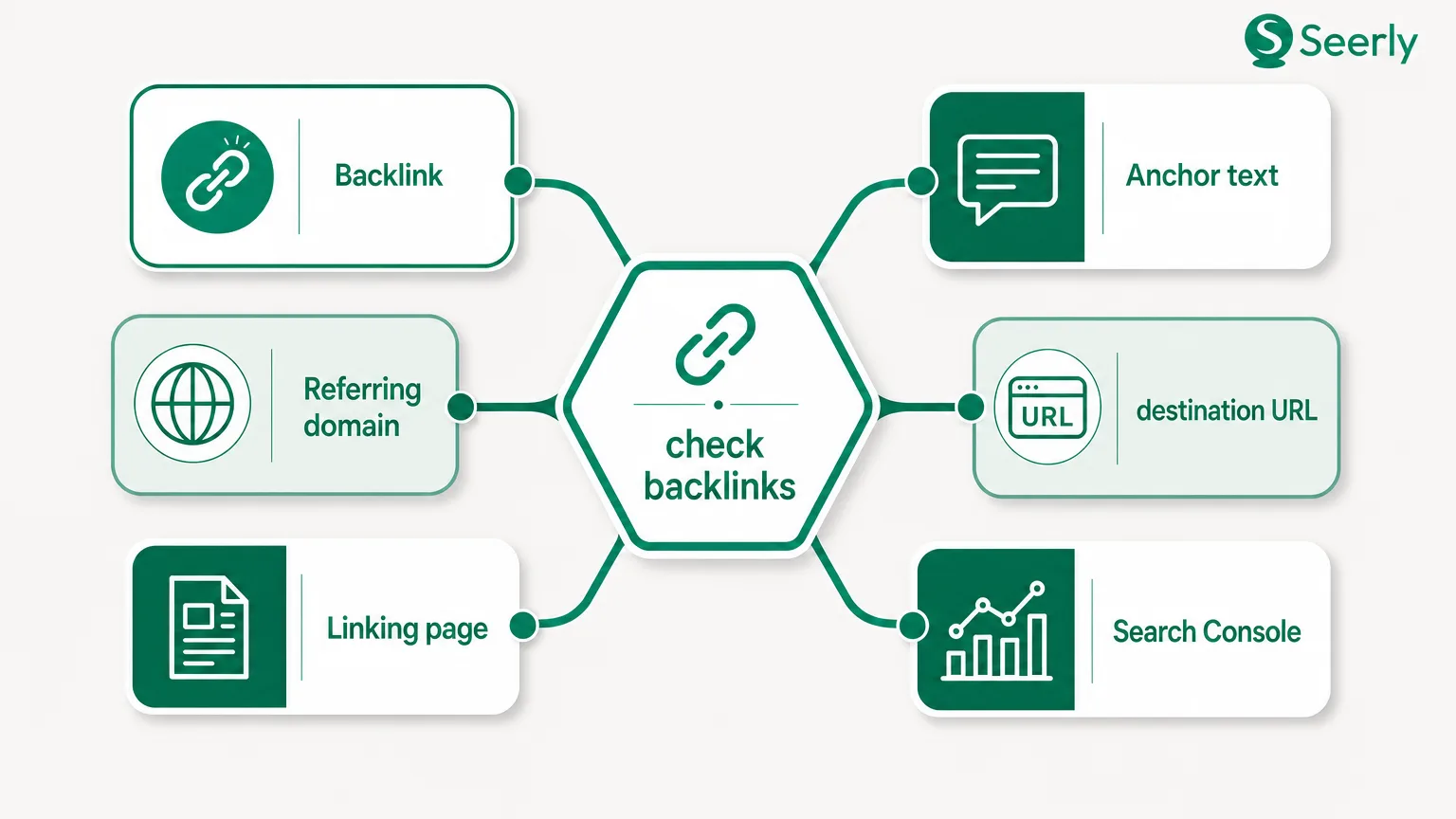
A link is also not the same as a referring domain. One website can create many backlinks through navigation, syndication, or repeated templates, which is why it is useful to distinguish between individual backlinks and unique referring domains. Counting both without examining placement can overstate the breadth of external support behind a brand claim.
This is particularly important when links were created through practices that provide little editorial value. Google’s spam policies identify manipulative link practices, including links intended primarily to manipulate ranking signals, rather than to help users navigate or evaluate information. Teams should not assume that a larger backlink total represents stronger credibility when some links may fall into the broader category of link spam practices.
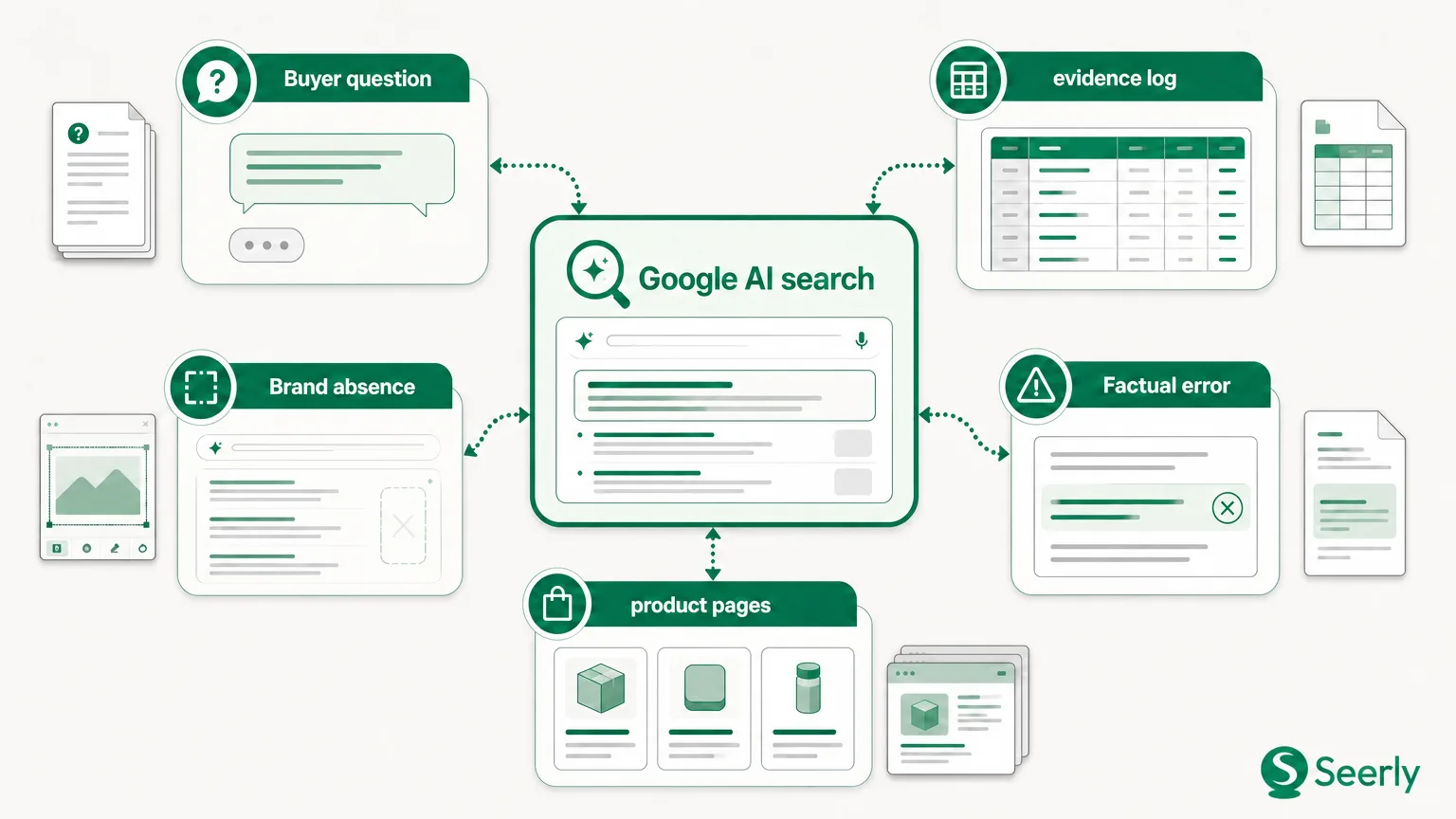
An evidence-oriented review does not replace conventional SEO reporting. It adds a layer that connects link analysis to positioning, reputation, and AI search visibility. If an AI answer draws on web pages that describe your company inaccurately, a dashboard showing more referring domains will not explain the risk - or tell your team what to fix.
Define the claims worth investigating first
Reviewing every inbound link is rarely a sensible starting point. Instead, begin with claims that influence buying decisions, regulatory exposure, partner confidence, or the way AI-powered search experiences categorise your brand. This creates a manageable evidence review rather than an unstructured exercise in checking links online.
Prioritise claims using the following checklist:
- Product capabilities: Statements about integrations, workflows, supported markets, security, automation, or technical functionality.
- Pricing language: “Free,” “affordable,” “lowest cost,” “enterprise-ready,” or claims that may become outdated after packaging changes.
- Outcomes and performance: Assertions about time saved, revenue impact, accuracy, adoption, or other measurable results.
- Founder and company statements: Funding, launch dates, ownership, leadership, market position, or mission-related claims.
- Customer proof: Named customers, reviews, awards, market comparisons, and use-case claims that require careful permission and accuracy checks.
Start with three claims that would cause the most harm if they were misstated. For example, a SaaS company may prioritise “supports enterprise SSO,” “offers transparent monthly pricing,” and “is used by teams in regulated industries.” The purpose is not to prove every marketing sentence through third-party coverage; it is to understand where critical claims are independently supported, weakly represented, or contradicted.
This process also improves the way teams use tools such as Semrush. When you check backlinks in Semrush, use the report as a discovery layer rather than the final judgement. Export linking pages and referring domains, then map them to a defined claim set. That makes the backlink data actionable for both SEO and brand governance.
Classify links by context and credibility
The source domain matters, but it is only one part of the evaluation. A highly regarded publication may link to an outdated announcement, while a specialist partner site may provide a precise and useful explanation of a current product capability. Context determines whether the reference functions as meaningful evidence.
| Link type | Typical context | Evidence value | Recommended treatment |
|---|---|---|---|
| Editorial reference | Independent article, expert guide, or comparison that explains the brand or claim | High when accurate, relevant, and current | Preserve the relationship; offer updates only where needed |
| Directory entry | Basic company profile with limited description | Low to moderate | Correct factual fields; do not treat as independent validation |
| Partner page | Integration, reseller, customer, or ecosystem listing | Moderate to high when the relationship is clear | Verify wording, status, and destination page |
| Press coverage | Announcement, funding news, launch coverage, or interview | Moderate; may age quickly | Confirm dates and statements remain current |
| Low-context link | Footer, author bio, resource list, widget, or sitewide placement | Low | Count cautiously; review only if volume or relevance is notable |
| Irrelevant placement | Unrelated topic, poor-quality page, or misleading association | Very low or negative | Investigate origin and consider corrective action where appropriate |
The distinction between editorial and low-context links is not merely an SEO preference. An editorial reference usually contains enough surrounding language for a reader - or an AI system - to understand what the brand does and why it is relevant. A footer link may pass a visitor to a homepage but provide no meaningful support for a product or outcome claim.
Relevance should be judged at three levels: the source’s audience, the page’s topic, and the claim surrounding the link. A cybersecurity publication linking to a security documentation page can be valuable evidence for a security claim. The same publication linking to a generic careers page is still a legitimate link, but it does not substantiate the product capability being assessed.
Review the page around the link, not only the domain
A useful backlink review records the page-level evidence. The destination URL, anchor text, page title, publication date, adjacent wording, author or organisation, and relationship to your brand all influence the quality of a reference. Search Console can help surface sites linking to your pages through its Links report, but the analytical work begins after the export.
Consider this illustrative log entry for a fictional analytics platform:
| Field | Example review note |
|---|---|
| Priority claim | “Provides AI visibility monitoring for marketing teams” |
| Linking page | A 2025 agency guide to AI search measurement |
| Wording around link | “Tools such as ExamplePlatform help teams track brand mentions in generative search results.” |
| Brand named correctly? | Yes; category and audience are accurate |
| Linked destination | A product page explaining monitoring, tracked queries, and reporting |
| Does destination substantiate the claim? | Yes; page provides capability detail rather than only promotional language |
| Relationship and credibility | Independent agency resource; topical relevance is high |
| Next action | No correction needed; monitor for future updates |
This format reveals issues a domain-level metric cannot. If the article calls the company a “social listening tool” when it actually measures AI search visibility, the link may be topically adjacent but strategically inaccurate. If the link points to a homepage with no explanation of the named capability, the destination page may be the weakness - not the linking source.
A review should also separate fact from interpretation. “The platform offers weekly reporting” is a checkable product statement. “The platform is the best option for agencies” is an opinion, and may require a different response: improve comparison content, clarify differentiators, or leave an independent viewpoint untouched. The goal is accuracy and useful context, not forcing every third-party source to repeat brand copy.
Identify claims that lack independent corroboration
A high-stakes claim can appear well supported because it is repeated across your own website, press release syndications, social profiles, and directory entries. But repetition among owned or thinly derived sources is not the same as independent corroboration. This is the gap a claim-first backlink check is designed to expose.
For each priority claim, label its evidence status as one of the following:
- Independently corroborated: A relevant third party explains or verifies the claim with sufficient context.
- Owned-source only: The claim appears on company-controlled pages but not in credible external references.
- Thinly repeated: Listings or republished announcements repeat the claim without meaningful evaluation.
- Conflicted or outdated: One or more external sources state something inaccurate, incomplete, or no longer current.
- Unverified: The claim appears in marketing language but lacks a clear source, documentation, or support.
This exercise is not an instruction to manufacture third-party validation. It is a way to calibrate language and direct work toward evidence that can genuinely exist. For example, a new capability may be accurately described as “available” on your documentation before external coverage exists. It should not automatically be framed as “widely adopted” or “industry-leading” without support.
The same principle applies to authority metrics. A domain rating check can indicate aspects of a site’s link profile, but it cannot confirm that sources accurately explain your brand. Credibility is claim-specific: a relevant partner page may be more useful evidence for an integration than an unrelated high-authority publication.
Turn findings into content and outreach priorities
Once each link and claim has been assessed, use a simple decision tree to choose the next action. This prevents the review from becoming a static spreadsheet and gives content, PR, SEO, and product marketing teams a shared operating model.
Is the external reference inaccurate? If yes, first determine whether the error is material and whether the publisher has a reasonable correction process. Provide concise, verifiable information, a clear replacement sentence, and the most relevant destination page. Do not demand editorial changes for interpretations or opinions simply because they are not favourable.
Is the reference accurate but the linked page weak? Improve the destination before requesting new links. Add precise capability details, definitions, screenshots where appropriate, current pricing or eligibility language, and supporting documentation. A source can only direct readers to a page; it cannot compensate for a destination that fails to substantiate the claim.
Is a critical claim unsupported externally? Consider whether relevant independent validation is realistic and useful. Potential actions include contributing expert insight to an industry publication, publishing a well-documented resource that partners can reference, updating an integration listing, or creating a customer-proof process using approved, supplied evidence. Avoid link acquisition campaigns that prioritise volume over topical fit and factual context.
When pursuing links, measure quality beyond placements gained. Industry research continues to show that link builders evaluate tactics and tools differently depending on their goals, resources, and constraints; the State of Link Building research examines the techniques used across the field. For brand evidence, the standard should be stricter: will this source help a customer understand an important claim accurately?
Establish a recurring evidence review
An evidence review should be lightweight enough to repeat. Quarterly is a practical starting cadence for most brands, with monthly checks for rapidly changing product, pricing, or reputation-sensitive claims. The objective is not to create an unmanageable SEO report; it is to keep a small, high-impact set of public claims current.
Use a shared template such as this:
| Claim | Supporting sources | Evidence status | Risk level | Owner | Next review date |
|---|---|---|---|---|---|
| Product capability | Documentation, partner listing, editorial guide | Independently corroborated | Low | Product marketing | 30 June |
| Pricing statement | Pricing page, directory profile | Owned-source only | Medium | Growth marketing | 30 April |
| Customer outcome | Approved case study, review page | Needs validation | High | Customer marketing | 15 May |
Risk should reflect the likely impact of inaccuracy, not the number of links. A wrong founding date may be low risk for many businesses; an outdated compliance claim or discontinued integration could be high risk even if it appears on only one external page. Assigning an owner ensures findings become decisions rather than unresolved observations.
This approach also connects conventional backlink analysis with AI-ready content operations. Teams can check backlinks that influence AI search visibility while reviewing whether the cited sources are current, relevant, and aligned with the claims they support. It is a more useful measure of trust signals than a monthly total alone.
Make your next backlink check evidence-led
The key lesson is simple: backlinks are not proof of authority by themselves. Their value depends on who is linking, what the surrounding page says, whether the reference is accurate, and whether the linked destination gives readers evidence for the claim being made.
Choose three high-stakes claims this week and complete an evidence log for each one. Then use Seerly to monitor how those claims compare with the sources appearing in tracked AI answers, so your team can connect backlink context, brand citation monitoring, and AI search visibility in one ongoing review.