Ranked, cited, or both? A decision framework for visibility gaps
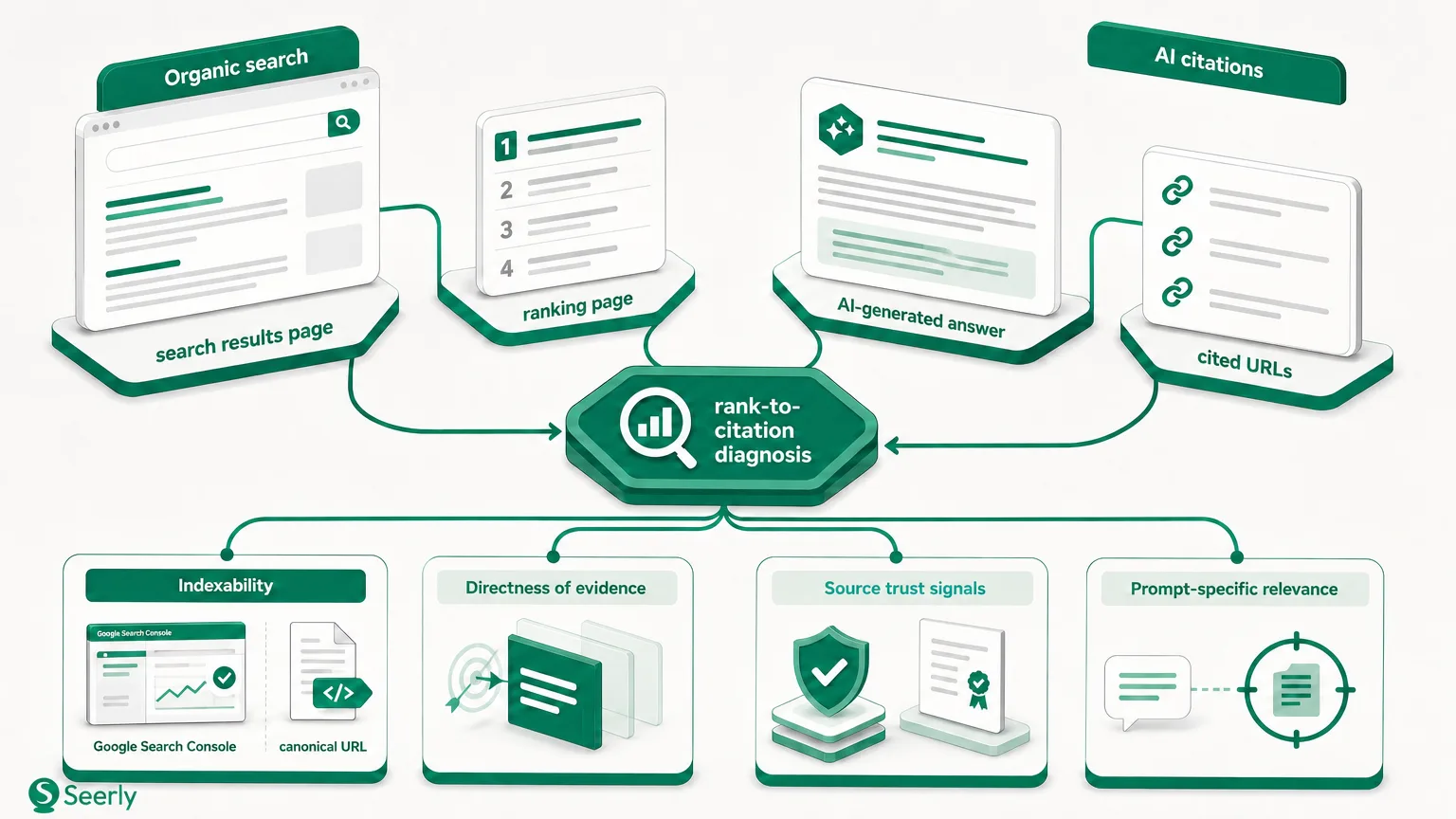
A page can hold a strong position in organic search and still be absent from an AI-generated answer’s supporting links. For digital marketing managers, that creates a measurement problem: conventional rankings show whether a page is visible in a search results page, while AI citations indicate whether a system selected that page as evidence for a specific answer. The two outcomes can overlap, but they are not interchangeable.
This distinction matters as answer-led interfaces change how people engage with search results. In a 2025 Pew Research Center study, users clicked a traditional search result on 8% of visits where Google displayed an AI summary, compared with 15% of visits without one. Organic search remains essential for discoverability and traffic, but teams also need direct evidence of whether their pages are being used to substantiate AI answers.
The practical question is not, “Why does this page rank but not get cited?” It is, “Which condition makes this page less useful to an AI answer for this query, in this context?” This framework helps teams separate those possibilities and choose a proportionate next action.
Why is a strong organic position not the same as being selected as an AI source?
Organic search rankings and AI citations solve related but different problems. A ranking system orders pages for a results page based on its interpretation of relevance, quality, usability, and many other signals. An AI system must additionally assemble an answer, decide which claims need support, retrieve candidate information, and select sources that appear suitable for the answer it is generating. A page can perform well in one process without being selected in the other.
| Assumption | What it misses | More useful interpretation |
|---|---|---|
| “A top-three organic ranking should produce an AI citation.” | Rank position does not prove that the page contains the most direct support for the generated claim. | Strong rankings are a valuable eligibility signal, not proof of source selection. |
| “If competitors are cited, their organic search SEO must be better.” | A cited page may be more specific, more current, or more easily attributable for that question. | Compare the evidence on cited pages before changing broad SEO strategy. |
| “No citation means the page is poor.” | The answer may use a different retrieval set, query interpretation, model, locale, or response format. | Treat absence as a diagnostic signal that requires repeated observation. |
| “More organic search traffic means more AI visibility.” | Traffic measures visits; citations measure use as supporting evidence. | Report both, but do not use either as a proxy for the other. |
The gap is especially important because AI-generated results can change click behaviour even when rankings remain stable. Research from Ahrefs found that AI Overviews were associated with lower click-through rates for the top organic result, reinforcing the need to monitor outcomes beyond position alone. A page may still attract qualified visits, but its role in a search journey can shift when an answer is resolved directly in the results interface.
This is not an argument to abandon organic search optimization. Google’s own SEO guidance still centres on making content useful, accessible to crawlers, and understandable to people and search engines through helpful, reliable, people-first content. Rather, it is an argument to treat organic rankings as one layer of visibility benchmarking - not the final measure of whether a brand is discoverable and accurately represented in AI search.
What foundation must a page meet before it can be used as supporting evidence?
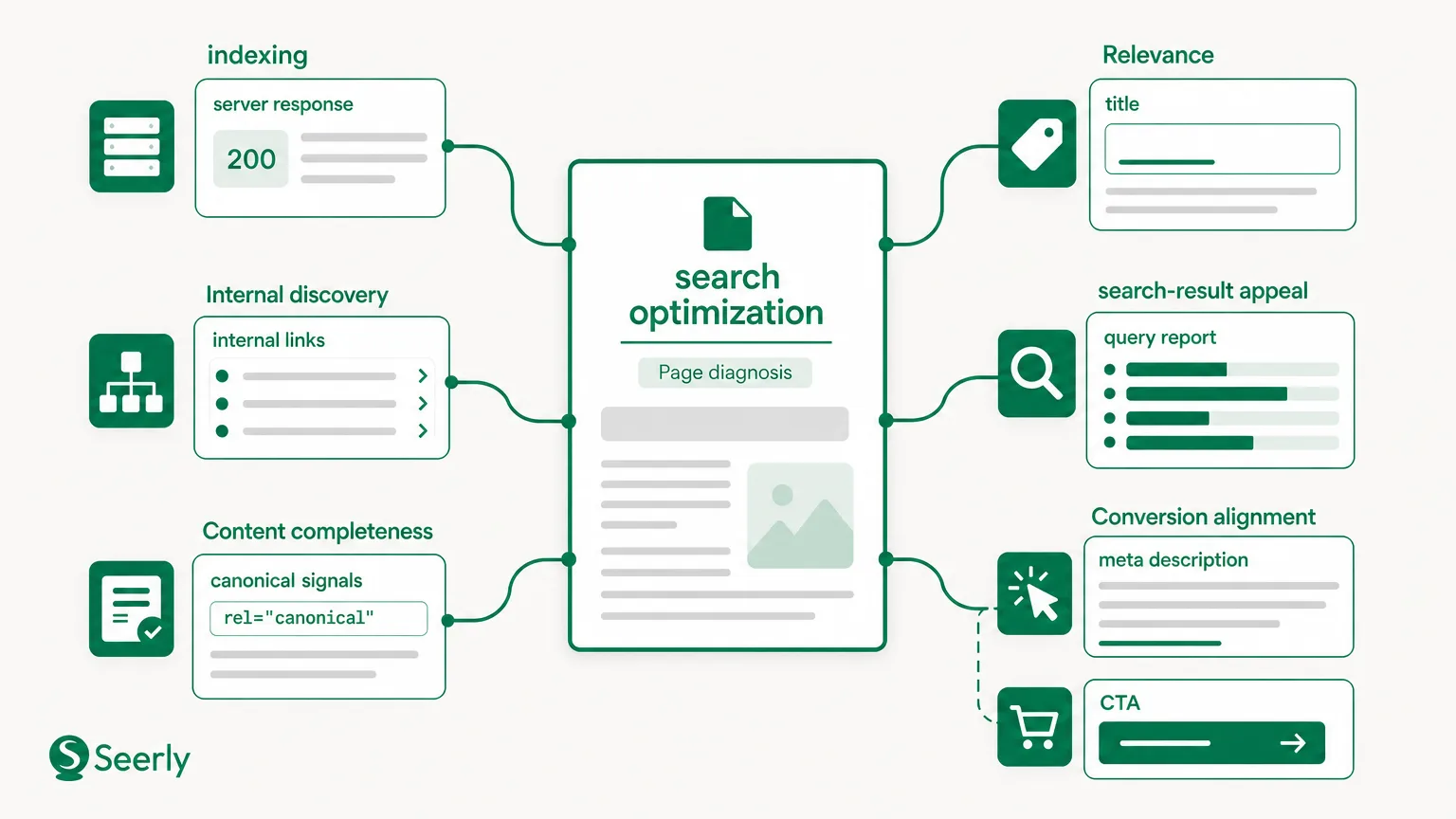
Before diagnosing evidence quality, confirm the basic conditions that make a page eligible for conventional search discovery. A page that is not indexable, cannot be crawled reliably, or is excluded from useful result presentation has a weaker starting point for any downstream visibility. Technical defects can also create inconsistent performance across pages that appear similar from a content perspective.
Foundation check: Google explains that pages should be crawlable and indexable, use valid HTTP status codes, and avoid blocking Googlebot from resources needed to understand the page. Review the technical requirements for appearing in Google Search before interpreting a rank-to-citation gap as a content problem. In practical terms, verify that the page is indexed, available to users, and eligible to appear with a meaningful search snippet.
Use Google Search Console to validate impressions, queries, indexed URLs, and page-level trends before drawing conclusions from third-party rank data. Google notes that connecting Search Console and Analytics helps teams understand how Google Search traffic behaves after visitors reach a site. This is useful because a page with limited impressions, unstable indexing, or a recent decline should not be assessed as though it had a stable organic search baseline.
The purpose of this stage is not to chase technical perfection for its own sake. It is to prevent teams from rewriting content when the issue is actually accessibility, indexing, canonicalisation, or weak query-level exposure. Once the page has a sound foundation, the comparison can move from “Can this page appear?” to “Why might another source be better suited to support this answer?”
Which four conditions should teams compare when rankings and citations diverge?
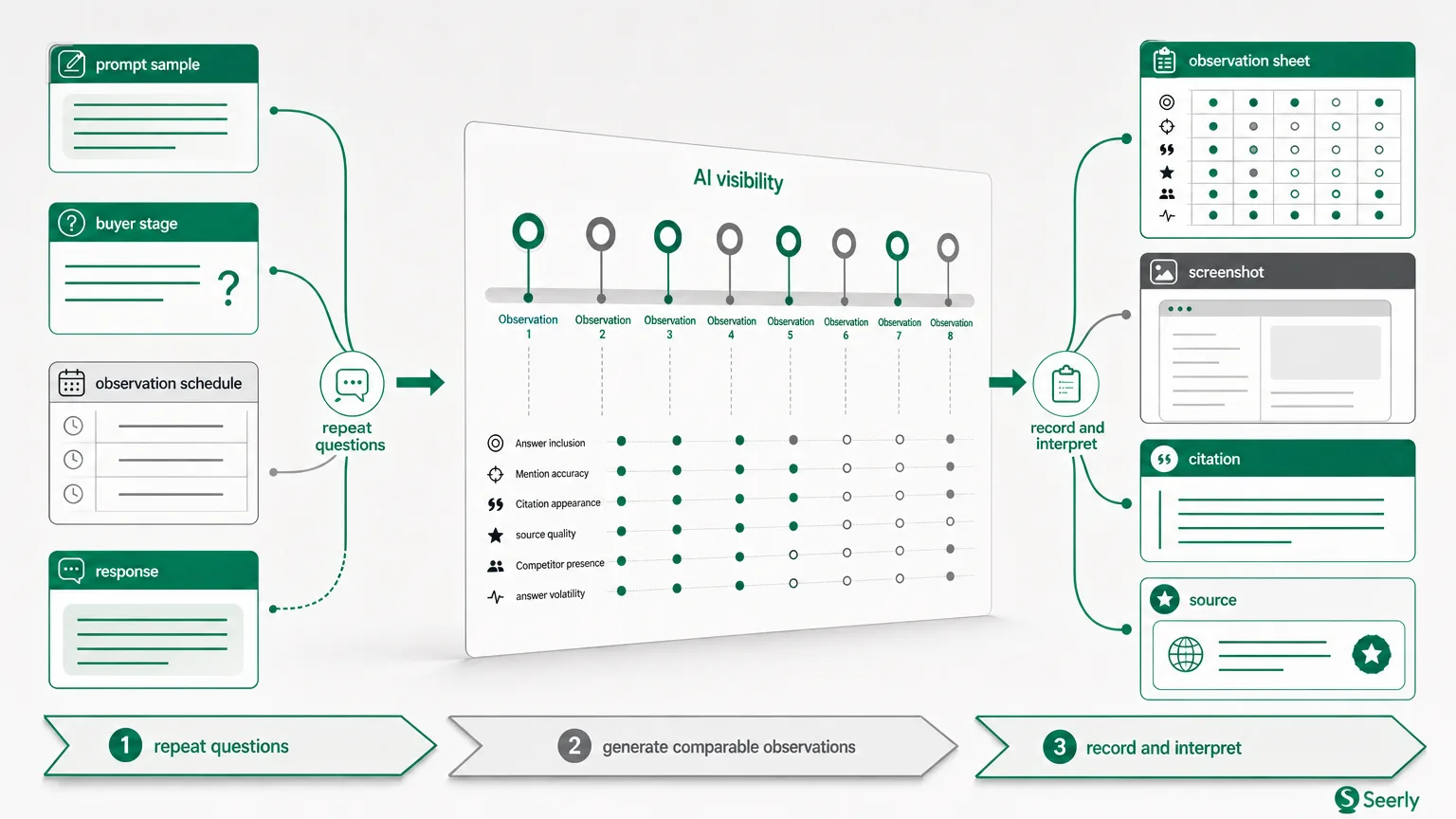
A useful diagnosis compares the ranking page with the pages that are actually cited for the same query. Avoid judging a single response in isolation: record the engine, date, market, device context where applicable, wording of the question, answer inclusion, and cited URLs. Then assess the four conditions below side by side.
| Condition | What to inspect on your page | What to inspect on cited alternatives | Likely next action |
|---|---|---|---|
| Indexability | Index status, canonical URL, crawl access, rendering, snippet eligibility | Whether the cited URL is a clean, accessible, canonical page | Fix technical barriers before changing copy. |
| Directness of evidence | Whether the answer, definition, comparison, method, or statistic appears clearly on-page | Whether competitors state the needed point more explicitly or nearer the top | Add concise, verifiable evidence that directly answers the query. |
| Source trust signals | Named author or organisation, dates, methodology, references, product documentation, consistent claims | Whether cited pages show stronger provenance or primary-source detail | Strengthen attribution, maintenance, and first-party evidence. |
| Prompt-specific relevance | Fit for the exact wording, audience, use case, geography, and intent | How closely cited pages match the answer’s framing | Create or refine coverage for the specific decision context. |
Indexability is the gate, not the explanation
Indexability is a binary-looking issue with nuanced consequences. A URL may be indexed while its preferred canonical points elsewhere, while a key section depends on rendering, or while metadata does a poor job of signalling the page’s purpose. Google’s SEO Starter Guide recommends helping search engines understand content and links while creating pages that are useful for people, not merely search systems; review its guidance on how Google discovers and understands content.
For diagnosis, do not assume that a page ranking for one variation of a topic is technically healthy for every relevant query. Review the precise URL, not only the domain or keyword group. If your cited competitor uses a tightly focused page while your ranking result is a broad hub, that structural difference may affect how easily each source can be used as evidence.
Direct evidence reduces interpretation work
AI answers frequently need support for discrete claims: a definition, a process step, a feature comparison, an eligibility rule, or a numerical statement. A page can rank because it comprehensively covers a broad subject but fail to state the needed fact with enough precision. By contrast, a cited page may answer one narrow part of the question in a visible heading, table, or well-attributed paragraph.
Directness does not mean reducing every page to short answers. It means ensuring that important claims are explicit, qualified where necessary, and supported by context. If an answer requires a comparison, show the comparison; if it requires a process, present the steps; if it requires a data point, explain its source and scope. This makes the page more useful to readers as well as systems retrieving evidence.
Trust signals make evidence easier to evaluate
Source trust is not a single score that marketers can optimise in isolation. It is the combined impression created by accurate claims, transparent authorship, current information, original documentation, clear editorial ownership, and links to supporting sources where appropriate. Pages that rely on unsupported assertions can still rank for broad terms, but they provide weaker material for a system that needs to attach a source to a specific claim.
Prioritise evidence your organisation can genuinely stand behind. That could include original research methodology, product documentation, named expert review, dated updates, or a clear distinction between observation and recommendation. Do not add credentials, statistics, or customer outcomes that cannot be verified; stronger trust signals come from transparent substance, not decorative authority.
Relevance changes with the question asked
A visibility gap may be caused by query context rather than a page-level weakness. “Best project management software” calls for different evidence than “project management software for a regulated healthcare team,” even when the same vendor appears in both searches. Model variation, conversational follow-ups, local settings, and phrasing can all alter which sources are retrieved and how an answer is constructed.
This is why monitoring should use a representative set of priority questions rather than a single head term. Track informational, comparative, and high-intent queries separately, then look for repeated patterns. A recurring gap around one use case is a stronger signal for content work than an isolated omission on a highly variable query.
What does a rank-to-citation diagnosis look like in practice?
Consider an illustrative B2B software company targeting the query, “how to choose a customer data platform for a mid-market retailer.” Its guide ranks on the first page of organic search and receives impressions for related queries. However, when the question appears in an AI-generated result, the answer references an analyst explainer, an implementation guide from a specialist consultancy, and a vendor’s technical documentation - not the company’s ranking guide.
The team first confirms that its page is indexed, canonical, accessible, and still receiving Search Console impressions. It then compares the evidence. The ranking guide discusses platform benefits at a high level, while the cited alternatives directly address data-source compatibility, implementation ownership, identity resolution, and retail-specific compliance considerations. The issue is not necessarily that the page is untrustworthy or that its rankings are weak; it is that the page does not supply the decision criteria the answer is trying to support.
The next action should be specific: add a clearly labelled retailer evaluation framework, explain trade-offs between implementation approaches, and cite authoritative sources for claims that require external validation. The team might also publish a separate implementation-readiness page if the evidence is too substantial to add cleanly to the existing guide. It should not promise that these changes will create a citation, because selection remains query- and system-dependent.
A structured workflow can make this comparison repeatable. Seerly’s gap analysis view shows the pages cited in place of your own for missed topics, helping teams turn repeated absences into focused content and evidence reviews. The goal is to identify the smallest credible improvement that closes an observable coverage or evidence gap, then monitor whether visibility changes over time.
How should this be reported to leadership?
Leadership reporting should avoid blending search performance and AI-answer performance into one headline number. A compact view makes the difference clear, connects observations to decisions, and protects teams from treating a single model response as a definitive verdict. Review trends by priority topic, not just aggregate totals.
| Priority topic | Organic search position and trend | AI-answer inclusion | Source citation status | Corrective action |
|---|---|---|---|---|
| Retail CDP selection | First-page visibility; stable | Mentioned or absent, by engine | Cited, not cited, or cited URL differs | Add retail-specific evaluation evidence |
| Implementation readiness | Position improving or declining | Included in a direct answer or not | Supporting link present or absent | Publish a practical implementation guide |
| Feature comparison | Ranking URL and query coverage | Brand accurately represented or not | Competitor sources selected instead | Clarify comparison claims and source them |
Pair this table with a short narrative: which gaps repeat, what evidence is missing, what action is planned, and how results will be validated. Search Console remains useful for identifying changes in clicks and impressions; Google recommends analysing performance data by query, page, country, and device rather than relying on a single aggregate view. AI visibility should be reviewed with the same discipline: segmented, repeatable, and connected to a clear business topic.
The core message for leadership is straightforward. Organic search performance is still necessary because it supports reach, demand capture, and a technically sound content foundation. But a ranking alone cannot show whether a page is selected to support AI-generated answers. Establish a recurring Seerly baseline for priority queries, compare ranked pages with cited alternatives, and use the differences to prioritise clearer coverage, stronger evidence, and more reliable AI search visibility.