How to evaluate an AI visibility dashboard alongside your SEO reporting
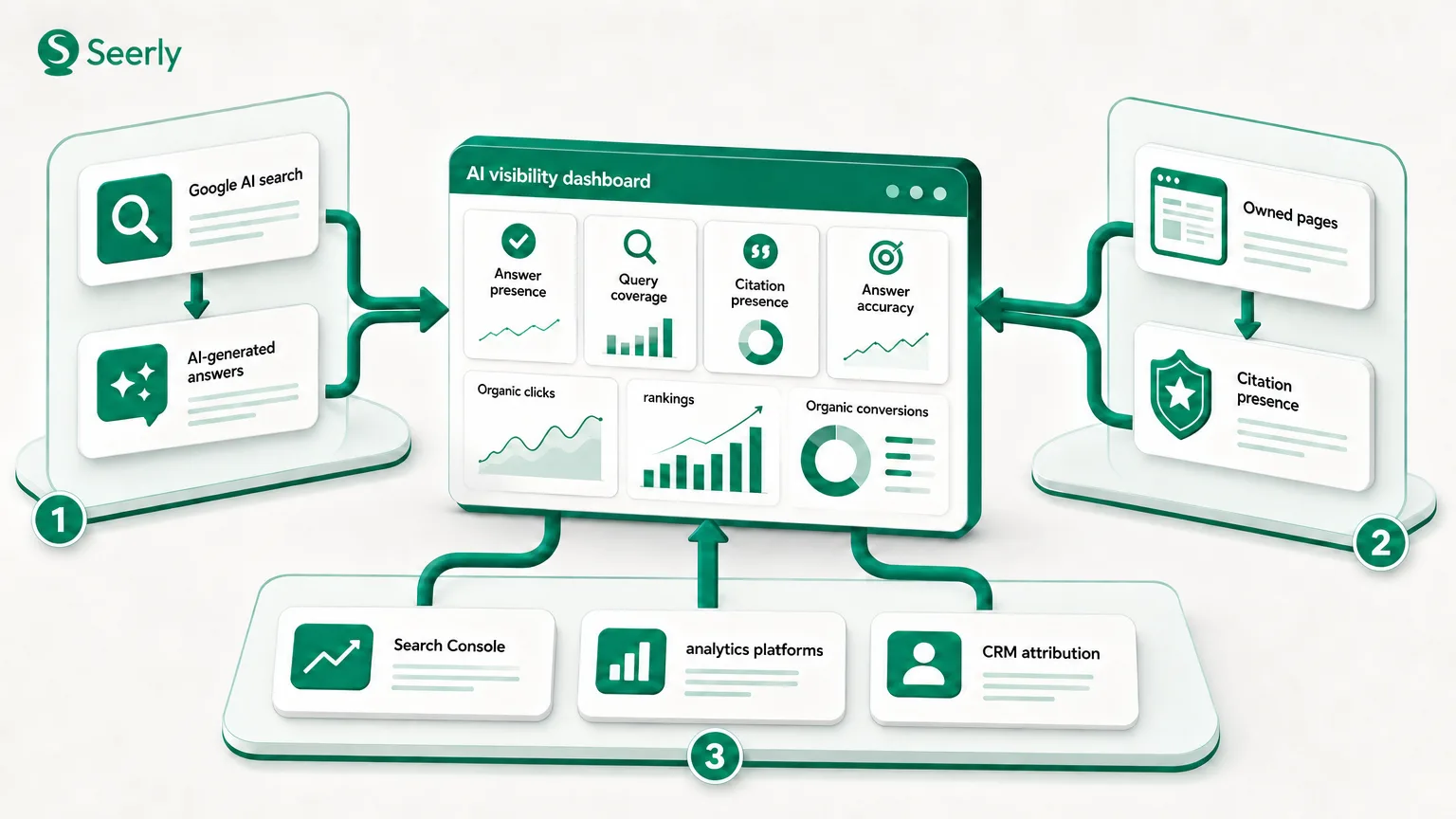
A monthly SEO report can show that organic sessions increased, rankings improved, and conversions held steady - while leaving a critical question unanswered: does your brand appear accurately when Google AI search generates an answer to the questions buyers are asking?
That question matters because AI-generated search experiences change how people interact with results. In a Pew Research Center analysis of Google browsing behavior, users clicked a traditional search-result link on 8% of visits with an AI summary, compared with 15% of visits without one. That does not make organic traffic irrelevant. It means traffic, rankings, citations, and answer presence must be evaluated as related but distinct signals.
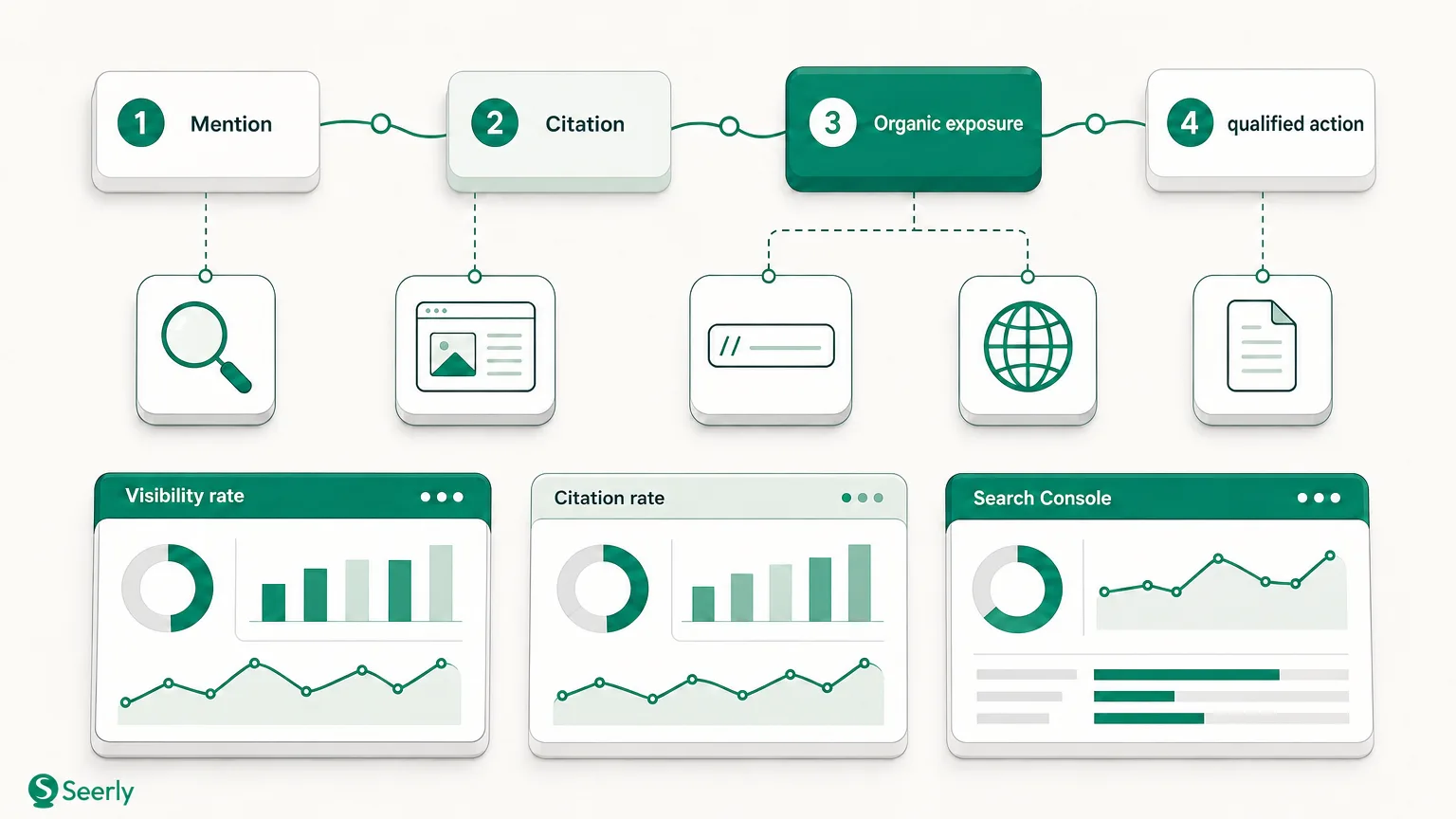
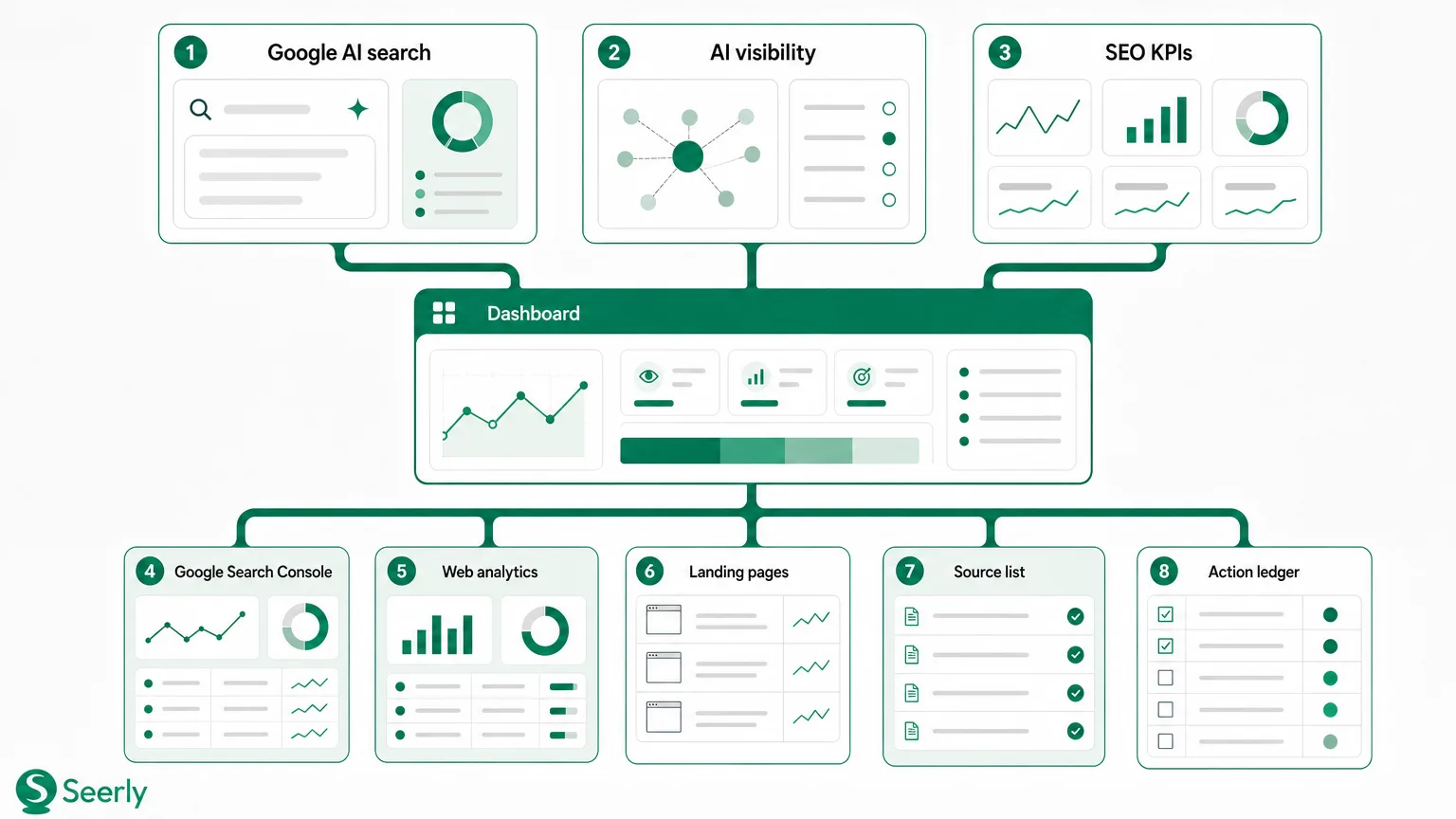
Teams can track AI visibility alongside organic traffic and SEO KPIs in a unified reporting workflow: one that records where a brand appears in AI-generated answers, what sources support those answers, what changed, and which actions the team took in response. The objective is not to create a single “AI score” that implies a direct business outcome. It is to give marketing leaders defensible evidence for content, technical SEO, brand reputation, and measurement decisions.
Define the reporting decision before choosing a dashboard
An AI visibility dashboard is useful only when it supports a decision someone is accountable for making. Without that discipline, reporting can become a collection of screenshots from Google AI search, rank trackers, analytics platforms, and citation tools - interesting, but difficult to act on.
Start by separating four reporting purposes. They may use some of the same data, but they should not be measured or communicated as though they answer the same question.
Decision worksheet: what should AI-search reporting help you decide?
| Reporting decision | The question to answer | Useful evidence | Appropriate action |
|---|---|---|---|
| Monitor brand presence | Does our brand appear when relevant AI answers are generated? | Answer presence, mention position, competitor mentions, query coverage | Prioritize categories, products, or audiences with weak representation |
| Identify content gaps | Which buyer questions produce answers that omit our expertise or resources? | Missing topics, cited competitor pages, recurring query themes | Create, improve, consolidate, or clarify supporting content |
| Validate answer quality | Is the brand description accurate, current, and aligned with our positioning? | Extracted claims, sentiment flags, factual-error notes, source context | Correct owned content, improve evidence, or address reputation concerns |
| Report business performance | Did search activity contribute to qualified visits, pipeline, revenue, or retention? | Organic sessions, assisted conversions, leads, revenue, CRM attribution | Invest, reallocate budget, or test a conversion-path improvement |
The key distinction is between visibility evidence and business outcomes. A brand mention in an AI answer is evidence that the brand appeared for a defined query scenario at a specific point in time. It does not prove that the user clicked, converted, or even accepted the answer. Conversely, a traffic increase does not establish that AI visibility caused it.
Google’s own guidance states that traffic from AI features is included in the broader Web reporting in Search Console rather than treated as a fully separate channel, and recommends using normal Search Console and analytics practices to evaluate site performance. That makes it especially important to retain a separate layer of evidence about answer presence and citations while keeping organic-search outcomes in their established reporting context.
For example, an enterprise software agency may find that its client appears in AI-generated answers for “best workflow automation platform” but is absent from answers about implementation risk, integrations, and procurement requirements. The reporting decision is not “our AI score fell.” It is: Should we improve the evaluation content and proof points that support the commercial questions where the brand is currently missing?
This framing prevents a common mistake: selecting a dashboard based on the volume of data it displays rather than the quality of decisions it enables.
Map AI-search signals to the SEO KPIs teams already use
Google AI search activity should sit beside conventional SEO reporting, not replace it. Organic rankings, impressions, clicks, engaged sessions, leads, and revenue retain their established roles. AI visibility adds a new diagnostic layer: how a brand and its sources appear when a search experience synthesizes information into an answer.
The table below separates directional AI-search indicators from conventional SEO measures and shows how to interpret them together.
| Signal | What it measures | Classification | What it does not prove | How to use it with SEO KPIs |
|---|---|---|---|---|
| Answer presence rate | Share of monitored query scenarios where the brand is mentioned | Directional AI visibility signal | That the mention generated a visit or influenced revenue | Compare with rankings and organic impressions for the same topic cluster |
| Prompt or query-scenario coverage | Breadth of monitored buyer, brand, and category questions | Directional AI visibility signal | That the sample represents all Google searches | Use to show where measurement is strong or incomplete |
| Citation or source presence | Whether owned pages or third-party sources appear as supporting evidence | Directional trust signal | That the source will be cited consistently in future answers | Review beside indexed pages, backlinks, and topic authority indicators |
| Answer accuracy or sentiment | Whether the answer describes the brand correctly and appropriately | Directional reputation signal | User perception, purchase intent, or brand lift | Pair with review trends, branded search, and customer-feedback signals |
| Organic impressions and clicks | Recorded appearances and clicks in Google Search results | Conventional SEO measure | That an AI answer drove the outcome | Use as the traffic-performance baseline |
| Rankings | Estimated position for tracked organic results | Conventional SEO measure | AI inclusion, citation likelihood, or buyer preference | Use to diagnose discoverability and competitive organic demand |
| Organic conversions | Leads, purchases, sign-ups, or other tracked outcomes from organic traffic | Conventional business-performance measure | That a single ranking, citation, or AI answer caused the conversion | Use for budget and commercial reporting, with attribution caveats |
The practical reporting principle is simple: show the signals together, but do not collapse them into one unsupported composite score. A combined number may look efficient on an executive slide, but it conceals important tradeoffs. A brand can have high organic traffic and low AI answer presence for commercial comparison questions. It can also have strong answer presence but little measurable referral traffic because the AI experience satisfied the immediate informational need.
This distinction is reinforced by evolving click behavior. Pew found that links cited within AI summaries were clicked on only 1% of visits in its observed data. Google, meanwhile, has said that AI search experiences can lead to higher-quality clicks, where users spend more time on linked sites. These are not directly comparable performance benchmarks: they use different contexts and methods. Together, they illustrate why teams should avoid treating AI visibility, clicks, and conversion value as interchangeable.
A useful executive report might therefore present three aligned views:
- Visibility: where the brand, product, or expert sources appeared across a documented set of query scenarios.
- Search performance: organic impressions, clicks, rankings, and landing-page engagement for the relevant content cluster.
- Commercial performance: qualified leads, pipeline contribution, revenue, or another agreed conversion metric.
For more context on separating AI answer monitoring from rank tracking, see Seerly’s guide to monitoring brand presence in Google AI chats versus search rankings.
Review the capabilities that make an AI-search dashboard useful
The right dashboard is not merely a place to count mentions. It should preserve the context required to understand why a brand appeared, disappeared, or was described in a particular way. This is especially important in a Google AI search engine environment, where answers can vary with wording, time, location, account context, and the sources available to the system.
Use the following checklist when assessing a platform or designing an internal reporting layer.
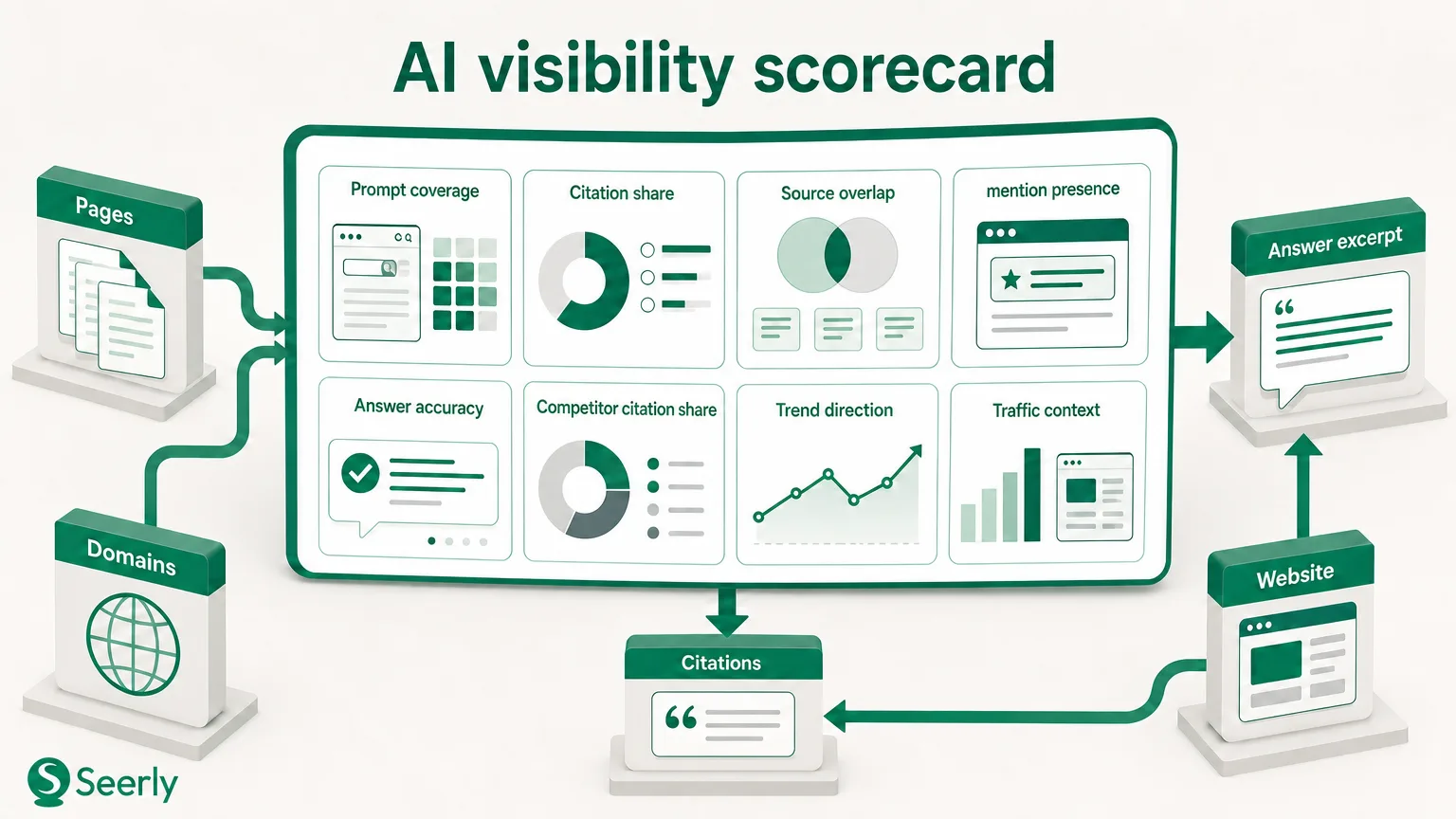
AI visibility dashboard checklist
-
Answer presence: The dashboard should record whether the brand appears in the generated answer for each monitored query scenario. Ideally, it should retain the answer text or a reviewable capture, not just a binary inclusion label. A mention without context can hide whether the brand was recommended, merely listed, or framed negatively.
-
Query-scenario coverage: Teams need a transparent inventory of what was tested: category questions, comparison questions, “best for” questions, troubleshooting queries, branded queries, and reputation-sensitive questions. Coverage matters because a 70% answer-presence rate across 10 narrow queries should not be interpreted the same way as 70% across 200 scenarios mapped to priority customer journeys.
-
Cited sources and source evidence: A useful dashboard identifies the pages, publishers, or domains associated with the answer where available. This makes the metric actionable. If competitor editorial coverage repeatedly supports an answer, the strategic issue may be third-party validation; if outdated owned pages are surfaced, the issue may be content maintenance or technical discoverability.
-
Changes over time: The system should make it possible to compare like with like: the same query set, market, language, device assumptions, and observation period. Trend reporting should show both the change and the underlying observation count so that a small number of changed results does not appear more significant than it is.
-
Accuracy and sentiment flags: Mark answers that contain stale claims, incorrect pricing, inaccurate product descriptions, unsupported comparisons, or reputationally sensitive language. Sentiment labels should be a review aid, not an automated verdict. The underlying answer and source evidence are more valuable than a simplistic positive-or-negative classification.
-
Tracked follow-up actions: Every material finding should be linked to an owner, action type, priority, due date, and later outcome. This converts proactive monitoring into data-driven management rather than a passive scorecard.
-
Connections to established SEO reporting: The dashboard should support a topic, URL, campaign, or product mapping that allows teams to view AI visibility signals next to Search Console, web analytics, and conversion reporting. Google notes that standard SEO fundamentals still apply to AI features and that there are no additional technical requirements or special AI-only markup needed to appear in these experiences. That makes integration with the existing content and SEO workflow more valuable than a parallel reporting silo.
A strong evaluation process also asks whether the platform can preserve evidence. When an account team reports that a client was omitted from an answer, leadership should be able to inspect the query scenario, date, answer output, cited sources, competitor context, and assigned next step. That record is what turns a visibility observation into an accountable marketing decision.
Compare an all-in-one workflow with disconnected point tools
Separate SEO and AI tools create reporting gaps when the team must manually reconstruct the story between an observed issue and the action taken. A rank tracker might show stable positions. Search Console might show rising impressions. A separate AI-monitoring spreadsheet might reveal that the brand is missing from high-intent answers. If those systems do not share a topic taxonomy, reporting cadence, or owner, the finding can disappear between meetings.
Worked example: a monthly marketing report
Consider a B2B cybersecurity company that tracks the query scenario “best endpoint security platform for mid-market healthcare organizations.” In April, its AI visibility dashboard records no brand mention in five comparable observations. Two competitors appear regularly, supported by analyst content, review pages, and detailed industry-specific implementation resources.
The SEO report tells a different but complementary story. The company ranks on page one for its generic endpoint-security landing page and receives steady organic traffic, but its healthcare-industry resource hub has low impressions and no meaningful conversion activity. The team should not conclude that AI omission caused the weak hub performance. The evidence instead supports a more precise hypothesis: the company lacks accessible, credible, healthcare-specific material that addresses the buyer context appearing in the answer set.
In an all-in-one reporting workflow, the May action register might document the following:
| Finding | Evidence | Assigned action | Owner | Review date |
|---|---|---|---|---|
| Brand absent from healthcare comparison answers | Five dated answer captures; competitor and source evidence | Publish implementation guide, update healthcare solution page, secure expert-review input | Content lead and product marketing | June reporting cycle |
| Outdated compliance statement appears on a cited owned page | Answer capture and source URL | Correct copy, add expert review, validate structured page updates | Compliance lead and SEO manager | May |
| Healthcare hub underperforms organically | Low impressions, low clicks, no tracked assisted conversions | Improve internal linking and map content to buyer questions | SEO manager | June |
In June, the report should not simply declare success because the new guide is published. It should record what changed: whether the query scenario produced a mention, whether a relevant owned or third-party source appeared, whether organic impressions moved for the mapped pages, and whether any early engagement or conversion indicators changed. The team can then describe the result accurately: answer presence improved in a defined sample after content and evidence updates; organic performance is being monitored over subsequent cycles.
Disconnected point tools make this chain harder to maintain. Someone has to export screenshots, align dates, remember the original rationale, and update an action tracker elsewhere. That increases the likelihood that teams report a visibility fluctuation but never document the underlying content, reputation, or technical response.
A documented workflow also supports agencies managing multiple clients. It creates a clear boundary between what the agency observed, what it recommended, what the client approved, and what later evidence suggests changed. Seerly’s perspective on Google AI search reporting before hiring an AI-search specialist offers a useful starting point for teams that need this discipline before expanding their tool stack.
Set reporting guardrails for AI-search data
AI-search reporting is most credible when it makes uncertainty visible. Generated answers and their sources can change, results may differ across contexts, and not every observation has the same commercial importance. Reporting guardrails protect decision-makers from overreading short-term changes or treating monitoring as control over inclusion.
Responsible reporting checklist
-
Date-stamp every observation. Record the date, time, market, language, and tested query scenario. An answer observed today is evidence of today’s result, not a permanent representation of the search experience.
-
State the sample size. Report the number of scenarios tested, the number of observations per scenario where relevant, and any exclusions. A result based on 12 priority queries can be valuable, but it must not be framed as a universal market share estimate.
-
Define each KPI. Clarify whether “visibility” means answer presence, citation presence, recommendation appearance, or another measure. Define organic conversions separately, including attribution model and conversion window.
-
Preserve the underlying evidence. Keep answer captures, source references, change logs, and notes on methodology. This helps reviewers validate claims and distinguish a meaningful pattern from a one-off variation.
-
Use calibrated language. Say “the brand appeared in 18 of 30 monitored query scenarios” rather than “the brand owns AI search.” Say “the result suggests a content gap” rather than “this proves the cause of lost revenue.”
-
Separate action from outcome. Publishing a page, earning coverage, or correcting a claim is an action. A later change in answer presence, rankings, or conversions is an observed outcome that still requires context before causal conclusions are made.
-
Review material shifts manually. A sudden change in sentiment, inclusion, or source mix should receive human review before it reaches an executive report. Automated flags are useful for scale, but brand-reputation decisions require source-level judgment.
FAQ: reporting Google AI search visibility responsibly
Can we attribute revenue directly to AI answer presence?
Usually not from answer presence alone. A mention or citation may influence awareness, consideration, or trust, but it does not inherently establish a trackable user journey to conversion. Treat it as a directional visibility and brand-authority signal, then evaluate it alongside organic sessions, assisted conversions, branded demand, CRM data, and other agreed business metrics.
Should AI visibility replace rank tracking?
No. Rank tracking measures conventional organic-result positioning, while AI visibility monitoring evaluates how a brand appears in generated answer experiences. Both can inform the same content strategy, but they answer different questions. Maintaining both views is more useful than forcing them into a single number.
How often should teams review AI-search visibility?
A monthly cycle is appropriate for most marketing and agency reporting, with more frequent monitoring for high-risk brand, pricing, compliance, or reputation queries. The best cadence depends on the speed of content changes, campaign activity, and the consequences of inaccurate answers - not simply on how often a tool can refresh data.
What should we do when an AI answer is inaccurate?
First, document the exact answer, date, query scenario, and cited sources. Then identify whether the issue stems from inaccurate owned content, missing authoritative evidence, outdated third-party coverage, or ambiguous positioning. Correct what the organization can control, assign the appropriate content or reputation action, and record the next observation without claiming that any change guarantees future inclusion.
Build a reporting workflow, not another isolated metric
The most useful Google AI search dashboard does not promise control over generated answers or convert visibility into a guaranteed revenue figure. It gives teams a disciplined way to connect answer presence, cited-source evidence, and follow-up actions to the organic traffic, rankings, and conversions they already report.
Audit your current monthly report. List the SEO KPIs stakeholders already receive, identify the AI-search evidence that is absent, and decide which decisions that missing evidence should support. Then use Seerly to bring visibility signals, citation evidence, and tracked actions into one documented workflow built for stronger AI search discovery and AI-ready brand authority.