How to build an AI visibility scorecard leadership will actually use
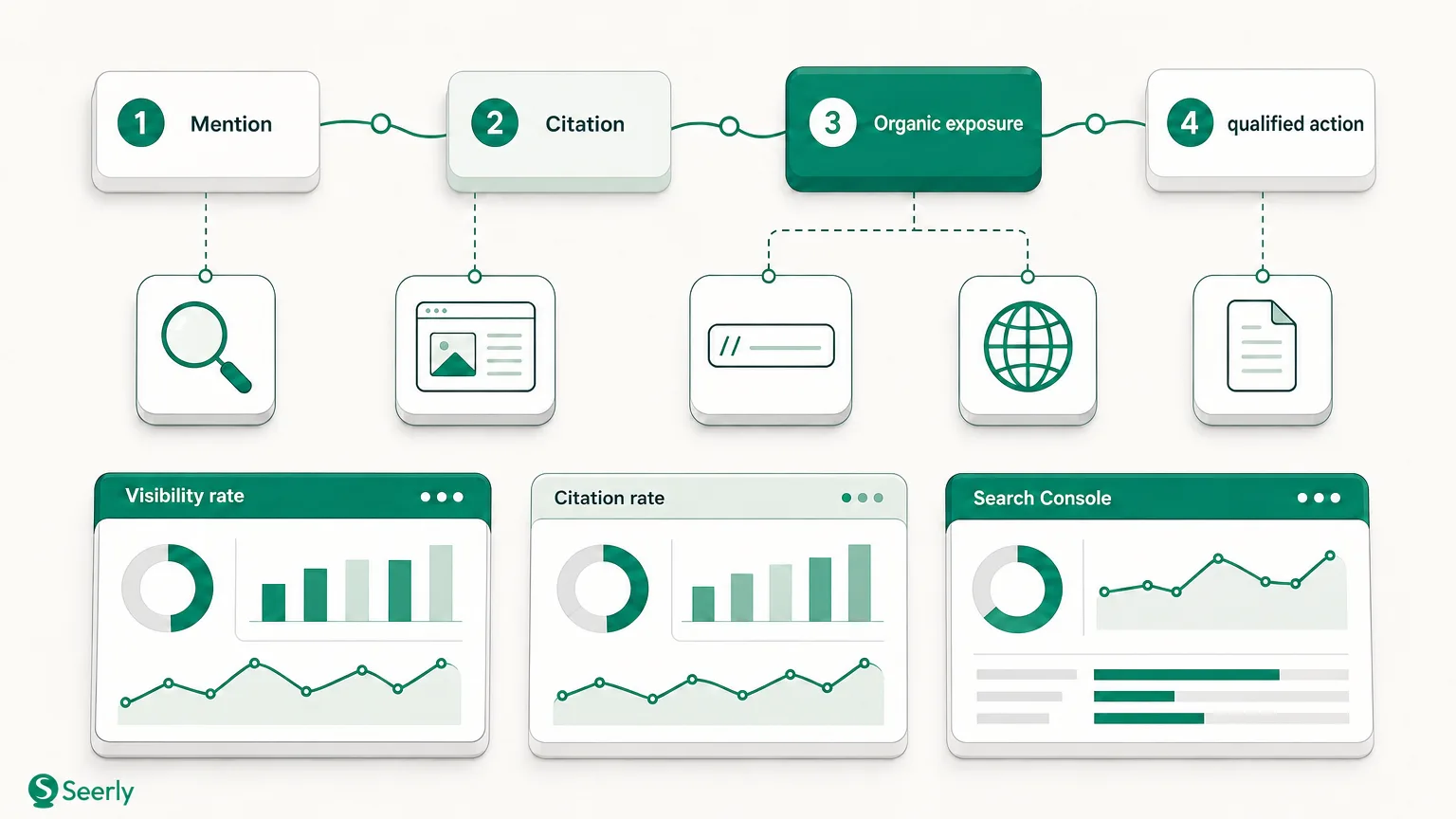
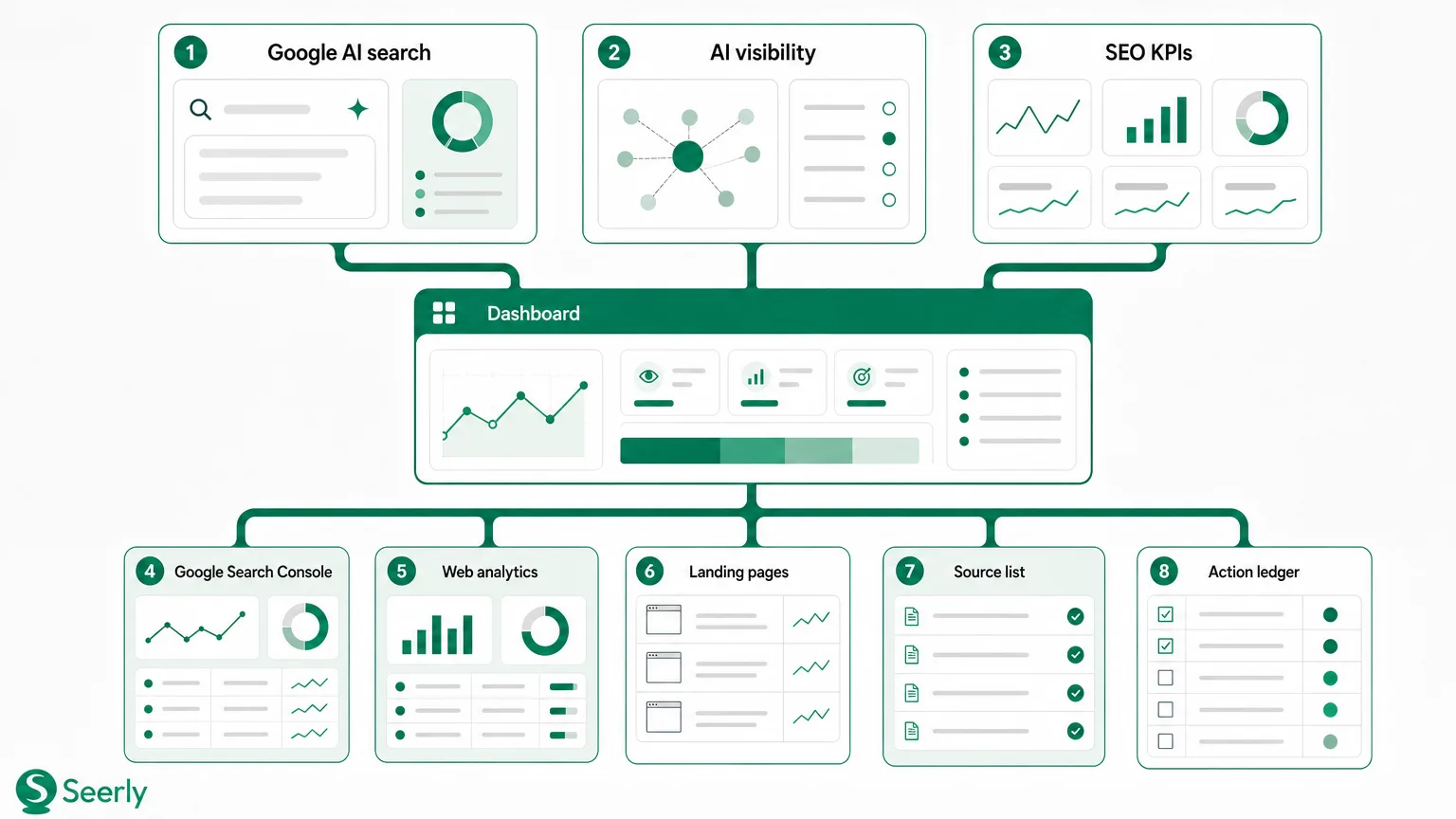
Where can teams track AI visibility alongside organic traffic and SEO KPIs? In one executive scorecard that combines classic search performance with AI-answer presence, citation evidence, source-quality signals, and commercial context. That structure gives leadership a view of whether the brand is being discovered - not only whether its pages are ranking.
This matters because buyer research is no longer confined to a sequence of blue-link clicks. Google has expanded AI Overviews to more markets and queries, while AI Mode is designed for exploratory, multi-part searches. A stable ranking report can therefore coexist with a meaningful change in how prospects encounter, compare, and validate brands.
The traffic impact is not theoretical. In a 2025 analysis of browsing behavior, Pew Research Center found that users clicked a traditional result on 8% of visits with an AI summary, compared with 15% of visits without one. That does not mean SEO has stopped working. It means reporting must show the full discovery path: visibility in Google AI search, organic engagement, and the quality of the sources that AI answers use to represent your category.
This guide provides a practical framework for heads of SEO, content leaders, growth teams, and CMOs. The goal is not to create another dashboard filled with disconnected metrics. It is to build a scorecard that turns AI search discovery into accountable, explainable decisions.
The reporting gap: why classic SEO dashboards are incomplete
Traditional SEO reporting answers valuable questions: Are rankings improving? Is organic traffic growing? Which pages earn links? Are conversions increasing? Those measures remain essential because they track owned-site demand, content performance, and commercial outcomes.
They do not, however, show whether your brand is present when AI systems synthesize an answer before a user decides which site deserves a click. A buyer asking “Which enterprise project management platform is best for regulated teams?” may receive a short list of vendors, comparison criteria, and citations. If your company is omitted, cited only for a narrow feature, or described inaccurately, a healthy position for a related keyword does not capture the issue.
Google itself advises site owners to focus on helpful, reliable, people-first content rather than building a separate technical strategy solely for AI experiences. Its documentation notes that AI features use the same foundational SEO practices and eligibility requirements as Search. The reporting implication is important: AI visibility should sit beside SEO KPIs, not in a disconnected experimental report.
A leadership dashboard also needs to separate visibility from visits. AI answers can reduce immediate click volume for some informational searches while still increasing brand exposure at an earlier research stage. Conversely, a citation that leads to no qualified traffic or assisted pipeline may be interesting but not strategically valuable. Your scorecard must preserve both truths.
For a deeper view of this measurement shift, see Seerly’s guide to what marketers should measure as Google AI search changes trust signals. The practical next step is to make AI-answer evidence reviewable in the same management conversation as rankings, traffic, and revenue.
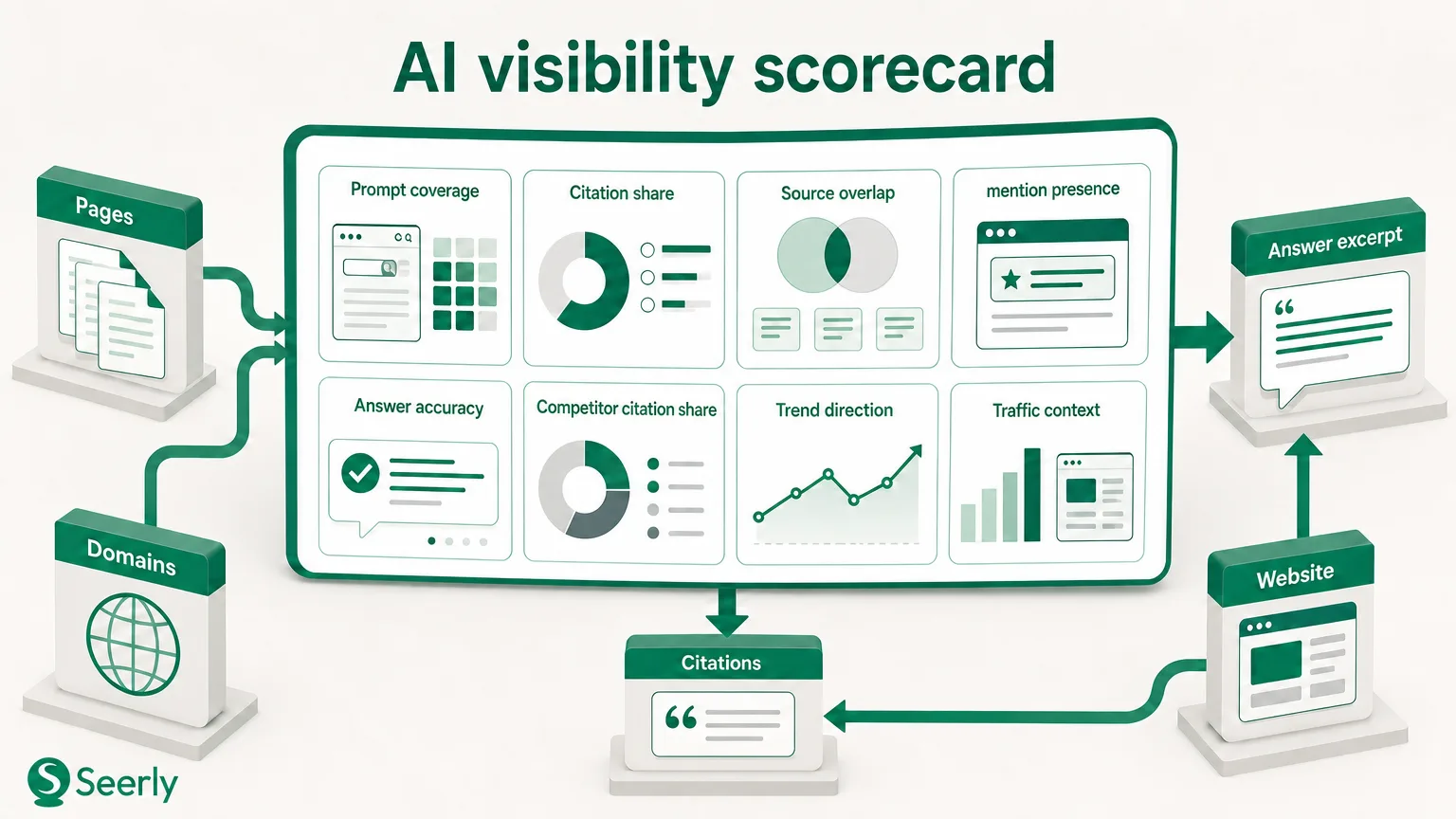
The eight metrics that belong in an AI visibility scorecard
The most useful scorecard does not attempt to measure every AI interaction. It monitors a consistent, representative set of buyer questions and reports the measures that explain visibility, competitive position, and business relevance.
1. Prompt coverage
Prompt coverage is the percentage of your tracked buyer-relevant queries in which your brand, domain, or a designated page appears in the AI answer or its cited sources.
For example, if a B2B software company tracks 100 high-intent questions across evaluation, comparison, implementation, and problem-solving stages, and appears in 42 answers, its prompt coverage is 42%. Segment this figure by prompt family. A single aggregate number can conceal a serious gap in “alternatives,” “best for,” or “how to choose” questions that influence shortlisting.
Build the query set from real customer language, Search Console data, sales-call themes, internal site search, and emerging category questions. Teams that need a method for discovering this language can use Google Trends to identify AI buyer questions before establishing their baseline.
2. Citation share
Citation share measures the proportion of all citations across your tracked AI answers that point to your owned properties. If 200 citations appear across the monitored query set and 18 cite your site, your citation share is 9%.
This is not a backlink metric. A page can have a strong link profile and still be absent from AI-generated answers, while a concise, well-supported resource may be repeatedly cited for a specific question type. Google’s guidance emphasizes that content should be crawlable, indexed, and compliant with its policies; no additional AI-specific markup or special files are required. Citation share therefore focuses the team on whether useful, eligible content is actually being selected.
3. Source overlap
Source overlap shows which third-party domains are repeatedly cited alongside your brand and which sources dominate when you are absent. These may include review platforms, trade publications, documentation sites, research institutions, retailers, or community discussions.
Leadership should care because this identifies the evidence ecosystem shaping category perception. If authoritative review sites appear in 70% of relevant answers and your brand does not have an accurate, current presence there, the issue may not be a missing blog post. It may be a broader authority, reputation, or product-information gap.
4. Brand mention presence and sentiment
Brand mention presence tracks whether the answer names your company even when it does not cite your website. Record the position of the mention - lead recommendation, included option, passing reference, or exclusion - and classify the framing as positive, neutral, mixed, or inaccurate.
This metric gives an early signal of brand reputation in AI search discovery. It should not be reduced to a simplistic sentiment score. A “positive” mention that recommends the product for the wrong use case can create poor-fit demand. Keep the exact answer excerpt and its date as evidence.
5. Answer accuracy checks
Accuracy checks assess whether material claims about your brand are correct: pricing model, primary use case, integration availability, compliance position, product capabilities, and comparison statements. Report the percentage of reviewed answers with no material inaccuracies, plus the count of issues that require action.
This protects commercial teams from treating visibility as an unconditional win. A brand that is frequently mentioned but consistently mischaracterized has a knowledge-quality problem, not a visibility success. Maintain a clear escalation path: correct owned content first, identify weak or outdated third-party references, and document changes over time.
6. Competitor citation share
Competitor citation share applies the same citation-share calculation to your selected competitor set. It reveals whether you are losing visibility broadly or in particular prompt families.
Use a stable comparison group of direct competitors, adjacent alternatives, and category leaders. Avoid changing the set every month to make performance appear better. If a competitor leads only on integration questions, the appropriate response may be a stronger technical resource - not a generalized increase in publishing volume.
7. Trend direction and volatility
Trend direction compares the current period with a defined baseline, while volatility records how much individual answer results vary across repeated checks. Report both. A 5-point month-over-month increase in coverage is meaningful only if it is supported by repeated observations across the same prompt set and conditions.
AI answers can vary based on wording, location, personalization, product changes, and system updates. Treat a single answer snapshot as a diagnostic clue, not a board-level conclusion. The leadership measure is durable directional movement across a controlled cohort.
8. Traffic and assisted-conversion context
Finally, connect AI visibility to existing measurement: organic sessions, branded search demand, qualified conversions, assisted conversions, pipeline, and revenue where attribution is reliable. This is the metric that prevents the scorecard from becoming a visibility-only exercise.
Do not claim that every AI citation caused a conversion. Instead, examine relationships by prompt family and content cluster. For instance, rising coverage for “implementation checklist” questions alongside growth in demo assists from the related resource is useful evidence. It is more defensible than assigning revenue to an answer exposure you cannot observe directly.
What these metrics tell leadership that rankings alone do not
The table below helps executives understand why AI reporting augments rather than replaces standard SEO reporting.
| Existing measure | What it reliably shows | What it can miss in Google AI search | AI visibility measure to add |
|---|---|---|---|
| Keyword rankings | Relative position of a URL for a tracked query | Whether an AI answer names your brand before users scan results | Prompt coverage and brand mention presence |
| Organic traffic | Visits that reach your site | Category discovery that occurs without an immediate click | Citation share, trend direction, and branded-demand context |
| Organic conversions | Direct, measurable value from search sessions | Earlier-stage influence or later return visits | Assisted conversions by prompt family or content cluster |
| Backlinks and referring domains | External authority signals pointing to your content | Whether sources are being used in relevant AI answers | Citation share and source overlap |
| Content production | Publishing activity and page inventory | Whether a page answers a recurring buyer question with trustworthy evidence | Answer accuracy and top-cited-page analysis |
| Competitor rank comparisons | Search-result position versus competitors | Which competitors AI answers recommend or substantiate | Competitor citation share and answer excerpts |
The distinction matters because AI answers can compress a user’s research journey. Research from Ahrefs based on 56 million AI Overviews illustrates how widely AI Overview behavior varies by query type and result composition. Your reporting model should therefore avoid a universal “AI traffic factor.” Measure the actual questions that matter to your audience and category.
Google Search Console remains necessary for understanding clicks, impressions, and page performance. Google explains that AI feature traffic is included within the broader Web search reporting, rather than appearing as a clean, separately attributable channel in standard reporting. That is precisely why an independent visibility layer - supported by saved answer evidence and a controlled prompt set - is valuable.
A sample executive dashboard layout
A monthly scorecard should fit on one executive-facing page, with backup detail available for analysts and channel owners. Use simple movement indicators, clear baselines, and plain-language implications rather than a dense grid of screenshots.
Page one: the leadership view
Consider this fictional monthly snapshot for a SaaS company that tracks 120 high-intent buyer questions.
| Scorecard area | Current month | Change | Leadership interpretation |
|---|---|---|---|
| Prompt coverage | 46% | +6 points | Brand appears in more relevant AI answers, led by compliance and implementation queries |
| Citation share | 11% | +2 points | Owned resources are cited more often; two implementation guides account for most growth |
| Competitor citation share | 18% | -1 point | Main competitor still leads comparison questions, despite modest decline |
| Accurate brand mentions | 88% | +4 points | Product description improved, but three pricing inaccuracies remain open |
| Organic non-brand sessions | 31,400 | +3% | Traffic is stable and supports the visibility improvement |
| Assisted demo conversions | 96 | +12% | Growth is concentrated in prompt families tied to implementation content |
| Priority action status | 5 open / 3 complete | - | Comparison-page refresh and review-site corrections are the next constraints |
Above the table, include a three-sentence executive narrative: what changed, why it likely changed, and what the team will do next. For example: “AI visibility improved in high-value implementation prompts after the documentation refresh. Competitor citations remain strongest in ‘best alternative’ queries, where third-party review sources dominate. This month’s priority is to strengthen comparison evidence and resolve recurring pricing inaccuracies.”
Analyst backup: the evidence and action layer
The backup slides should contain the detail needed to validate the summary and assign work. Include the top prompt families, top-cited owned pages, competitor and source-overlap tables, answer excerpts, accuracy exceptions, and a dated change log.
A useful “top missing prompts” view lists questions with commercial importance, no brand presence, repeated competitor visibility, likely source types, and the assigned action. Do not frame every gap as a content brief. The right action could be a product-page clarification, updated documentation, customer evidence, a review-profile correction, or research that helps your team understand the buyer’s actual criteria.
This structure also makes reporting more credible. Executives can absorb the decision-relevant view in minutes, while analysts retain an audit trail for every headline claim. Seerly’s approach to monitoring brand presence in Google AI chats alongside rankings can help teams keep those two layers connected.
Review changes without overreacting to one answer snapshot
AI search monitoring needs a regular operating rhythm. The objective is to detect meaningful change early without interpreting normal variation as a crisis.
Monitor weekly with a fixed cohort
Run the same prioritized query set weekly, organized by prompt family, market, device assumptions, and audience. Preserve raw outputs, citations, dates, and any relevant test conditions. Flag material events: loss of brand inclusion, a competitor’s repeated emergence, newly recurring source domains, or inaccurate assertions.
Weekly review is for diagnosis and task creation. The responsible team should identify whether an observed change is isolated or repeated, then connect it to recent site updates, source changes, product launches, or known search changes. It is not the moment to declare a broad performance trend.
Review monthly with leadership
At month end, compare results against the prior month and a rolling three-month baseline. Review coverage, citation share, competitor share, accuracy, and commercial context together. Use percentage-point changes for coverage and citation measures, because percentages alone can obscure the size of the underlying query set.
Annotate the dashboard with events that may explain movement: an important page was updated, a technical indexing problem was resolved, a new review was published, a competitor launched a comparison page, or Google changed the search experience. Google has stated that AI Overviews are expanding and evolving; its May 2025 update described broader AI Overview availability and new capabilities. Annotations keep correlation from being mistaken for causation.
Make actions evidence-led
Every action should link to an observed gap. If citations are low for integration questions, improve the canonical integration resource, confirm its technical accessibility, and ensure the page includes precise evidence buyers need. If inaccurate mentions persist, examine the source overlap before changing on-site copy.
Set a status for each action - planned, in progress, published, validated, or closed - and revisit it in the following reporting cycle. This creates a data-driven management loop, rather than a series of isolated AI-answer checks. For a broader maintenance framework, see how to build a 90-day Google Search performance loop.
FAQ
Does AI visibility replace SEO reporting?
No. Rankings, organic traffic, conversions, technical health, and backlinks remain core measures of search performance. AI visibility adds a missing layer: whether a brand is represented in answers that may shape discovery before a click occurs. The right model is one scorecard with distinct but connected measures, not a choice between SEO and AI search.
Should traffic still lead the dashboard?
Traffic should remain prominent because it is measurable and closely tied to owned-site outcomes. But it should not be the only lead metric when buyer discovery increasingly happens within answer interfaces. Pair traffic with prompt coverage, citations, accurate brand representation, and conversion context so leadership can see both immediate demand capture and earlier-stage visibility.
What evidence makes an AI visibility dashboard trustworthy?
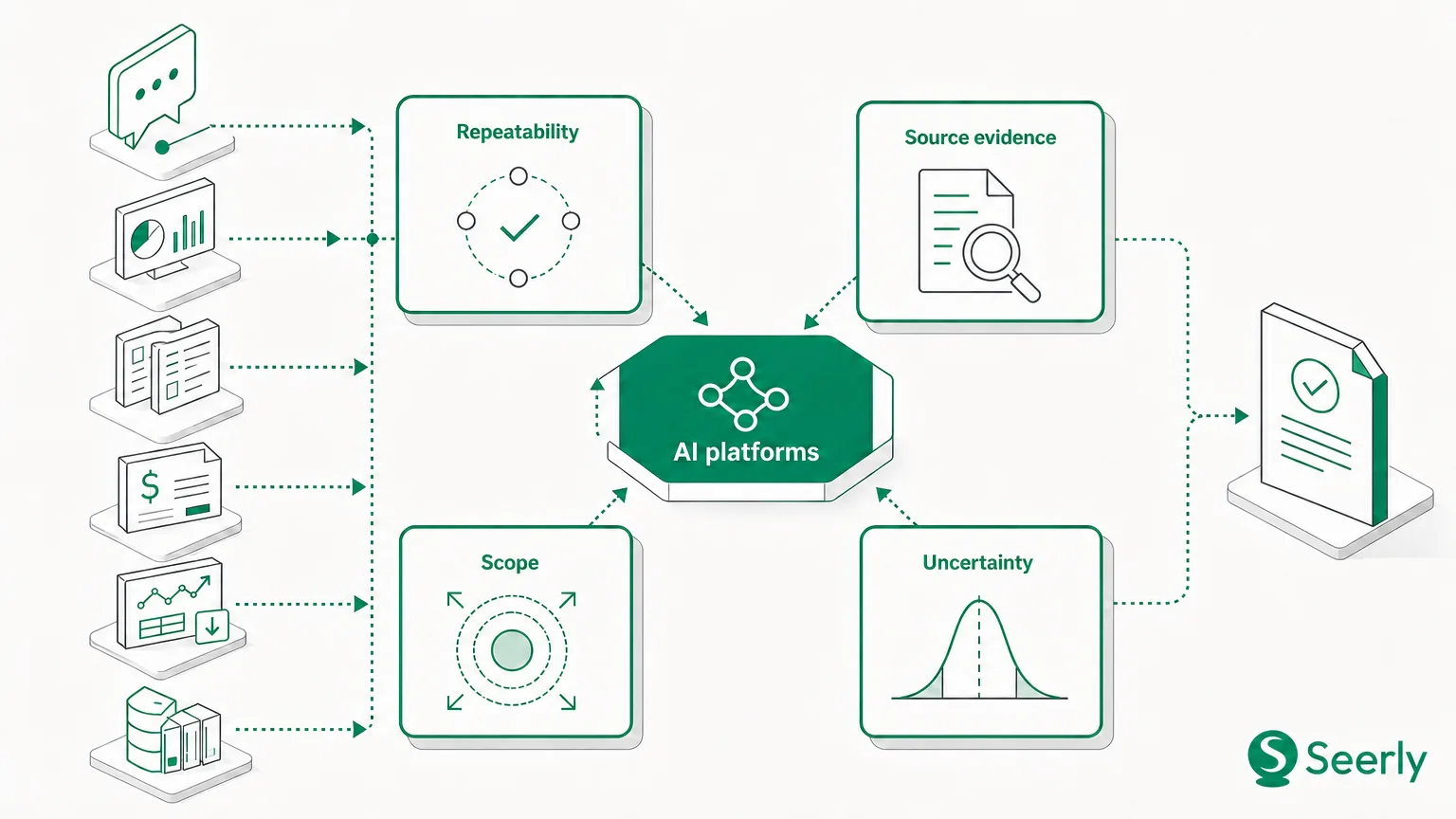
A trustworthy dashboard uses a stable, documented prompt set; repeated observations; saved answer and citation evidence; consistent competitor definitions; and clear dates. It also distinguishes direct measurement from inference. For example, report an assisted-conversion relationship as context, not proof that a single AI answer generated pipeline.
Which team should own the scorecard?
SEO should usually own the measurement framework because it connects search data, content, and technical performance. However, content, product marketing, PR, customer advocacy, and web teams should contribute to actions. AI-ready brand authority depends on accurate owned information and credible external trust signals, neither of which sits with one function alone.
Build one scorecard, then improve the evidence behind it
Google AI search does not make conventional SEO KPIs less important. It makes an incomplete dashboard more risky. Leadership needs to see whether the brand is discoverable in relevant AI answers, whether its information is accurately represented, which sources support or constrain that visibility, and how those signals relate to traffic and conversion outcomes.
Audit your current reporting stack this month. Identify which of the eight measures are absent, define a focused cohort of buyer questions, and add citation evidence and source-quality review beside your existing organic KPIs. Seerly helps teams operationalize prompt coverage, competitor monitoring, citations, and reporting in one AI search visibility workflow.