A data dictionary for AI visibility reporting that leaders can trust
A leadership dashboard can become misleading the moment it places Google AI Search mentions, organic rankings, sessions, and pipeline in one undifferentiated score. These signals may move together at times, but they describe different stages of discovery and different types of evidence. A brand can be named in an AI-generated answer without receiving a click, cited without being the first brand mentioned, or earn an organic visit that never becomes a qualified action.
This distinction matters because AI features are now part of the broader Google Search experience, and Google advises site owners that visibility in these experiences follows the same foundational requirements for indexing and eligibility as Search overall. At the same time, user behavior is changing: in a Pew Research Center analysis, users clicked traditional search-result links on 8% of visits where an AI summary appeared, compared with 15% when no summary appeared. That is a reason to measure visibility carefully - not a reason to assume a mention equals lost or gained revenue.
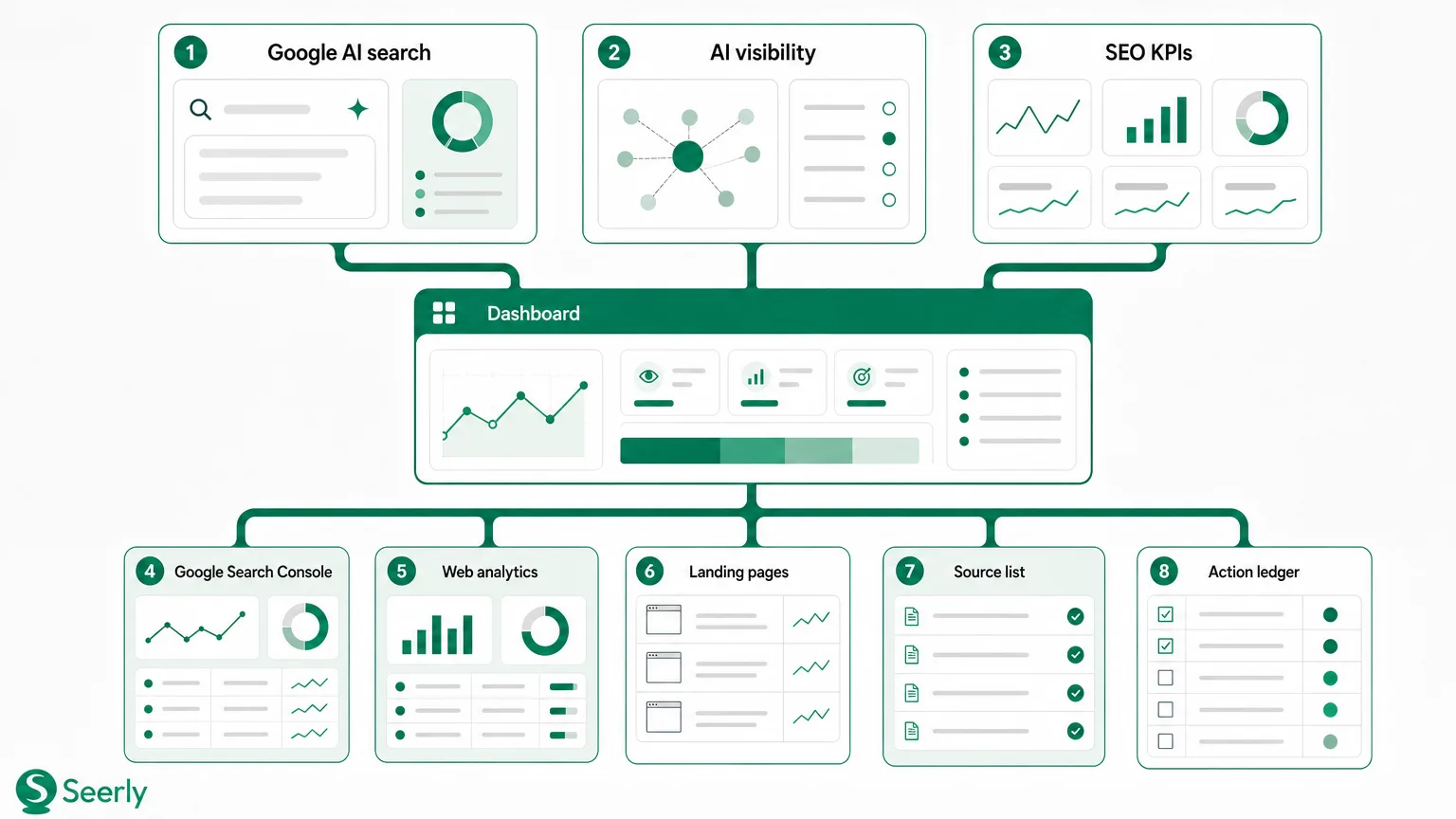
Where can teams track AI visibility alongside organic traffic and SEO KPIs? In a single reporting environment with separate panels for AI-search evidence, Google Search performance, and business outcomes; shared date ranges and segment definitions; and an annotation layer for changes. The goal is not a universal blended score. It is a decision-ready view built on shared metric definitions, evidence rules, and attribution boundaries.
Why AI visibility, organic performance, and outcomes need separate definitions
Google AI Search can expose a brand in ways that conventional rank trackers and analytics platforms were not designed to describe. An AI answer may mention a company in prose, include it in a comparison, link to one of its pages, or cite it among several supporting sources. Each event is relevant to brand reputation and AI search discovery, but none alone proves a visit or a commercial result.
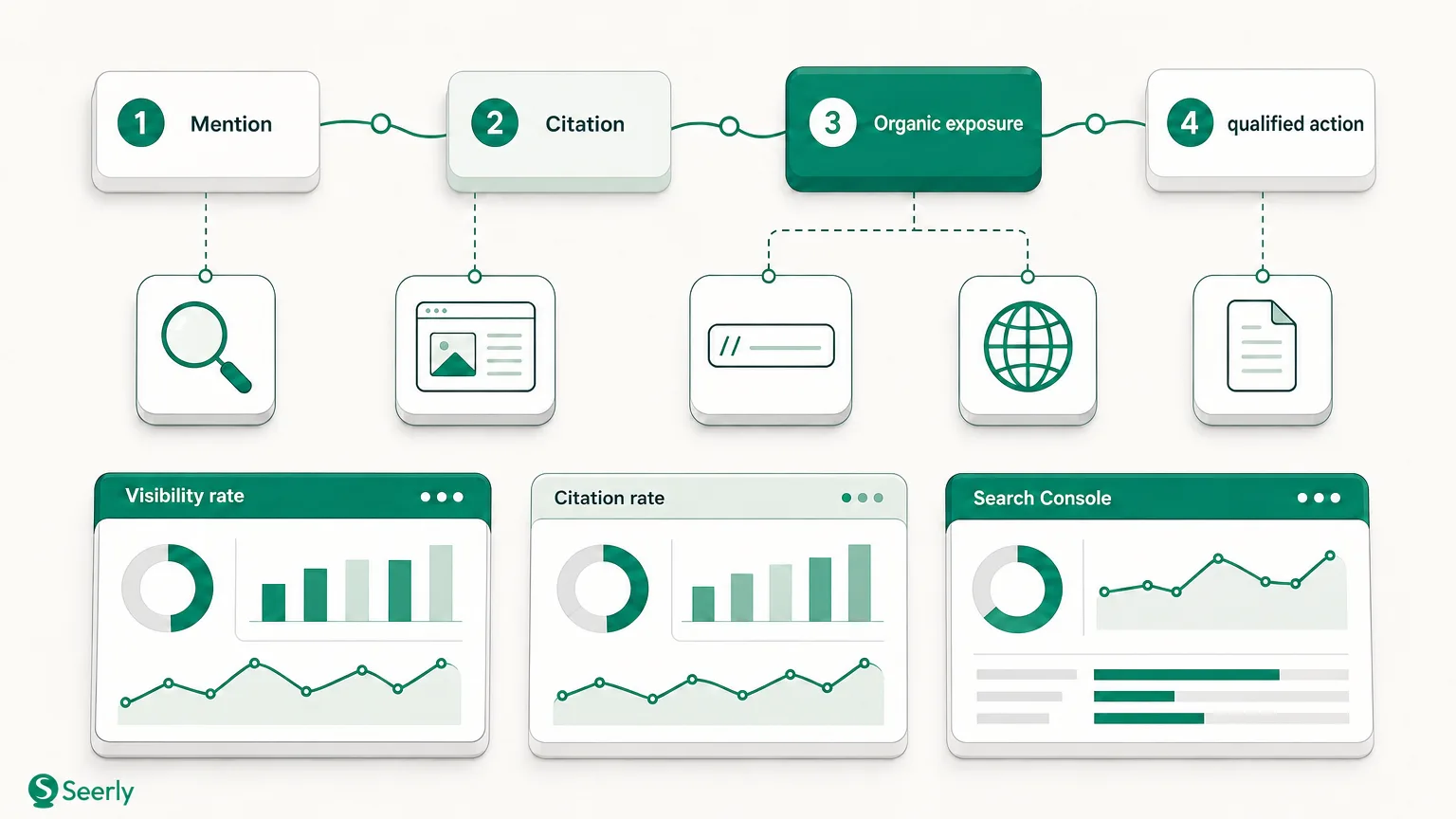
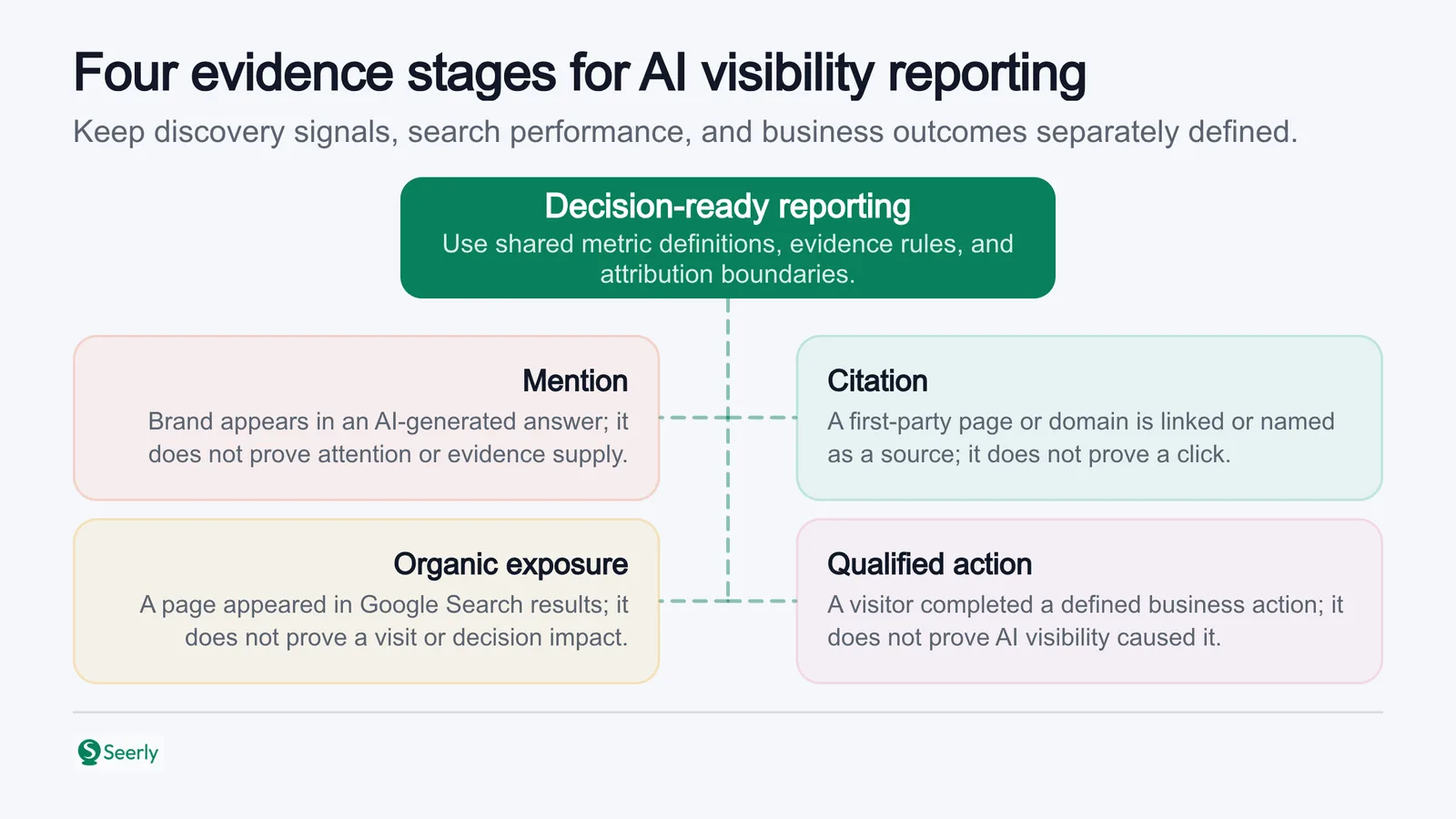
Use a four-stage model to keep the evidence clear:
Stage | What happened | Example evidence | What it does not prove |
|---|---|---|---|
Mention | The brand appears in an AI-generated answer | Captured answer text and date | That the brand supplied evidence or earned attention |
Citation | A first-party page or domain is linked or named as a source | Source link, screenshot, archived answer record | That a user clicked or trusted the source |
Organic exposure | A page appeared in Google Search results | Search Console impressions and query/page data | That the page generated a visit or influenced a decision |
Qualified action | A visitor completed a defined business action | Analytics event, CRM stage, or transaction | That AI visibility was the cause |
A mention is principally a visibility signal. It can indicate that a provider associates the brand with a topic, but answer wording can vary by query wording, location, account state, model behavior, and time. A citation is stronger evidence of source selection because it ties the answer to a URL or domain. Yet a citation still does not establish that a searcher opened the link, read the page, or entered a buying journey.
Organic impressions and rankings answer a separate question: whether Google displayed a result in conventional search surfaces. Google states that AI features are reported within the existing Web search type in Search Console, rather than as a wholly separate reporting property. This is useful for aggregate search reporting, but it means teams should not label every Search Console impression as an AI-feature impression or infer a one-to-one relationship between AI-answer inclusion and organic results.
Finally, qualified actions belong to the business-outcome layer. These may include a product demo request, a trial activation, a purchase, a lead accepted by sales, or an opportunity created. A team can analyze whether people arriving through organic search convert, but it should reserve causal claims about AI exposure for cases with defensible attribution evidence. The right reporting language is often “coincides with,” “was observed after,” or “is consistent with,” rather than “caused.”
Build the minimum viable metric dictionary before the dashboard
A metric dictionary is the operating contract behind the dashboard. It prevents an executive from interpreting a rising “AI visibility” trend as a rise in leads, and it prevents analysts from silently changing a query set or source method between reporting periods. Start with a manageable set of commercially relevant queries, then make every field reproducible.
Separate AI-search evidence from organic performance and business outcomes.
Define the query universe and observation rules
First, define the tracked query universe: the fixed set of customer questions, category comparisons, use-case searches, and brand queries that matter to the business. Segment it by funnel stage, market, language, and audience where needed. The denominator must be stable for period-over-period comparisons; if it changes, the dashboard should show a version note.
Second, record observation conditions. For every AI-search check, retain the provider, date and time, query wording, geography or locale, account state where relevant, answer type, and evidence link. This is particularly important when comparing Google AI Search with another Google AI search engine or answer provider: an answer experience is not interchangeable merely because the user’s intent looks similar.
Third, apply confidence labels. A metric derived from an exported platform dataset may be “high confidence,” while a manually verified answer capture might be “medium confidence,” and an ambiguous citation association should be “low confidence” or excluded. Confidence is not a cosmetic status; it tells leaders how strongly they can act on the finding.
Use this minimum viable metric dictionary
Metric | Practical definition | Can support | Cannot support | Confidence rule |
|---|---|---|---|---|
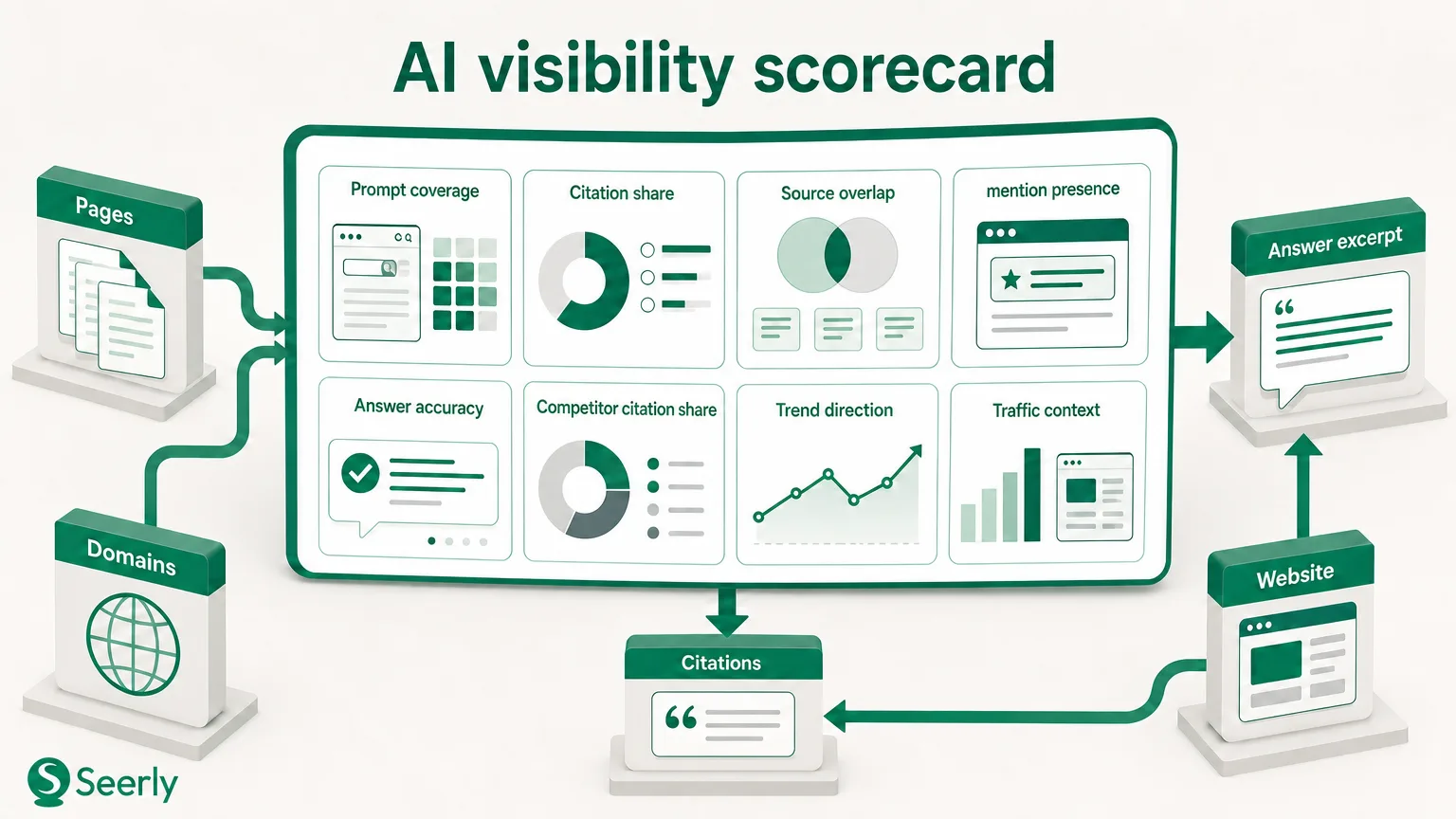
Visibility rate | Tracked queries with a brand mention ÷ eligible tracked queries | Share of the monitored query set where the brand appears | Traffic, ranking position, or revenue | Medium or high only with retained answer evidence |
Citation rate | Tracked queries where a first-party domain/page is cited ÷ eligible tracked queries | Source inclusion and trust-signal coverage | Clicks, engagement, or causation | High if the source link is captured and verified |
Prompt coverage | Number of eligible tracked queries observed in the period ÷ planned query set | Completeness of monitoring | Brand visibility performance | High only when coverage reaches the stated threshold |
Organic impressions | Google Search result displays reported in Search Console | Search exposure trends | Individual-user visibility or clicks | High for platform-reported totals |
Ranking | Position statistic for a defined query, page, device, and location | Relative conventional-search placement | AI-answer inclusion or business value | Medium; document tracker methodology |
Organic clicks | Search Console clicks to the site | Search-driven visits | On-site quality or conversion | High for Search Console reporting, subject to platform definitions |
Conversions | Completed, pre-defined qualified actions attributed by the analytics model | Measured business outcomes | Proof that AI exposure caused the action | High only when event and attribution rules are documented |
Confidence label | Evidence-quality classification attached to each metric or insight | Decision weight and need for review | Performance by itself | Required for all non-platform observations |
The formula matters less than the inclusion rule. For example, visibility rate should specify whether a brand qualifies when it appears only in a source list, only in answer body text, or in either location. Citation rate should state whether subdomains, owned review properties, distributors, and third-party marketplace pages count as first-party evidence. Without these decisions, two analysts can report different rates from the same underlying observations.
Treat prompt coverage as a data-quality metric, not a performance metric. If only 60 of 100 planned queries were observed because a provider changed interface behavior or a collection process failed, a 40% visibility rate is incomplete evidence. The dashboard should display “60% query coverage” beside the visibility number so leaders know whether they are seeing a reliable trend.
Place AI-search signals next to Google Search KPIs without double-counting
The most useful dashboard is a coordinated view, not a combined index. Give each evidence type its own panel, use one reporting period, and connect panels with annotations. This makes it possible to ask useful questions - such as whether citation rate improved after a content update - without pretending that the two datasets measure the same user event.
A worked monthly dashboard layout
For a B2B software company reporting on April 1-30 versus March 1-31, the top-level layout could look like this:
Panel | April measure | Comparison | Primary decision question |
|---|---|---|---|
AI-search presence | Visibility rate: 34%; citation rate: 19%; query coverage: 96% | +5 and +3 percentage points | Are AI-ready pages appearing and being selected as sources more often? |
Google Search performance | Impressions: 220,000; clicks: 8,900; average position: 12.4 | +9%, +4%, improved from 13.1 | Is conventional search exposure and traffic growing? |
Qualified outcomes | Organic demo requests: 96; qualified rate: 41%; pipeline influenced: $180,000 | +6%, flat, +8% | Is organic acquisition producing business value under the agreed model? |
Context and evidence | Three new guides, schema deployment, crawl issue resolved | N/A | Which documented changes may explain movements? |
The AI-search panel should contain only observed answer evidence: mentions, citations, answer types, and query coverage. The Google Search panel should contain Search Console and rank-tracking measures, with labels that preserve the platform’s definitions. The outcome panel should report analytics and CRM measures with an explicit attribution model, such as last non-direct click, data-driven attribution, or assisted pipeline rules.
Do not add AI citations to organic clicks, or multiply an AI visibility rate by a conversion rate to manufacture “AI revenue.” Those calculations can be exploratory models if clearly labeled as estimates, but they are not observed performance. This is especially important because Google describes AI search as driving more complex queries and higher-quality clicks, while independent click-behavior evidence shows that AI summaries can also coincide with lower click-through to traditional links. Both observations can be true in different contexts; neither justifies a generic conversion multiplier.
Add an annotation layer that explains movement
Annotations turn a dashboard from a scorecard into a management tool. Record content releases, substantial page revisions, internal-linking changes, technical deployments, indexation incidents, redirects, template changes, tracking changes, and changes to the monitored query set. Include the owner, date, affected URL group, and a link to the supporting ticket or release note.
For example, if citation rate rises two weeks after publishing an original research guide but organic clicks are flat, the team can investigate whether the new page is being selected as an AI source before it has accumulated conventional-search demand. If impressions decline after a canonical-tag deployment, the technical change belongs in the annotation layer before anyone concludes that AI visibility work was ineffective. Seerly’s guide to which Google Search changes matter in the SEO and AI era can help teams separate material search developments from routine dashboard noise.
Evaluate the surrounding AI-search landscape consistently
Comparing providers is valuable, but only when each observation has context. “We rank in the best AI search engine results” is not a usable reporting statement unless the team can answer: which provider, for which query, in which answer experience, and with what evidence? Provider outputs can differ because they use different retrieval systems, answer layouts, citation conventions, and personalization or locale conditions.
Use this checklist for every monitored observation:
-
Provider and surface: Record the provider, product surface, and whether the answer was an overview, conversational response, shopping result, local result, or another format.
-
Query and intent: Keep the exact query, funnel segment, locale, language, and device context where available. Small wording changes can alter answer composition.
-
Answer type and brand treatment: Identify whether the brand was directly recommended, merely listed, compared with competitors, or mentioned in a caveat.
-
Citation evidence: Capture linked first-party URLs, source labels, and answer records. Do not classify a nearby unrelated link as a citation.
-
Result context: Note whether conventional links, ads, map results, product modules, or other features surrounded the answer.
-
Repeatability: Repeat critical observations on a planned cadence and flag unstable findings rather than treating one capture as a trend.
This record supports meaningful comparison across providers while protecting against false equivalence. It also guides content teams toward the assets that create durable trust signals: clear first-party explanations, verifiable claims, structured information, and pages that directly address buyer questions. For a deeper content perspective, review how original content affects reuse and recommendations in AI search experiences.
Choose tools by reporting job, not by a promise of certainty
No tool should own every part of AI-search reporting. A resilient workflow separates collection, production, analytics, and verification, then makes the handoffs visible. Automation can improve coverage and speed, but high-stakes claims still require human review of the captured evidence and business interpretation.
Reporting job | Suitable tool category | Output | Human review requirement |
|---|---|---|---|
Data collection | AI visibility monitoring, rank tracking, Search Console exports | Query observations, citations, rankings, impressions | Verify sample captures, query-set integrity, and failed collection |
Content production | Content planning, research support, editorial workflow tools | Briefs, page updates, structured drafts | Validate facts, claims, source quality, and brand positioning |
Analytics | Web analytics, CRM, BI dashboarding | Clicks, events, conversions, pipeline measures | Confirm event definitions, attribution logic, and deduplication |
Verification | QA checklist, page inspection, expert review | Evidence links, confidence labels, exception log | Required for provider comparisons and executive conclusions |
Tools can collect a large number of observations, but they cannot decide whether a source link actually supports a claim, whether an answer is commercially relevant, or whether a change is material enough to report upward. Those are governance decisions. The same principle applies to content AI tools: they can accelerate drafting and gap analysis, but they do not replace subject-matter validation or editorial accountability.
Establish reporting governance before executive reporting
A trustworthy dashboard needs named ownership. The SEO lead may own organic definitions, the growth analytics lead may own conversion logic, the content lead may own page-release annotations, and a marketing operations or data lead may own dashboard quality checks. One accountable executive should approve the final interpretation for leadership reporting, especially when the report includes implications for investment or brand reputation.
Monthly governance checklist
Run a monthly review with the metric dictionary open, not just the dashboard. Confirm that the query universe has not changed without a version note, coverage meets the agreed threshold, evidence links work, and all notable movements have either an annotation or an open investigation. Reconcile organic conversions against the analytics and CRM definitions, and ensure no event is counted twice across acquisition channels.
Every dashboard field should have four required metadata fields: metric owner, source system, evidence link or query, and escalation rule. An appropriate escalation rule might state that any finding below medium confidence cannot be included as a performance conclusion; it may only appear as a research observation. Another might require investigation when visibility rate changes by more than five percentage points while query coverage falls below 90%.
FAQ
Who owns metric definitions?
The function closest to the source should propose the definition, but cross-functional owners should approve it. SEO should define organic visibility fields, analytics should define conversion and attribution fields, and the AI-search lead or equivalent should define answer-observation rules. A shared monthly sign-off prevents a dashboard from becoming a collection of department-specific interpretations.
How often should data quality checks happen?
Perform lightweight checks each reporting cycle and a deeper audit monthly. Lightweight checks confirm imports, coverage, obvious anomalies, and annotation completeness. The monthly audit reviews evidence samples, changed provider behavior, query-set versioning, and whether confidence labels still reflect the data-collection method.
What should leaders do with uncertain findings?
Leaders should treat uncertain findings as hypotheses with a clear next action, not as confirmed outcomes. For example, “citation rate appears to have increased after the guide launch; repeat observations and review source links next month” is useful and honest. It preserves momentum without overstating what the evidence can establish.
Build a dashboard that preserves evidence
Google AI Search reporting becomes decision-ready when it respects the boundary between exposure, source selection, visits, and outcomes. Separate panels do not make a dashboard less strategic; they make it more credible because every number retains its meaning. A rise in AI visibility may point to stronger brand authority, while a rise in organic conversions may validate acquisition performance - but each deserves its own evidence trail.
Before publishing the next leadership report, create a one-page metric dictionary and map every dashboard field to a named owner and evidence source. Then compare that structure with Seerly’s analytics workflow to strengthen proactive monitoring, AI-search visibility reporting, and accountable interpretation.