A confidence rubric for AI claims before they enter a marketing report
Marketing teams increasingly use AI platforms to investigate visibility, audience behaviour, competitors, content gaps, and brand representation. The challenge begins when an answer that is useful for exploration becomes a sentence in a performance report. A plausible AI response can sound decisive while relying on incomplete sources, an unclear time range, or an assumption that has not been tested against first-party data.
This is a reporting governance problem, not simply a model-quality problem. AI capability and adoption continue to accelerate: the Stanford AI Index documents rapid improvements in model performance and declining costs for many AI systems, while organisations are finding more business functions in which AI can assist work. That makes disciplined validation more important, not less.
The working rule is straightforward: an AI answer is reportable only when the team can reproduce it, inspect its evidence, record its limitations, and assign an owner to the next action. Everything else may still be valuable - but it belongs in research notes, not executive reporting.
Separate an AI observation from a verified reporting claim
An AI-generated observation is a lead. It can help a marketing team notice a change, frame a hypothesis, identify candidate sources, or decide which dashboard to inspect. It should not be presented as proof simply because the answer is detailed, fluent, or repeated by more than one AI platform.
A verified reporting claim has a higher standard. It has a defined question, a stable enough method, accessible evidence, and a scope that matches the statement being made. For example, “AI search responses frequently cite third-party review pages for this category” may be an observation worth investigating. “Third-party reviews caused a 12% increase in qualified pipeline” is a performance claim that requires much more than an AI-generated explanation.
| Dimension | Useful AI-generated observation | Verified reporting claim |
|---|---|---|
| Purpose | Generates a hypothesis or investigation path | Supports a decision, report narrative, or stated result |
| Reproducibility | May appear in one session or one platform | Can be rerun with the recorded query, settings, date, and market |
| Evidence | May include no sources, partial sources, or general references | Links to inspectable sources and relevant first-party reporting inputs |
| Scope | Often broad or implied | Defines audience, location, timeframe, platform, and metric |
| Uncertainty | Usually unstated | Explicitly records what is unknown, disputed, or not causal |
| Accountability | No assigned follow-up | An owner is responsible for validation or next action |
When is an AI-generated observation strong enough to include in a performance report?
It is strong enough when the report can answer four questions without relying on the model’s authority: What exactly was asked? What evidence supports the answer? What does the finding cover and exclude? Who will act on it or validate it further?
This threshold protects both the analyst and the audience. Leaders do not need false certainty; they need a clear distinction between measured results, observed signals, and open questions. A report that labels evidence quality is more decision-useful than one that compresses uncertainty into a confident headline.
For AI search visibility work, that distinction is particularly important. A platform may show that a brand appears in a response, but the business implication still needs evidence. A team can investigate whether its product content is structured, current, and independently corroborated - similar to the work involved in improving product-page visibility in AI search - without claiming that visibility alone produced commercial performance.
Use a four-part rubric before treating an answer as fact
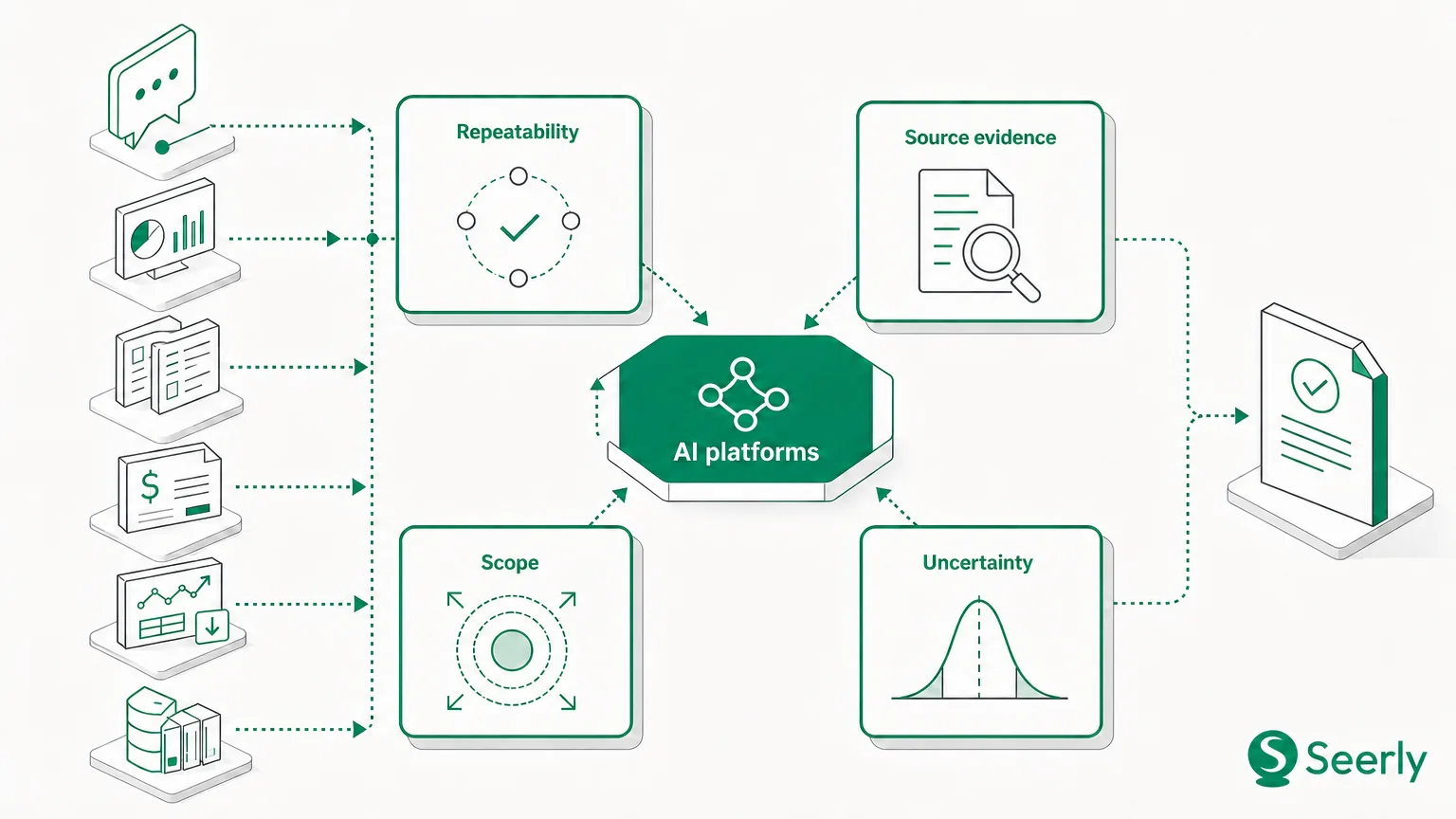
The rubric below gives teams a shared method for reviewing outputs from AI platforms. It is deliberately platform-neutral: models differ in retrieval, citation behaviour, recency, personalisation, and how they express uncertainty. Agreement can increase confidence, but it never replaces source inspection.
1. Repeatability
Record the full question, date and time, platform, account context where relevant, language, location, and any files or data supplied to the system. Then rerun the same question at least once. If practical, have a second reviewer repeat the test from a separate session.
Repeatability does not mean the wording must be identical every time. Generative systems are probabilistic, and changing web results or platform updates can affect outputs. It means the core finding remains materially similar under documented conditions - or, if it changes, the team records that instability rather than hiding it.
2. Source evidence
Capture every cited source, the relevant extract, publication date, access date, and the portion that supports the claim. If the answer contains no citations, the output begins with a lower confidence level. The team must locate primary evidence independently before converting it into a reporting statement.
Source quality matters as much as source quantity. A vendor blog may explain a product feature, but it is not evidence of market-wide performance. A first-party analytics export can verify a metric for the reporting period, while an independently published benchmark can add context. Keep those roles separate.
3. Scope
State what the answer covers: geography, language, audience, query type, platform, date range, business unit, and metric definition. AI platforms commonly turn partial information into a broad statement. That is especially risky when a report uses terms such as “customers,” “market,” “visibility,” or “conversion” without defining them.
For instance, a finding from five English-language informational queries is not a finding about all AI search visibility. It is a directional sample. Similarly, a visibility change in one AI platform is not automatically a change in organic search, direct traffic, or revenue.
4. Uncertainty
Document the limitations that could change the interpretation. These may include conflicting answers, inaccessible sources, stale information, ambiguous terminology, small samples, missing first-party data, or the inability to establish causation. Uncertainty is not a disclaimer added after the analysis; it is part of the evidence record.
The need for this discipline is reinforced by the pace of development across AI systems. Comparative evaluations show model performance shifts frequently across capabilities and releases, as reflected in the Artificial Analysis Intelligence Index’s ongoing model comparisons. A conclusion tied to one model response should therefore be timestamped and retested on a reporting cadence that fits the decision’s importance.
Worked example: verifying a brand-citation finding
Suppose the recurring business question is: “Which sources do AI platforms use when answering ‘best enterprise project-management software for distributed teams’ in the UK?”
The team tests the exact query on three AI platforms on the same day, using clean sessions where possible. One response includes the brand and cites a major review site plus the company’s pricing page. A second mentions the brand but cites only review sites. The third does not mention the brand and provides no sources.
| Rubric area | Recorded result | Reporting implication |
|---|---|---|
| Repeatability | Two reruns produce similar source categories, but brand inclusion varies | Treat brand mention as unstable |
| Source evidence | Review pages are accessible; one cited pricing page confirms plan details | Cite source patterns, not a universal recommendation claim |
| Scope | UK English query; one category phrase; one test date | Do not generalise to all buyer journeys or markets |
| Uncertainty | One platform lacks citations; results may vary by session and product updates | Flag a monitoring need and avoid causal language |
The reportable version might read: “In a limited UK test on 14 May, two of three AI platforms referenced third-party review pages when answering a category query; our brand’s presence was inconsistent. This is a visibility signal requiring ongoing monitoring, not evidence of buyer preference or pipeline impact.”
That sentence is useful because it preserves the evidence boundary. The team can then compare the result with website analytics, referral traffic, assisted conversions, and sales feedback. For SaaS teams, this is closely aligned with evaluating how AI search optimisation can help buyers find the right product: discoverability is a measurable condition to monitor, while commercial impact requires separate evidence.
Inspect citations before accepting an AI answer
A citation attached to an AI response is not automatically evidence. It may link to a page that mentions the topic but does not substantiate the conclusion, present a dated statistic as current, or support only one part of a compound claim. Treat citations as leads for review.
Follow a five-step evidence review
First, break the answer into atomic claims. “Our competitors are more visible in AI search because they publish more comparison content” includes at least three claims: competitors are more visible, the difference is meaningful, and comparison content explains it. Each needs its own evidence.
Second, open the original source rather than relying on the AI summary. Check the author, publication, methodology, date, geography, population, and definitions. A source that reports responses from US consumers, for example, cannot verify a claim about UK B2B buyers unless the report says so.
Third, find the exact supporting passage or data point. Ask whether it supports the conclusion as written. A page that lists a brand does not prove the brand is recommended. A product launch announcement does not demonstrate adoption. A study about general AI usage does not validate your campaign performance.
Fourth, test currency against the reporting period. Sources can be accurate and still be too old for the claim. This matters in fast-moving categories, where model behaviour and underlying web content change quickly. The AI Index’s 2026 reporting highlights the continuing pace of change in AI capabilities and deployment, so teams should document both publication date and the date they accessed or tested the evidence.
Fifth, classify the result. Use “supported,” “partially supported,” “unsupported,” or “unverifiable.” A partially supported conclusion can remain in internal analysis with revised wording. An unsupported conclusion should not appear as a factual result, regardless of how credible the AI response sounded.
When there are no citations, do not attempt to reverse-engineer a source solely to justify a preferred answer. Instead, mark the AI output as unverified and search for primary data: analytics exports, CRM records, customer research, official documentation, or controlled tests. If those inputs are unavailable, report the gap, not an invented level of confidence.
Add verified AI findings without overstating causation
AI-derived findings belong alongside conventional reporting inputs, not above them. Use them to explain a visibility pattern, prioritise an audit, or identify a question for experimentation. Do not use them to substitute for measured outcomes from analytics, CRM, media platforms, customer research, or finance systems.
This distinction matters because association is not causation. If brand inclusion in AI-generated answers rises during the same quarter as organic conversions, multiple explanations may be plausible: seasonality, campaigns, product launches, pricing changes, changes in tracking, or broader category demand. The AI finding can be a contextual signal, but a report should not claim it caused the outcome without a credible measurement design.
Use a standard evidence record
A consistent template prevents important fields from disappearing when reporting cycles become busy.
| Field | Example entry |
|---|---|
| Original question | Which sources are cited for our priority category query in the UK? |
| Answer summary | Third-party reviews appear in two tested answers; brand inclusion is inconsistent |
| Evidence links | Saved response captures, source URLs, analytics export, query log |
| Confidence level | Medium: source pattern repeated, but sample is small and one response lacks citations |
| Scope and limitations | Three platforms, one query, UK English, tested on a defined date |
| Business interpretation | Potential trust-signal and citation-monitoring opportunity; not a conversion claim |
| Owner | SEO lead |
| Follow-up date | Re-test monthly; audit cited review pages before next quarter |
Use calibrated language in the final report. “We observed,” “the test suggests,” “in this sample,” and “requires validation” are appropriate when evidence is directional. Reserve “increased,” “caused,” “delivered,” and “proved” for findings supported by the relevant measured data.
This approach also makes cross-functional discussion easier. The SEO team can own prompt performance tracking and evidence capture; analytics can validate traffic or conversion movement; brand teams can assess representation and sentiment; content teams can improve source material. Each team sees what is known, what is assumed, and what action follows.
Choose verification tools by capability, not by claims of certainty
Which tools help marketing teams verify AI answers before sharing performance reports? The most useful toolset is usually a connected workflow rather than a single product: AI platforms for controlled tests, a query log or spreadsheet for comparison, source archives for evidence capture, web analytics and CRM systems for first-party validation, and monitoring tools for repeat testing. The selection criterion is whether the system preserves evidence and uncertainty - not whether it promises a definitive answer.
Use this checklist when assessing a tool or workflow:
-
Reproducible queries: Can the team save exact questions, platform context, locations, languages, dates, and prior outputs? Reproducibility turns an anecdote into a test that can be repeated during the next reporting period.
-
Answer comparison: Can reviewers compare outputs across AI platforms and over time without manually reconstructing the test? This matters because systems differ materially in their answers and citations, while their underlying capabilities continue to evolve.
-
Source capture: Can the workflow retain cited URLs, response snapshots, quoted supporting passages, and access dates? Screenshots alone are useful records, but they should sit alongside inspectable source links and the reviewer’s determination.
-
Exportable evidence: Can the team export results into a report, data warehouse, spreadsheet, or audit file? Executive reporting needs traceability; a conclusion trapped in a product interface is difficult to verify later.
-
Uncertainty notes: Can users label an answer as unsupported, partially supported, volatile, or out of scope? A platform that only produces a score without preserving its limitations encourages overconfidence.
-
Connection to first-party data: Can AI visibility findings be compared with the metrics the organisation already trusts, including qualified traffic, conversions, pipeline, retention, or customer feedback? Without this connection, AI answers remain research signals.
A mature setup can support visibility benchmarking and brand citation monitoring while keeping an audit trail for every reportable finding. The objective is not to remove human judgement. It is to make that judgement inspectable, repeatable, and accountable.
FAQ
What should we do when AI platforms give conflicting answers?
Record the conflict rather than averaging the answers into a false consensus. Check whether the platforms used different citations, had different access to current information, interpreted ambiguous terms differently, or reflected different session conditions. Report the disagreement as evidence of uncertainty, then prioritise primary sources and recurring tests for the decision that depends on it.
What should we do when an AI answer is plausible but cannot be verified?
Keep it as an internal hypothesis. Assign an owner to locate primary evidence, run a controlled test, or gather customer and performance data. If verification is not possible by the reporting deadline, state that the claim is unverified or omit it from the executive report; plausibility is not a reporting standard.
Can an answer with several citations be treated as high confidence?
Not necessarily. Several weak, outdated, circular, or irrelevant citations do not equal strong evidence. High confidence requires that the specific sources support the specific claim, apply to the reporting scope, and remain current enough for the decision being made.
Which findings should remain internal research rather than reportable metrics?
Keep findings internal when they are based on one-off responses, inaccessible evidence, tiny samples, unclear attribution, or untested causation. Examples include a single AI mention, an inferred audience preference, or a claimed visibility advantage that cannot be reproduced. These can still guide monitoring and content audits, but they should not be framed as performance outcomes.
Make the next reporting cycle more defensible
AI platforms can accelerate investigation, but they should not lower the evidence standard for marketing reporting. The most reliable teams distinguish model-generated observations from verified claims, test repeatability, inspect sources, define scope, document uncertainty, and assign a responsible owner.
This week, choose one recurring reporting question - such as brand inclusion for a priority category query or the sources cited in an AI answer. Run the four-part rubric, save the evidence record, and note every gap between the AI output and what your conventional reporting systems can verify. Those gaps will show whether you need stronger source validation, more consistent monitoring, or a better way to connect AI search visibility to measurable growth.