Enhance Google Search Performance With a 90-Day Maintenance Loop for Teams That Already Have Traffic

Many teams know how to launch an SEO program. They set up Search Console, publish a cluster of pages, fix obvious technical issues, and see early gains. Then growth flattens. Not because the program failed, but because search performance is rarely preserved by setup alone. Google’s systems continually reassess pages using signals tied to relevance, quality, usability, and context, and the company states that ranking depends on many factors and signals working together, not a one-time configuration.
That creates a maintenance gap. Marketing managers and content owners often have enough traffic to know what is working, but not a disciplined review process for what needs upkeep next. This matters even more now because search behavior is dynamic: users compare, scroll, pause, and reconsider results before clicking, with observed behavior showing searchers often evaluate multiple results before making a choice. If you want to enhance Google search performance after the first wave of SEO wins, the practical answer is not “start over.” It is to run a tighter 90-day loop focused on queries, stale pages, CTR, overlap, and prioritization.
The 90-day loop at a glance
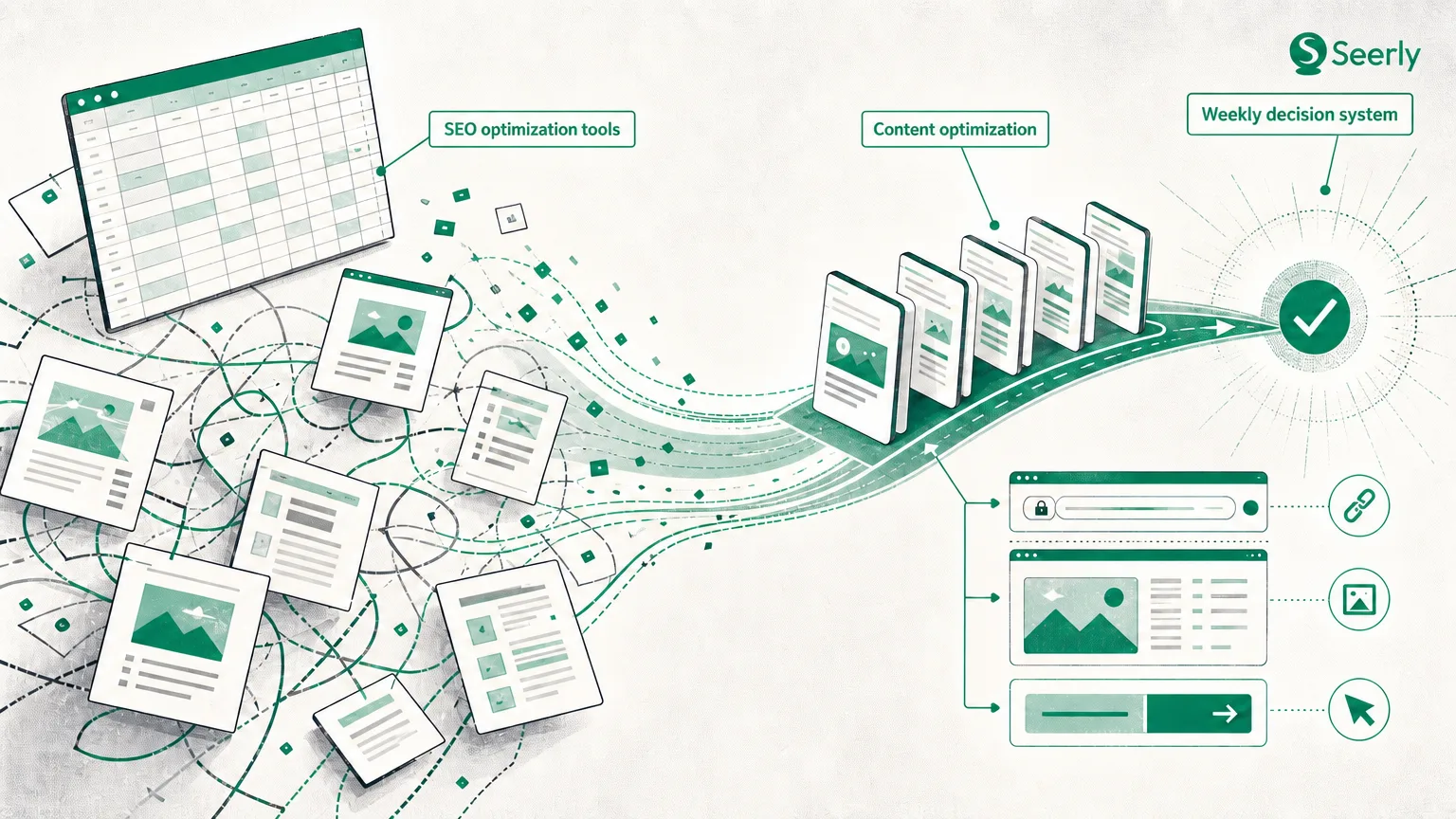
Think of the process as a recurring operating rhythm rather than a project. Every 90 days, you review which queries are surfacing your pages, identify pages that are aging or drifting from current intent, improve click appeal where impressions are present but clicks lag, reduce internal overlap, and decide which assets deserve deeper investment. This is how to enhance Google search systematically without rebuilding your whole program.
The sequence matters. Query review comes first because it shows whether your page is still aligned with what searchers mean now, not what they meant when the page was first published. Refreshes come next because many ranking declines are not failures of authority but failures of freshness, specificity, or proof. CTR checks then help you separate “not being seen” from “being seen but not chosen.” Cannibalization cleanup prevents your own pages from competing with each other. Finally, prioritization ensures that limited team time goes to pages with revenue value and broader discovery potential, including AI search discovery and citation readiness.
Step 1: Review query drift before you touch the page
Start in Search Console at the page level, not the sitewide level. Pull the top queries for pages that have meaningful impressions but flattening or declining clicks over the last 90 days compared with the prior period. You are looking for pages that still appear in Google, but no longer match the exact question, format, or decision stage implied by the query mix.
What query drift looks like
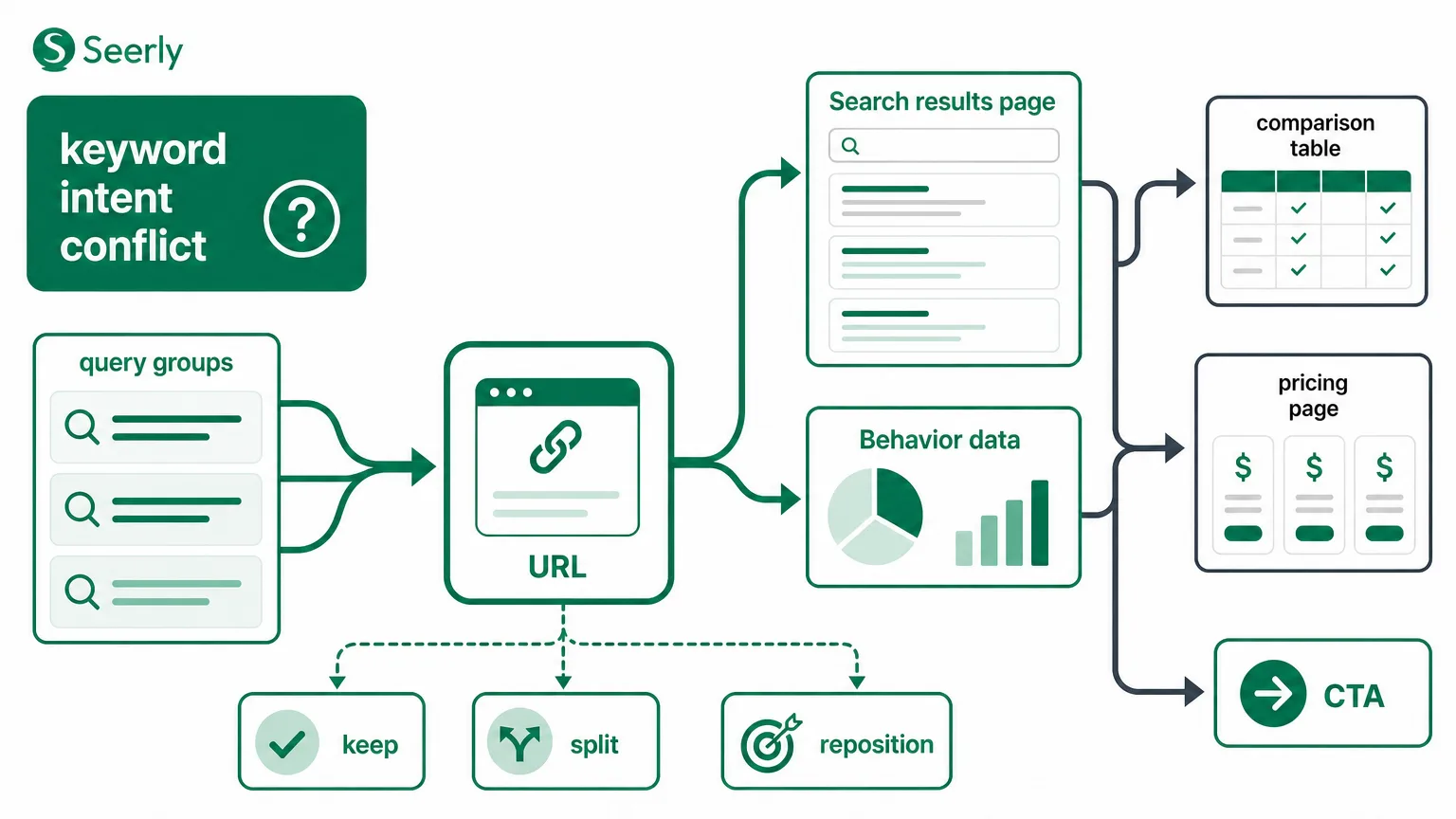
A page may have been built to rank for a broad educational term, but its current impressions may come from more comparison-oriented or implementation-oriented searches. That is a warning sign. If your “what is X” article now mostly surfaces for “X vs Y” or “best X tools,” the page may still rank, but it is misaligned with live demand. Google emphasizes returning results that are helpful and relevant to the query in context, supported by extensive ranking systems designed to interpret intent and usefulness.
A useful diagnostic is to ask three questions for each page. First, are the top queries still one coherent intent group? Second, does the page’s headline and structure answer that group directly? Third, do the SERP leaders now use a different format, such as comparisons, templates, steps, or updated examples? If the answer to any of those is no, the page does not necessarily need a rewrite, but it does need repositioning.
Step 2: Refresh stale pages with the highest-return edits first
Once you have identified pages with query drift or soft decay, refresh them in a fixed order. Do not begin by rewriting every paragraph. Begin with the elements most likely to improve relevance and trust signals quickly: examples, proof, definitions, comparison language, and outdated claims.
A stale-page refresh checklist
First, update examples so they reflect current workflows, products, or market conditions. Second, add newer supporting evidence or explain your methodology more clearly. Third, tighten definitions near the top of the page so users instantly understand scope. Fourth, add comparison framing if searchers are evaluating options rather than learning basics. Fifth, remove sections that pad word count but no longer help the page satisfy intent.
For a worked example, imagine a B2B software page originally written as “What Is Lead Scoring?” It still gets impressions, but many are now from “lead scoring models,” “manual vs predictive lead scoring,” and “lead scoring examples.” Instead of publishing three new thin articles, refresh the existing page by adding a section that compares scoring approaches, includes a current example model, and clarifies where manual methods break down. Research on information relevance and user evaluation has long shown that perceived usefulness and relevance shape content selection behavior, so sharper alignment often improves performance without net-new URLs.
This is one reason content maintenance often outperforms endless publishing. If you already have pages with history, links, and impressions, refreshing them can be a more efficient path to improving website ranking in Google than starting from zero every quarter. For a related maintenance mindset, Seerly’s guide to keeping pages discoverable when publishing slows fits well with this approach.
Step 3: Improve CTR when the page ranks but under-earns clicks
If a page has stable impressions and acceptable average position but weak CTR, the issue may be your search-result promise rather than the page itself. This is where many teams miss easy gains. Users do not click rankings in a vacuum; they compare alternatives, and title framing strongly influences selection. Experimental work on list scanning and item choice found that presentation and position affect how people evaluate options in a visual field, which maps closely to SERP behavior.
A before-and-after snippet example
Before: “Lead Scoring Guide for Modern Teams”
After: “Lead Scoring Models: Examples, Rules, and When Predictive Scoring Wins”
The first title is broad and generic. The second mirrors likely query language, clarifies format, and sets a stronger expectation. You can apply the same logic to meta descriptions and on-page introductory copy. If the SERP has shifted from basic education to evaluation, your snippet should signal that you understand the job the searcher is trying to do now.
Do not treat CTR work as cosmetic. Google runs rigorous testing to evaluate search quality changes, and while CTR is not a simple direct ranking lever, weak click appeal can still suppress the business impact of otherwise solid visibility. In practical terms, if your page is visible but not persuasive, it is underperforming.
Step 4: Clean up cannibalization before creating new pages
Cannibalization happens when two or more pages on your site target closely related queries without clear differentiation. The result is diluted authority, confused internal linking, and inconsistent rankings. Teams often respond by creating even more pages, which compounds the problem.
How to decide whether to merge, redirect, or reposition
Merge when two pages answer the same core question and neither has a strong reason to exist independently. Redirect the weaker URL if one page is clearly better and the other adds little unique value. Reposition when both pages are useful, but each should serve a distinct intent stage. For example, keep one page focused on “what is lead scoring” and another on “lead scoring software comparison,” but make the separation explicit in titles, headings, and internal links.
A useful rule is this: if your pages would compete for the same click from the same searcher in the same session, they are probably too close. This matters because only a share of searches generate outbound visits, with reporting indicating that about 23% of Google queries lead to the open web. When click opportunities are constrained, internal overlap becomes more expensive.
Step 5: Prioritize pages that can improve both search and AI visibility
Not every page deserves the same level of optimization. Your quarterly loop should end with prioritization. Choose pages where a lift in Google performance is likely to matter commercially and where stronger trust signals could also support reuse in AI-driven discovery systems.
The best candidates usually meet three conditions. They are tied to revenue or high-intent journeys, they already show some search traction, and they contain facts, frameworks, or original clarity worth citing. This is where search upkeep connects to AI-ready websites. Pages that are current, well-structured, specific, and evidence-backed are better positioned for broader visibility rankings beyond classic blue-link search.
A simple prioritization framework is to score pages on four axes: business value, existing impressions, intent clarity, and citation readiness. Citation readiness means the page includes original examples, unambiguous definitions, and trustworthy supporting details. If you want to connect this work to broader monitoring, Seerly has useful reads on moving from Search Console setup to search visibility and measuring trust signals as Google AI search changes.
FAQ
Should we refresh underperforming pages first?
Not always. Refresh pages that already have impressions and some evidence of demand before rescuing pages with no traction at all. A page that is visible but mismatched is often a better optimization bet than a page that never earned meaningful discovery.
How often should we rerun the loop?
Quarterly is a strong default because it is frequent enough to catch drift without turning maintenance into constant churn. A 90-day cadence also gives Google time to recrawl, reassess, and reflect changes while keeping your team focused on a manageable set of actions.
What if rankings improve but business impact does not?
That usually means the page is attracting the wrong audience, the intent is too early-stage, or the offer-path on the page is weak. In that case, do not just celebrate ranking movement. Recheck query quality, conversion pathways, and whether the page deserves deeper optimization at all.
Conclusion
To enhance Google search performance after you already have traffic, stop thinking in terms of one-time setup and start thinking in operating loops. The most effective quarterly review is simple: check query drift, refresh stale pages, improve snippets, reduce overlap, and prioritize the few pages that can drive both search gains and stronger AI search discovery.
A practical next step is to pick three revenue-relevant pages and run this 90-day loop on them. Track not only impressions, clicks, and CTR, but also whether those pages become more structured, trustworthy, and reusable across AI-driven search experiences. If you want a system for monitoring that broader visibility picture, explore Seerly.