How AI Search Optimization Helps SaaS Buyers Find the Right Product
SaaS teams are asking a new version of an old growth question: if buyers are increasingly starting with AI answers instead of ten blue links, can artificial intelligence search engine optimization produce real pipeline, or just more brand mentions that never convert?
That question is not theoretical anymore. Across founder communities, growth forums, and SEO discussions, there is visible tension between improving traditional rankings and actually getting discovered inside AI-generated answers. That tension mirrors a broader shift in search behavior. Marketers are already seeing cases where SEO rankings rise while traffic still falls, largely because answer surfaces absorb more of the discovery journey before a click ever happens. For SaaS brands, that changes what “being found” means.
This guide explains what artificial intelligence search engine optimization looks like in practice, which SaaS pages are most likely to surface in AI answers, how acquisition happens from those answers, why many teams fail to appear, and what to do in the next 30 days if you want measurable AI search visibility. The practical takeaway is simple: AI search optimization works best when you build retrieval-friendly pages around commercial questions, monitor which prompts produce mentions and AI citations, and improve source coverage instead of chasing vanity visibility.
Why SaaS teams are suddenly asking about AI search optimization
The sudden interest is not just hype around ChatGPT. It reflects a real change in buyer behavior: people now ask AI systems to shortlist software, compare tools, explain categories, and recommend products for specific workflows before they ever visit a website. In SaaS, that matters because the discovery step often shapes the entire buying journey. If an AI answer names three vendors and your brand is absent, you may never enter the consideration set.
That concern is backed by broader market data. Recent AI search and optimization roundups show that marketers increasingly view answer engines as a separate acquisition surface, with AI-assisted search behavior and optimization demand rising across industries. For SaaS teams, the commercial impact is especially direct because software evaluation is highly question-driven. Buyers rarely search only for a brand name; they ask things like “best CRM for seed-stage startups,” “alternatives to HubSpot for small sales teams,” or “project management software for agencies with approvals.”
Another reason the topic is accelerating is that answer engines compress top-of-funnel research. Instead of reading five vendor pages and three review sites, a buyer may prompt an AI model once, then click only one cited source if the answer appears credible. That means discovery is increasingly tied to whether your content is retrievable, attributable, and relevant to a narrow use case. In other words, the shift is not from SEO to no SEO. It is from rank-first optimization to answer-first optimization.
What artificial intelligence search engine optimization means in practice
Artificial intelligence search engine optimization is the practice of improving how a brand is discovered, interpreted, cited, and recommended across AI-powered search and answer systems. The terminology overlaps with answer engine optimization and generative engine optimization, which generally describe optimizing content for AI-generated responses rather than only conventional rankings. In practical SaaS terms, the job is not merely to rank a page. It is to help an AI system confidently use your page as evidence.
That distinction matters because answer engines do not behave like a traditional SERP. They synthesize information, compress multiple sources, and often privilege content that is easy to extract, compare, and attribute. Research into citation behavior suggests that clear structure, source specificity, and directly answerable content patterns influence which pages get cited. So if a SaaS page buries the actual answer under generic marketing copy, it may still rank somewhere in search while failing to surface in AI responses.
In practice, artificial intelligence search engine optimization has three core goals. First, improve discoverability: make sure your relevant pages can be found and understood by crawlers and retrieval systems. Second, increase citation-worthiness: publish content that answers a precise question with enough clarity and evidence to justify inclusion. Third, strengthen category relevance: help AI systems connect your brand to the commercial problem you solve, not just your homepage tagline.
For SaaS brands, this usually means shifting content strategy away from broad awareness pages and toward pages built around buyer tasks, category comparisons, implementation questions, switching scenarios, and objections. It also means accepting that visibility is prompt-dependent. Your brand may appear for “best help desk software for Shopify stores” and disappear for “customer support platform for ecommerce brands under 50 agents.” That is why prompt-level tracking and source analysis matter more than generic impressions in this environment.
The SaaS pages most likely to win AI-driven discovery
Not every page type has the same chance of surfacing in AI answers. In most SaaS categories, the winners are pages that help a model answer a commercial question quickly and credibly.
Comparison pages
Comparison pages work because buyers naturally ask AI systems to weigh options. A page like “Product A vs Product B for remote sales teams” gives a model structured material it can summarize. The strongest versions avoid vague feature grids and instead compare pricing model, onboarding speed, integrations, reporting depth, ideal team size, and known tradeoffs. Citation studies consistently point to the importance of specific, extractable passages in earning AI references.
Use-case pages
Use-case pages are often stronger than generic product pages because they match the way buyers phrase prompts. “CRM for solo consultants,” “knowledge base software for fintech support,” or “survey analysis tool for university research teams” gives an answer engine a tighter semantic target than “all-in-one customer platform.” When the page includes workflow detail, expected outcomes, and fit criteria, it becomes much easier for AI systems to map your solution to the question.
Category pages
Category pages help define what your product is and where it belongs. This matters because AI systems often need a concise category frame before they can recommend a tool. A good category page explains the software type, who it is for, key buying criteria, and how your product fits that category. If your site lacks this, the model may rely on third-party summaries instead. Teams looking to improve content patterns that get cited in AI answers often find category definitions are a major gap.
FAQ-led solution pages
FAQ-led pages perform well because they mirror the structure of AI retrieval. A well-built page can answer several adjacent commercial questions in one place: who the tool is for, what problem it solves, how long implementation takes, which alternatives buyers compare, and when it is not the right fit. These concise answer blocks create clean retrieval units without sacrificing depth.
Proof-heavy support and documentation content
This is the underrated asset class. Support docs, implementation guides, migration articles, integration explainers, and troubleshooting pages are often written in direct, factual language. That makes them highly usable for answer engines. Benchmarks and field analyses indicate that AI-crawled sites can generate materially higher downstream human traffic, which suggests that practical, machine-readable content can contribute to real visits, not just passive visibility.
How customer acquisition happens from AI answers
The acquisition path from AI search rarely looks identical to classic organic search, but it is still measurable. A simple funnel looks like this: a buyer asks a commercial question, the AI generates an answer, your brand appears in the recommendation set, the answer includes your page as a source or implied authority, the buyer clicks through or later searches your brand directly, and then the standard website conversion path begins.
Consider a B2B buyer asking, “What is the best expense management software for a 100-person remote company?” If the answer engine lists four vendors and briefly explains fit, the first win is inclusion. The second win is whether the answer cites a page that reinforces your positioning, such as a buyer guide or use-case page, instead of a generic homepage. The third win is post-click alignment: when the visitor lands, the page must continue the exact conversation the AI started.
This is where teams often misread performance. A rise in AI mentions alone is not enough. You need to measure assisted discovery signals: referral traffic from AI tools where available, branded search lift after AI visibility gains, increases in direct visits to cited pages, demo starts from high-intent content, and conversion rate by landing page type. Emerging benchmark work on generative optimization has found that visibility patterns differ sharply by query type and page format, which means attribution needs to be segmented by prompt cluster, not treated as one channel.
There is also an important behavioral nuance. Not all AI-driven acquisition is click-driven. Some buyers get a shortlist from an answer engine, then navigate directly to the vendor they remember most. That creates “dark influence” similar to podcast or community-driven demand. In those cases, one of the best indicators is prompt exposure paired with subsequent brand search growth or direct traffic from the same time period. If your team wants a more systematic framework for this, engineering AI search visibility beyond traditional dashboards is the right mindset: track visibility, sources, prompts, and outcomes together.
Common failure patterns that keep SaaS brands out of AI answers
The most common failure pattern is the generic homepage. Homepages are designed to introduce a company broadly, not answer narrow buying questions. They are usually full of positioning language like “the unified platform for modern teams,” which may be persuasive to a human after context is established but is weak evidence for an answer engine trying to determine best-fit vendors for a precise use case.
Thin feature pages fail for a similar reason. They describe functionality in isolation without connecting it to category, audience, or buying scenario. A page titled “Advanced Reporting” may explain a capability, but it does not answer whether the product is better for finance teams, agencies, ecommerce operators, or enterprise procurement groups. AI systems need contextual clues, not just feature labels.
Another failure pattern is non-specific educational content. Many SaaS blogs publish broad articles like “What is digital transformation?” or “Benefits of automation in business.” Those pieces may build topical breadth, but they rarely help with commercial AI search discovery because they do not map to decision-stage prompts. Worse, if they are long and diffuse, the model may not find a concise claim worth extracting. Research on AI citation behavior and hallucination risk has also highlighted inconsistency in source attribution and the appearance of ghost citations in some outputs. That makes specificity and source clarity even more important.
Finally, some brands fail because they optimize for mentions without optimizing for proof. If your site makes claims about implementation speed, ROI, accuracy, compliance, or customer outcomes, but does not support them with examples, data, or explicit context, an answer engine has little reason to trust that page over a review site, analyst page, or better-structured competitor asset. AI search visibility is not purely a formatting game. It is also an evidence game.
A 30-day execution plan for SaaS teams
A strong first month does not require rebuilding your whole site. It requires disciplined scope and better signal collection.
Week 1: Identify commercial prompt clusters
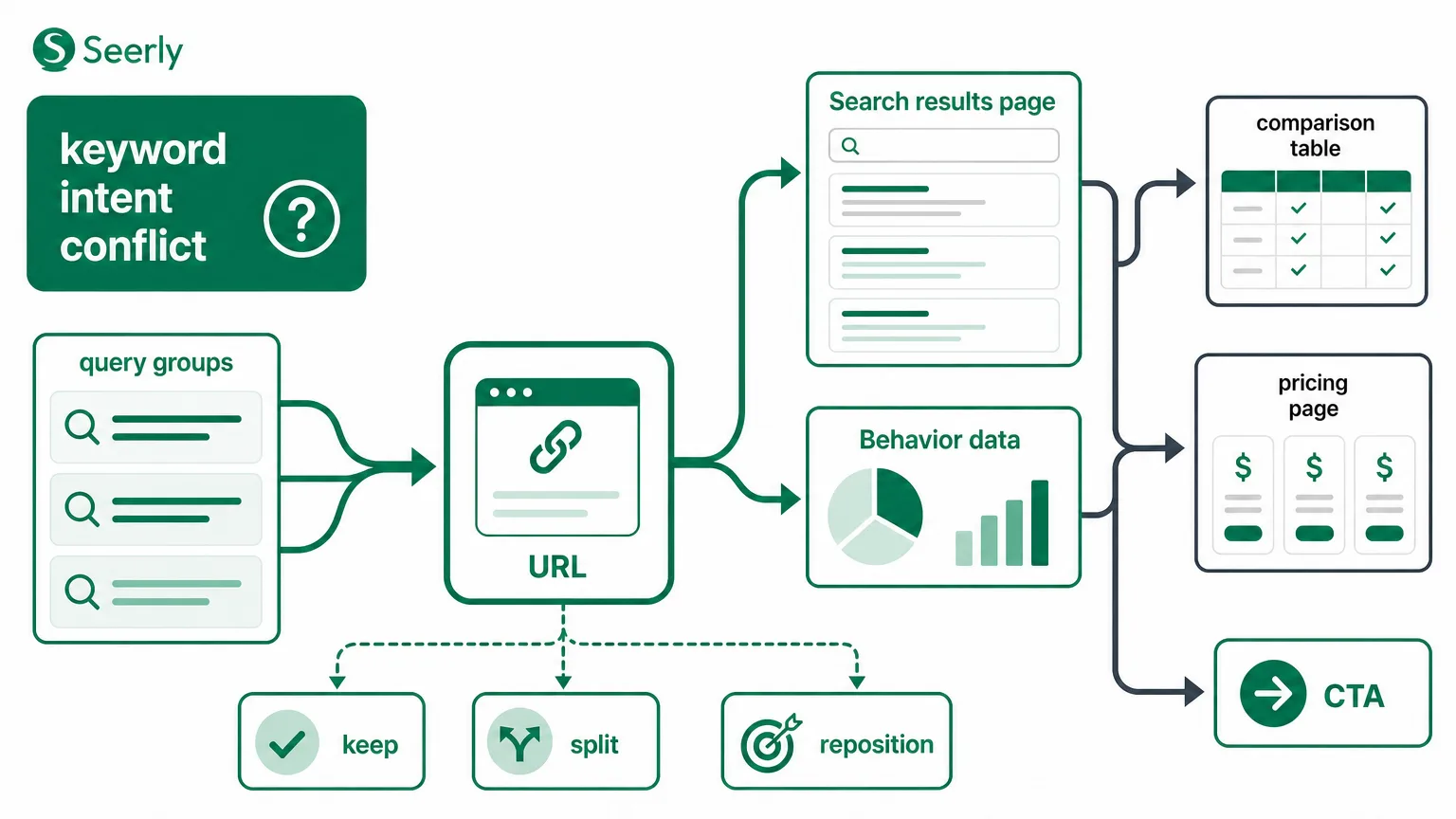
Start with the real questions buyers ask before demos: best tool for X, alternatives to Y, software for Z team, how to solve A workflow, and what to choose between B and C. Pull these from sales calls, search query data, support tickets, onboarding questions, Reddit threads, and review site language. Group them into clusters based on commercial intent and category similarity rather than surface wording alone.
Your goal is to find one cluster where your product has a legitimate right to win. For example, “best survey analysis tool for academic researchers” is better than “best AI software,” because it is commercially meaningful and narrow enough to support with evidence. Keep a baseline record of which prompts currently mention your brand, which competitors are cited, and which source pages appear repeatedly. This kind of LLM citation mechanics analysis reveals where source coverage is weak.
Week 2: Build one answer-first category or use-case page
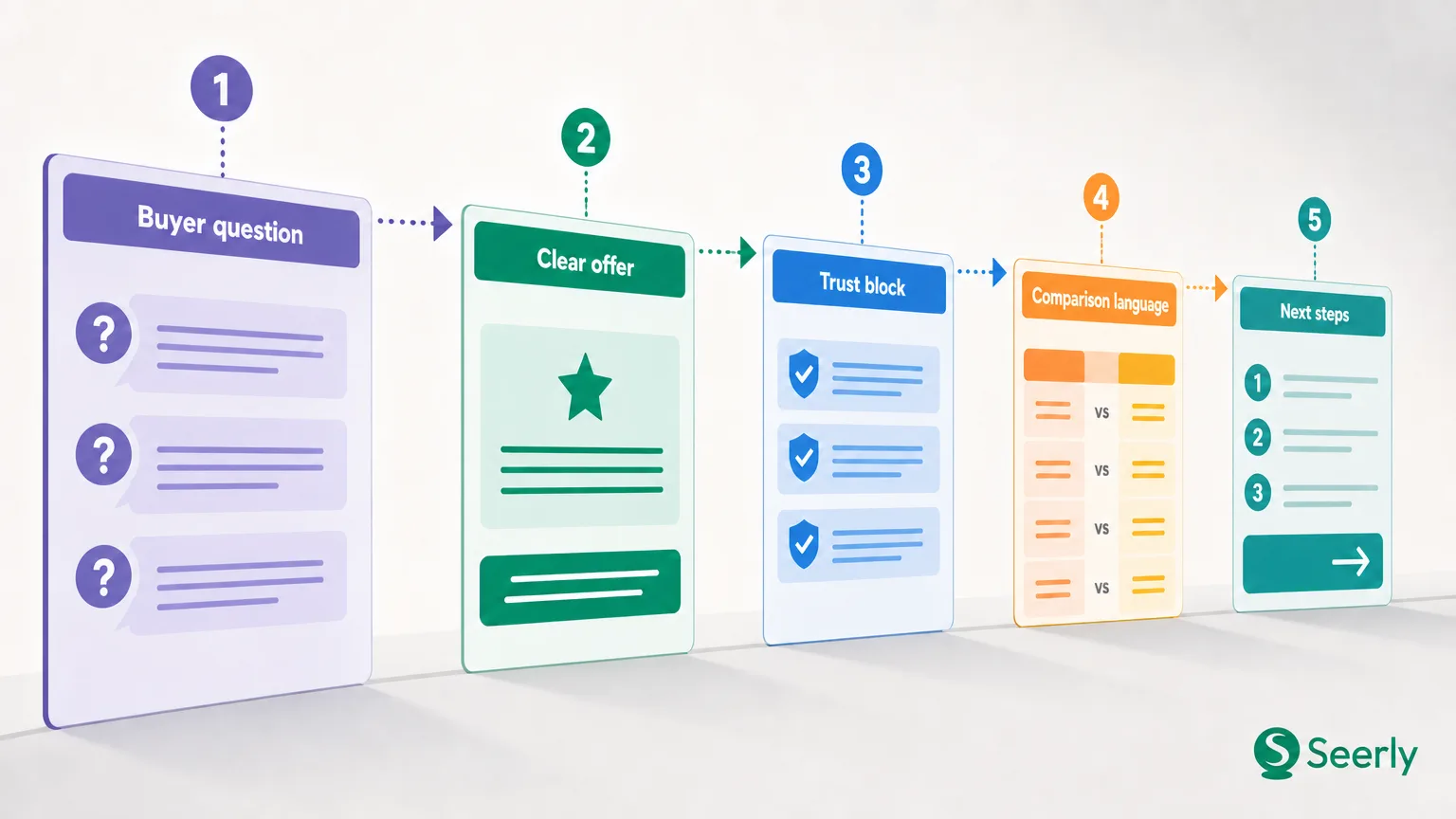
Create a dedicated page for the best prompt cluster you found. The page should open by directly answering the commercial question in plain language. Then define the category or use case, explain who the product is for, clarify when it is and is not the right fit, and support the answer with concrete decision criteria.
Structure matters here. Use descriptive headings, short answer blocks, comparison sections, implementation notes, and objection handling. Avoid burying the core answer under brand copy. Whitepaper and research-based GEO guidance increasingly emphasizes retrieval-friendly structure and concise semantic relevance signals, which aligns closely with what practical SaaS teams are seeing in the field.
Week 3: Add evidence and internal support
Strengthen the page with examples, customer patterns, migration notes, pricing context where appropriate, and links to supporting documentation. If you claim fast setup, explain what setup includes. If you position against a competitor, describe the tradeoff honestly. If you say the product fits a segment, name the operational conditions that make that true.
Then connect the page internally from relevant blog posts, docs, and solution pages. Internal linking helps both human navigation and machine understanding. A focused cluster of related pages sends a clearer category signal than one isolated asset.
Week 4: Monitor citations, mentions, and outcome signals
After publishing, track a fixed prompt set weekly across the main AI answer environments your buyers use. Look for three changes: whether your brand starts appearing, whether your new page becomes a cited or reflected source, and whether downstream traffic or branded demand shifts. Do not overreact to one result. AI systems can vary by time, model, interface, and source freshness.
Use the findings to iterate. If your brand is mentioned but not cited, the page may still lack evidence density. If competitors are cited for adjacent prompts, compare their page structure and specificity. If no one is cited clearly, your opportunity may be to produce the cleanest answer asset in the category. For tactical ideas, improving AI search visibility through content optimization patterns is a better play than trying to brute-force homepage authority.
The strategic shift SaaS teams should make now
The biggest mindset change is to stop treating AI visibility as a brand-awareness vanity metric. For SaaS companies, the real opportunity is not “being mentioned by ChatGPT.” It is becoming a reliable source for the commercial questions buyers ask before they compare vendors, request demos, or shortlist tools.
Artificial intelligence search engine optimization works when the asset matches a buyer prompt, the page gives a direct and evidence-backed answer, and the brand is contextually relevant to the category. That is why comparison pages, use-case pages, category pages, FAQ-led solution content, and proof-heavy docs outperform generic marketing copy. They are easier for answer engines to retrieve, summarize, and trust.
If you want a practical next step, pick one commercial AI-search question your buyers already ask. Build a dedicated answer-first page for it, publish supporting evidence, and track whether that page begins earning mentions or AI citations over the next crawl cycle. If you want a clearer system for monitoring those changes over time, explore Seerly to turn scattered visibility signals into more informed decisions.