Reddit Threads Are Becoming the Trust Layer in Search - How Brands Earn Mentions Without Spamming
Search visibility is no longer defined only by where a brand ranks on a results page. Buyers increasingly validate options through discussions where people describe what worked, what failed, and what they would choose again. For SaaS teams, that means a social mention is valuable not simply because a brand name appeared online, but because it appeared in a credible conversation at the moment someone was evaluating a solution.
The shift is especially visible in conversations about AI-shaped search itself. In one team-reviewed Reddit discussion about removing AI summaries from search results, the thread attracted 5.5K upvotes and 95 comments - a useful signal that searchers care deeply about how answers are selected, summarized, and trusted. When search interfaces provide direct answers, people often look for an additional layer of validation: independent discussion from practitioners, peers, and customers.
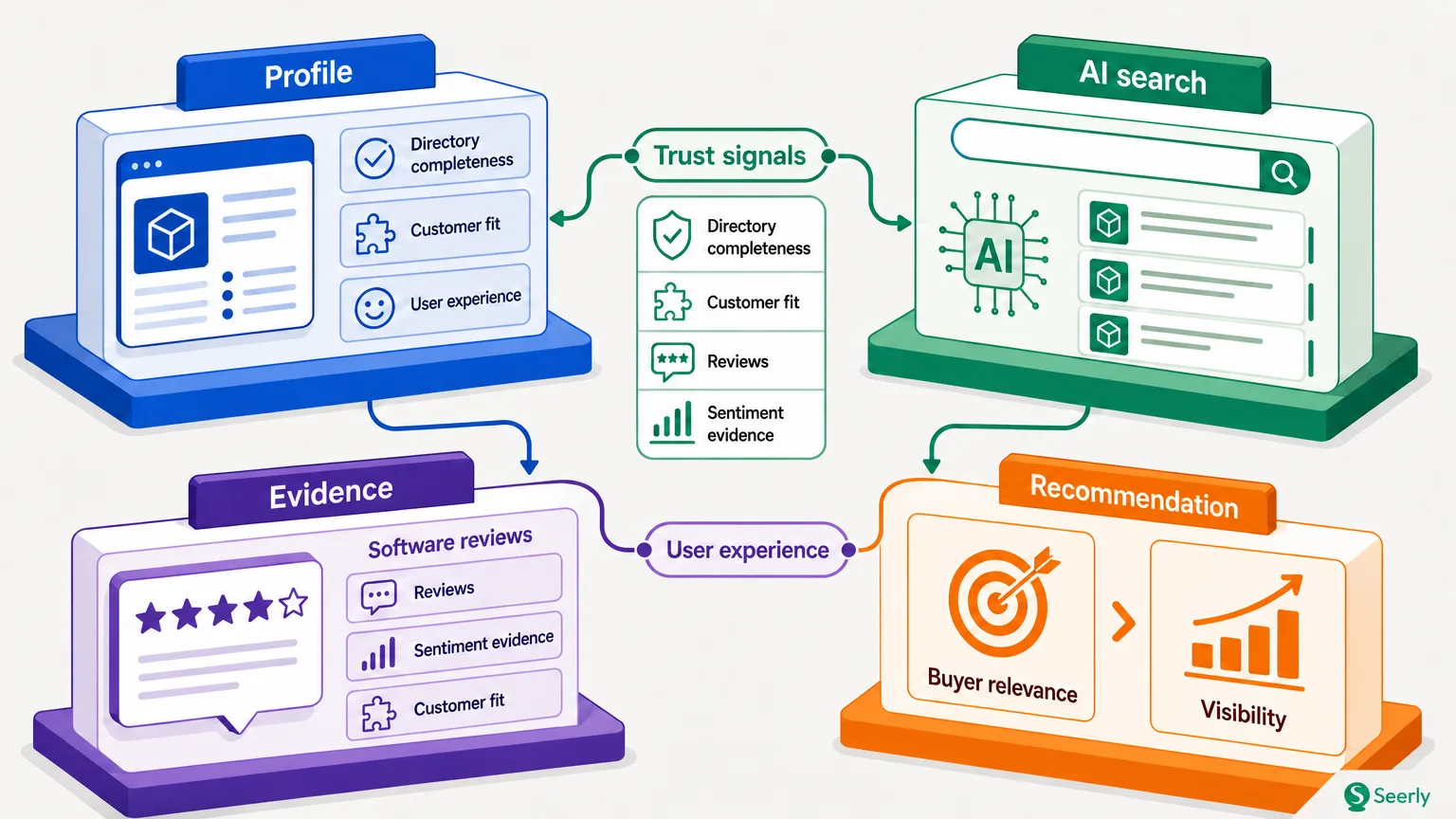
That trust layer matters for more than referrals. Community language can influence buyer perception, reveal the questions people bring to AI search, and provide the evidence a brand needs to build more useful AI-ready content. The objective is not to manufacture more mentions. It is to earn credible mentions in discussions that genuinely help buyers make decisions.
Why trusted discussions matter in AI search discovery
Classic SEO has trained marketers to focus on pages, positions, and clicks. Those remain important, but they do not fully explain how a buyer discovers and evaluates a SaaS product today. A buyer might start with an AI answer, search for “best tool for X,” scan product pages, and then add Reddit or a community name to the query to see what people say when they are not reading marketing copy.
Discussion-driven discovery changes the role of brand visibility. A thoughtful mention from an experienced user can reduce uncertainty more effectively than a generic claim on a landing page. Product comparison threads, implementation questions, and troubleshooting posts give prospective customers details that official websites often omit: migration effort, integration limitations, use-case fit, customer support quality, and the practical tradeoffs of adopting a tool.
This is why a social mention monitoring should be connected to broader search visibility rather than handled as a standalone social listening task. Research on social-search tools has long emphasized their value for identifying conversations and emerging trends, rather than merely collecting brand-name references. The ability to find and analyze trends in social conversations is useful because it shows what audiences are asking before those needs become obvious in keyword data.
For AI search discovery, the important question is: When someone asks a meaningful buying question, does your brand appear in the evidence buyers trust? That evidence can be a direct community recommendation, a detailed comparison, or a useful response that explains a problem clearly enough for readers to investigate your brand independently.
Mentions are trust signals, not a substitute for product quality
A mention cannot compensate for poor product-market fit, misleading claims, or weak customer experience. Communities tend to surface these gaps quickly, particularly in technical and operator-led spaces where participants can compare notes. Attempting to seed praise or disguise promotional activity usually creates the opposite outcome: skepticism, downvotes, moderation issues, and reputational risk.
Instead, treat community visibility as the result of sustained usefulness. A product that solves a real problem, explains its limitations honestly, and helps users succeed will be easier for customers and practitioners to mention naturally. Your marketing team’s job is to understand where that value is being discussed, contribute where it can add evidence, and turn recurring insights into stronger owned content.
Not all social mentions create the same discovery value
Mention volume is an incomplete metric. A thousand shallow posts may have little commercial relevance, while one well-positioned recommendation in a high-intent thread can shape a buyer’s shortlist. To monitor social media mentions effectively, teams need to classify context before they count totals.
| Mention type | Typical signal | Discovery value | Recommended response |
|---|---|---|---|
| Anonymous chatter | Brief brand-name reference, meme, repost, or unsupported opinion | Low | Monitor for patterns; do not overreact to isolated comments |
| Expert recommendation | Specific use case, constraints, implementation experience, or alternatives | High | Thank contributors when appropriate and capture the language used |
| Buyer problem thread | A user asks how to solve a pressing workflow, cost, or technical problem | High | Provide a useful, non-promotional answer with clear boundaries |
| Product comparison discussion | Buyers compare tools, pricing models, integrations, or outcomes | Very high | Correct factual inaccuracies and offer decision criteria, not a sales pitch |
Anonymous chatter can still matter when it indicates a sudden reputation issue or a recurring perception. But a name-only mention does not tell you whether the author is a customer, whether the audience trusts them, or whether readers have a purchase decision in mind. Treat raw volume as an alerting signal, not a measure of brand authority.
Expert recommendations are more valuable because they contain verifiable context. A practitioner who says, “We adopted this after outgrowing spreadsheets because it supported role-based workflows,” gives readers a reason to investigate. That same statement provides marketing teams with a useful positioning cue: the product may be credible for teams reaching a particular operational stage.
Buyer problem threads are especially important because the buyer’s need is explicit. They often begin with questions such as “How are you handling…?” or “What tool works for…?” These discussions should guide both participation and content strategy. Social media intelligence research similarly frames online conversation analysis as a way of measuring brand sentiment and extracting meaning from unstructured discussion, not simply recording exposure; see the work on measuring brand sentiment from online conversations.
Comparison discussions deserve the highest priority when resources are constrained. They attract readers who are close to a decision, surface the criteria that matter most, and reveal which competitors buyers consider interchangeable. A well-informed contribution can clarify fit without pretending that your product is ideal for every company.
A practical social mention quality score
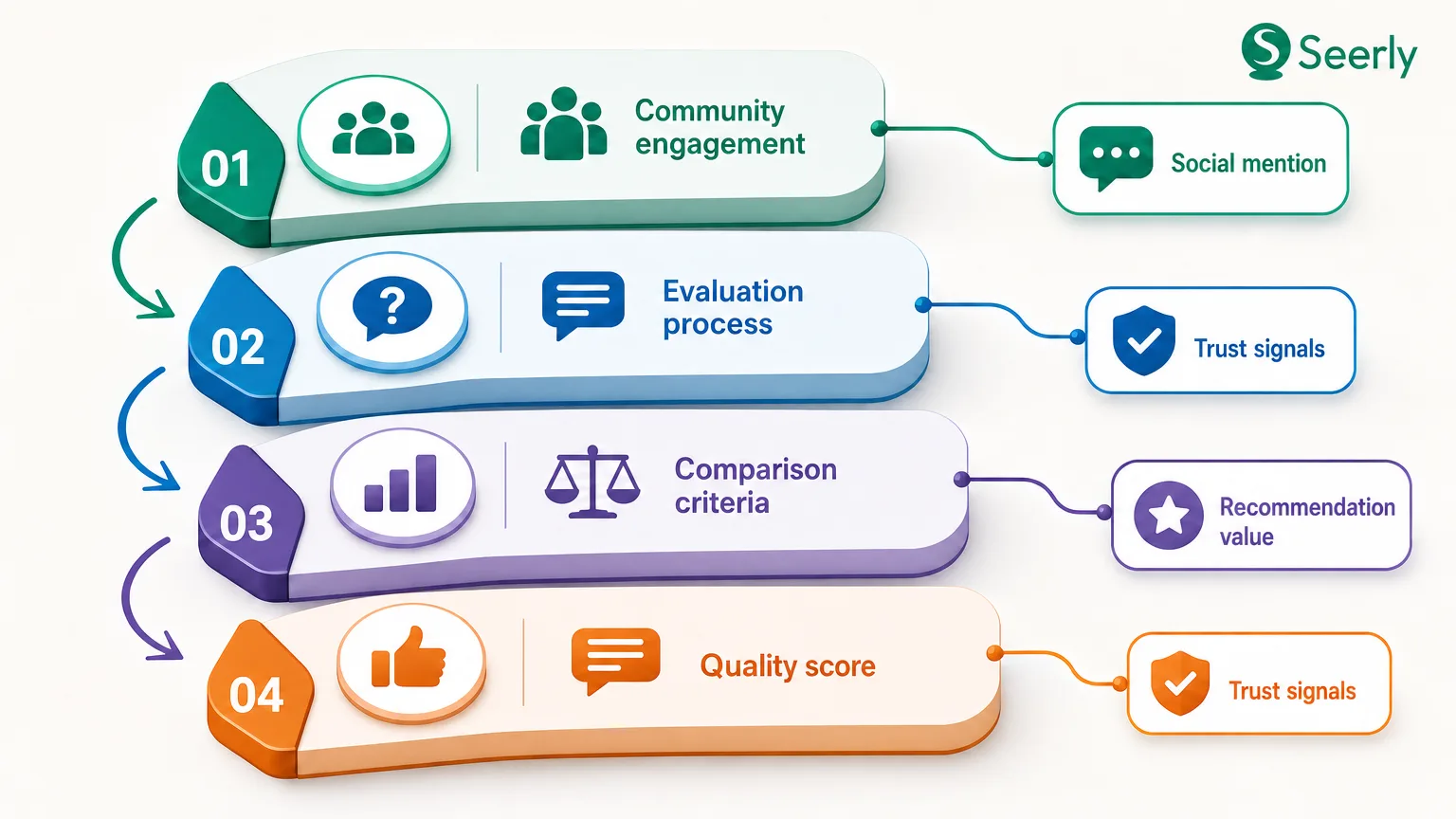
Create a simple score for each meaningful mention using five factors: intent, credibility, specificity, relevance, and reach. Intent asks whether the conversation concerns evaluation, implementation, or an active problem. Credibility assesses whether the contributor shows firsthand knowledge; specificity evaluates whether the post explains a real use case; relevance reflects fit with your target customer; and reach captures the likely number of qualified readers, not just total views.
Score each factor from one to five. A vague, anonymous endorsement might score low despite high engagement. A detailed recommendation from an experienced practitioner in a small specialist community may score much higher because it is likely to influence the right buyers.
A four-step framework for earning mentions without spamming
1. Identify high-intent communities, not just high-traffic ones
Start by listing the places where your ideal buyers seek advice before purchase or during implementation. For a SaaS brand, that may include relevant subreddits, professional communities, product-specific forums, developer groups, and specialist Slack or Discord spaces where participation is permitted. Do not select communities simply because they are large; prioritize places where members exchange detailed, decision-relevant information.
Review each community’s rules, tone, recurring post formats, and tolerance for company participation. Some welcome vendors who disclose their affiliation and provide expert answers. Others restrict self-promotion heavily. Respecting these norms is not merely a moderation precaution - it is how a brand demonstrates that it understands the community’s purpose.
Build a community map with columns for audience role, recurring topics, buying-stage indicators, existing brand perception, relevant competitors, and participation rules. This map should be a working asset shared among SEO, content, customer success, product marketing, and demand generation teams.
2. Map the recurring questions behind the mentions
Search for problem language before searching only for your company name. A brand may be absent from a discussion today, but the discussion can still reveal the exact need it is qualified to address. Look for phrases such as “alternative to,” “how do you manage,” “what is the best way to,” “anyone switched from,” and “what breaks at scale.”
Group posts by recurring question rather than by individual keyword. For example, “How do we prove content impact?” and “What should we measure for AI visibility?” may belong to the same underlying problem: teams need credible visibility reporting beyond traffic alone. That cluster can inform a community response, an FAQ, a product page, or a more complete editorial guide.
Language analysis is useful here because recurring terms reveal how real users frame their needs. Studies of social-media text analysis show the practical challenge - and value - of extracting sentiment and meaning from informal, unstructured language, including through sentiment analysis of social media text. Preserve the buyer’s phrasing rather than translating every question into internal product terminology.
3. Contribute evidence instead of promotion
The strongest community contribution is useful even if the reader never visits your website. Explain a method, identify tradeoffs, share a relevant benchmark with appropriate context, or offer a diagnostic question that helps the original poster choose between approaches. If your product is relevant, disclose your affiliation and mention it only after giving the reader a substantive answer.
Avoid comments that lead with a product link, repeat homepage messaging, or claim to be “the best” without evidence. A reader asking how to monitor brand visibility does not need “Try our platform!” as the first sentence. They need to know what to measure, which surfaces to prioritize, and why a particular workflow will produce better decisions.
A better pattern is: acknowledge the specific problem, provide a practical framework, state the conditions where your product may help, and invite follow-up only if it is genuinely useful. This approach earns credibility because it lets the buyer retain control of the evaluation process.
4. Turn support insights into useful replies and owned content
Customer support and success teams often possess the most relevant community knowledge in the business. They see where users get stuck, which integrations create friction, and which capabilities produce the most value after adoption. Create a process for routing recurring, non-confidential questions from those teams into a shared insight backlog.
When a community question overlaps with a known support pattern, write a response that explains the resolution in public-safe, product-neutral terms. Then use the same insight to improve documentation, publish a detailed guide, or add clarification to product messaging. This creates a productive loop: community conversations sharpen owned content, and stronger owned content gives teams better evidence to share in future discussions.
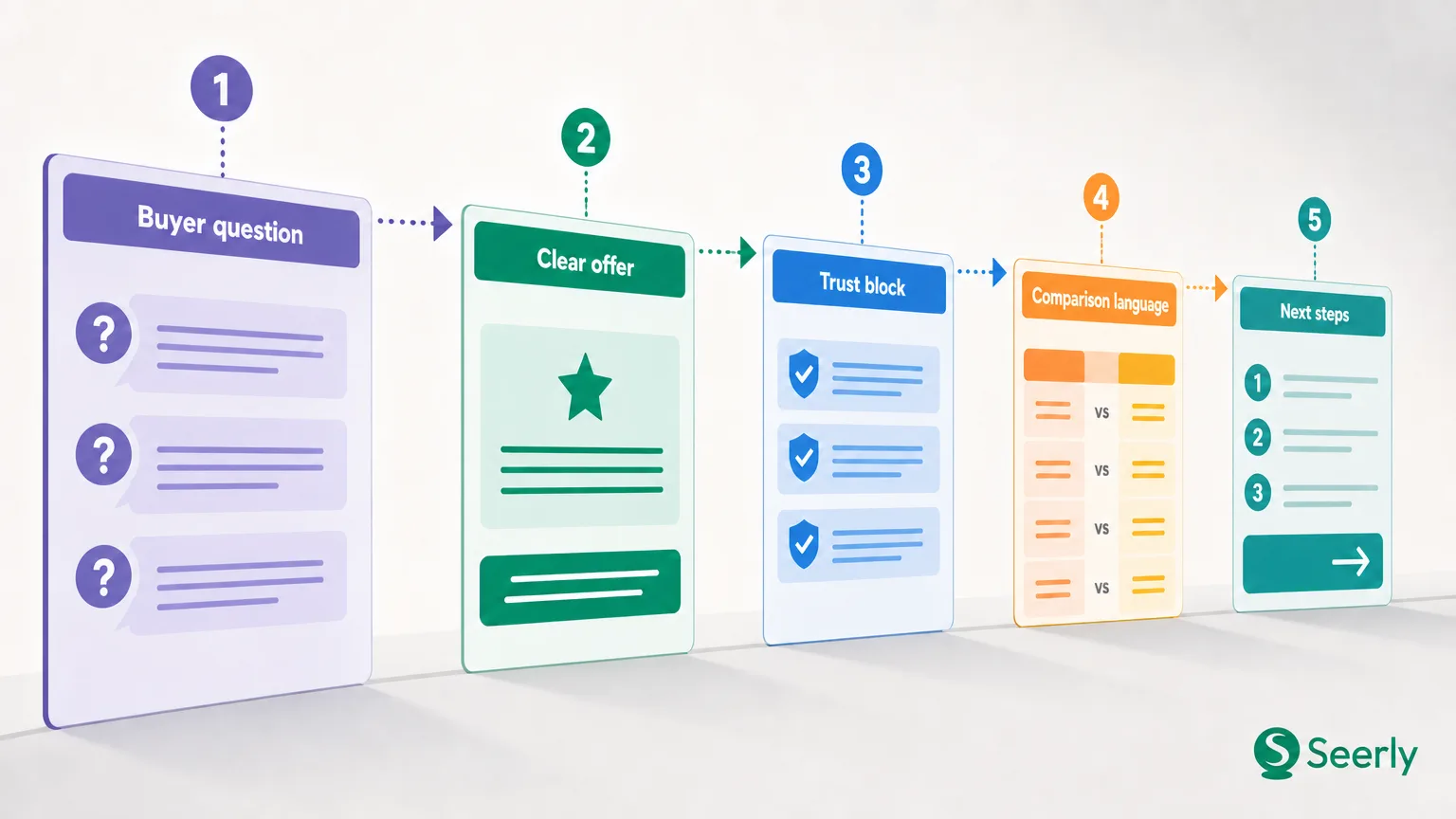
For SaaS marketers, this also supports AI search optimization that helps buyers find the right product. Clear explanations of product fit, implementation realities, and buyer questions make it easier for both people and AI systems to understand when your solution is relevant.
Three discussion patterns that create durable discovery value
Recommendation threads: solve the stated problem first
A recommendation thread may ask, “What are you using to measure brand visibility in AI answers?” The ignored response says: “Use BrandX - it is the best platform. Here’s our link.” It contributes no decision criteria, assumes every reader has the same requirements, and immediately reads as promotion.
A helpful response might explain that the buyer should compare prompt coverage, competitor context, source visibility, geographic variation, and the ability to connect findings to content actions. A disclosed brand representative could then say that their platform supports a subset of those needs and explain where it is best suited. This contribution is useful regardless of the buyer’s final choice.
Tool-comparison threads: make tradeoffs explicit
Comparison threads are valuable because they reveal the criteria the market uses to define category leadership. The wrong approach is to attack competitors, dismiss valid alternatives, or post a feature checklist without explaining why each capability matters. Buyers rarely trust a vendor that claims every product is inferior.
The useful approach is to distinguish between use cases. For example, one solution may be stronger for broad social monitoring, while another is designed to connect AI answer visibility, cited sources, and content opportunities. Give readers a decision framework: “Choose a general listening platform if your main need is campaign conversation volume; prioritize AI discovery monitoring if you need to understand where your brand appears in answers and why.”
Troubleshooting threads: offer a path to resolution
Troubleshooting posts often receive long-term search visibility because future users encounter the same issue. A poor reply says, “Contact support,” or offers a private message before providing any public value. That may solve a single ticket, but it does not help the community.
A stronger reply clarifies likely causes, provides safe diagnostic steps, and identifies when escalation is necessary. For instance, a SaaS team could explain how to validate an integration setting, check permissions, or isolate whether an issue is caused by configuration versus a platform limitation. Detailed, honest troubleshooting strengthens trust because it shows the brand is willing to be useful after the sale.
What to measure after you participate
Use this checklist monthly or quarterly to evaluate whether your social mention work is improving meaningful visibility rather than producing superficial activity.
-
Mention context: Record whether the mention appeared in discovery, evaluation, implementation, support, or reputation conversation. Context shows whether the brand is present at commercially important moments, not just whether people are talking.
-
Sentiment and rationale: Label sentiment as positive, neutral, mixed, or negative, then capture the reason behind it. A neutral comparison may be more strategically useful than a positive but vague compliment because it tells you exactly what buyers need to know.
-
Referral quality: Measure not only sessions, but engaged visits, conversions, demo quality, return visits, and assisted pipeline where attribution permits. Community traffic can be small and still be highly qualified.
-
Repeated community citations: Track whether independent contributors repeatedly recommend your brand for the same use case. Repetition from different people is a stronger trust signal than repeated promotion from a company account.
-
Language for owned content: Compare the wording in high-quality threads with your website copy, FAQs, and sales enablement materials. If communities repeatedly ask about a concern your site does not address, that gap is a content priority.
-
AI-search visibility correlation: Monitor whether the brands, sources, and language appearing in relevant community discussions also appear in AI answers for your target prompts. The goal is not to claim a simple one-to-one causal relationship, but to identify patterns worth validating through proactive monitoring and prompt testing.
A disciplined measurement model protects teams from optimizing for vanity metrics. It also gives content and SEO leaders a common view of reputation, buyer questions, and visibility rankings across the surfaces that matter.
FAQ
How does brand mention tracking differ from rank tracking?
Rank tracking measures where a page appears for a query in a defined search environment. Brand mention tracking measures where and how a company is discussed across conversations, sources, and answer surfaces. Both are useful, but mentions add context that rankings cannot provide: who is recommending the brand, what problem they associate it with, and whether the discussion supports or weakens buyer trust.
Why does Reddit matter if it does not produce a direct referral spike?
A Reddit thread can influence discovery without generating immediate tracked traffic. Buyers may read it, search for the brand later, ask a colleague, or use the language from the thread in a subsequent AI search. High-intent discussions also reveal what information buyers need before they are ready to click, making them valuable inputs for content strategy and brand reputation management.
How should a small team prioritize communities?
Choose three to five communities where your ideal buyers discuss high-value problems in detail. Prioritize relevance, recurring evaluation questions, contributor credibility, and participation rules over audience size. Start by listening, documenting patterns, and answering only when you can add material value; consistency in a few trusted communities is more effective than thin activity across dozens of channels.
Is it appropriate for employees to mention their own company?
Yes, provided they disclose their relationship and follow community rules. Employees should contribute expertise rather than impersonate customers or use anonymous accounts to promote the product. Transparency may reduce the short-term conversion rate of a comment, but it protects long-term trust - and trust is the scarce resource these conversations are built on.
Build a visibility plan around trusted evidence
The most valuable social mention is not the loudest one. It is the credible, specific reference that appears in a buyer’s real decision process and helps them understand whether your brand fits their needs. Teams that monitor this context can improve community participation, sharpen owned content, and build stronger trust signals for AI-era discovery.
Use Seerly to compare where your brand is visible across AI answers and search surfaces, then turn recurring community language into a repeatable visibility plan. That connects discussion visibility to the broader authority your AI-ready website and content need - without treating social conversations as a generic listening metric.