How to track brand discovery when buyers use ChatGPT like a search engine
A buyer who asks ChatGPT, “What is the best project management platform for a distributed product team?” is not following the familiar search journey. They may receive a short list of vendors, a comparison of tradeoffs, and linked sources without ever scanning a results page. If your brand is absent from that answer - or included but positioned as a weaker alternative - the discovery opportunity has already shifted to a competitor.
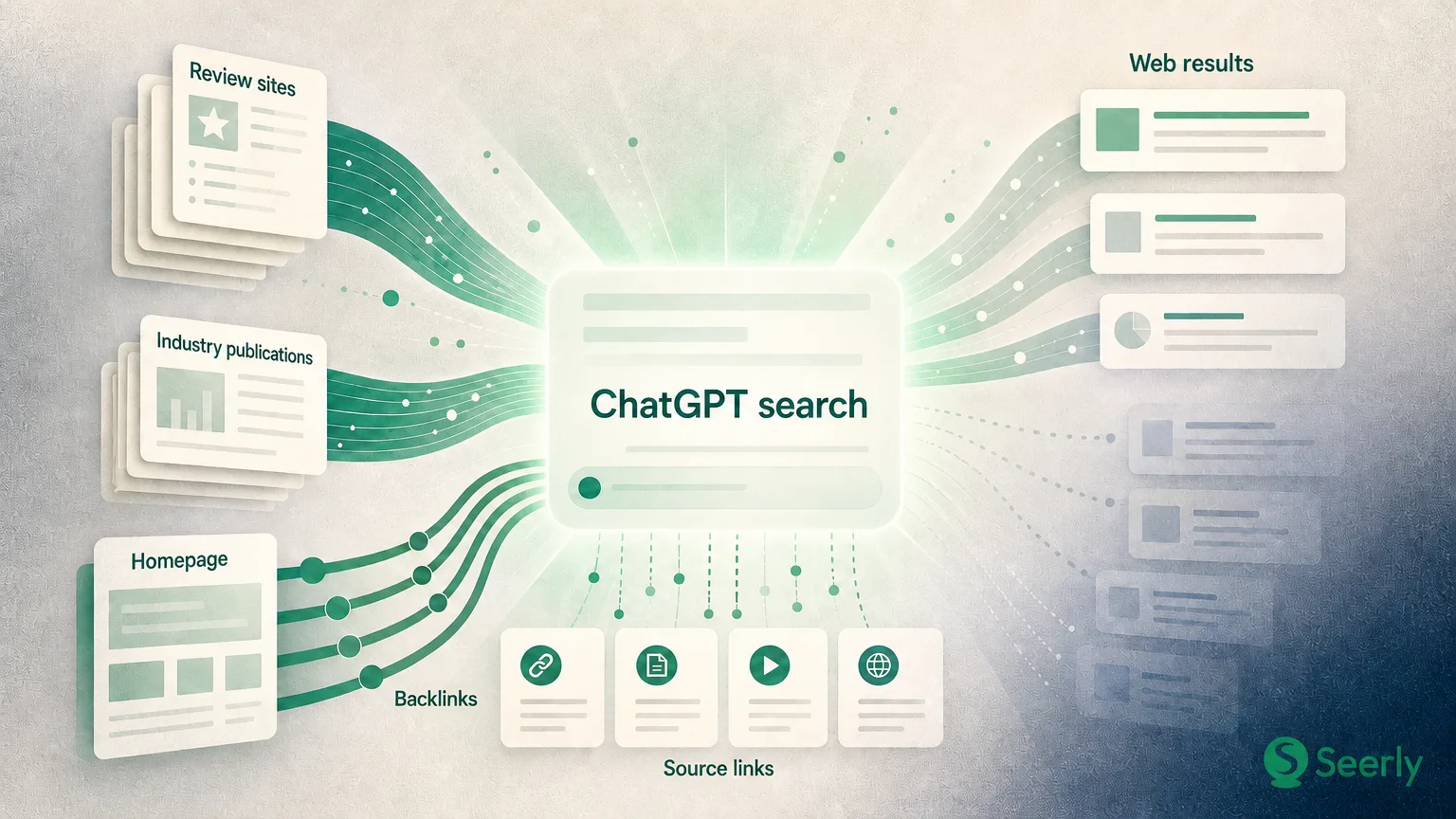
This behavior matters because ChatGPT search can combine conversational answers with web results and source links. OpenAI describes ChatGPT search as a way to get timely answers with links to relevant web sources, which creates a discovery layer that is related to traditional search but cannot be reduced to rankings or referral sessions.
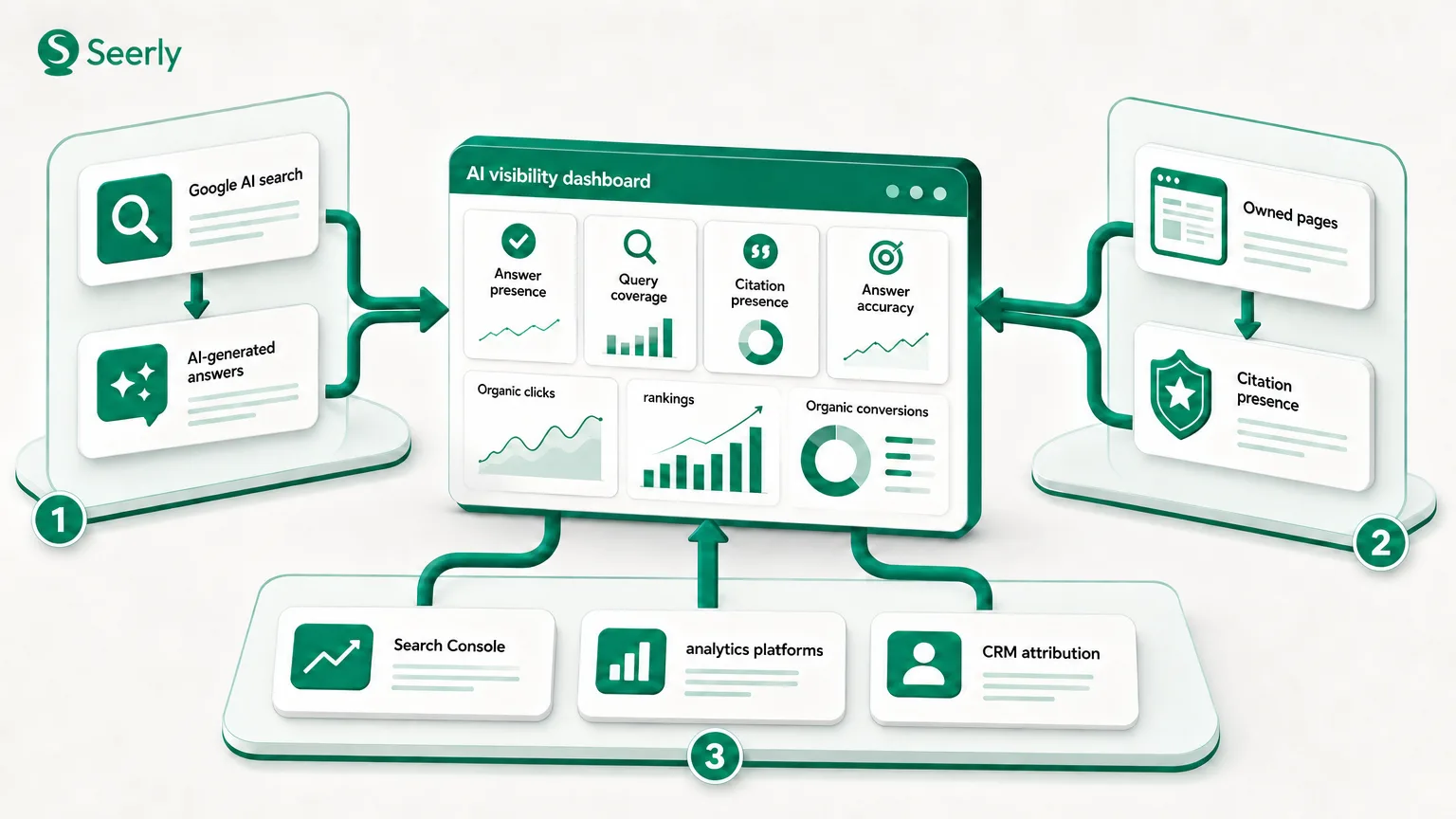
The direct answer is that brands need AI search visibility platforms that repeatedly test buyer-relevant queries, capture the resulting answers, record brand mentions and linked sources, and compare outcomes against competitors. Seerly is designed for this use case: proactive monitoring of brand discovery across AI search prompts, with attention to visibility rankings, trust signals, and source quality.
The goal is not to replace SEO reporting. It is to add a measurement system for the moment when an AI answer decides which brands are introduced, which are supported by evidence, and which are left out.
Why ChatGPT search requires a separate discovery model
Traditional organic search gives teams several stable units of measurement: keyword rank, impression, click-through rate, landing-page traffic, and conversions. A ChatGPT search interaction is different. The response is generated as a synthesized recommendation or explanation, so the buyer may encounter a brand as one item in a shortlist rather than as a destination link in a ranked index.
Consider a B2B software company that ranks well for “customer success platform.” A prospective buyer may instead ask ChatGPT, “Which customer success platforms work well for mid-market SaaS companies with a small operations team?” If the answer recommends three competitors, cites review sites and industry publications, and does not name the company, its conventional rankings have not protected it from losing early-stage consideration.
This is increasingly relevant because ChatGPT use has moved beyond experimentation. Pew Research Center reported that 34% of U.S. adults had used ChatGPT by 2025, roughly double the share reported in 2023. That figure does not mean every user is researching products, but it establishes why marketing teams should treat conversational discovery as a measurable channel rather than a fringe behavior.
The measurement challenge is also more nuanced than asking whether a site appears in search. An answer can mention a company without recommending it, recommend it without linking to its own site, or cite a third-party source that frames the brand inaccurately. Monitoring must therefore evaluate the answer itself, the sources behind it, and the alternatives that appear alongside the brand.
The four things a ChatGPT search platform must measure
A credible ChatGPT search monitoring platform should turn variable conversational outputs into a repeatable dataset. At a minimum, teams should measure prompt coverage, answer presence, citation source mix, and competitor share of voice. Together, these metrics show not only whether a brand appears, but how reliably it participates in the buyer’s research path.
Prompt coverage
Prompt coverage is the percentage of strategically selected queries that your monitoring program tests. It is the foundation of the entire model because a brand cannot claim visibility based on a handful of favorable prompts chosen after the fact.
Build coverage across three groups:
- Branded prompts: “What does [Brand] do?”, “[Brand] pricing,” and “[Brand] alternatives.”
- Category prompts: “Best workforce analytics software for enterprise HR” or “How should a SaaS team choose a customer data platform?”
- Competitor and substitution prompts: “[Competitor] alternatives,” “Compare [Competitor A] vs. [Competitor B],” and “What tools are similar to [Competitor]?”
The category group matters most for new demand because buyers often describe a problem before they know a vendor. Teams can make this prompt set more representative by using customer interviews, sales-call themes, internal site-search data, and AI buyer-question workflows that convert real research language into testable queries.
Answer presence
Answer presence tracks whether and how a brand appears in the response. “Mentioned” is too broad on its own. A useful platform should classify whether the brand is named in the main answer, included in a list, compared directly with rivals, excluded from a recommendation, or only surfaced in a passing caveat.
For example, an answer that says, “Vendor A and Vendor B are strong choices; Vendor C may suit teams with specialized reporting needs,” gives the three brands very different exposure. Vendor C technically has presence, but it has less prominence and a narrower positioning. Recording answer placement and language helps a team detect that distinction before treating raw mention counts as success.
Citation source mix
ChatGPT search answers can include linked sources, so teams need to know which domains support the answer and what they say about the brand. Source mix should show the share of cited sources coming from your owned site, earned media, review platforms, analyst or industry publications, community discussions, and competitor-controlled pages.
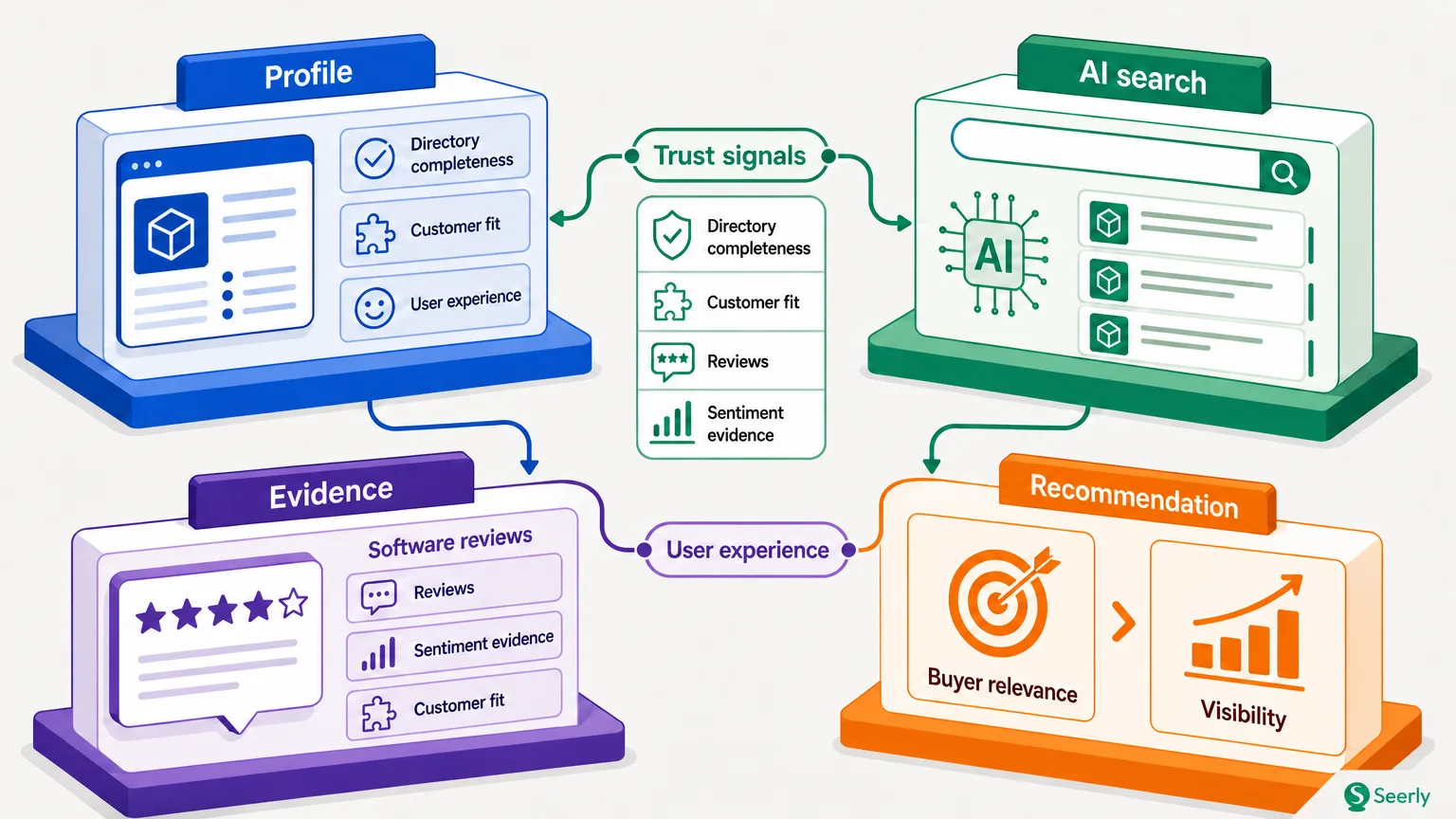
This matters because source quality shapes recommendation readiness. A brand supported by current, specific product documentation, credible independent coverage, and detailed customer proof has a stronger evidence base than one supported only by thin listicles or outdated directory pages. Brands should also assess whether their pages provide the original, useful information AI systems need before they reuse or recommend it, as explored in what ChatGPT search engines need from original content.
Competitor share of voice
Competitor share of voice measures how often each brand appears across the same prompt set. This reveals competitor substitution: the gap between the brands buyers might reasonably consider and the brands ChatGPT search actually introduces.
A simple calculation is:
Brand share of voice = prompts where the brand appears ÷ total monitored prompts
Use the same denominator for every competitor and segment the result by prompt type. A company may lead on branded prompts but have little presence on high-intent category questions. Conversely, a competitor may be rarely searched by name yet dominate “best tool for” and “alternatives to” answers - the prompts that shape consideration before buyers form a preference.
A before-and-after tracking example
Imagine “Northstar,” a hypothetical SaaS platform for product analytics. Its marketing team currently tracks Google rankings, organic sessions, demo conversions, and backlinks. Those indicators are useful, but they do not show whether ChatGPT search introduces Northstar when buyers ask for solutions.
Before: a traditional reporting view
For the branded query, “What is Northstar product analytics?”, the team sees that Northstar’s homepage ranks prominently in conventional search and receives branded traffic. It assumes brand awareness is strong because searchers who already know the name can easily reach the site.
For the non-brand query, “What are the best product analytics tools for B2B SaaS?”, the team sees a mix of category-page rankings and traffic to comparison content. It knows its page performs, but cannot tell whether ChatGPT search mentions Northstar, which competitors appear first, or what evidence supports the response.
This creates a blind spot. Conventional analytics captures visits after a user reaches the site, while conversational discovery may influence which brands the user knows to investigate in the first place. Research into web browsing and AI has similarly highlighted that AI’s online role must be understood through observed behavior, not only assumptions about search substitution; Pew’s analysis examines how AI appears in web browsing data.
After: a ChatGPT search visibility view
The team monitors both queries on a defined cadence. For the branded query, it records that Northstar appears in the answer, receives an accurate description, and is supported by links to its documentation and a respected third-party review. That is strong brand-defense performance, though it still requires checking whether pricing, capabilities, and limitations are represented accurately.
For the non-brand query, the monitoring report shows that Northstar is absent in 70% of tested responses. Two competitors appear consistently, often supported by review content and comparison pages. Northstar’s owned site is rarely among the linked sources, while a dated directory listing appears occasionally and describes an old positioning.
The next action is no longer vague “AI optimization.” The team can strengthen the category page, publish clearer evidence for the relevant B2B SaaS use case, improve third-party validation, and monitor whether source mix and answer presence change. It can also compare those outcomes with Google AI experiences, since changes in Google search that matter in the AI era may affect the same underlying questions differently.
Visibility is not the same as recommendation readiness
A mention is an exposure signal. Recommendation readiness is the likelihood that a brand can be presented as a credible, relevant option when the query calls for a decision. Treating those as identical encourages teams to celebrate weak visibility while missing the evidence gaps that shape buyer confidence.
A brand may be mentioned for several reasons that do not indicate trust: it has a well-known name, it appears in a broad list, it is framed as an alternative, or the answer identifies it as unsuitable for a particular need. In contrast, a recommendation-ready brand is associated with a clear use case, accurate differentiation, credible support, and sources that can substantiate the claim.
Use this interpretation guide when reviewing results:
| Signal | What it means | What to do next |
|---|---|---|
| Brand appears, but no source supports it | Awareness exists, but evidence is weak or inconsistent | Improve authoritative owned pages and independent coverage |
| Brand is cited, but the source is outdated | Visibility may depend on inaccurate positioning | Refresh core content and correct third-party information |
| Brand appears only on branded prompts | Existing awareness is protected, but category discovery is limited | Build content around buyer problems and use cases |
| Competitors dominate category prompts | Buyers are being introduced to substitutes first | Analyze competitors’ cited source patterns and content gaps |
| Brand is recommended with relevant sources | Strong discovery and trust signals | Preserve the evidence base and monitor changes over time |
Source quality deserves special attention. A link is not automatically a trust signal if it leads to outdated specifications, a low-substance profile, or a page that does not answer the buyer’s question. Teams should prioritize AI-ready websites that offer clear product details, original expertise, and evidence that aligns with the claims the market needs to verify.
How to choose a ChatGPT search tracking platform
Not every reporting product that mentions AI visibility can support strategic decision-making. Use this checklist to evaluate whether a platform can create an auditable, useful view of ChatGPT search discovery.
Check for prompt controls and verification
You should be able to define, group, and update prompts by market, audience, funnel stage, and competitor. The platform should also retain the full response and its supporting links so a marketer can verify why a brand was counted as present. A dashboard score without the underlying answer makes it difficult to challenge errors or interpret changes.
Check for competitor benchmarking
The platform should evaluate your brand and competitors against the same prompt set, rather than providing isolated mention totals. Look for the ability to compare answer presence, prominence, linked-source patterns, and changes by query cluster. This is essential for identifying where competitor substitution is happening and where a content investment can plausibly change the outcome.
Check for historical trends and exports
Conversational answers can vary, and individual results should not dictate strategy. Choose a platform that supports historical views, repeat testing, and data exports for internal reporting. Exportability lets SEO, content, product marketing, and revenue teams connect AI search visibility with campaign themes, sales feedback, and conventional search performance.
Check for source-level insight
A useful platform should show which sources recur across your priority prompts, not merely how often your brand is named. This view helps identify whether trusted third-party reviews, first-party content, or community discussions are shaping the category narrative. It also creates a practical input for reputation management: improve the pages and trust signals that influence how the brand is represented.
Frequently asked questions
How often should teams refresh ChatGPT search monitoring?
Weekly monitoring is appropriate for high-priority categories, active product launches, and competitive markets where messaging changes quickly. Monthly monitoring can work for a broader baseline program, especially when teams are tracking long-term shifts rather than reacting to every response variation. The important principle is consistency: use a documented schedule and compare like-for-like prompt sets over time.
How should we choose prompts for ChatGPT search tracking?
Start with the questions buyers ask before, during, and after they know your brand. Include branded terms for reputation monitoring, category terms for new-demand discovery, and competitor terms for substitution risk. Prioritize prompts that reflect actual sales conversations and content demand rather than relying only on short-tail keywords; buyer language is often more specific and decision-oriented in conversational search.
Can Google Search Console and web analytics measure conversational discovery on their own?
No. They remain essential for understanding search impressions, clicks, onsite behavior, and conversion performance, but they cannot reliably show whether ChatGPT search named your brand in an answer, how it positioned you, or which sources supported that positioning. Use them alongside dedicated AI search monitoring rather than expecting them to provide the complete discovery picture.
Do citations guarantee that a brand will be recommended?
No. Citations indicate that a source may have contributed evidence to an answer, but recommendation depends on query context, the available sources, product fit, and how the answer synthesizes information. The stronger objective is to earn accurate, relevant visibility supported by trustworthy sources across the buyer questions that matter most.
Build a measurable AI search discovery layer
ChatGPT search changes where brand consideration can begin. A buyer may receive a shortlist, comparison, or recommendation before visiting a search results page, so rankings and traffic alone cannot show whether your brand is participating in that decision.
Build a starter prompt set across branded, category, and competitor queries. Then use Seerly to monitor which queries produce brand mentions, which produce supporting citations, which sources shape the answer, and where competitors still replace your brand in the conversation. That creates a disciplined, data-driven foundation for improving AI search discovery and building trusted brand authority.