Which Google Search Changes Actually Matter for SEO in the AI Era?
Every week seems to bring a “major” announcement: a new AI feature, a layout test, an indexing rumor, an ad placement, a ranking fluctuation. In a busy marketing team, each headline lands like a fire alarm. Someone drops it into Slack. Someone else asks whether the content roadmap needs to change. Nobody has time to answer properly.
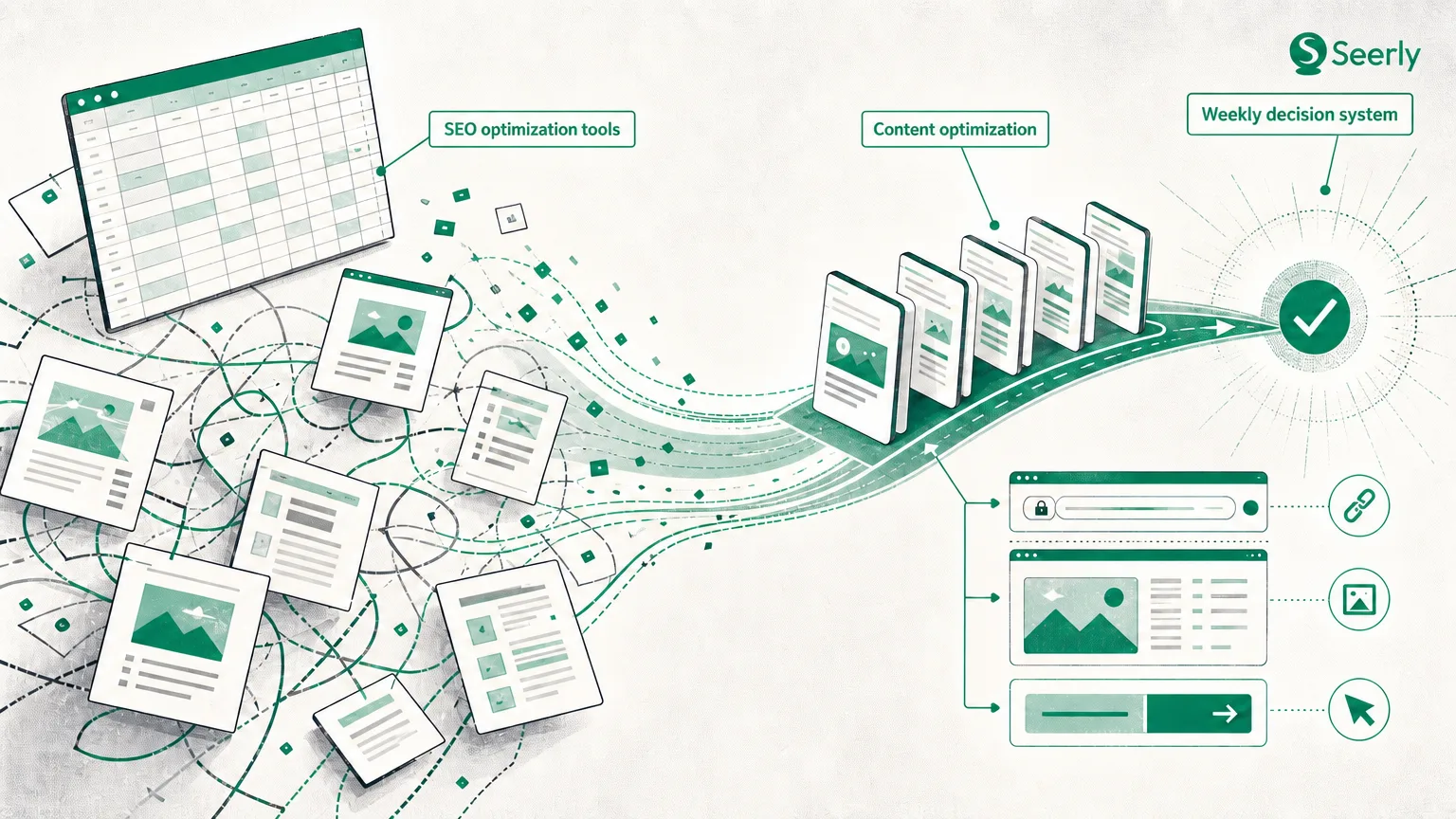
That pattern creates a strange problem. Teams often react fastest to the changes that are easiest to see, such as a fresh result-page design. Meanwhile, quieter shifts in how Google retrieves, extracts, or attributes information can alter organic exposure without much fanfare. The visible change gets the meeting. The consequential one gets missed.
Google changes matter for SEO when they alter one of three things: which sources can enter an answer, how clearly a page can be interpreted, or how performance must be measured. Everything else starts with a lower priority until evidence says otherwise.
That isn’t an argument for ignoring search news. It’s an argument for treating it like an operating input, not a breaking-news feed. The goal is a calmer process: classify the change, test its likely reach, then decide whether a rewrite, a measurement change, or no action at all makes sense.
Change-impact definition: A Google update deserves immediate attention when it affects retrieval, source selection, content extraction, or the way search exposure appears in reporting.
Why most Google changes create more noise than direction
Search teams have a bias toward surface-level movement because surface-level movement is easy to screenshot. A new AI Overview treatment, a different label, or a shifted module can feel like proof that the ground moved. Sometimes it did. Other times, Google changed the wrapper while the source-selection behavior stayed close to what it was.
The harder work begins after the headline. Ask what has actually changed underneath it. Did Google alter the kinds of pages it retrieves? Did the answer layer begin drawing more frequently from product pages, discussion threads, or publisher content? Did a new result type reduce the number of clicks available for a query set? Those questions lead to decisions. “Did the SERP look different this morning?” usually doesn’t.
I’ve seen teams burn a week rewriting high-performing pages after a visual update, only to find no material shift in impressions, referrals, or brand mentions. That time would have been better spent checking page-level exposure and query patterns. Not glamorous. Still useful.
Search behavior is also changing in ways that make click-only reporting incomplete. Pew Research Center found that users clicked a traditional result on 8% of visits with an AI summary, compared with 15% of visits without one in its March 2025 browsing analysis. The gap in link-click behavior when AI summaries appeared is not a reason to panic. It is a reason to separate ranking data from answer-surface exposure.
A filter for deciding which Google changes deserve action
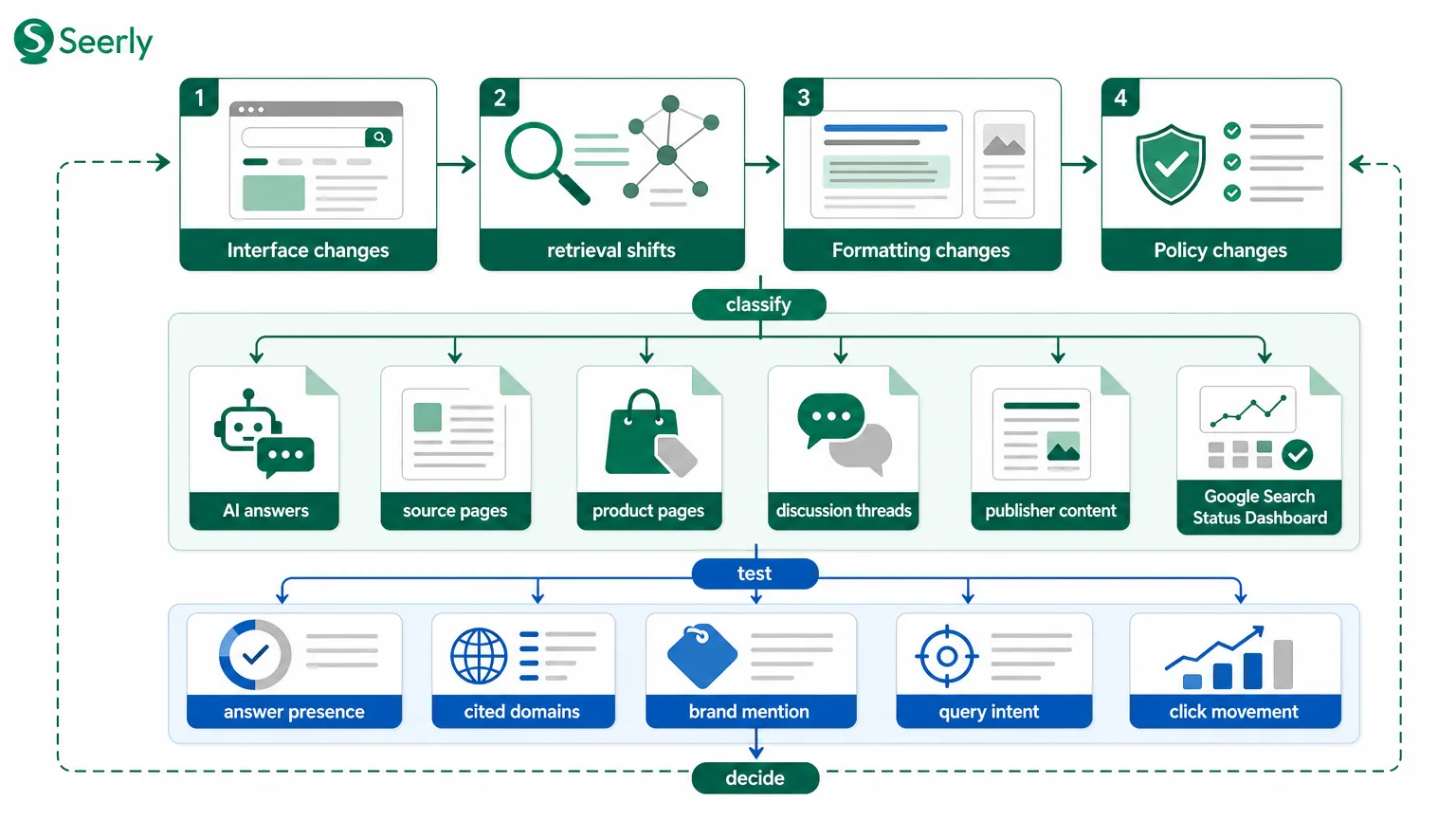
Before assigning work, place the announcement into one of four buckets. The categories sound simple, but they stop a lot of expensive overreaction.
Interface changes
Interface changes alter what people see: labels, layouts, expandable modules, desktop-versus-mobile placement, or an updated presentation for AI answers. They may affect click-through rate, but they do not automatically mean your content became less eligible to appear.
Treat these as a measurement question first. Segment the affected query group, compare click-through rate against prior periods, and look for changes in impression volume or average position. A design update with flat exposure data does not call for a full content rewrite.
Retrieval and citation shifts
Retrieval shifts deserve faster scrutiny. They involve changes in the types of sources Google uses, how often answer surfaces include linked sources, or which content formats appear in response to commercial and informational questions.
A move from broad articles toward tightly scoped source pages can change the work queue quickly. So can a visible increase in citations to third-party review sites or forums in a category where your owned content used to lead. Watch the answers themselves, not only rankings. Who gets named? Which page types recur? What statements on those pages are easy to quote?
Google’s documentation on core updates makes a useful distinction here: broad core updates call for assessing content quality across the site, not chasing a single technical fix. That advice also applies to answer sourcing. Start with patterns, not panic edits.
Formatting and extraction changes
Extraction changes affect how easily Google can pull a direct answer, a comparison point, a price, a definition, or a supporting claim from your page. These changes can be subtle. A page may still rank, yet lose its usefulness as a source because its answer sits under vague headings, behind a script-dependent interface, or inside a dense paragraph stuffed with caveats.
Look for pages where the first useful answer appears halfway down the screen. Tighten the heading, state the answer early, and place qualification immediately after it. Clear source material is not simplistic source material. It just saves the system from guessing.
Policy and ad-layer changes
Policy updates and ad-layer adjustments matter, especially in regulated or paid-heavy categories. But they rarely justify an immediate rewrite of every organic page. Their first impact may land in ad approval, disclosure rules, shopping modules, or the amount of unpaid space left above the fold.
Check revenue exposure before changing editorial priorities. A new ad treatment on a handful of high-value queries may matter more than a broad cosmetic update across low-intent research searches. Context wins.
Google changes that should trigger work this week
A retrieval shift is the clearest example. Say your team tracks 100 buyer questions and notices that Google’s AI answers now cite vendor documentation and original research more often than generic explainers. Your old articles might still pull impressions, yet the pages lack short definitions, sourceable claims, and named product details.
Start with the 20 questions closest to pipeline or revenue. Add a direct answer near the top of each page, use plain descriptive H2s, and make comparisons easy to parse. Then check whether external evidence, product specifics, and first-party experience appear near the claim they support. Don’t tear down a page that still works. Fix the parts that make extraction finicky.
A reporting change also deserves quick action. If AI answers show up across a growing share of branded and high-intent searches, rank tracking alone can paint a rosy but incomplete picture. Add fields for answer presence, cited domains, brand mention, query intent, and estimated click movement. Google AI search reporting for founders covers why those measures should sit beside traditional rankings, not replace them.
Verification workflows need attention when Google reports an incident, a serving problem, or a confirmed ranking-system update. Before declaring an algorithm hit, compare your data against the Google Search Status Dashboard. A crawl, indexing, or serving issue can look painfully similar to a content problem during the first few days.
The thing is, the fastest useful response is often a verification task, not an editorial task. Check the query sample. Check the pages. Check whether the shift appears outside your own domain. Then assign the right work.
Headlines that can wait until the next review
A redesigned AI answer icon can wait. So can an isolated social post about a ranking wobble, a single screenshot of a strange result, or a vague claim that “Google is favoring X now.” Those items may become relevant later. On their own, they aren’t evidence of a change in sourcing behavior.
Feature announcements also deserve a slower read when they apply to a limited region, a small test group, or a query type outside your customer journey. Google frequently tests presentations and interaction patterns. A feature can look enormous in industry conversation while touching none of the queries that support your business.
I’m not 100% sure why teams find restraint so difficult here. Maybe a dramatic update feels easier to act on than a quiet audit. Still, an immediate rewrite carries risk: you can remove language that already earns traffic, change internal links, and create a misleading before-and-after comparison.
Use a “wait” label when there is no change in your tracked query set, no shift in source composition, and no reporting gap. Put the item on a watchlist with a review date. That is not inaction. It is controlled attention.
A monthly review model that keeps the team sane
A monthly review works better than a permanent emergency room. Bring one owner from search, one from content, and one person who understands reporting or revenue attribution. Keep the meeting short, but force every claimed change through the same sequence.
-
Log the change and its source. Record the date, market, device context, query types affected, and whether Google confirmed it. Screenshots are useful, though they are not proof of broad reach.
-
Score business exposure. Estimate how many tracked queries sit in the affected area, then weight them by commercial value. A shift on five high-intent queries deserves more attention than a new module across hundreds of trivia searches.
-
Inspect answer sourcing. Sample live results and record the domains, page types, and source formats that recur. You are looking for a pattern in extraction, not a single favorable or unfavorable result.
-
Choose one response. The options are simple: revise content structure, adjust reporting, verify technical health, or monitor. One owner and a due date stop the “someone should look into it” problem.
-
Review the result after two to four weeks. Compare the chosen query group against a stable control set where possible. If citations, mentions, clicks, or conversions did not change, write that down. Negative findings save future effort.
At Seerly, we use that kind of review to connect search change chatter with observed AI search discovery. The record matters. Six months later, your team should know which announcements changed page work and which were just loud.
For a broader maintenance rhythm, pair the review with a 90-day Google Search performance loop. Monthly triage catches short-term shifts; the longer cycle catches slow decay in pages that once answered buyer questions cleanly.
Frequently asked questions
How quickly should a team respond to Google changes?
Respond within a day when Google confirms a serving issue, an indexing problem, or a change that touches high-value queries. Start with verification and a small sample of live results. For unconfirmed chatter, log it and review it at the next scheduled checkpoint.
Who should own update triage?
One search lead should own the decision log and pull in content, analytics, or paid-media colleagues when the evidence points there. Shared ownership sounds friendly but often creates delay. Give one person the call on whether an item needs action or monitoring.
Does every Google change require a content refresh?
No. Refresh content when the change affects what Google extracts, which page formats get cited, or the accuracy of your answer blocks. Keep stable pages stable when their search exposure and business outcomes have not moved.
Build the checklist before the next headline hits
The strongest teams don’t predict every Google move. They build a way to tell a real shift from a noisy one. Start with four questions: Did source selection change? Can Google still extract a clear answer from our pages? Did reporting become less representative of exposure? Is there enough business impact to act now?
Put those questions into a shared checklist. Then use Seerly to test whether a headline changed citations, visibility rankings, and brand reputation, or merely created another busy afternoon.
Learn more at seerly.app.