What AI search sees when your software listings have no reviews
A software brand can be visible in search and still be poorly equipped for recommendation-style AI answers. Your product may have a directory profile, a category page, a short description, and a website that explains what it does. But if the third-party listing shows zero reviews - or only a handful with little detail - there is far less independent evidence to support claims about outcomes, usability, support, or customer fit.
That distinction matters more as Google AI search changes how buyers discover software. When an AI-generated answer appears, users are less likely to click through to traditional search results. Brands therefore need to compete not only for a blue-link visit, but also for credible inclusion in the evidence behind a concise recommendation or comparison.
For SaaS marketers and founders, the issue is not that missing reviews make a brand invisible everywhere. The more immediate commercial risk is being present but unproven: named as an option, yet lacking enough third-party proof for an AI system to confidently characterize, compare, or recommend it.
The evidence gap behind empty review profiles
Review availability is often treated as a reputation-management detail. In Google AI search, it is better understood as an evidence-quality problem. A directory profile with no customer feedback tells a prospective buyer - and the broader web ecosystem - very little about whether a product delivers value in real operating conditions.
Sentiment evidence: In a cross-platform assessment of references across Google AI Overview, OpenAI, and Perplexity, empty or thin review listings represented Seerly’s weakest negative aspect, accounting for 81.8% of negative coverage. The repeated concern was not product availability; it was the absence of verifiable customer proof.
That pattern is strategically important because review gaps tend to affect the exact questions that create demand: “What is the best platform for a small marketing team?” “Which alternative is easier to implement?” “What software has strong support?” A product page can make these claims, but independent confirmation gives them more weight.
Google itself describes AI Mode as a search experience designed for complex questions and follow-up exploration, using techniques that can issue multiple related searches to assemble a useful answer. As AI Mode expands the range of questions people can ask in Search, software brands need evidence that holds up across more than one webpage or one branded statement. Thin listings reduce that evidence layer.
The practical conclusion is straightforward: an empty profile is not neutral. It leaves a gap where buyer experience, implementation context, and proof of value should be.
How AI systems assemble trust for software recommendations
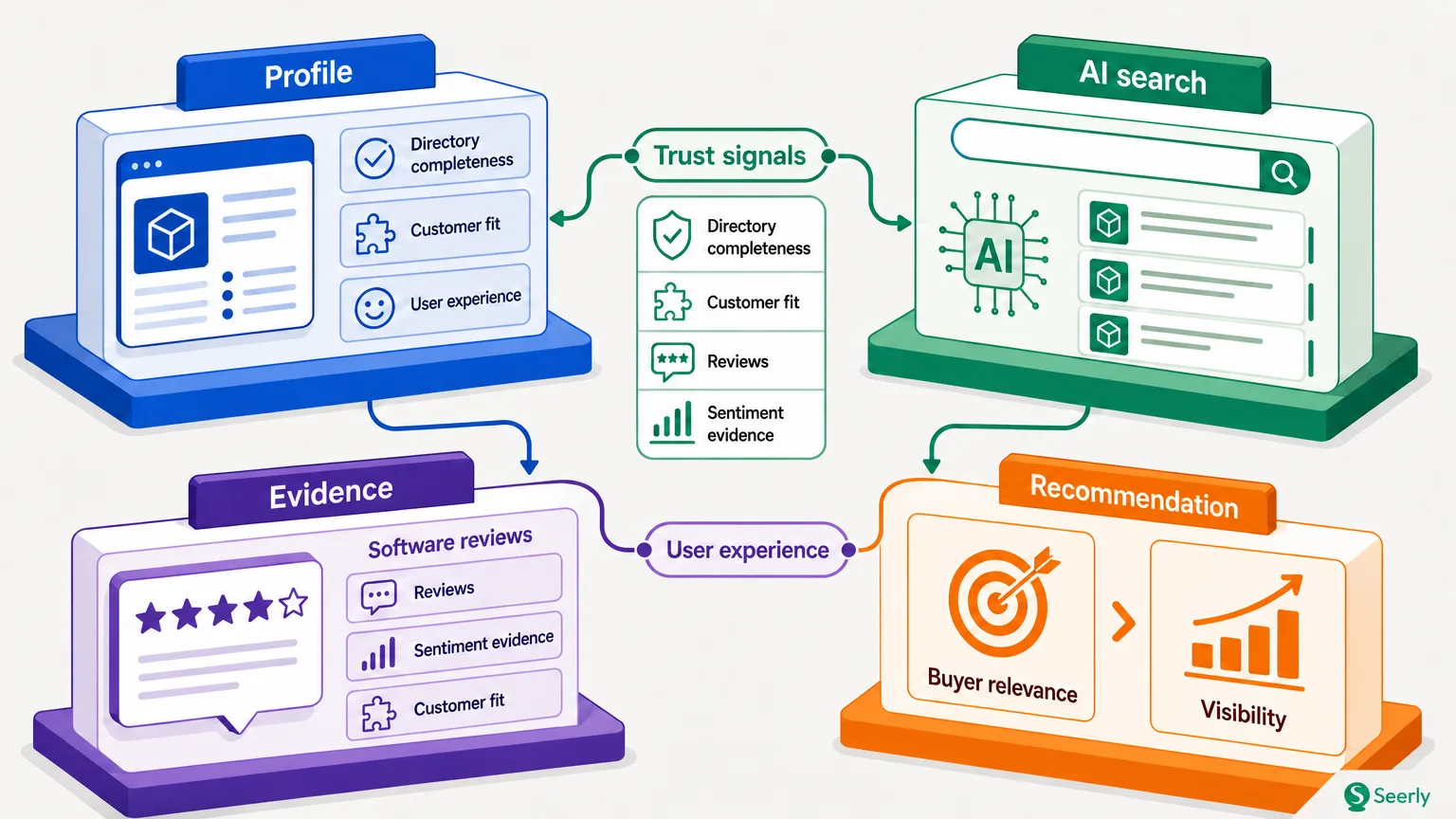
AI search systems do not need to “believe” a single review site to benefit from the signals found there. In plain language, they can encounter a brand repeatedly across sources: a product’s own website, category directories, review platforms, comparison pages, customer stories, community discussions, and editorial coverage. Consistency and substance across those sources make it easier to identify what a product is, who it serves, and what users experience.
Directories establish the baseline identity
A complete software directory listing gives a system basic context: category, core use case, integrations, pricing model, target company size, and product description. It helps establish that the brand exists and belongs in a particular competitive set.
That baseline still has limits. “Listed in the marketing analytics category” is not the same as “a strong choice for lean B2B teams that need attribution reporting without a large operations function.” The latter statement needs supporting evidence about use cases, outcomes, and customer experiences. A listing can establish identity without establishing preference.
Reviews add independent, use-case-specific proof
Reviews are valuable when they describe concrete conditions rather than generic praise. For example, a reviewer who explains that onboarding took two weeks, that the product replaced three disconnected tools, or that support helped configure a specific workflow provides useful context. The review does not need to be universally positive to be credible; balanced comments about tradeoffs can be especially informative.
For recommendation-oriented Google AI search results, this type of evidence helps distinguish a broad product claim from a customer-validated pattern. It can clarify whether a tool is better suited to enterprise teams, early-stage companies, technical users, self-serve buyers, or a specific industry.
Repetition across credible sources makes claims easier to support
Third-party descriptions matter because they can corroborate your own positioning. If a product is consistently described as an AI search visibility platform for marketing teams - and reviewers, customer stories, and category pages all add detail around that use case - the wider web contains a more coherent account of the brand.
This does not mean every source must use identical language. In fact, natural variation is healthier than copied descriptions. The goal is a consistent factual center: who the product is for, which problem it solves, what outcomes customers report, and what limitations or requirements buyers should understand.
The risk of being present but unproven
Visibility is not a single state. A software company can be discoverable in an index, shown as a source, or actively recommended to a buyer. Each stage requires a different level of evidence.
| Visibility state | What it means | What a thin review profile signals |
|---|---|---|
| Listed | The brand appears in a directory, category page, or product database. | The brand exists, but customer validation is limited. |
| Referenced | The brand may be mentioned in a comparison, answer, or source set. | It can be included as an option, but supporting detail may remain generic. |
| Recommended | The brand is presented as a suitable choice for a defined buyer and use case. | The system has less independent evidence to justify a confident recommendation. |
Consider two hypothetical project-management tools. Both have polished websites, detailed feature pages, and profiles in the same directory. Tool A has no reviews. Tool B has 35 recent reviews that describe faster onboarding, reliable integrations, responsive support, and a good fit for 20-100-person teams.
For a simple factual question, both products may appear. For a comparison question - such as which tool suits a growing agency that needs implementation help - Tool B has more externally observable proof. Its reviews provide language and evidence around the buyer’s actual decision criteria.
This is why listing completeness alone is not enough. A directory description written by your team may be accurate, but it is still a first-party description. Reviews, editorial summaries, and independently written customer stories add context that makes your market position more legible. That is particularly important when AI-generated search answers can reduce the number of visits a brand receives before a buyer forms an initial shortlist.
A remediation plan for stronger third-party proof
Do not attempt to improve every profile at once. Start where a missing or incomplete profile creates the widest credibility gap, then build an ethical, repeatable review program around customer evidence rather than volume alone.
1. Prioritize profiles by buyer relevance and visibility
List every meaningful third-party profile: major review platforms, category directories, marketplace listings, partner directories, and industry comparison sites. For each, record whether the profile is claimed, accurate, current, category-appropriate, and supported by reviews.
Prioritize the profiles most likely to appear when buyers compare alternatives in your category. A highly visible directory with zero reviews is usually a more urgent fix than a niche listing with limited audience relevance. Also check for conflicting company descriptions, outdated screenshots, old pricing, or category labels that no longer match the product.
2. Make the product description buyer-specific
A strong listing should answer the questions a qualified buyer would ask before booking a demo. State the primary problem solved, ideal customer profile, core workflows, integrations, implementation requirements, and product boundaries. Avoid broad claims such as “the leading all-in-one platform” unless you can substantiate them.
Customer fit is especially important. “Built for B2B SaaS demand-generation teams that need to monitor AI search discovery” is more useful than “a powerful AI platform.” Specific positioning helps directory visitors and AI systems connect the product to a defined need rather than a vague category.
3. Request reviews at moments of demonstrated value
The best review request follows a real customer outcome: a successful launch, completed onboarding, renewal, measurable performance improvement, or positive support interaction. Ask customers to share their honest experience in their own words, and make clear that critical feedback is welcome. Do not offer incentives contingent on positive ratings or provide prewritten copy for customers to publish.
Give reviewers useful topic guidance instead. Invite them to discuss the problem they were solving, team size, setup experience, results, support quality, and who would benefit most. This produces the proof elements buyers need without manufacturing testimonials.
4. Build evidence around ROI, support, and fit
The most commercially useful third-party proof usually addresses three questions:
- ROI evidence: What changed after adoption? Examples include hours saved, workflow consolidation, lead-quality improvements, faster reporting, or fewer tools required.
- Support expectations: What was implementation like? Buyers want to know response quality, onboarding effort, documentation depth, and whether assistance matched the complexity of the product.
- Customer fit: Which team, maturity level, or use case gets the most value? Specificity reduces the risk of attracting - and disappointing - the wrong buyers.
These elements should also appear in case studies and on your own website, but independent review profiles are where customers can validate or complicate those claims. Treat both outcomes as useful feedback. Credible reputation management includes resolving recurring concerns, not hiding them.
5. Keep profiles maintained after reviews arrive
A burst of reviews on an outdated profile does not create a coherent trust signal. Revisit category selection, product screenshots, pricing information, integrations, and positioning every quarter or whenever the product changes materially. Pair this work with a practical Google AI search reporting framework so reputation work is tied to real discovery questions, not handled as a disconnected directory task.
Monitor whether proof is changing AI visibility
Review count is a lagging signal on its own. A better measurement approach combines profile health, review quality, sentiment themes, and brand behavior in AI search results.
Track recommendation queries, not only rankings
Build a small, stable set of buyer questions that reflect category discovery, comparisons, alternatives, and use cases. Examples might include “best AI search visibility tools for SaaS marketers,” “software for monitoring brand mentions in AI answers,” or “tools for improving AI-ready website authority.” Record whether your brand is absent, merely named, described accurately, or recommended for the right customer profile.
Run the same questions periodically across the AI search experiences your buyers use. The aim is not to force a single answer, but to detect trends in visibility, positioning, competitor context, and recurring evidence gaps. For a broader operating model, use this guidance on monitoring brand presence across Google AI chats and search rankings.
Measure directory completeness and review depth
Create a simple scorecard for priority profiles: claimed status, accurate category, current description, current visuals, number of recent reviews, average rating, and presence of useful themes such as onboarding, ROI, support, and fit. Review quantity matters, but recency and detail matter too. Ten generic reviews from years ago provide less decision support than a smaller set of recent, specific experiences.
Also monitor whether the same weakness repeats across listings. If profiles consistently lack implementation information, for example, the solution may not be another description rewrite. It may be a gap in the customer education, onboarding, or proof-collection process.
Watch sentiment alongside visibility
A brand can become more visible while accumulating unhelpful associations. Track positive, neutral, and negative themes in reviews and AI-generated descriptions. Look for recurring language about value, complexity, support, pricing, missing features, or unsuitable customer types.
This is a more useful view of AI search discovery than a binary ranking report. It reveals whether your evidence layer is becoming stronger and whether the market understands your product in the way your ideal customers need it to.
FAQ
Are one or two reviews enough to improve Google AI search visibility?
One or two genuine reviews are better than none because they introduce third-party customer evidence. However, they rarely establish a reliable pattern around product value, support, and customer fit. Aim first for a steady flow of detailed, representative reviews rather than a one-time push for a minimum number.
Do missing reviews prevent a software brand from being cited or mentioned?
No. A product can still be listed, indexed, mentioned, or included in a comparison without reviews. Missing reviews primarily weaken the independent evidence available when an answer needs to explain why a product is a good fit, how it performs in practice, or how it compares with alternatives.
How long does it take for stronger reviews to matter after profiles are updated?
There is no fixed timetable. Profiles must be crawled, processed, and reflected in the sources and systems that inform search experiences; changes can take weeks or longer depending on the platform and the broader web’s refresh cycles. The practical approach is to improve the underlying proof first, maintain it consistently, and monitor relevant buyer questions over successive refreshes rather than expecting an immediate change.
Empty review profiles are not simply incomplete directory pages. They reduce the quality of the independent evidence available to support your product in Google AI search, comparisons, and buyer research. Identify your thinnest high-priority directory and review profiles first, improve the quality of the proof there, and then monitor whether recommendation-oriented answers become more favorable over the following refresh cycles.