The Best Search Research Workflow for Finding the Questions AI Buyers Ask Before They Click
How content teams can turn buyer language into clear, answer-ready pages without assembling a giant research stack.
A prospect rarely begins with the neat two-word phrase a keyword spreadsheet expects. They ask things like: “Can an agency fix our reporting without replacing our whole CRM?” Or, “Is this service worth paying for if our team can already do part of it in-house?” The wording is messy, specific, and often packed with anxiety about cost, risk, or effort.
That gap changes what best searching looks like. Collecting high-volume phrases still has a place, but it misses the language people use when they are close to making a decision. AI-assisted discovery makes the gap more visible because people phrase requests as full questions, comparisons, and scenarios. They expect a direct explanation, not a page that circles the subject for 900 words.
I’ve watched teams spend weeks building sprawling keyword lists, then publish articles that answer questions nobody on a sales call has actually asked. The result is polished content with a faintly museum-like quality. Nice to look at. Not much use when someone is trying to choose.
A better research process begins closer to the customer: sales conversations, support tickets, Reddit threads, Instagram comments, and recurring objections. It then translates that raw language into pages with plain answers, clear boundaries, and enough detail for a reader to judge fit. That’s the work here: a practical workflow for finding the questions worth publishing around.
Why traditional keyword collection misses buyer language
Keyword research tends to flatten intent. A phrase such as “marketing reporting service” may appear useful, yet it says almost nothing about the person behind the search. Are they replacing an underperforming agency? Trying to avoid a six-month migration? Looking for proof that their board will trust the numbers?
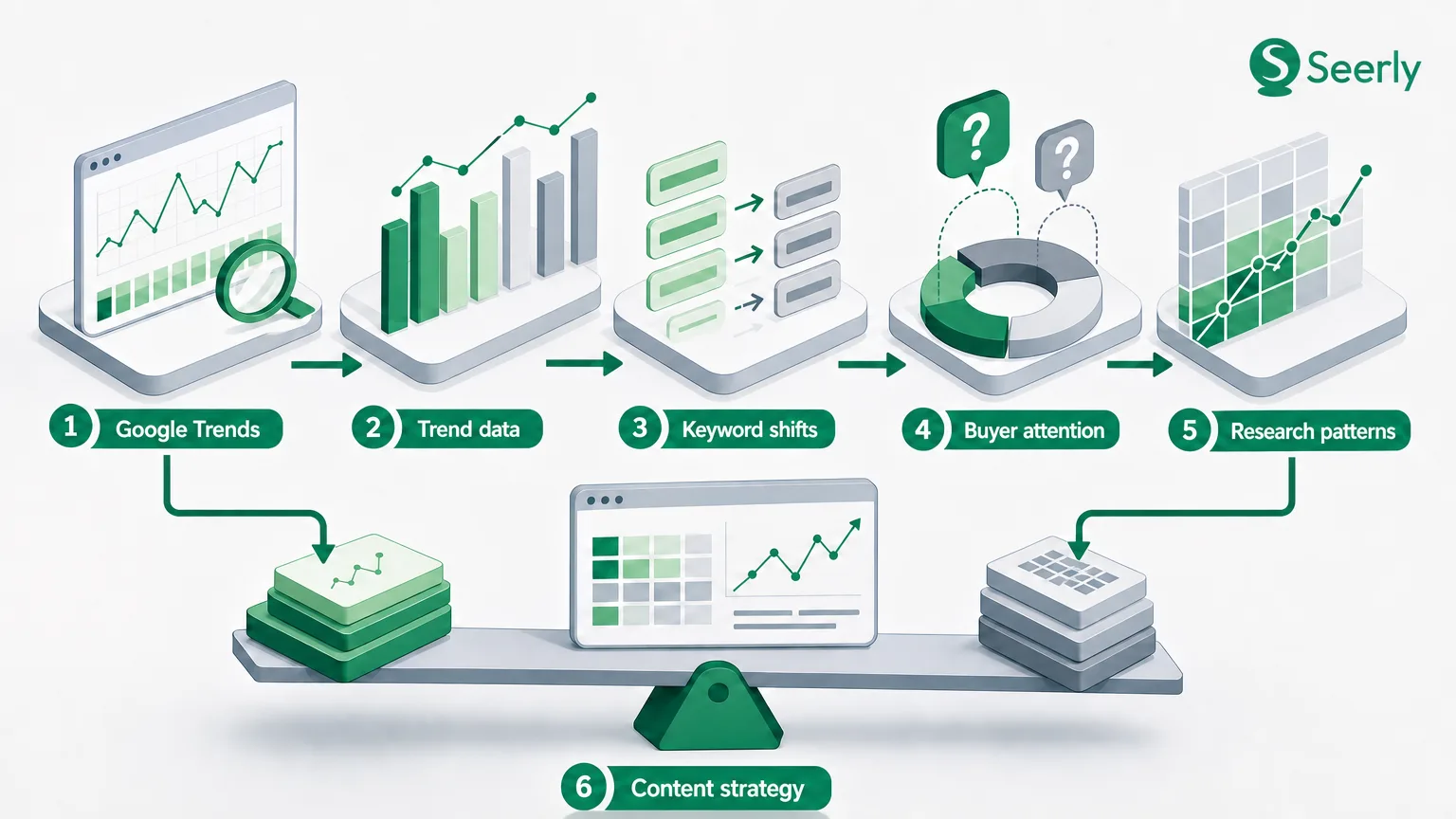
Full-sentence queries carry more commercial context. Google’s own search guidance encourages people to add useful detail, use quotation marks for exact phrasing, and filter results when a broad query produces poor matches. Those behaviors point to a simple reality: people refine searches when the first wording fails to express what they mean. Search operators and refinements help people narrow results because the first query is often only a rough draft of the real question.
Social posts expose that rough draft in public. A trend finder that monitors Instagram and Reddit can surface phrases such as “I need someone to explain the numbers, not just send a dashboard” or “Which service won’t make our team learn another platform?” Those aren’t polished search terms. They are service-copy material.
Working definition: Best searching is the practice of finding repeated buyer language, then matching it to the page that can answer the decision behind it.
Look, search volume is useful for estimating demand. It is weak at showing frustration, hesitation, and the exact comparisons that delay a purchase. The more I looked at buyer conversations, the more obvious this became: the best page ideas were often already sitting in a sales rep’s notes.
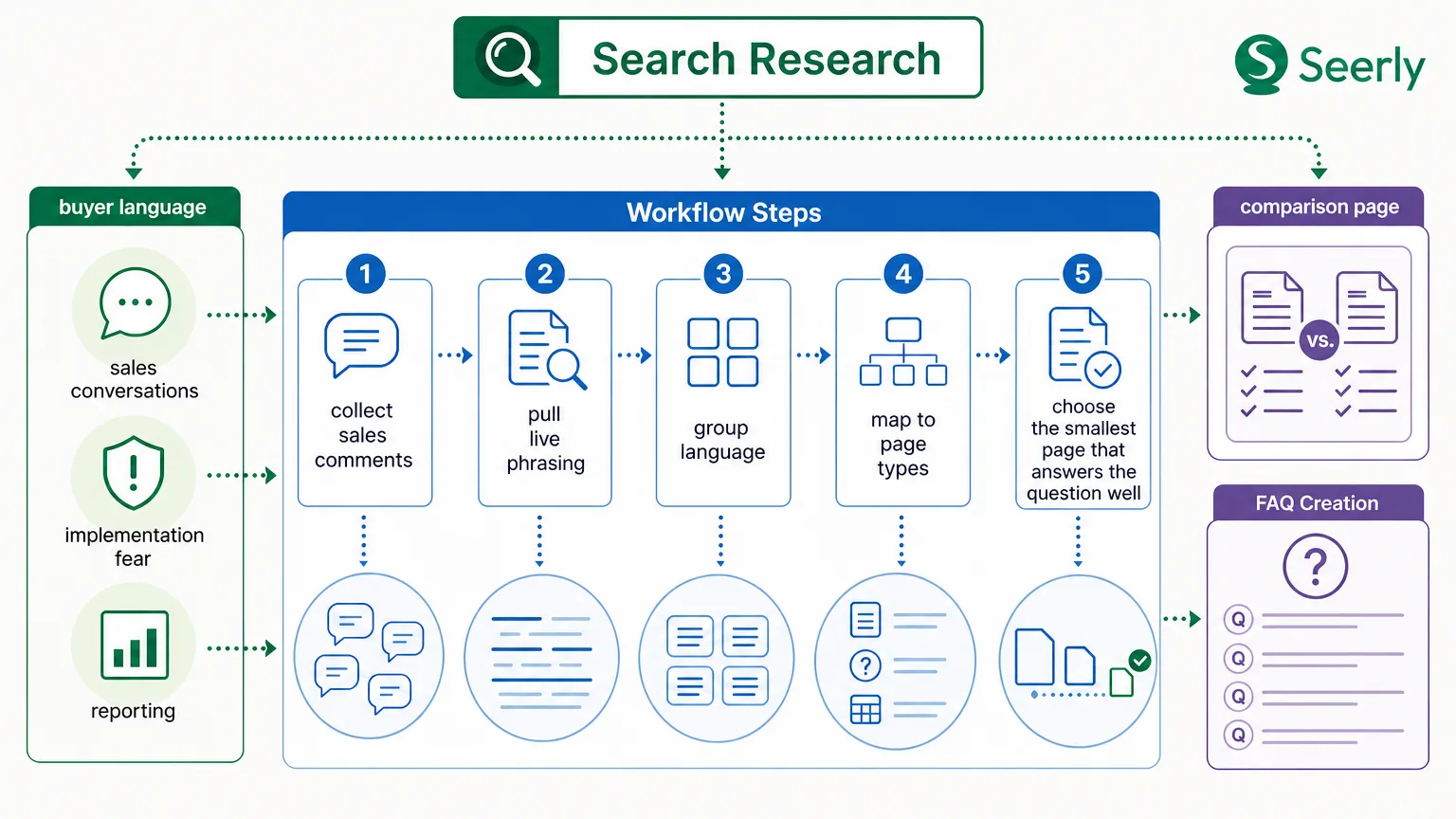
Best searching starts with a five-step research loop
The workflow works because it has a narrow input and a clear output. You are not collecting every phrase that exists. You are gathering language that can change a page, a conversation, or a buying decision.
-
Collect questions from sales and support. Ask for call notes, lost-deal reasons, chat transcripts, and onboarding questions from the last 60 to 90 days. Keep the wording intact, including awkward grammar. “Can you work with what we already have?” may sound plain, but it carries a big concern about disruption.
-
Pull live phrasing from communities. Search relevant Reddit communities, comment threads, and Instagram posts for people describing the problem in their own terms. Save the sentence before and after the phrase, not only the phrase itself. Context separates “I need cheaper reporting” from “I need reporting my CFO won’t question.”
-
Group the language around an objection. Don’t sort only by topic. Put “Do we need to change tools?” beside “Will this integrate with our current process?” because both signal implementation fear. A cluster should describe the decision a buyer is struggling to make.
-
Map each cluster to a page type. Comparison questions belong on comparison pages. Questions about fit, process, or scope often belong on a solution page. Narrow, recurring questions can sit in an FAQ, provided the core page already explains the larger issue.
-
Choose the smallest page that answers the question well. A full article makes sense when the reader needs education before they can judge options. Rewrite an existing conversion page when the person is already evaluating your service and needs reassurance. This part is honestly a pain, because teams often want a new asset when a 250-word page revision would do more work.
The process works best in a shared sheet with five columns: raw quote, source, objection group, page destination, and evidence needed. Keep the evidence column. It forces writers to distinguish between a claim they can support and a promise that merely sounds good.
A service-brand example: turning one messy question set into pages
Take a fictional fractional finance service for growing software companies. Over two weeks, the team captures these comments from calls and community posts:
- “Do I need a full-time finance hire yet?”
- “Can someone fix our board reporting without changing QuickBooks?”
- “What’s the difference between a fractional CFO and an outsourced bookkeeping firm?”
- “Will I still have to chase people for numbers every month?”
At first glance, those look like four unrelated questions. They are not. Two revolve around role and timing. One asks about technical disruption. The last expresses exhaustion with a monthly process that keeps breaking.
The team should not write “The Ultimate Guide to Finance.” That title would swallow the buyer’s real concern. Instead, turn the set into three assets with distinct jobs.
1. A comparison page for a choice already underway
Build a page called “Fractional CFO vs. Outsourced Bookkeeping: What Each Service Handles.” Put the boundary near the top: bookkeeping records transactions; a fractional CFO interprets financial position, plans decisions, and helps lead higher-stakes financial work. Then state where the categories overlap and where they do not.
A comparison page earns trust when it admits non-fit. A company that only needs reconciliations and invoicing may not need fractional CFO support. That line can feel uncomfortable to publish. It also saves a sales team from spending time on mismatched conversations.
2. A solution-page revision that reduces implementation fear
The existing fractional CFO page likely talks about strategy, planning, and expertise. Add a section titled “Can we keep QuickBooks?” Answer in natural language: explain what stays, what changes, who owns the setup, and what the first month looks like. Avoid vague claims about a painless transition. Buyers want to know where the friction lives.
Pages that name a buyer’s current tools and process feel more grounded than generic service copy. Seerly’s own perspective on how AI search optimization helps SaaS buyers find the right product makes a related point: decision-stage readers need clear fit information, not broad category language.
3. A supporting FAQ for repeatable operational concerns
Create an FAQ asset around recurring questions: “When should we hire a full-time finance leader?” and “Who prepares board reporting each month?” Each answer should start direct, then name the conditions that change the answer. Early-stage teams may need a part-time strategic lead; businesses with daily finance operations and complex reporting may need a full-time hire.
That small set of pages gives readers different entry points without repeating the same article three times. Better still, each page uses language a buyer would recognize. No jargon costume required.
Don’t chase every phrase that starts trending
A phrase can spike because a creator used it in a viral post, not because buyers are trying to solve a durable problem. Treat social listening as an idea source, not a publishing calendar. The goal is repeated commercial language, not the loudest sentence from Tuesday.
I personally use a simple score from 1 to 5 across four checks:
| Check | What to ask | Why it matters |
|---|---|---|
| Recurrence | Did the phrase appear in several places? | Repetition suggests a shared problem, not one person’s wording. |
| Stakes | What happens if the buyer gets this wrong? | High-risk decisions merit clearer content, even with lower volume. |
| Revenue proximity | Does the question appear near a service choice? | “How much does it cost?” usually deserves attention sooner than a vague curiosity. |
| Answerability | Can your team give a specific, honest answer? | If the answer is foggy, publishing will only add more fog. |
A phrase with low recurrence can still win if it sits right beside revenue. “Do you support enterprise security review?” may appear only a handful of times, but it could block a large contract. Meanwhile, “best productivity hacks” might trend all week and produce no useful page for a specialized service business.
Point being, prioritize commercial tension over entertainment value. A buyer saying “I don’t know if this will work with our existing team” has told you far more than a thousand generic likes.
The research filter: repetition, risk, and revenue
Here is the filter I’d apply before an editorial meeting. A phrase needs at least two of the following signals before it enters the publication queue:
- It repeats across separate sources. Sales calls and Reddit threads are especially useful together because they show the question exists both inside and outside your current pipeline.
- It carries a costly objection. Price, implementation, accountability, and switching risk often shape a decision more than feature descriptions do.
- It sits close to a service page or sales conversation. Ask where someone would land if they typed the question into a search box. If the answer is “nowhere useful,” you may have found the gap.
There’s also a practical test: could a sales rep link to the proposed page tomorrow? If not, the topic may still be too abstract. The best searching workflow has to help real conversations, not merely produce an attractive content board.
Research on evaluating web information supports the habit of checking claims beyond the first source. In a study of online instruction, lateral reading improved students’ ability to assess digital sources. Apply that discipline to social phrasing too: verify a promising phrase across more than one community before you turn it into a headline.
Your editorial checklist for answer-ready pages
Before assigning the next piece, run through this list with the writer and subject expert.
- Capture the full buyer sentence. Record what came before the question and what outcome the person wants. A fragment without context often sends a writer toward the wrong page.
- Rewrite the page’s opening in natural language. If a buyer asks, “Can we keep our current tools?” the page should answer that exact concern early. Don’t bury it under a brand slogan.
- Name conditions and limits. Strong answers say when a service fits, when it does not, and what the customer must do. Readers can smell evasive copy from a mile away.
- Ignore broken or overly tool-specific phrasing unless it repeats. A typo, an internal product nickname, or one creator’s catchphrase does not need its own page. Keep the underlying concern if it appears elsewhere.
- Check that the page can stand alone. Someone who sees only one excerpt should still understand the subject, the answer, and the next logical step.
The shift toward AI summaries makes direct answers more consequential. In Pew Research Center’s 2025 analysis, Google users clicked traditional results less often when an AI summary appeared. That does not mean every page needs to sound like a FAQ database. It means evasive copy has fewer places to hide.
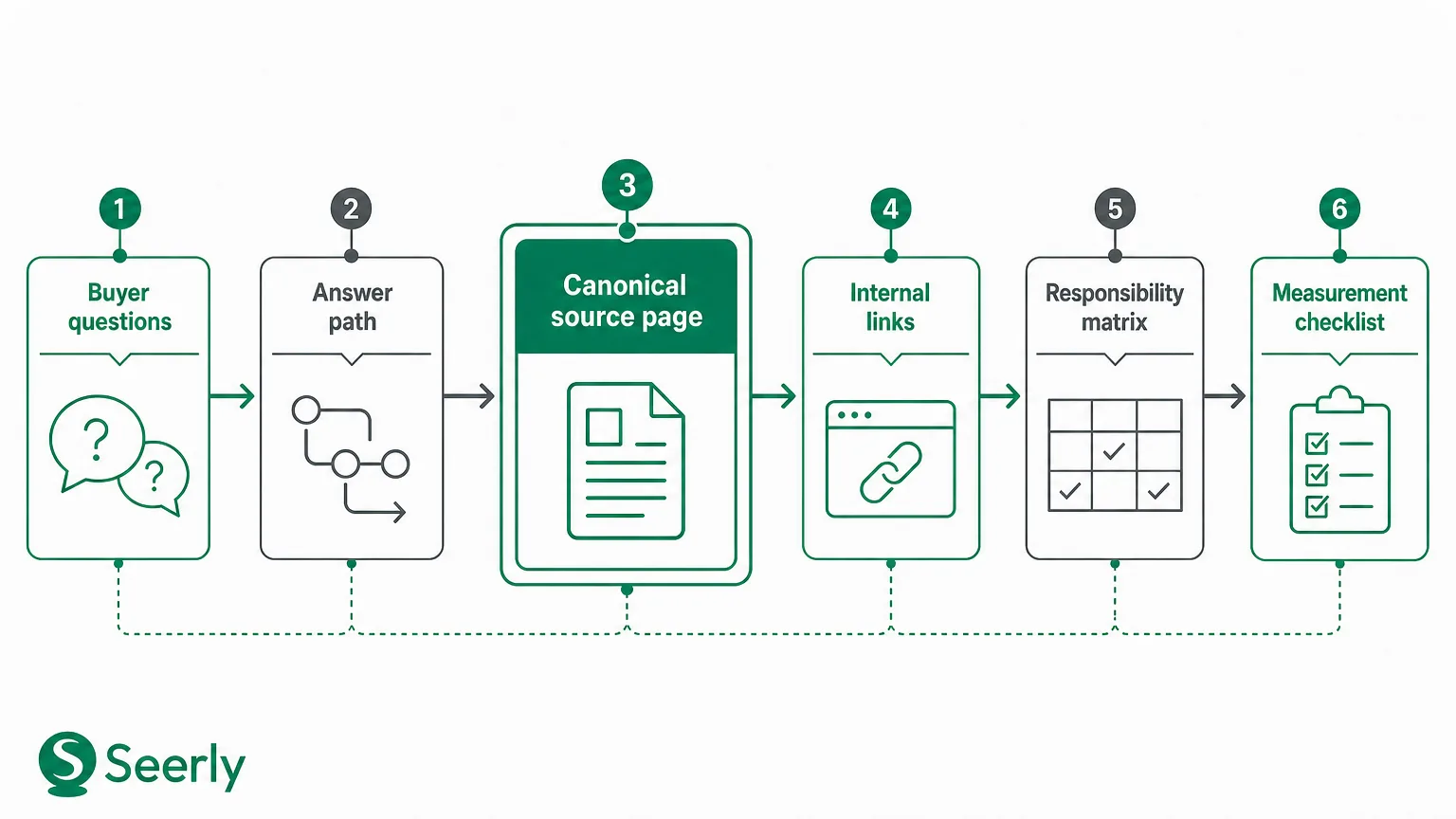
Image recommendation: Use best-searching-buyer-question-workflow.png, a simple flow diagram showing raw buyer quotes moving through objection groups into a comparison page, solution-page revision, and FAQ. Alt text: “Workflow for turning buyer questions into answer-ready content pages.”
Frequently asked questions
How often should a team run this research process?
Run a light review every month, then revisit major service areas each quarter. Sales objections change faster than most editorial calendars acknowledge, especially after pricing changes or a new competitor enters conversations. Keep the raw-question sheet open all the time, though. Useful language appears in odd places.
Should every repeated question become a new article?
No. Start by checking whether an existing conversion page can answer it better. New articles work when a reader needs context, comparison, or a longer explanation before they can act. Otherwise, update the page closest to the decision.
Run this workflow on one service or solution area this month. Pull 20 raw questions, group them by objection, and build a small queue of pages from the phrases that repeat near revenue. Then use Seerly’s content planning and audit work to turn that queue into publishable material that answers buyers before they click.
Learn more at Seerly.