How Low-Authority Sites Can Win Buyer Visits From AI Search Optimization
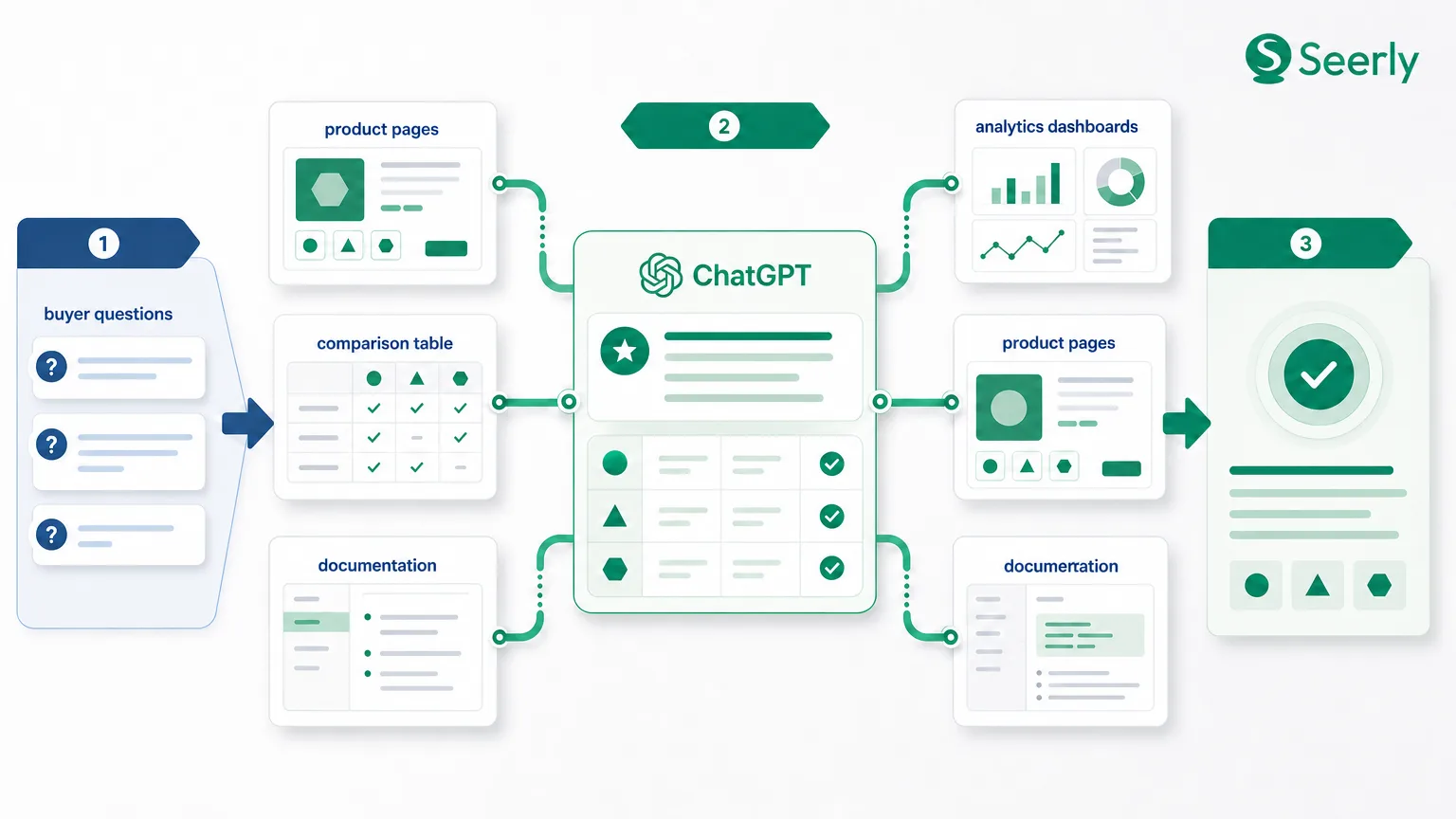
Marketers are often looking for the same practical answer: how can a smaller brand appear when buyers ask an AI assistant for a product, service, or alternative? Buyers use conversational AI search to turn broad needs into shortlists, comparisons, and next actions - and they expect direct, evidence-based answers rather than a list of blue links, especially with respect to AI search optimization.
That shift matters most for teams without a dominant domain or extensive backlink profile. A low-authority site may not win every broad category query, but it can make a high-intent service or product page easier to understand, reuse, and trust. Google’s original Bard launch positioned the product as an interface for combining broad knowledge with user questions, while the later Gemini update expanded that experience across Google’s AI products. In other words, the opportunity is not simply “rank higher.” It is to make the right page legible when an answer engine needs to explain which solution fits a buyer’s situation.
The commercial stakes are clear in the discussions surfaced through Trend Finder: marketers are increasingly focused on turning ChatGPT-style discovery into qualified visits, not merely visibility. The teams that benefit are not necessarily those publishing the most AI content. They are the ones tightening the buyer-intent pages they already have: clarifying the offer, substantiating claims, addressing alternatives, and directing the visitor toward a meaningful next step.
Why buyer-intent page clarity matters more than domain prestige
AI search systems synthesize answers. When a buyer asks, “What is the best project-management platform for a 20-person agency?” or “Which payroll provider works for global contractors?”, the system needs to identify entities, capabilities, limitations, and supporting evidence. A page that buries its offer beneath generic positioning creates unnecessary ambiguity, even if the brand has strong awareness elsewhere.
That does not mean authority is irrelevant. Established brands still benefit from broader brand reputation, linked mentions, and years of published material. But smaller sites can compete on narrower, solution-aware searches by being explicit about who they serve, what they solve, where they fit, and where they do not. This is especially relevant as AI systems become more capable of handling long-context information and multimodal reasoning, capabilities described in the Gemini 1.0 technical report.
For the marketer, the operational lesson is straightforward: do not start by creating ten new “AI SEO” articles. Start with the pages closest to revenue - service pages, solution pages, product-use-case pages, migration pages, and comparison pages. If a visitor lands from an AI-generated recommendation, that page must immediately validate why the recommendation was made.
A good buyer-intent page does two jobs at once. It gives answer engines compact, accurate material they can retrieve and summarize, while giving human visitors enough proof and direction to continue evaluating the brand. That is why AI search optimization helps SaaS buyers find the right product: the strongest pages reduce uncertainty at the point where a buyer is choosing, not just browsing.
The five on-page elements for AI search optimization that support buyer-intent retrieval
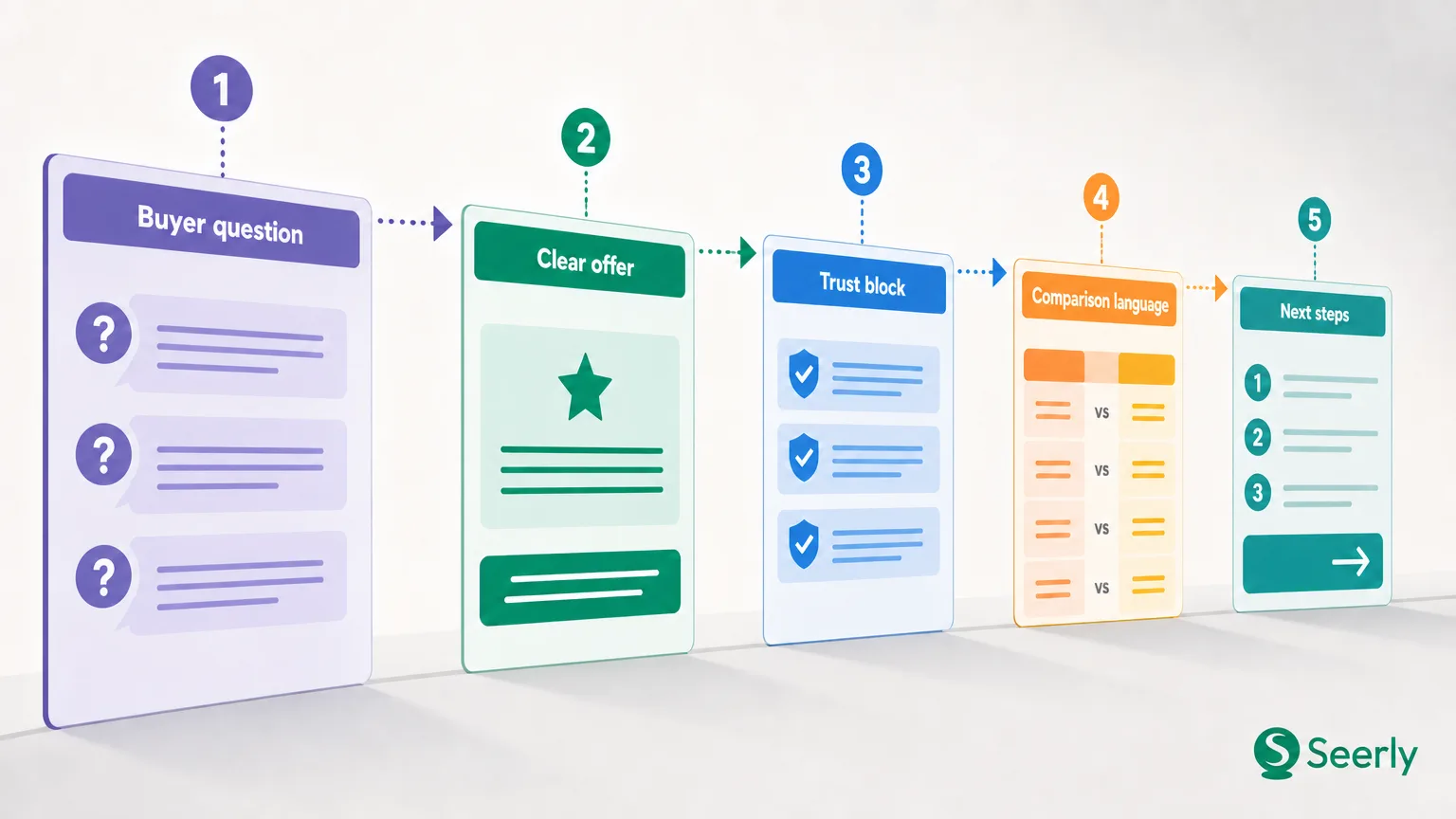
A page does not need to sound robotic to be AI-ready. It needs a clear structure that connects a buyer problem to a credible, specific solution. The following five elements should appear on every page intended to attract commercial AI search discovery.
1. A clear offer statement
The opening section should state what you offer, who it is for, and the outcome it supports. Avoid headline language such as “Transform your workflow” unless the following sentence defines the actual product or service. A buyer and an answer engine should both be able to identify the category, audience, and primary use case in seconds.
For example, “Expense management software” is less useful than “Expense management software for distributed consulting teams that need approval controls, corporate-card reconciliation, and client-level reporting.” The second version contains meaningful qualifiers. It establishes the product category, user type, business context, and operational value without relying on buzzwords.
2. Proof and trust blocks
Trust signals convert general relevance into a defensible recommendation. Include specific customer outcomes where they can be verified, recognizable customer examples where permission exists, implementation details, security or compliance information, methodology, and clearly attributed testimonials. If the claim cannot be supported, soften it or remove it.
This matters because generative systems can produce confident but inaccurate outputs. Early public scrutiny of Bard, including an inaccurate answer in a promotional demonstration, reinforced a broader lesson for brands: factual precision is not optional. Your pages should make it easy to distinguish substantiated product facts from aspirational marketing language.
A practical trust block might include three short components: “Used by 120+ agencies,” “SOC 2 Type II controls,” and “Average onboarding completed in 14 days,” provided each can be documented internally. The point is not to overload the page with badges. It is to give a buyer concrete reasons to believe the solution can deliver.
3. Comparison language buyers actually use
Commercial discovery rarely begins and ends with a category query. Buyers ask whether a product is better than an incumbent, suitable for a certain company size, compatible with a workflow, or worth the cost of switching. Your page should acknowledge those decision paths directly.
Use comparison language responsibly. “Best for teams replacing spreadsheet-based approval processes” is more helpful than “the best platform on the market.” Likewise, explain where the offer is a poor fit: a tool designed for lean agencies may not suit enterprises requiring complex procurement controls. Those boundaries strengthen credibility because they help buyers self-qualify.
Comparison content also gives AI search systems clearer context. A solution page can naturally include phrases such as “alternative to manual reporting,” “built for multi-location teams,” or “better suited to companies with fewer than 500 employees.” These are not keyword tricks; they are decision criteria.
4. Objection-handling FAQs
FAQs work when they answer real pre-purchase questions concisely and specifically. They fail when they repeat vague statements such as “Is your platform easy to use?” followed by “Yes, our platform is intuitive.” A useful FAQ should remove a realistic point of friction around pricing, implementation, integrations, data handling, service scope, or eligibility.
For a B2B service page, questions might include: “How long does implementation take?” “Can you work with our existing CRM?” “Do you support multi-region reporting?” and “What happens after the initial engagement?” Each answer should begin with a direct response, then add the qualification a serious buyer needs. This structure creates compact answer blocks without sacrificing nuance.
Google’s evolution from Bard toward Gemini reflects the growing role of AI interfaces in helping users explore and get answers across tasks. The Bard-to-Gemini product transition is a reminder that brands should optimize for clear answers that remain useful across changing interfaces, rather than tailoring pages to a single product name.
5. An obvious next step
A buyer-ready page must make the next action proportionate to the visitor’s stage. “Book a demo” is appropriate for a complex platform, but a lower-friction alternative - such as viewing pricing, downloading an implementation checklist, seeing an integration guide, or requesting an audit - may suit earlier evaluation.
Place the primary action near the offer statement and repeat it after proof or FAQs. The call to action should state what happens next: “See a 15-minute workflow review,” “Compare plans,” or “Request a migration assessment.” Vague buttons such as “Learn more” force the visitor to do unnecessary interpretive work at the moment they should be moving forward.
Rewriting a weak B2B SaaS service page
Consider a fictional SaaS company, NorthstarOps, which sells reporting software for multi-location fitness businesses. Its original service page is polished but weak for both AI retrieval and buyer conversion.
Before:
Unlock better business intelligence with NorthstarOps. Our innovative platform helps ambitious businesses make smarter decisions, accelerate performance, and gain total visibility. Schedule a call to learn more.
This copy provides almost no usable detail. It does not identify the target customer, the type of reporting, the source systems involved, the buyer problem, or the expected next step. An answer engine has little reason to connect the page to a query about gym-location reporting, franchise dashboards, or membership-revenue reconciliation.
Here is a more effective version:
NorthstarOps is multi-location reporting software for fitness operators that need one view of memberships, class utilization, payroll, and location-level revenue. It connects data from point-of-sale, scheduling, and payroll systems to give operators weekly performance dashboards without manual spreadsheet consolidation.
Built for fitness brands with 5-100 locations, NorthstarOps is a strong fit for teams replacing fragmented franchise reporting. Implementation typically starts with a data-source review, followed by dashboard configuration and stakeholder training.
Why operators choose NorthstarOps: location comparisons, automated weekly reporting, configurable role permissions, and support for franchise and corporate-owned sites.
Not the best fit for: single-location studios that only need basic booking reports.
Next step: Request a reporting-stack assessment to see which data sources can be connected.
The revised page is not longer merely for the sake of length. It makes the offer retrievable through buyer language: “multi-location reporting software,” “fitness operators,” “franchise reporting,” and “manual spreadsheet consolidation.” It also includes fit criteria, implementation context, a limitation, and a defined conversion action.
The next sections of the page should reinforce those claims with a customer result, an integration list, a short implementation timeline, a comparison between manual reporting and NorthstarOps, and FAQs on data connections, onboarding, pricing model, and access controls. That is the difference between a generic marketing page and an AI-ready commercial asset.
A five-day process to improve one high-intent page
Lean teams do not need a major site rebuild to begin. Select one page already connected to revenue and run a focused rewrite cycle. The goal is to strengthen relevance, trust signals, and conversion clarity in less than a week.
Day 1: Identify the buyer question behind the page
Start with the question the page should answer, not the keyword you want it to rank for. A cybersecurity consultancy might choose: “How can a mid-market SaaS company prepare for SOC 2 without hiring a full internal compliance team?” This question identifies the buyer, need, constraint, and desired outcome.
Review sales calls, support tickets, on-site search terms, and competitor comparison discussions to validate the question. Then note the evidence the buyer will need before taking action: timeline, scope, cost model, methodology, proof, and potential risks. This creates the editorial brief for the rewrite.
Day 2: Align headings with the decision process
Restructure headings so they reflect how a buyer evaluates the solution. Begin with the service or product definition, then explain who it is for, how it works, what results or deliverables to expect, where it differs from alternatives, and what to do next. Avoid clever headings that obscure meaning.
For example, replace “Compliance, Simplified” with “SOC 2 readiness support for B2B SaaS teams.” Replace “How we deliver impact” with “What is included in a SOC 2 readiness engagement.” Clear heading language improves skimmability for people and makes the section’s purpose easier for systems to interpret.
Day 3: Tighten proof and qualify claims
Audit every claim that could influence a purchase decision. Add specifics where your team can verify them, such as industries served, project duration ranges, implementation steps, support coverage, documented outcomes, or certifications. Remove unsupported superlatives, especially claims that position the business as universally “leading,” “best,” or “most trusted.”
This is not simply a legal review. It is a brand reputation practice. The more precise the page is, the less likely a buyer - or an AI-generated summary - to misunderstand the offer.
Day 4: Add concise answer blocks and FAQs
Build short sections that answer the page’s highest-value questions directly. Keep the first sentence of each answer clear enough to stand alone, then use the next sentences for nuance. Avoid turning the page into a wall of FAQs; five to seven high-quality questions are usually more useful than twenty generic ones.
Use the same process for comparison language. Explain what the buyer may use instead, the trade-offs involved, and the circumstances in which your offer is the stronger choice. Transparency builds trust more effectively than pretending every buyer is a perfect fit.
Day 5: Strengthen internal links and conversion paths
Link into the rewritten page from relevant product pages, industry pages, case studies, and educational articles using descriptive anchor text. Internal links establish topical relationships for visitors and crawlers while helping potential buyers move from research to evaluation. For example, a general AI visibility article can link readers toward a more specific service page when it addresses their next decision.
Do not treat internal linking as a navigation afterthought. A logical content architecture helps a smaller site concentrate relevance around its best commercial pages. Teams looking for technical implementation guidance can also use Seerly’s AI-ready engineering resources to connect content improvements with the site foundations that support reliable discovery.
What not to do when optimizing for AI search
The pressure to “optimize for AI” can lead teams toward low-trust tactics. These may create more words on a page, but they rarely create a stronger commercial resource.
First, do not stuff terms such as “AI search,” “Bard,” “Gemini,” or “ChatGPT” into a page that is actually about payroll software, legal services, or CRM implementation. The buyer’s need should determine the language. Mention AI-search concepts only where they accurately describe the user journey or the solution itself.
Second, do not add generic FAQs generated from broad templates. An FAQ that could appear on any competitor’s site does not resolve a buyer’s uncertainty. Prioritize questions that sales teams repeatedly hear and answer them with information your business can substantiate.
Third, do not copy generic chatbot output into core commercial pages. It tends to flatten differentiation, introduce unsupported claims, and remove the operational details that make a company credible. The original Bard experiment was built around helping people bring together information and creative collaboration; your site should contribute distinctive expertise, not recycled language.
Finally, do not measure success only through a handful of head-term rankings. AI-driven discovery is often more fragmented and conversational. The most meaningful gains may appear in qualified visits, assisted revenue, and engagement on pages that historically received limited organic traffic.
How to measure whether the rewrite is working
Give the updated page time to be crawled, indexed, and incorporated into your broader content ecosystem. Then review performance in weekly and monthly windows, separating informational traffic from commercial traffic where possible. The objective is not to prove that every visit came from a single AI interface; it is to see whether the page is becoming more visible and useful for buyer-led discovery.
Track commercial-query impressions in Search Console for category, solution, alternative, integration, and use-case language. A rise in impressions for “software for,” “best for,” “alternative to,” “pricing,” “implementation,” or industry-specific solution queries can indicate stronger alignment with buyer intent. Pair that with changes in clicks, landing-page conversion rate, and the quality of sessions arriving on the page.
Track assisted conversions, not only last-click conversions. A visitor may discover the solution through an AI search experience, return through branded search or direct traffic, and convert later. Use analytics attribution paths, CRM source details, demo notes, and self-reported “how did you hear about us?” fields to identify whether the rewritten page is part of the evaluation journey.
Finally, watch deeper-page engagement. Meaningful signals include visits to pricing, case studies, implementation information, integration documentation, and contact paths. If the page begins attracting more visitors but they do not continue to these validation assets, revisit the offer statement, proof blocks, and calls to action.
FAQ
Can this work without strong backlinks?
Yes, especially for narrow, well-defined buyer questions where a precise page can offer clearer fit and stronger evidence than a broad competitor page. Backlinks and brand authority still matter, particularly in crowded markets, but they are not a reason to leave high-intent pages vague. Start by making the page accurate, specific, and connected to the rest of your site’s relevant content.
How long do on-page changes take to matter?
Technical discovery can occur relatively quickly after crawling, but commercial performance takes longer to evaluate because buyers have different research cycles and query patterns. Review early indexing and engagement signals within several weeks, then assess commercial-query trends and assisted conversions over one to three months. The important point is to establish a baseline before publishing so the team can distinguish improvement from normal variation.
Which page types should a low-authority site update first?
Prioritize pages tied directly to revenue: core service pages, product use-case pages, industry pages, competitor alternative pages, migration pages, and pricing-adjacent content. Choose a page with an identifiable buyer question and enough existing substance to improve. Educational articles can support discovery, but they should lead readers toward a well-structured evaluation page.
Turn AI search attention into commercial momentum
The lesson for teams evaluating ChatGPT, Perplexity, and other AI search experiences is not to chase every new interface. It is to make buyer-intent pages unambiguous, evidence-led, and easy to act on. Smaller brands can improve their odds of being retrieved and trusted when their pages clearly state the offer, demonstrate proof, explain trade-offs, resolve objections, and guide the visitor forward.
Choose one high-intent page this week and conduct a manual rewrite review focused on offer clarity, proof, FAQs, comparison language, and internal links. Then use Seerly’s AI search discovery workflows to monitor whether the updated page is becoming easier for AI engines to retrieve, understand, and cite as buyers evaluate their options.