Search optimization: Fix the page problem before rewriting the page
A low-performing page does not automatically need a rewrite. It may be blocked from indexing, poorly connected within the site, unclear in search results, incomplete for the query, or misaligned with the visitor’s next step. Treating every issue as a content problem can waste editorial effort and make measurement harder.
Effective search optimization starts with diagnosis. Before changing a title, adding copy, or redesigning a call to action, identify where the page is failing: discovery, interpretation, search-result appeal, informational usefulness, or conversion. That approach helps teams make the smallest useful change, test a clear hypothesis, and avoid rewriting pages that are already doing their intended job.
Start with the page’s actual failure mode
A page can be difficult to find, difficult for search systems to interpret, or difficult for visitors to act on. These are related issues, but they require different remedies. For example, a page that is not indexed will not benefit from a more persuasive title, while an indexed page with impressions but weak click-through may need better search-result messaging rather than a full content revision.
Google’s crawling and indexing systems first need to discover a page, access it, process its content, and decide whether to include it in the index. Google’s explanation of how Search works makes this distinction important: crawling, indexing, and ranking are separate processes. A ranking or conversion problem should therefore not be assumed to be an indexing problem, and vice versa.
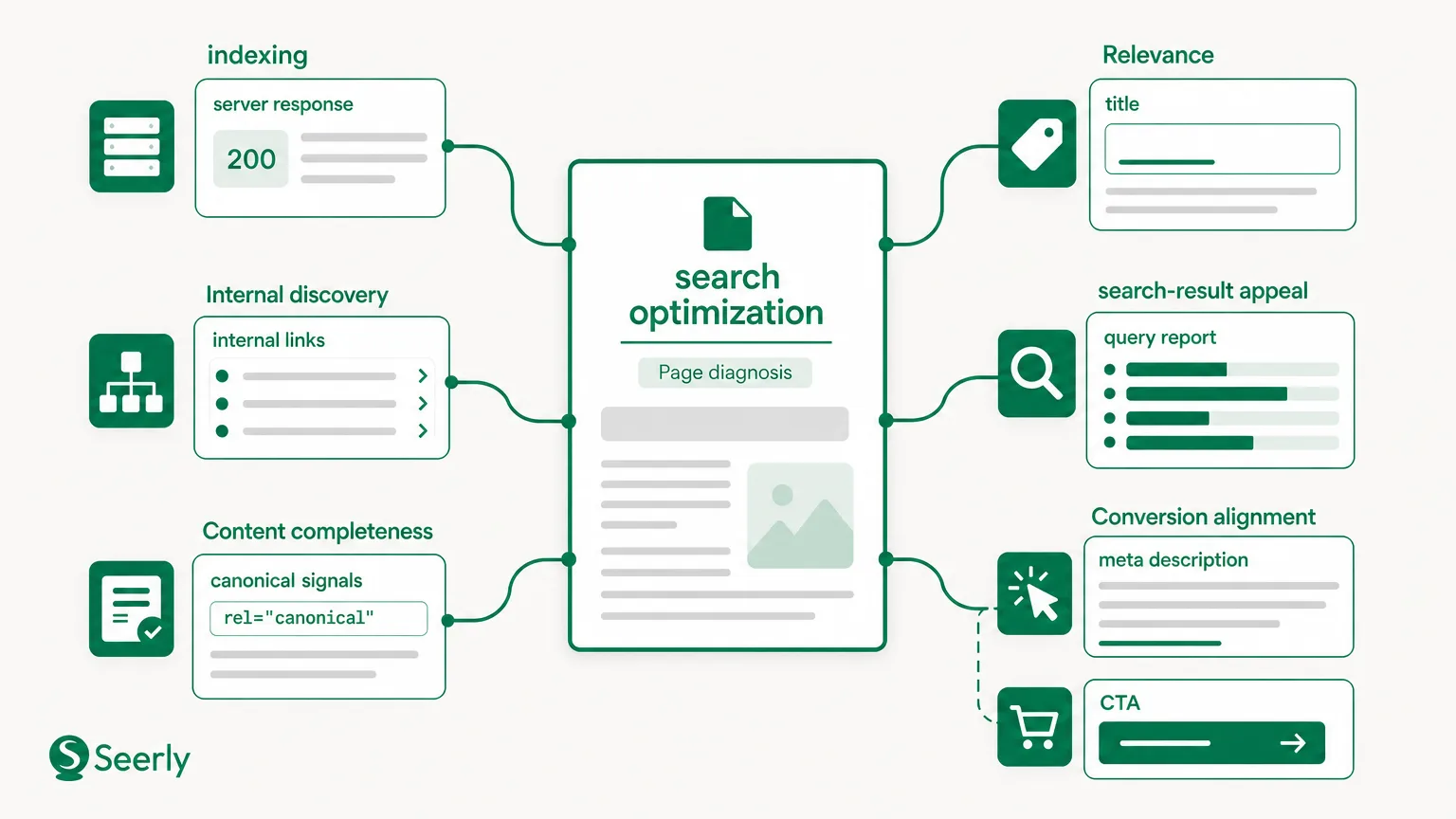
| Failure mode | Typical symptom | Evidence to inspect | Likely first remedy |
|---|---|---|---|
| Indexing | No impressions, no indexed URL, or unexpected exclusion | Indexing status, robots directives, canonical signals, server response | Technical correction or noindex/canonical review |
| Relevance | Indexed page appears for irrelevant queries or does not rank for its intended topic | Query report, page title, headings, body copy, competing intent | Clarify purpose and restructure content |
| Internal discovery | Important page has few or no meaningful internal links | Crawl data, referring internal URLs, navigation paths, orphan-page report | Add contextual internal links |
| Search-result appeal | Impressions are present but clicks lag | Query-level impressions, CTR, displayed title link, meta description | Title and metadata improvement |
| Content completeness | Visitors reach the page but do not engage with key information | Query intent, content gaps, FAQs, proof, task completion | Add or reorganize essential content |
| Conversion alignment | Organic traffic arrives but does not progress | CTA clicks, form starts, assisted conversions, journey analysis | Improve next step, offer, and page path |
Use this matrix as a starting point, not a formula. A page can have more than one weakness, but teams should identify the primary constraint first. If a service page is invisible because it is isolated from the rest of the site, a full rewrite may produce no measurable change until the page becomes easier for users and crawlers to reach.
This diagnostic approach also applies to AI search visibility. A page may be technically indexable and rank for conventional queries yet lack the original evidence, precise explanations, or entity clarity that make content useful in generated answers. Teams building AI-ready websites should distinguish between “the page is absent” and “the page is present but not sufficiently useful or credible to be reused.” Seerly’s guide to content that gets cited in AI answers offers additional context on designing content that supports citation-worthy answers.
Test whether the page clearly communicates its purpose
The title element is not a cosmetic field. It is one of the most direct signals of what a page represents, and it shapes the initial expectation for searchers. Google recommends titles that are distinctive, clear, concise, and accurate to the page’s content, while noting that title-element text and headings can inform a search-result title link. In other words, a title rewrite should be consistent with the visible page rather than a disconnected attempt to target more phrases.
Use a title diagnostic checklist
Before changing a title, ask whether it identifies one page-specific purpose, reflects the dominant search intent, and matches the promise made by the H1 and opening section. Check for duplication across templates and category pages, especially where boilerplate has displaced useful context. Also compare the title with the queries generating impressions; a mismatch may show that the page’s intended subject is unclear or that the page is being interpreted for the wrong task.
Avoid evaluating titles only by character count or keyword inclusion. Search optimization is stronger when the wording tells a user what they will gain from the page. A search optimization company might use a service-page title to define the offer and audience, while a tutorial should state the problem and practical outcome. Repeating “search optimization” several times does not make the page more precise.
Try a before-and-after editing exercise
Consider a page about improving product pages for AI discovery.
Before: “Search Optimization Services | Best Search Engine Optimization Company | AI SEO”
This title is repetitive, vague, and does not tell a decision-maker what the page actually covers. It also makes several competing promises without explaining the page’s specific service or use case.
After: “AI search optimization services for product discovery”
The revised version is concise, describes the offering, and aligns with a page that explains how product information can be made more discoverable in AI-powered search. The next step is to check whether the H1, opening copy, service scope, and conversion path make the same promise. If they do not, the issue is not title length; it is page alignment.
Inspect the page’s internal discovery path
Internal links are often the overlooked part of search engine optimization because they sit between technical SEO, information architecture, and editorial work. Yet a page that is absent from category hubs, supporting articles, and related service pages gives both users and crawlers fewer meaningful routes to it. Google’s documentation explains that links help Google discover pages and understand relevance, particularly when they use standard crawlable anchor elements and descriptive anchor text.
Worked example: a weakly linked service page
Imagine a B2B software company has a service page called /ai-search-audit. The page is indexable, has a sensible title, and contains a strong explanation of the audit. However, a crawl shows it receives one internal link from a footer menu and no contextual links from its SEO service page, AI visibility resources, or relevant blog content.
The first remedy is not necessarily a rewrite. Review the pages that naturally introduce the problem the service solves. A blog article on content quality might add a sentence such as: “Teams can use an AI search audit to identify pages with weak evidence, unclear entity signals, or missing discovery paths.” A service overview could link with more transactional language, while a resource hub could provide an educational route for earlier-stage readers.
The anchor text should describe the destination rather than say “learn more” or repeat an exact-match phrase everywhere. Context matters too: a link embedded in a paragraph about diagnosing AI-search readiness is more useful than an isolated link in an unrelated list. After adding links, verify that the destination is reachable through normal HTML anchors, that the source pages are themselves indexable, and that the new pathway makes sense for a human visitor.
Choose the smallest effective intervention
The most efficient search optimization service does not begin with “rewrite the page.” It begins with a hypothesis: If we fix this specific constraint, this evidence should change over time. Record that hypothesis before deployment so a team can distinguish a successful intervention from a coincidental movement in traffic or rankings.
Match the remedy to the evidence
A title-only change is appropriate when the page is indexed, aligns with the target intent, has adequate content, and earns impressions but communicates its purpose poorly in results. Change the title, retain the page’s substantive structure, and observe query-level impressions, clicks, and displayed title behavior.
A metadata cleanup is appropriate when titles or descriptions are duplicated, templates inject inaccurate text, or search-result messaging is inconsistent across a page set. This is usually a scalable implementation task rather than an editorial rewrite. It should be paired with checks for canonical URLs, noindex rules, and other basic controls described in Google’s SEO guidance for site owners.
An internal-link intervention fits pages with limited crawl paths, low internal prominence, or weak topical connections. Add a small number of relevant links from authoritative hub pages and closely related articles, then validate the linking pattern in a fresh crawl. Do not add sitewide links indiscriminately; they can dilute navigation and make the architecture less useful.
A content restructuring or revision is warranted when the page ranks for the wrong intent, leaves core questions unanswered, buries key information, or does not provide enough detail for a considered decision. Reorder the page around the user’s task, define terms, add missing comparisons or process details, and remove material that distracts from the purpose. For teams producing AI-ready content, original, well-supported information can also improve its usefulness in AI-mediated discovery.
An evidence addition is different from simply adding more words. Add verifiable methodology, product details, first-party data where available, expert explanation, or clearly sourced claims when the page makes assertions without support. A conversion-path improvement is appropriate when qualified visitors arrive but cannot easily identify the next action, evaluate the offer, or reach the relevant contact or product step.
Change one primary variable at a time whenever practical. If a team changes the title, rewrites every section, adds links, alters templates, and redesigns the CTA simultaneously, it may improve the page - but it will not know why.
Validate changes across traditional and AI discovery
Publishing is the start of measurement, not the end of the task. Allow time for recrawling, indexing, and normal variation, then compare performance against the hypothesis you documented. Search visibility is influenced by query demand, competition, site changes, and ranking systems, so observation should never be framed as a ranking guarantee.
Post-publication measurement checklist
Monitor whether the URL remains indexable and canonicalized as intended, then review impressions, clicks, CTR, and queries for the affected page. Compare pre- and post-change periods carefully, accounting for seasonality and major campaign changes. For internal-link work, confirm that the page has gained relevant referring internal URLs and that crawlers can reach it through normal site paths.
For conversion work, review the user action that the page was designed to support: demo requests, product exploration, downloads, contact starts, or another defined next step. Do not treat sessions alone as success. A page can gain traffic while attracting a less relevant audience, which would signal that relevance or expectation-setting still needs work.
Finally, include AI discovery in the review. Track priority AI-answer prompts, whether the revised facts are reflected accurately, and whether the page or brand is cited where relevant. This is prompt performance tracking over time, not a promise that a system will cite a specific URL. Combining conventional search performance with brand citation monitoring gives teams a more complete view of whether the page is discoverable, understandable, and trusted.
Build a repeatable page-diagnosis process
The central lesson is simple: fix the page problem before rewriting the page. Diagnose whether the constraint is indexing, relevance, internal discovery, search-result appeal, content completeness, or conversion alignment, then choose the smallest intervention that directly addresses it.
To make that process operational, run an initial diagnostic in Foundations > Smart Audit > Overview, document the selected remedy and hypothesis, and monitor page-level results in Foundations > Analytics > Search Performance. Then use Monitoring > Visibility to track the related prompt and citation evidence as your changes are observed across traditional and AI search.