Five questions to ask before adding Google AI search to your monitoring plan
Marketing teams have long relied on rankings, impressions, clicks and conversions to understand search performance. Google AI search introduces a different visibility layer: buyers may receive a synthesized answer before deciding which source, brand or product page deserves their attention. The issue is not whether every query produces an AI-generated response; it is whether the questions that shape buying decisions do.
This matters because AI search experiences can alter the path from question to website. A Pew Research Center analysis found that Google users clicked a traditional result on 8% of visits with an AI summary, compared with 15% of visits without one; clicks on sources within the summary were rarer still, at 1% of visits. That does not make conventional SEO irrelevant. It makes evidence-led monitoring more important: teams need to know whether their brand is present, accurately represented and supported by the sources buyers are shown.
Before adding Google AI search to an existing reporting routine, ask these five questions. The goal is not to create another disconnected dashboard. It is to build a manageable process that links buyer questions to observed answers, citations, owned content, competitor presence and accountable action.
Which customer questions are most likely to matter when AI-generated search results appear?
Start with questions, not with a large keyword list or an assumed AI visibility score. Google has continued to expand AI-powered search experiences, including AI Overviews reaching more than 200 countries and territories, but the operational question for a marketing team is narrower: which buyer questions could materially influence demand, trust or conversion?
Choose an initial set of five to 15 questions using a prioritization checklist. A smaller set makes it possible to review answers consistently, compare changes over time and involve the people who can validate the facts. Broadly sampling hundreds of queries too early tends to generate observations without decisions.
Prioritize questions that meet several of these conditions:
- They reflect high-intent evaluation. Include questions such as “What is the best platform for distributed customer support teams?” or “How does [your product category] compare with the alternative?” These indicate that a buyer is narrowing options, not simply learning terminology.
- They are connected to revenue or strategic segments. Give more weight to use cases tied to priority products, locations, verticals or account sizes. A brand mention on a low-value informational query is not equivalent to an omission during a core comparison.
- They carry brand or compliance risk. Review questions likely to surface outdated pricing, incorrect eligibility details, safety claims, capabilities or geographic availability. An inaccurate answer can create a sales objection or support burden before a prospect visits your site.
- They require category education. If buyers need to understand a new category before they can choose a provider, monitor foundational questions. The brand that helps define the category may gain consideration even where the answer does not produce an immediate click.
- They recur in customer conversations. Sales-call notes, support tickets, onboarding questions, chat transcripts and lost-deal reasons are useful inputs. These are questions real people have already asked, rather than assumptions derived only from search volume.
Use query wording that mirrors how a buyer frames the problem. A team selling analytics software, for example, might track “How do marketing teams measure AI search visibility?” alongside “AI search monitoring tools for agencies.” The first tests whether the category is explained accurately; the second tests whether the brand appears in an active vendor-selection context. For a broader method of building this question set, review how buyer questions can guide AI-era keyword research.
What should a team record each time it reviews an AI-generated search answer?
A single unrecorded answer is an anecdote, not a strategic signal. AI-generated responses can differ by query wording, location, device, language, timing and the sources available to the system. Google also describes AI Mode as supporting follow-up questions and more complex exploratory tasks, which means a buyer journey may extend beyond one static result.
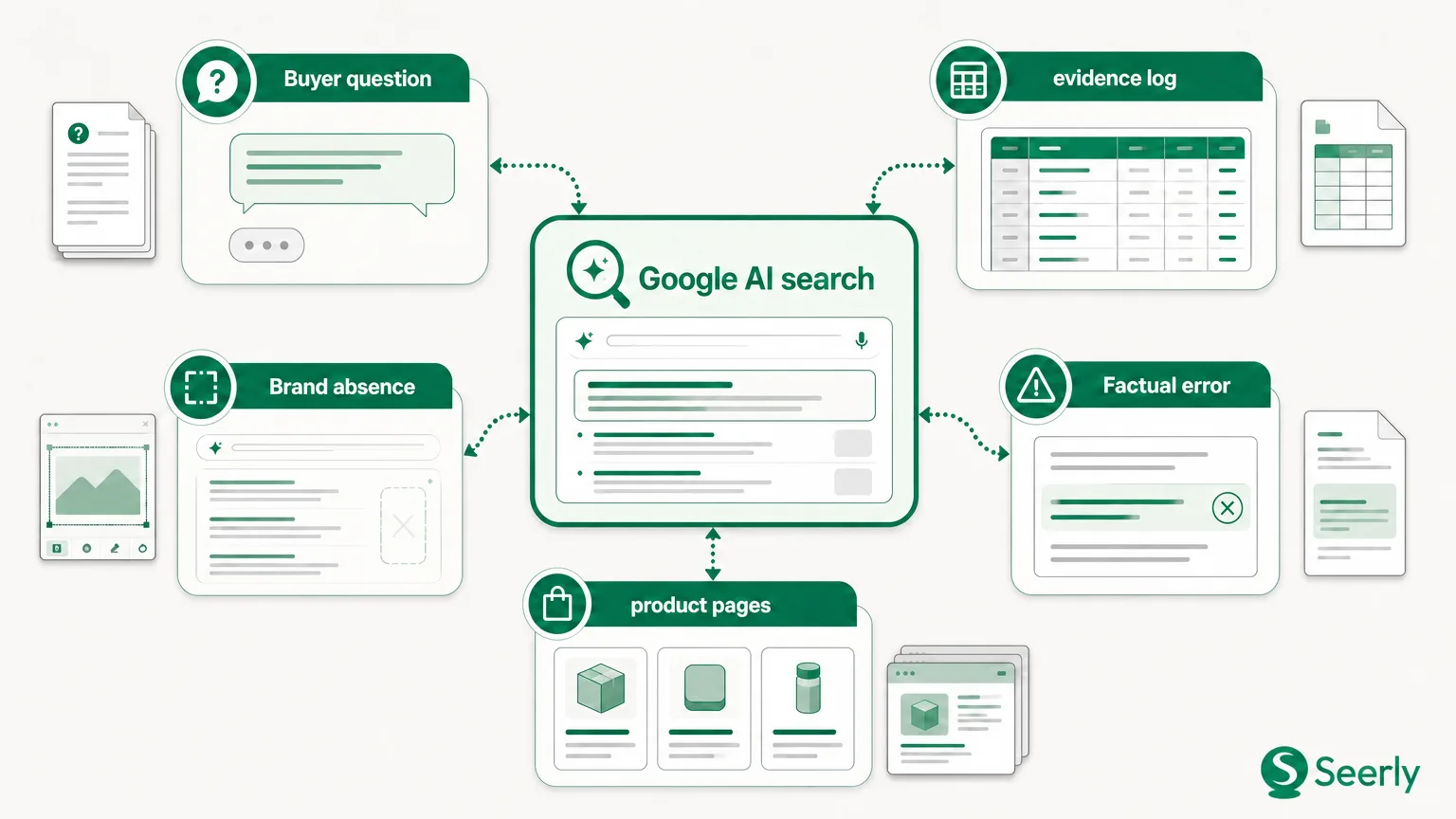
Create a shared evidence log for every review. It can begin as a spreadsheet, but the fields should remain consistent if the process later moves into a platform.
A practical evidence template
| Field | What to record | Why it matters |
|---|---|---|
| Buyer question | Exact search wording and any follow-up | Preserves intent and makes retesting possible |
| Date and market | Review date, country, language and device context where available | Separates change over time from market variation |
| Observed brand claim | The specific statement about your company, product or category | Enables factual validation rather than impressionistic judgment |
| Cited sources | URLs or domains cited in the answer | Shows the evidence base being surfaced |
| Competitors named | Brands mentioned, their role and any comparative claim | Identifies displacement and positioning patterns |
| Answer variation | What changed from a prior observation | Distinguishes a possible trend from normal variability |
| Screenshot or export | Visual proof of the answer and citations | Creates an auditable record for cross-functional review |
| Reviewer notes | Accuracy assessment, risks, hypotheses and next step | Turns observation into a decision-ready item |
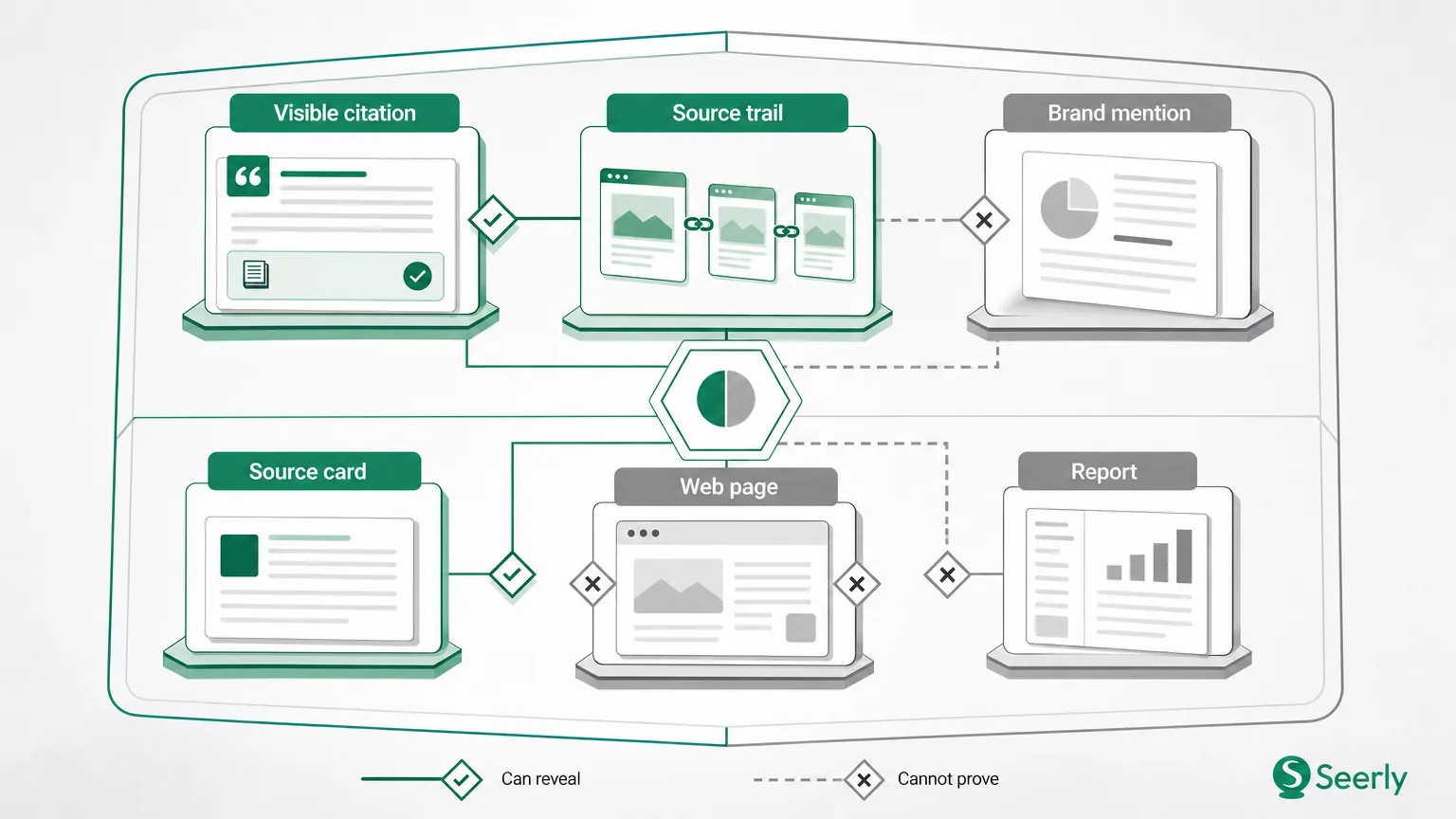
Treat the screenshot as evidence, not the whole analysis. A reviewer should state whether the answer addressed the buyer question, whether the brand claim is verifiable and whether each cited source genuinely supports the statement being made. This is particularly important when an answer mentions a brand without linking to its own documentation.
Consistent capture also helps avoid overreacting to one result. An isolated omission could be normal answer variation. Repeated omission across equivalent high-value questions, markets or review dates is more meaningful. Brand citation monitoring works best when it measures repeatable scenarios and retains the context needed to explain why a result did - or did not - change.
How can you distinguish a missing brand from an inaccurate brand representation?
“Not represented well” is not one problem. Different patterns point to different causes, owners and remedies. Classifying what you see before editing pages prevents teams from applying content updates to what is really a factual-data or third-party credibility issue.
Absence
The answer addresses the category or use case but does not mention your brand, despite the question being relevant. Investigate relevance first: does the page that should support this question explain the use case clearly, use the customer’s terminology and make the relationship between the product and the problem explicit? Then compare the independent sources and competitors that do appear.
Absence is not automatically a defect. A brand need not be included in every category answer. It becomes a priority when the pattern recurs across high-value buyer questions where the brand has a defensible, demonstrable fit.
Factual error
The brand is named, but a material detail is wrong: an outdated product capability, incorrect location, misleading pricing description or false relationship. This is the clearest case for immediate validation and correction. Maintain a current, accessible source of organizational facts - such as documentation, product pages and newsroom updates - then determine where the wrong information may be originating.
If the issue could affect customers, regulated claims, contractual expectations or safety, treat it as more than a marketing task. Escalate to the appropriate product, legal, communications or customer-support owner while preserving the observed evidence.
Weak source support
The answer mentions your brand but relies on vague, irrelevant, old or low-quality sources. This is a trust-signal problem. The brand may be visible today, yet poorly supported when a buyer asks a more detailed follow-up. Investigate whether your own authoritative pages answer the query directly and whether credible third parties validate the relevant claims.
Competitor displacement
A competitor is named in an answer where your brand has comparable relevance, or is positioned more favorably through stronger evidence. This calls for comparative diagnosis, not reflexive imitation. Identify the precise buyer need being answered, the competitor sources cited and the proof those sources provide. The corrective action may be a clearer category page, stronger use-case proof, better documentation or independently published evidence.
Normal answer variation
Answers differ across time or query phrasing without establishing a stable pattern. Continue monitoring rather than declaring victory or failure. This is why visibility benchmarking should report observations separately from conclusions: variation is a feature of AI search, while a pattern is an evidence-based finding.
Which website pages and external sources should be checked when a brand is not represented well?
Use a structured diagnostic rather than immediately publishing more content. First, map the buyer question to the most relevant owned page: a product page for a capability query, a category page for a “what is” question, a comparison page for evaluation, or a help article for implementation detail. If no existing page is a clear answer, that gap is useful evidence for the content roadmap.
Second, inspect supporting documentation. Product facts, pricing conditions, integrations, eligibility, methodology and location details should be current and easy to verify. Avoid leaving important claims solely in PDFs, gated materials or sales decks. Clear on-page language gives both buyers and search systems an accessible source to assess.
Third, check the sources cited in the observed answer. Ask four questions:
- Is the source reputable and current?
- Does it actually address the buyer question, rather than merely mention the brand?
- Is the source supporting a factual claim, an opinion or a broad category statement?
- Is there independent proof - reviews, research, partner documentation, expert coverage or customer evidence - that validates the relevant claim?
This approach protects teams from treating citation volume as quality. A cited source can be authoritative yet irrelevant to the question; conversely, an excellent owned page may be useful to buyers even when it is not visibly cited in one answer. Work on content characteristics that make sources more reusable in AI answers should therefore focus on directness, evidence, maintenance and genuine usefulness - not manufactured signals.
How should Google AI search observations connect to wider search reporting?
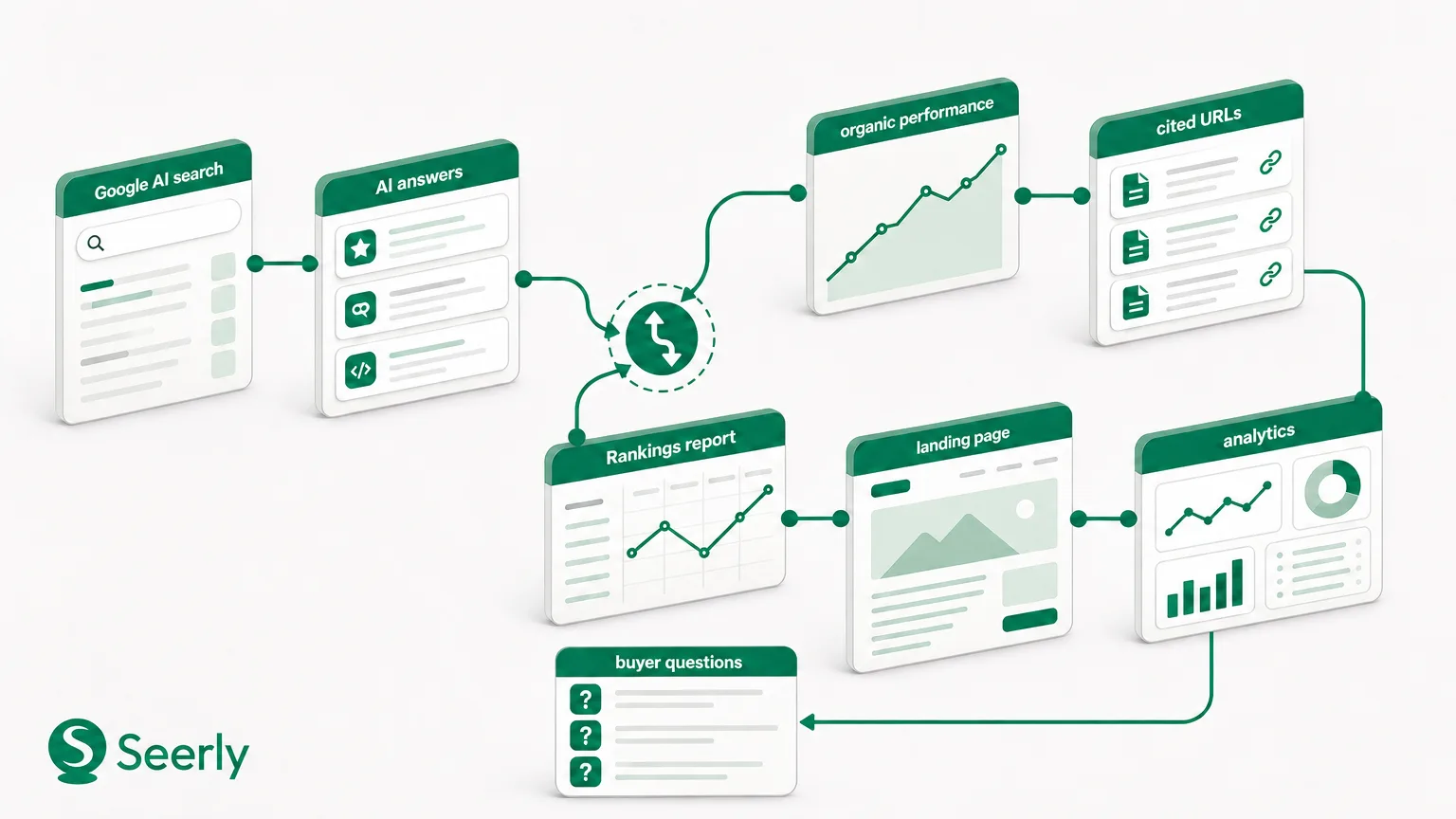
Keep AI-search monitoring connected to search reporting, but do not blend unlike measures into a single unsupported score. Traditional organic data describes impressions, clicks, average position and landing-page performance. AI-search observations describe answer presence, claims, citations, competitors and variation in a defined set of scenarios. Both matter, but they answer different questions.
A practical reporting workflow has five linked views:
- Prompt or question performance: Track the selected buyer questions, market context, brand presence and representation status.
- Citation evidence: Record which owned and external sources were cited, what claims they supported and whether the source was relevant.
- Organic entry pages: Review the pages that earn organic visits for related topics. A page with strong traffic but weak question coverage may need clearer use-case framing; a well-aligned page with low discovery may have a different SEO issue.
- Competitor comparisons: Compare who is named, what proof is surfaced and which questions create the gap. This makes competitor visibility actionable rather than anecdotal.
- Action status: Assign an owner, action type, due date and validation date. Mark whether the response is an owned-content update, factual correction, third-party proof initiative or continued observation.
The result is a reporting system that respects uncertainty. It does not claim that one AI answer caused a traffic change, or that a citation guarantees commercial impact. Instead, it creates a traceable chain from observed experience to the page, evidence and decision behind a corrective action. Teams can extend this into a regular maintenance cadence using a 90-day search-performance maintenance loop.
When should a team act, observe or escalate?
Use a simple decision tree to make monitoring operational.
Act on owned content when repeated observations show that a priority buyer question is unanswered, unclear or poorly matched to your relevant product or category page. Update the page with accurate, direct explanation, supporting evidence and the context a buyer needs to evaluate the claim.
Correct factual information when the answer contains a verifiable error and you can identify outdated or ambiguous owned information. Update the authoritative source first, document the change and recheck the scenario later. Do not assume an immediate answer change proves or disproves the value of the correction.
Build third-party proof when competitors are supported by credible independent sources and your brand lacks equivalent validation. This may involve customer research, transparent methodology, expert commentary, partner documentation or a stronger review and reputation program. The objective is not to manufacture mentions; it is to ensure important claims can be independently substantiated.
Escalate to support, product, legal or communications when an answer could mislead existing customers, create a compliance issue, misstate contractual conditions or signal a recurring product-information problem. Marketing should not be the sole owner of a material factual risk.
Continue observing when the result is isolated, the answer variation is not yet a pattern or the query is not commercially meaningful. Define when it will be reviewed again, rather than allowing it to remain an unresolved dashboard item.
Google AI search should enter the monitoring plan as a disciplined evidence practice, not a replacement for established SEO reporting. Begin with five high-value buyer questions, capture each answer consistently and connect what you observe to pages, sources, competitors and actions. Seerly helps teams bring prompt performance tracking, citation analysis, competitor visibility and tracked follow-through into one AI search visibility workflow - so emerging search experiences can be managed with evidence rather than assumption.