What visible citations reveal - and hide - about AI search answers
A visible citation in Google AI Search can feel like confirmation: the answer mentioned your brand, showed a link, and named a publication. For marketing teams, that is useful evidence - but it is not a verdict on whether the answer is accurate, representative, complete, or likely to recur for another buyer.
This distinction matters because AI-generated results are changing how people interact with search. Pew Research Center found that users clicked a traditional result on 8% of visits where an AI summary appeared, compared with 15% of visits without one; links inside the summary were clicked on just 1% of visits with an AI summary. As AI summaries reshape the path from question to website visit, the wording and sources within the answer can become a meaningful representation layer for a brand.
The practical takeaway is simple: treat visible citations as evidence to investigate, not proof to report in isolation. A defensible record combines the full answer, the exact question, date, brand mention, citation details, audience context, and an assessment of source quality.
What is the difference between a citation, a source trail and a brand mention?
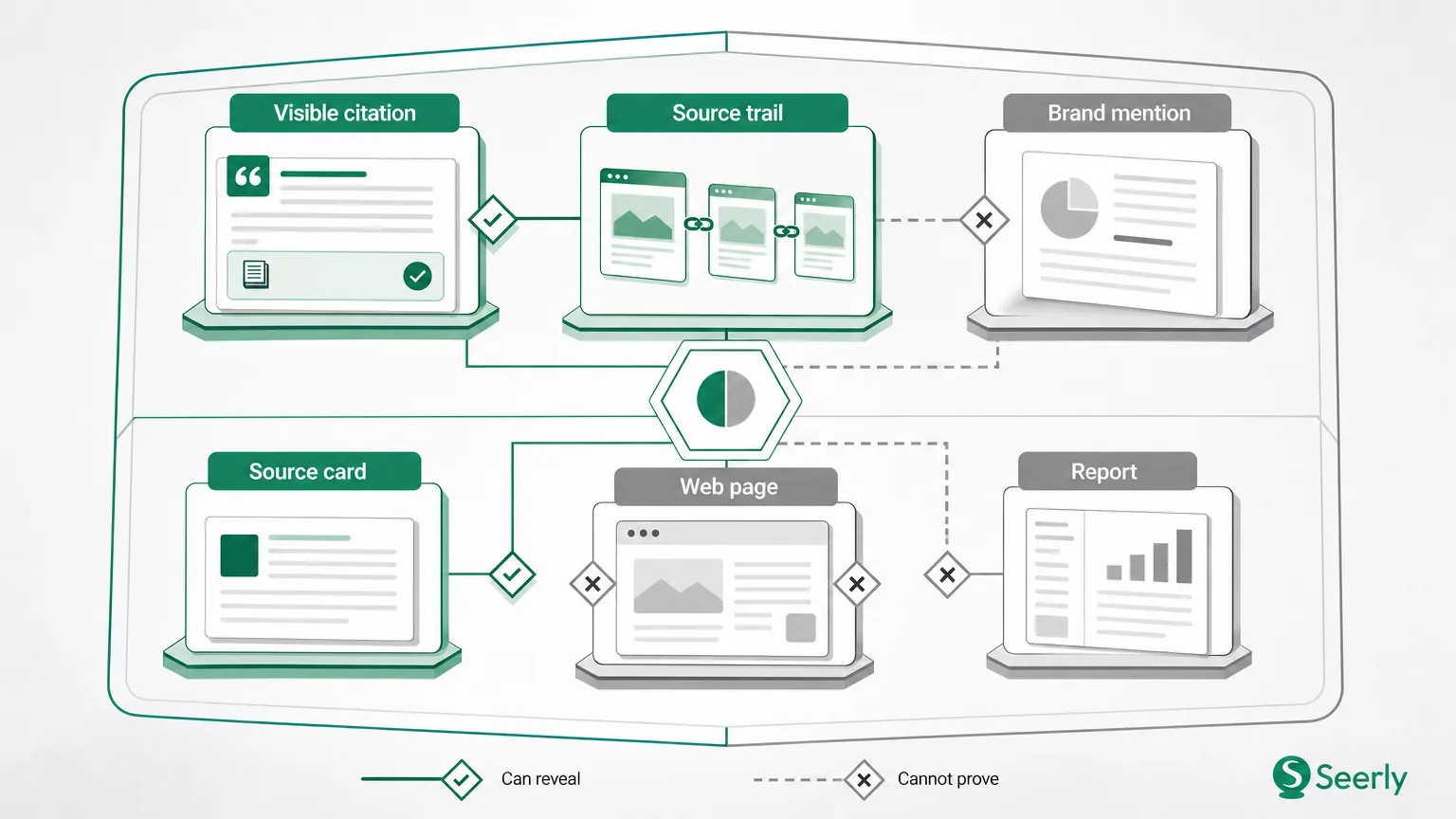
These terms are often used interchangeably in AI search reporting, but they answer different questions. Separating them helps teams avoid overstating what they observed. A brand might be named without being cited, cited without being recommended, or discussed across several sources that reveal a more complex source trail.
| Term | Plain-language definition | What it helps establish | What it does not establish |
|---|---|---|---|
| Citation | A visible link, source card, publisher name, or referenced page attached to an AI answer. | A source was displayed to the searcher in connection with the answer. | That every claim came from that source or that the source validates the whole answer. |
| Source trail | The set of visible sources and contextual clues a reviewer can follow to understand how an answer may have been framed. | Which publications, pages, and domains were surfaced around a response. | The model’s full retrieval, ranking, or reasoning process. |
| Brand mention | Any appearance of a company, product, spokesperson, or branded term in the response. | That the brand appeared in that specific answer. | Positive sentiment, recommendation status, factual accuracy, or visibility across prompts. |
For example, an answer to “best project management software for agencies” may name your company in a comparison, cite an industry publication, and link to a review platform. The brand mention tells you that your company was present. The citation tells you which source was visible. The source trail gives you a starting point for understanding whether the response relied on current product information, an old review, a competitor comparison, or a mixture of sources.
This is especially important in a Google AI search engine context because results can combine links, summaries, follow-up questions, and evolving interface elements. Google describes AI Overviews as providing information with links to supporting web content, while AI Mode is designed for more complex, exploratory questions. Teams should document what was actually shown rather than infer an unseen, complete explanation of how the answer was generated.
What can a visible citation tell us about an AI-generated answer?
A visible citation can establish a limited but useful set of observations. It can show that a particular page or publisher was presented alongside a response, that a source was positioned near a specific statement, and that a user had an available route to inspect further information. This is meaningful for brand citation monitoring because it identifies the public evidence available at that point in time.
Consider this illustrative answer:
“Acme Analytics is a suitable option for mid-market teams that need automated reporting, though it may require technical setup.”
Visible source: Industry Review Weekly - “Top analytics platforms for 2025”
A reviewer can record that Acme Analytics was described as suitable for mid-market teams, that implementation complexity was mentioned, and that a named publication appeared as a visible source. If the source card links directly to the review, the team can inspect its publication date, methodology, author, update history, and factual basis. That is an evidence trail worth preserving.
But wording proximity matters. If the citation appears after the sentence about “automated reporting,” it may be more relevant to that capability than to the statement about technical setup. A citation card displayed at the end of a paragraph may relate to part of the paragraph, several claims, or simply surrounding context. Avoid assigning claim-by-claim support unless the interface makes that relationship clear.
Visible links also help teams assess the quality of the material shaping their representation. A current first-party product page, an established trade publication, a customer review site, and an unmaintained affiliate list are not equivalent evidence. Google itself advises users that AI responses can contain mistakes and encourages them to check information in the linked sources. The same discipline should govern internal reporting.
What can a citation not prove on its own?
A citation is a snapshot, not an audit trail of the entire answer-generation process. It should raise useful review questions, but it cannot settle them. This caution is particularly important when a visible source supports a favourable brand statement, because positive mentions are often the ones teams are most tempted to turn into a performance claim.
Use this limitations checklist before drawing a conclusion:
- Completeness: A displayed source does not prove it was the only source that informed the response. The answer may reflect multiple pages, broader web patterns, or context from the query and follow-up questions.
- Accuracy: A citation does not guarantee that the cited page is current, that the answer interpreted it correctly, or that each adjacent statement is true. Check the primary facts independently, especially prices, features, certifications, eligibility, and comparisons.
- Consistency: One cited answer does not prove that the same representation will appear tomorrow, for a different location, or when wording changes. AI search visibility is best measured across a defined set of high-value buyer questions over time.
- Causation: A source appearing in an answer does not explain why it appeared. It may have been relevant, recent, structured clearly, widely referenced, or simply one of several useful pages for the query.
- Recommendation: A brand being cited, or appearing in a cited article, does not automatically mean Google AI Search recommends it. Read the modifiers: “best for,” “may suit,” “not ideal for,” and “consider” can materially change commercial meaning.
This is why citation counts alone can mislead. A growing count may indicate broader presence, but it can conceal negative wording, poor-quality sources, or weak relevance to revenue-critical questions. Conversely, a single authoritative citation attached to a precise product claim may matter more than several vague mentions.
For reporting, pair citation data with the answer’s language and intent. Seerly’s approach to monitoring brand presence in Google AI chats versus search rankings reflects the broader principle: visibility, citation, sentiment, and discoverability are related measurements, not interchangeable ones.
How should a marketing team capture an answer for later review?
Evidence loses value quickly when teams save only a screenshot or a link. Interfaces change, pages are updated, and stakeholders later need to know what the user actually asked. Create a consistent record while the answer is visible, then store it in a shared location with an owner and review status.
A practical capture workflow has six steps:
-
Record the exact question. Copy the full query verbatim, including qualifiers such as location, company size, use case, budget, or industry. Also note whether it was an initial question or a follow-up, because conversational context can affect the response.
-
Preserve the complete response. Capture the answer in full through a screenshot and searchable text where permitted. Do not save only the sentence that mentions your brand; the surrounding comparison, caveats, and recommendation language determine its meaning.
-
Log each visible citation. Record the publication or page title, destination URL, anchor text or source-card label, and where it appeared relative to the claim. If a citation opens a page, preserve a copy or screenshot of the relevant source section and note its publication or update date.
-
Add time and test conditions. Record the date, time, country or market, language, signed-in state where relevant, device type, and search experience used. These details make future comparison more reliable without pretending that a single test is universal.
-
Describe the audience context. Identify the buyer segment behind the question: for example, “UK operations leaders at 200-1,000-person logistics firms.” This turns an isolated answer into prompt performance tracking tied to a commercial scenario.
-
Write reviewer notes and next action. Classify the finding as accurate, incomplete, misleading, positive, neutral, negative, or requiring escalation. Assign an owner, a proposed action, and a recheck date so the evidence enters an operating process rather than a screenshot archive.
A repeatable format also makes trend analysis possible. When the same prompts are tested monthly or after a product launch, teams can compare what changed: the brand’s presence, answer framing, cited domains, source freshness, and unresolved factual risks. That is more useful than treating every AI answer as a standalone anecdote.
How can teams investigate a potentially misleading brand statement?
Suppose Google AI Search answers, “Northstar CRM offers native accounting integrations for enterprise finance teams,” citing a software directory. The statement sounds commercially valuable, but the product team knows Northstar offers integrations through partners and supports only selected accounting platforms. A citation should trigger triage, not acceptance or panic.
First, verify the claim exactly as written. Is the issue “native,” the supported platforms, enterprise suitability, or all three? Capture the original answer before rerunning anything, then compare the wording with current documentation, release notes, product packaging, and approved positioning. This separates a genuine factual problem from an imprecise but broadly acceptable description.
Second, inspect the cited evidence. Check whether the directory uses old vendor-submitted copy, collapses partner and native integrations into one category, or cites a previous product version. Assess source quality by asking who published it, how recently it was updated, whether it identifies its methodology, and whether the page is independently maintained.
Third, determine the appropriate follow-up action. If the cited page is wrong, request a correction through the publisher’s process and update relevant first-party pages with unambiguous language. If the source is technically correct but easily misread, improve product documentation, comparison content, FAQs, and structured explanations so the distinction is clearer for buyers and publishers alike.
Finally, record the disposition: “Claim inaccurate; source dated; directory correction requested; integration page updated; re-test in 30 days.” That record protects reporting integrity and lets leadership distinguish between an isolated representation issue and a recurring pattern. It also gives content, product marketing, and communications teams a shared factual basis for action.
Which questions should leaders ask before using AI-answer evidence in a report?
How confident should we be in one observation?
Be confident about what was directly observed: the query, answer text, brand mention, and visible citation at a stated date and context. Be less confident about generalising that observation to all searchers, buyer questions, or future results. Reports should label it as a tested instance unless repeated evidence supports a broader trend.
Should we repeat the test?
Yes - especially for high-priority questions or claims with reputational consequences. Repeat using a defined protocol across relevant markets, devices, and wording variations, while preserving the original record rather than overwriting it. A structured prompt universe, such as the one outlined in Seerly’s framework for keyword research and AI-search buyer questions, helps teams test commercially meaningful variations systematically.
When does a finding need human review?
Human review is necessary when an answer makes a regulated, legal, medical, financial, safety, pricing, competitive, or product-capability claim. It is also necessary when wording could materially affect buyer expectations or brand trust. AI-answer evidence can flag an issue quickly, but subject-matter experts should validate facts and approve any external correction or public response.
Build a record, not a conclusion
Visible citations in Google AI Search are valuable because they make part of an AI answer inspectable. They reveal which sources users can see, how a brand was described, and where a reviewer should begin. They cannot, by themselves, prove accuracy, completeness, consistency, or why a source was selected.
Start with your highest-priority buyer questions and create a citation-review record that preserves the answer wording, prompt, date, brand mention, audience context, visible sources, and source-quality assessment. Then monitor how those records change over time. Seerly helps marketing teams turn that evidence into ongoing AI search visibility monitoring, citation analysis, and more accountable brand representation decisions.