When AI visibility and organic search disagree, what should teams investigate first?
A strong organic ranking can coexist with weak representation in Google AI search. A brand can also appear repeatedly in AI-generated answers while sending little qualified traffic to the site. Neither outcome proves that content is succeeding or failing on its own.
This matters because AI-powered search experiences and traditional result pages expose users to information at different stages of discovery. Google has said that AI features are designed to help people ask more complex questions and continue their exploration, while links in AI Overviews can generate “higher-quality clicks” for some queries and journeys. At the same time, observed user behavior shows that Google users are less likely to click traditional result links when an AI summary appears.
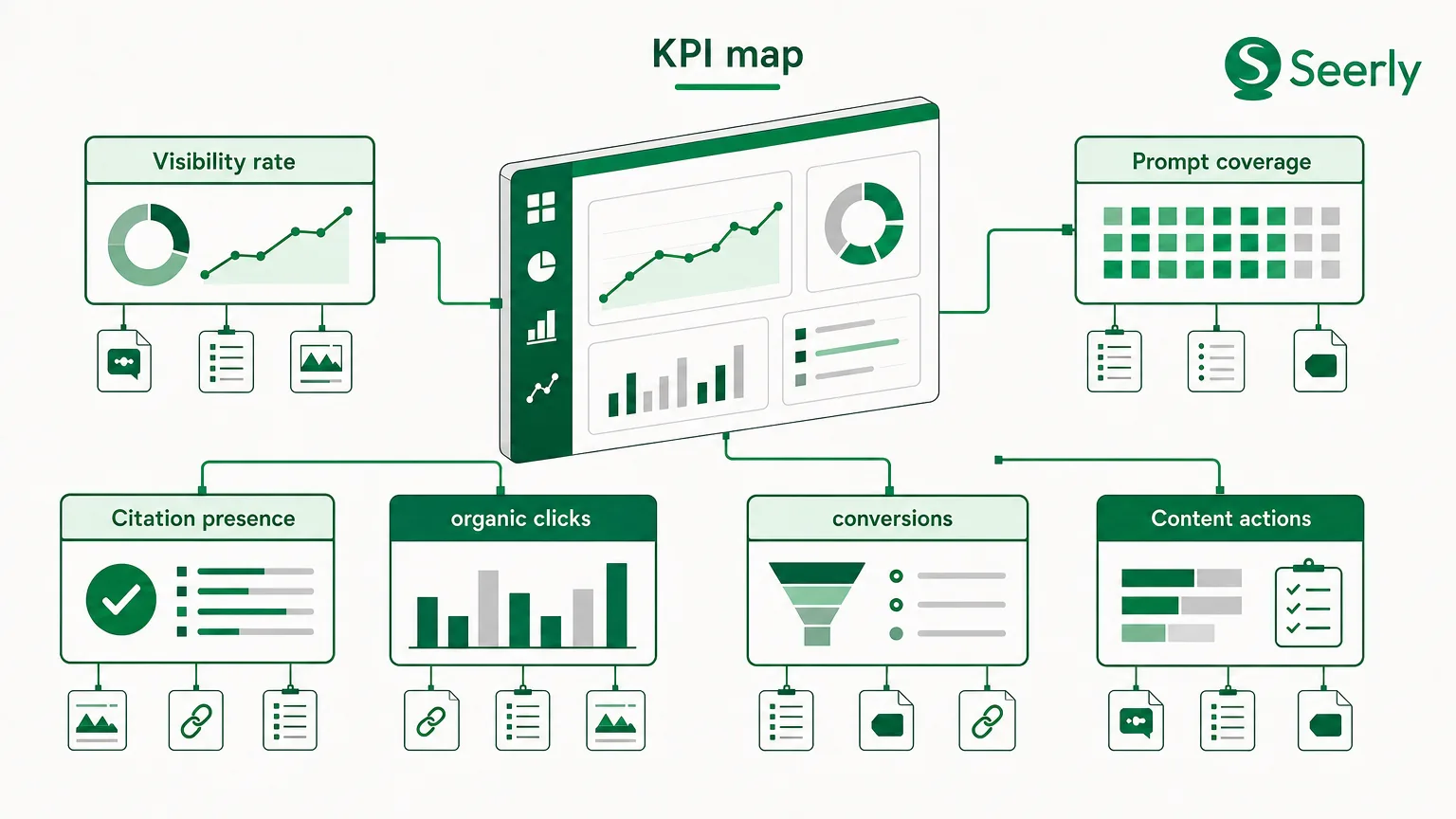
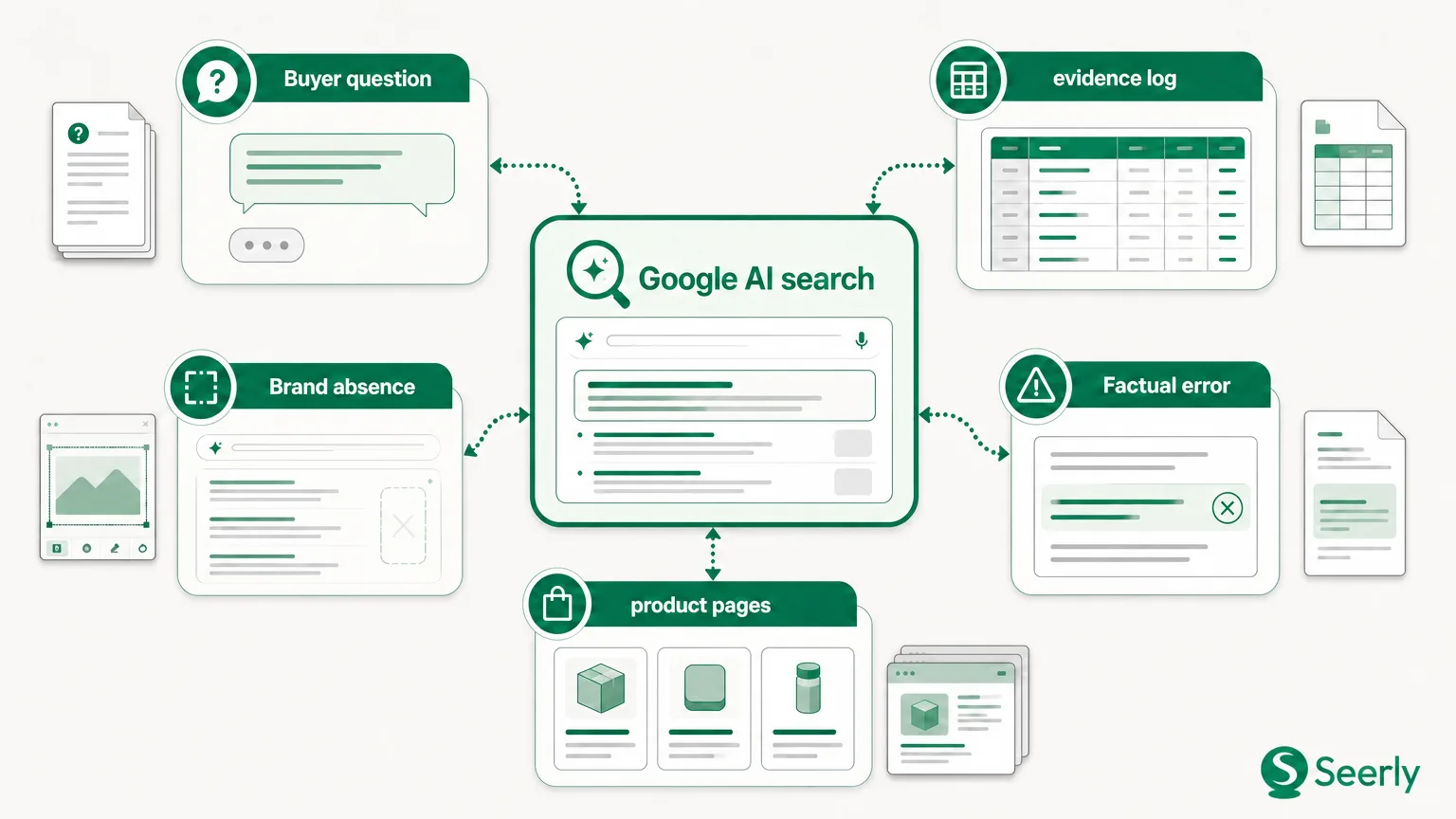
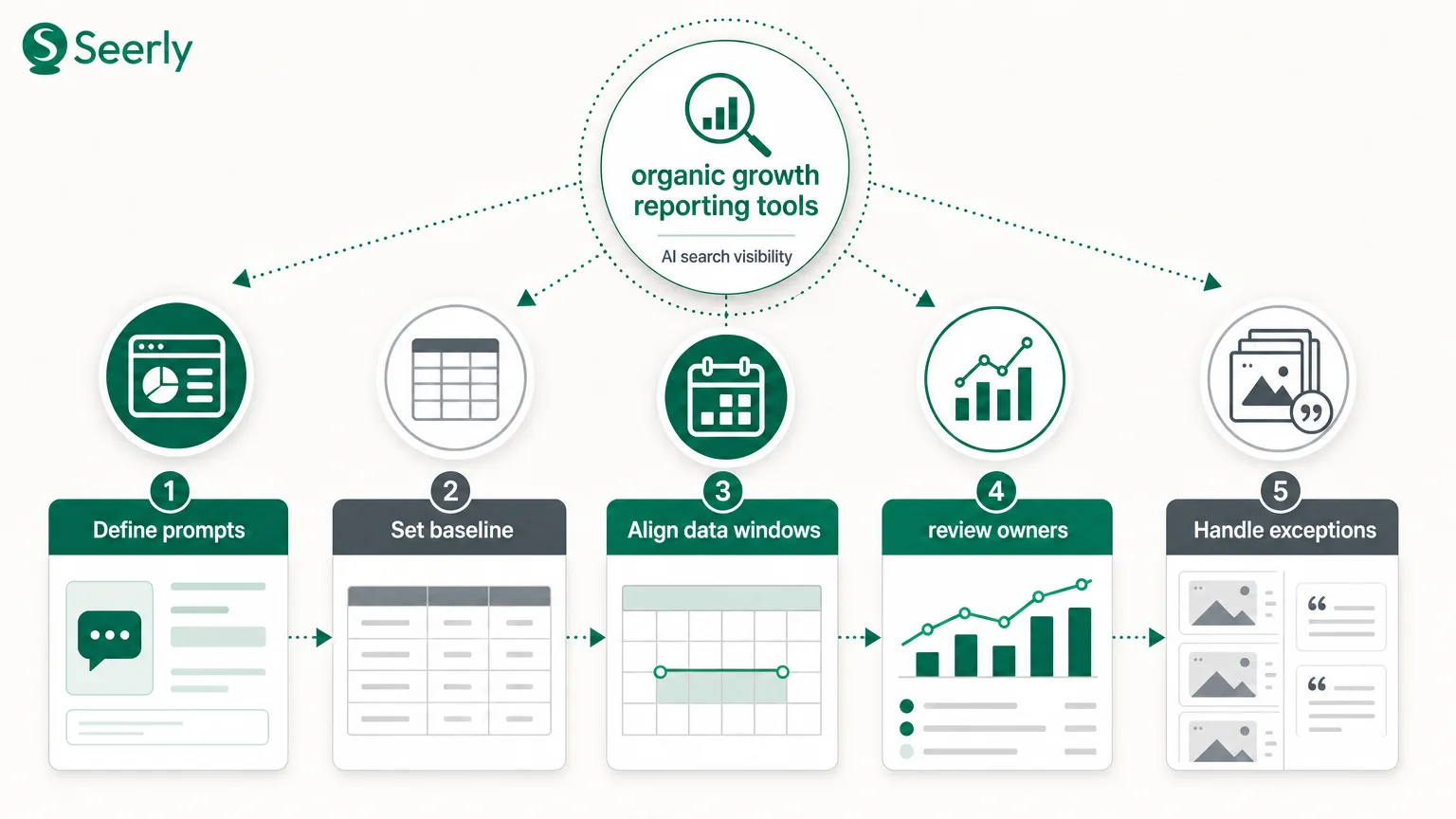
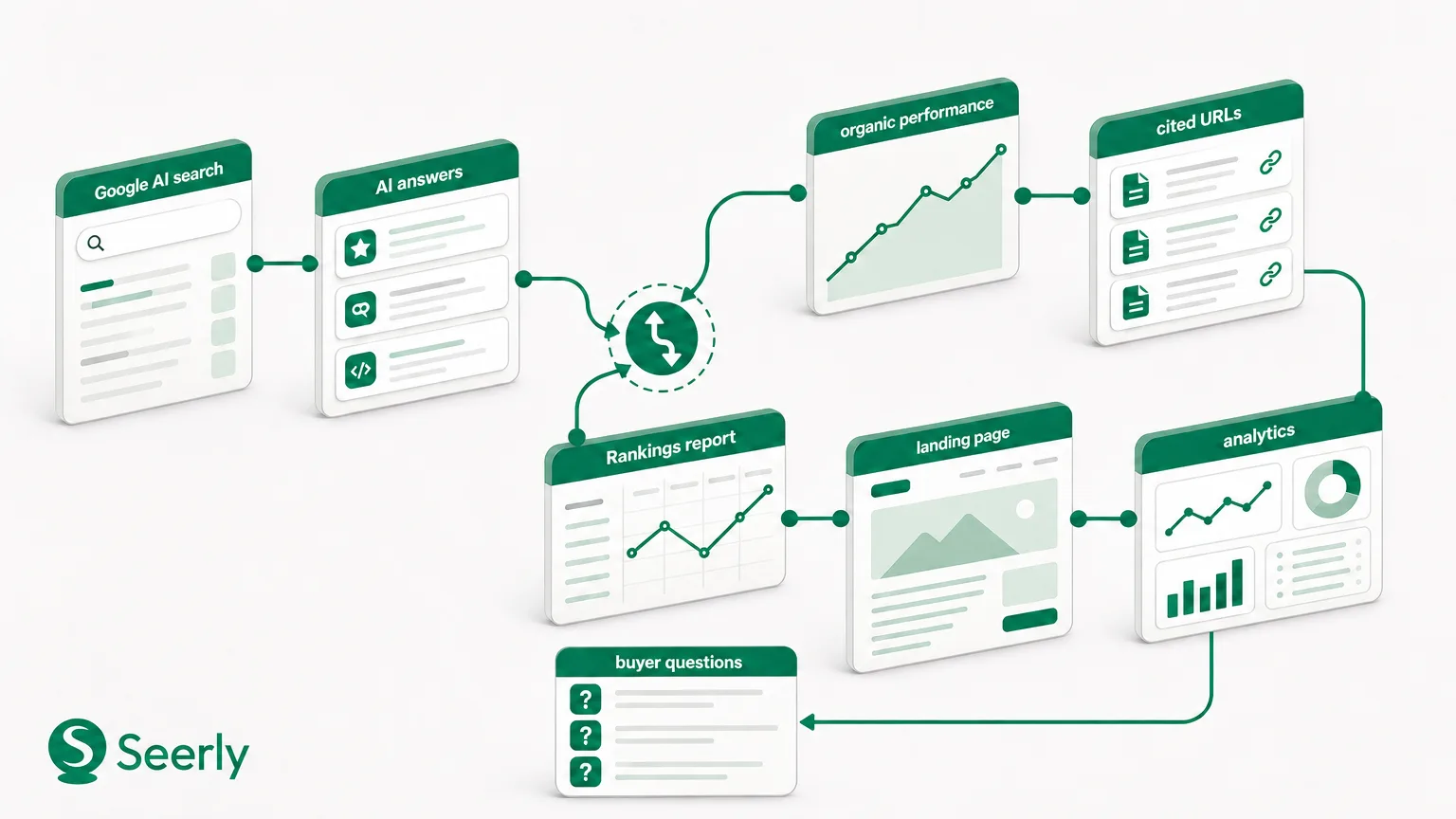
The practical question for marketing leaders is: Where can teams track AI visibility alongside organic traffic and SEO KPIs? The answer is not a single blended score. Teams need one evidence record that joins AI-search observations, citations, rankings, landing-page performance, and conversion context - then uses disagreements between those signals to form a testable hypothesis.
What does it mean when AI visibility and organic performance point in different directions?
Google AI search visibility and conventional SEO performance measure related but distinct events. Organic rankings indicate whether a page is eligible to appear prominently for a search query. AI visibility indicates whether a brand, product, source, or URL was represented in a generated response for a specific question, context, market, device, and date. Traffic and conversions then show what happened after a visitor reached the site.
Treating these as interchangeable creates reporting errors. A ranking report may overlook lost representation in high-value buyer questions, while an AI visibility report can overstate commercial impact if cited answers do not produce relevant visits or pipeline. The useful unit of analysis is the relationship between signals.
| Signal pattern | What it may indicate | What to investigate first |
|---|---|---|
| Strong organic traffic, weak AI representation | Existing demand and rankings are working, but the brand is not being selected or cited in AI answers | Whether AI answers cite competitors, third-party reviews, or more directly answer-focused pages |
| High AI visibility, low qualified traffic | The brand is present during research, but the scenario may be early-stage, poorly matched, or not compelling users to visit | Prompt intent, cited page relevance, referral quality, and assisted conversions |
| Stable rankings, changing AI answers | Traditional rankings have not moved, but source selection or answer framing has changed | Changes in cited domains, brand sentiment, product facts, and answer composition |
| Lower rankings, stable AI representation | The brand is still being referenced for a buyer question despite weakening conventional positions | Whether the cited asset is authoritative, whether other pages lost visibility, and whether traffic has actually declined |
| Falling AI visibility and falling conversions | A potentially material discovery issue, particularly for commercial query groups | Technical accessibility, content accuracy, competitor movement, and conversion-path changes |
Strong organic traffic with weak AI representation
Consider a B2B software company whose comparison pages produce steady organic sessions and demo requests. For “best workflow automation platform” and related terms, its pages rank well enough to drive visits. Yet Google AI search responses repeatedly recommend competitors and cite review platforms, analyst content, and competing vendor pages instead of the company’s resources.
The first conclusion should not be “SEO is broken.” Organic demand is still reaching the site. A better hypothesis is that the company’s pages serve traditional click-oriented discovery but do not provide the concise, substantiated comparison information that the AI answer is selecting or synthesizing. The team should inspect cited sources, compare claim coverage, validate product details, and assess whether the relevant pages make trust signals, evidence, and category fit easy to verify.
High AI visibility without qualified visits
Now consider a cybersecurity brand that appears in answers to broad educational questions such as “how does ransomware work?” The brand receives frequent mentions and citations, but analytics shows little referral traffic and no meaningful increase in qualified sessions or conversions. This is not necessarily a bad outcome - brand familiarity can matter before a buyer is ready - but it is not evidence of revenue impact.
The investigation should begin with the research stage represented by those questions. Broad informational answers may create awareness, whereas solution-comparison, implementation, pricing, and vendor-evaluation questions are more likely to align with a measurable commercial journey. Separate visibility by query group before deciding whether the team needs a different content asset, a stronger call to action, or simply different reporting expectations.
Stable rankings alongside changing AI answers
A third scenario is subtler: rankings remain stable, but the wording of AI answers changes. A brand may go from being described as a leading option to being omitted from a shortlist, or remain mentioned while losing its direct citation. Because generated answers can vary with query phrasing, available sources, location, and product context, a single observation is insufficient.
Track the pattern over repeated checks. Google’s guidance explains that AI features may show links to support further exploration, making cited sources an important part of the evidence - not just the answer text. If the same query group repeatedly shifts toward competitor sources while your rankings remain flat, investigate source-level representation rather than waiting for position tracking to show a change.
Which data points belong in a shared search-visibility record?
A shared record gives SEO, content, paid media, product marketing, and agency teams a common fact base. It does not claim a direct causal connection where none exists. Instead, it preserves the context needed to compare observations and decide what deserves deeper analysis.
Start with a limited set of priority buyer questions. These should come from sales calls, support tickets, onsite search, conversion paths, keyword research, and known competitive objections - not an unlimited list of speculative AI queries. Seerly’s guide to turning Google Trends research into AI buyer questions can help teams translate demand patterns into research scenarios that are practical to monitor.
Build the record in a consistent order
Use the following fields for every monitored scenario:
-
Priority buyer question: Record the exact question or search phrasing tested, such as “best payroll software for a 100-person UK company.” Preserve modifiers that change intent, including audience, budget, region, industry, or use case.
-
Query group and commercial role: Assign the question to a consistent cluster - awareness, comparison, pricing, implementation, replacement, or support. Note the affected product area and the landing page that should serve the searcher if they continue to the site.
-
AI representation: Capture whether the brand was mentioned, how it was described, whether it was recommended, and whether sentiment or qualification changed. Do not reduce this to “visible” or “not visible”; a mention as an unsuitable option means something different from a favorable recommendation.
-
Citations and cited URLs: Save the source links used in the answer, identify whether your own domain was cited, and distinguish between a homepage, product page, research article, third-party review, or competitor source. Citation evidence often reveals the gap more clearly than a mention count does.
-
Organic search context: Record the tracked query, ranking trend or position range, impressions, clicks, and the actual organic landing page. Search Console data should be grouped over meaningful date ranges rather than interpreted as a daily verdict.
-
Traffic and conversion context: Add sessions, engaged sessions, conversion events, assisted conversions where available, lead quality, and relevant revenue or pipeline stage. Define the conversion window in advance so monthly comparisons remain consistent.
-
Conditions and evidence: Include date and time, country or market, language, device, search experience, screenshots, and source links. These details make the observation reproducible and prevent teams from comparing unlike conditions.
A reproducible example record
A spreadsheet, warehouse table, or reporting workspace can hold the same structure. The example below is deliberately simple; teams can add fields for industry, audience segment, campaign period, or content owner when needed.
| Field | Example entry |
|---|---|
| Priority buyer question | “Best project management software for creative agencies” |
| Query group | Commercial comparison |
| Market and device | United States, desktop |
| Check date | 14 May 2026 |
| AI answer observation | Brand mentioned in a five-tool list, described as suitable for internal teams |
| Brand citation | No direct citation to brand domain |
| Cited sources | Two review sites, competitor pricing page, industry publication |
| Organic landing page | /solutions/creative-agencies |
| Organic trend | Positions 5-7 over prior 28 days; clicks stable |
| Traffic and conversion context | Organic sessions stable; demo-start rate below the comparison-page average |
| Working hypothesis | AI answer lacks evidence that the product supports agency client workflows |
| Owner and validation date | Product marketing owner; retest after page update in 30 days |
The record does not prove that revising the landing page will change AI representation. It does, however, create a falsifiable question: if the page adds verifiable client workflow evidence and clearer comparative information, do direct citations, answer framing, qualified visits, or conversion behavior change over the next validation period? This is much more useful than reporting a generic visibility score.
How can AI-assisted analysis support a reporting workflow without replacing verification?
AI can reduce the manual burden of reviewing repeated observations, particularly when a team monitors many questions across markets. It can summarize changes in answer language, group prompts by likely intent, identify recurring cited domains, and flag cases where a competitor becomes newly prominent. Those are analysis tasks, not evidence.
Use AI assistance as a first-pass analyst. Ask it to classify questions into commercial stages, cluster similar cited URLs, summarize the most common qualification language around your brand, or identify answer changes that warrant a human review. A reporting workflow becomes faster when analysts spend their time interpreting meaningful anomalies rather than copying text between systems.
Verification checklist for leadership or client reporting
Before an insight appears in an executive dashboard, client deck, or strategic recommendation, require a reviewer to confirm:
- The exact question, market, language, device, date, and search experience were recorded.
- Screenshots or exports show the original AI answer, including linked citations where available.
- Every cited URL is retained and categorized by source type.
- Organic rankings, clicks, landing-page traffic, and conversions use the same comparison period.
- The team distinguishes a repeated pattern from a one-off answer variation.
- The conclusion describes an observation and hypothesis, not an unsupported causal claim.
- A named owner, planned action, and revalidation date are attached to material findings.
This distinction protects credibility. “Our brand was absent from three monitored comparison answers, all of which cited two competitor pages” is verifiable. “Google AI search has stopped recommending us because our content is weak” is not, unless the team has tested alternative explanations and assembled evidence that supports it.
For agencies, this discipline is especially important. Clients need to see what was observed, what changed, what remains uncertain, and what will be checked next. A useful report does not hide variability; it makes the limits of the data explicit while still recommending proportionate action.
Which search experiences should teams monitor for their priority questions?
There is no universal Google AI search engine monitoring set. A consumer brand with high consideration purchases may need different scenarios from an enterprise vendor whose buyers research through comparison pages, documentation, review sites, and long buying committees. Monitoring should follow actual audience behavior and commercial exposure.
Google continues to develop AI search experiences, including AI Mode for more conversational and exploratory searching. That makes scenario selection more important, not less: a short conventional query, a detailed conversational request, and an AI Overview-triggering search can surface different sources and answer structures.
| Audience behavior | Prioritize these contexts | Evidence to connect |
|---|---|---|
| Quick local or transactional decision | Standard Google results, local results where relevant, AI summaries on service questions | Calls, directions, bookings, location-page traffic |
| Complex B2B evaluation | AI Mode-style detailed questions, conventional comparison queries, review and category searches | Demo requests, assisted pipeline, solution-page engagement |
| High-stakes product research | Detailed question chains, authoritative-source queries, feature and implementation searches | Qualified sessions, documentation usage, sales objections |
| Existing-customer support | Standard search, support questions, documentation-focused AI answers | Deflection, support tickets, help-centre visits |
| Brand reputation or category leadership | Brand-versus-competitor questions, recommendations, “best for” scenarios | Sentiment, cited domains, branded demand, referral quality |
Prioritize a bounded prompt set
Start with 20 to 50 high-value questions, depending on team capacity and market complexity. Score each one using three inputs: commercial importance, frequency in real customer conversations, and the importance of the affected landing page or product category. A question that influences enterprise shortlists deserves more monitoring than a low-intent variation with negligible conversion relevance.
Revisit the set quarterly rather than adding every new wording variation. Query groups should remain stable enough to show trends, while individual questions can be refreshed as products, buyer objections, and market language change. For a complementary framework, review how to monitor brand presence in Google AI chats alongside search rankings.
When should a visibility change lead to action rather than another reporting cycle?
One changed answer is an observation. A repeatable shift with commercial corroboration is an investigation priority. The difference prevents teams from overreacting to normal variation while ensuring that meaningful representation losses do not disappear into a monthly dashboard.
Escalate when the same pattern appears across repeated checks or related questions, particularly when it affects high-value buyer scenarios. Then ask whether the pattern is supported by other evidence: declining clicks to the affected page, lower conversion quality, altered cited sources, new competitor representation, technical changes, or product information that has become outdated.
Escalation checklist
Move from monitoring to action when most of the following are true:
- The AI visibility change appears across multiple checks, dates, or closely related buyer questions.
- The affected questions are commercially important or map to priority landing pages.
- Organic clicks, impressions, engagement, conversions, or assisted pipeline show a related shift - or the team has a documented reason why they may not.
- The cited-source mix has changed, such as competitors gaining citations, trusted third-party sources replacing your pages, or your cited URL disappearing.
- Competitor movement has been checked rather than assumed.
- A review confirms that the affected page is indexable, accurate, current, and technically accessible.
- An owner is assigned to investigate content, technical foundations, product messaging, or reporting definitions.
- The team sets a validation date and defines what evidence would support or challenge the proposed action.
Actions should match the diagnosed problem. If third-party reviews dominate citation patterns, the response may include reputation and evidence work rather than a simple keyword rewrite. If a product page is cited but visitors do not convert, focus on intent alignment, page experience, and conversion context. If the answer repeatedly misstates product capability, validate source accuracy across owned pages, documentation, and influential external references before changing reporting assumptions.
Build an evidence record, not a vanity score
When AI visibility and organic search disagree, do not force them into one conclusion. The disagreement is often the most valuable signal because it identifies where discovery, representation, traffic, and conversion are no longer telling the same story.
A shared search-visibility record helps teams retain the question, answer, citations, landing page, rankings, traffic, conversion context, and conditions behind every observation. That record makes it possible to distinguish normal variation from a repeatable issue - and to decide whether content, technical foundations, external trust signals, or measurement assumptions need attention.
Use Seerly to monitor priority AI-search scenarios alongside SEO performance, capture citation evidence, benchmark competitor representation, and validate whether content or site changes improve how your brand is represented over time.