From Search Console Setup to Search Visibility: A Practical Playbook for Getting Found in Google and AI Answers

If your site is “on Google,” that only means Google can find some of your pages. It does not mean the right buyers will consistently discover them, click them, or see them reused in AI-generated answers. That gap is where most teams lose momentum: they complete the setup tasks, submit a sitemap, check a few indexing reports, and then stall before turning that data into a repeatable visibility system.
That matters more now because discoverability is fragmenting. Search behavior has long depended on relevance, wording, and result presentation, and classic research on information retrieval showed that users’ choices are shaped not just by presence in results but by how systems rank and present information. Studies on search behavior and ranking effects found that users disproportionately engage with what appears most visible and most immediately useful, which makes searchability as much a presentation problem as an indexing problem users disproportionately select higher-ranked results and result relevance judgments are tightly linked to information-seeking behavior. At the same time, Google continually refines how it surfaces content, with its own team noting that it makes thousands of improvements to Search each year. In parallel, AI discovery is creating a second visibility layer, where a page may rank and still fail to be cited or summarized well.
For SaaS marketers, founders, and growth leads, the practical takeaway is simple: better google searchability is not one fix. It is an operating loop. You verify ownership, confirm coverage, identify where Google is already testing your pages, improve weak visibility signals, and then make those pages easier for AI systems to summarize and reuse. This guide walks through that loop from setup to weekly execution.
Why “being indexed” and “being found” are different problems
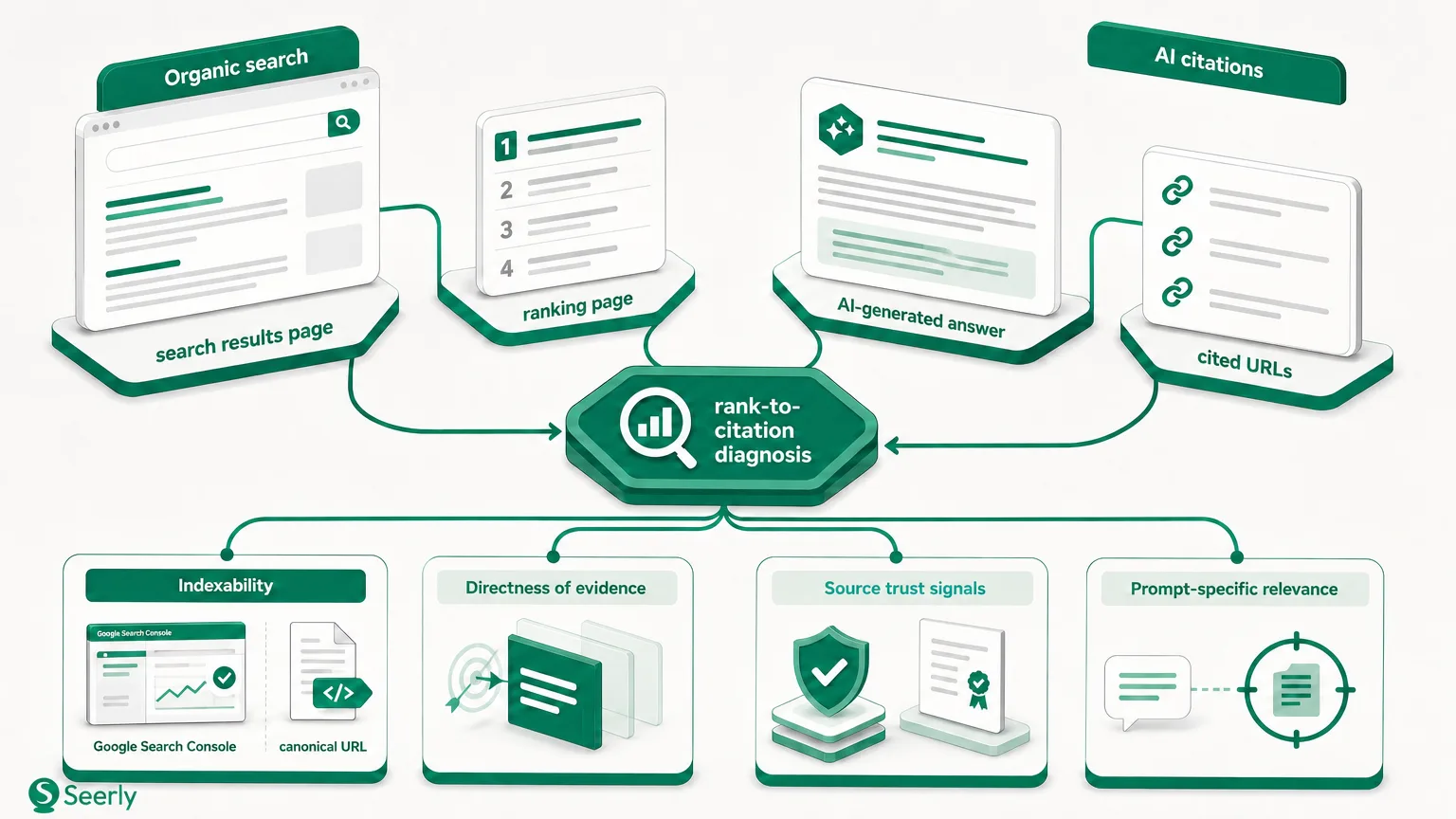
Indexing is a technical state. Search visibility is a market outcome. A URL can be crawled and included in Google’s index, yet still receive almost no meaningful impressions because it is poorly titled, weakly linked, mismatched to intent, or overshadowed by stronger alternatives. That distinction is easy to miss because Search Console gives teams the comforting signal that a page exists in Google, while hiding the more strategic question: what does Google think this page is actually about?
That distinction matters even more in an AI-influenced discovery environment. Traditional SEO reporting tells you whether demand exists and whether your page is entering result sets. It does not automatically tell you whether your content is structured in a way that makes answer engines confident enough to quote or synthesize it. Recent work on AI search and retrieval is increasingly focused on answer quality, retrieval grounding, and citation behavior, rather than simple rank position alone. Research into retrieval-augmented systems and answer grounding reflects the growing importance of whether content can be extracted, attributed, and reused cleanly by AI systems retrieval-grounded answer quality has become a central evaluation focus in AI search research.
So the job is not “get indexed, then wait.” The job is to create a feedback loop where technical eligibility, query-level demand, and answer-readiness all reinforce each other.
Step 1: Build the baseline for Google searchability
Before you analyze keywords or rewrite pages, make sure your site is truly eligible to surface in search. Treat this as a practical checklist, not a one-time setup ritual.
Verify the domain property
In Google Search Console, verify the domain-level property rather than just a URL-prefix property when possible. Domain verification gives you a fuller view across subdomains and protocols, which matters if your content lives across marketing pages, docs, blog content, or app subdomains. If you only verify part of the site, your reporting can become fragmented and lead to bad prioritization.
A complete property view also makes coverage analysis easier. If your blog drives discovery but your product pages sit on a separate subdomain, you want those signals in one place. For growth teams, incomplete verification often creates the false impression that searchability is weak across the site when the actual problem is reporting blind spots.
Confirm your sitemap is valid and useful
Submitting a sitemap does not guarantee rankings, but it does improve clarity around what you want crawled. Your sitemap should include canonical, index-worthy URLs only. Do not fill it with redirected, noindexed, duplicate, filtered, or thin utility pages. A noisy sitemap wastes attention and makes coverage review harder.
Check the Sitemaps report in Search Console and confirm three things: the sitemap was fetched successfully, important URLs are included, and newly published content is appearing there quickly. If your high-value content is missing from the sitemap, you are slowing down discovery for no reason.
Review indexing and coverage health
Next, move to the Page Indexing or Coverage reporting and look for patterns rather than isolated errors. The important question is not whether there are “some excluded pages,” because exclusions are normal. The important question is whether revenue-relevant pages are excluded for preventable reasons such as noindex, soft 404 behavior, duplicates without clear canonicals, crawl anomalies, or redirect chains.
Use a simple triage framework:
- Expected exclusions: admin pages, parameterized URLs, intentional duplicates, thank-you pages
- Unexpected exclusions: product pages, feature pages, comparison pages, high-intent blog posts
- High-priority blockers: canonical confusion, accidental noindex, broken internal links, server instability
If a page is not indexed, you have a technical problem. If it is indexed but invisible, you have a relevance or presentation problem.
Check whether important pages are actually eligible to rank
Eligibility goes beyond indexation. Review each core page template and ask:
- Does the page have a unique title and meta description?
- Is the main topic obvious in the H1 and opening section?
- Is there enough original substance to satisfy the likely query?
- Does the page have internal links pointing to it with descriptive anchor text?
- Can Google easily infer what action or audience the page is for?
Many pages are technically searchable but practically weak because they read like brand collateral rather than search answers. If the title says “Platform Overview” and the page vaguely discusses benefits, Google has very little reason to surface it for a concrete software-related query.
Step 2: Turn Search Console data into a visibility workflow
Once the baseline is clean, the next step is not “do keyword research” in the abstract. It is to use Search Console as evidence of what Google already associates with your site. This is the fastest way to improve google searchability because it builds on existing signals instead of guessing from scratch.
Export the Performance report with queries, pages, impressions, clicks, CTR, and average position for the last 90 days. Then sort the data into three working buckets.
Bucket 1: Pages earning impressions but underperforming on CTR
These are pages that already show up, but searchers are not choosing them often enough. In many SaaS sites, these are feature pages, integration pages, and blog posts sitting in positions 4 to 15 with decent impression counts and weak click-through rates.
The workflow is straightforward. Filter for pages with meaningful impressions and below-benchmark CTR relative to position. Then review the search snippet against the actual query set. Usually the problem is one of four things: the title is generic, the description does not match intent, the page targets too broad a topic, or the page lacks a direct answer that makes Google generate a compelling snippet.
For example, imagine a page about customer support analytics that receives impressions for “support analytics software,” “help desk reporting,” and “customer service dashboards,” but the title tag says “Analytics for Modern Teams.” That is not a technical failure. It is a message clarity failure. Rewrite the title around the dominant query pattern, tighten the intro, and make the first section answer the search need directly.
This is also where campaign measurement discipline helps. If you are trying to compare organic, paid, and AI-assisted traffic patterns cleanly, a structured tagging approach makes later analysis much easier. Seerly’s guide to clean UTM rules for measuring organic, paid, and AI traffic together is useful if your attribution reporting is muddy.
Bucket 2: Pages visible for the wrong terms
This is one of the most overlooked searchability problems. A page may get impressions, but for queries that are too broad, too academic, too unrelated to buying intent, or simply off-topic. That means Google understands something about the page, but not the thing you want it to rank for.
Suppose your “AI SEO platform” page draws impressions for “what is ai in search,” “search engine definition,” and other educational queries. That tells you the page is sending mixed signals. It may have too much introductory explanation, not enough category language, or headings that dilute the core commercial topic. In that case, the fix is not more traffic. It is tighter topic framing.
Review the query list and mark terms as:
- aligned and useful
- loosely related but low intent
- misleading or irrelevant
Then adjust the page accordingly. Move abstract definitions lower down. Strengthen comparison-oriented language if buyers are evaluating options. Add proof elements, use-case framing, and audience-specific headings. If necessary, spin out an educational article so the commercial page can stay focused on its actual job.
This is where internal linking matters. If your blog repeatedly links to a money page with vague anchors like “learn more,” you are wasting semantic reinforcement. Use descriptive anchors that reflect the target topic. If you are building a broader process around AI-era search visibility, Seerly’s post on monitoring brand presence across Google, AI chats, and search rankings complements this step well.
Bucket 3: Emerging queries that should become new content
The most valuable Search Console insights are often in the “almost” queries: low-click, growing-impression terms that suggest Google is testing your site for adjacent demand. These are not just keywords. They are signals of expanding topical authority.
Look for queries that meet three conditions:
- impressions are rising over the last few weeks or months
- your site has no dedicated page that fully addresses them
- the term is commercially or strategically relevant
For a SaaS company, this might mean seeing impressions for “ai search visibility,” “brand citations in ai answers,” or “compare [category] tools for enterprise” before you have dedicated pages for those topics. That is your content roadmap emerging from live search data.
Build one new page at a time around the strongest emerging cluster. Use the query wording to shape the title, H1, intro, and subheadings. Then internally link to it from related pages that already have authority. This turns Search Console from a reporting dashboard into a content planning engine. If your team needs a clearer bridge from keyword work to AI-led discovery topics, Seerly’s article on what keyword research actually helps you choose the right AI marketing tools offers a helpful adjacent lens.
Step 3: Measure traditional search visibility separately from AI-answer readiness
Classic search metrics still matter. Impressions tell you where demand exists. Clicks tell you whether your snippet and ranking earn action. Average position can show whether a page is entering competitive result sets. But none of those metrics tells you whether your content is easy for AI systems to quote, compare, or summarize.
That is a separate readiness layer. Emerging analysis of AI search behavior suggests that answer systems reward content that is easy to extract, attribute, and synthesize across sources. In practice, that means a page can be strong for Google rankings and still weak for AI answer inclusion if it buries definitions, lacks evidence, uses vague structure, or never states the answer clearly. Research on AI search ecosystems and visibility patterns increasingly points to answer selection behavior as a distinct evaluation challenge AI search visibility depends on more than traditional rank signals alone, while local and brand studies are already documenting differences between search rankings and answer-engine mention rates brand visibility in AI answer environments diverges from classic search rankings.
A practical AI-readiness review should ask five questions of every important page:
Is there a concise summary near the top?
The first 100 to 150 words should clearly answer the core question or define the page’s value. If an answer engine has to infer the point from scattered sections, your page is harder to reuse.
Are there proof elements?
Include data points, examples, customer evidence, benchmarks, or process details. AI systems and human readers both respond better to content that demonstrates substance rather than making unsupported claims.
Is the structure scannable?
Use logical H2s, H3s, short sections, tables where relevant, and plain-language transitions. Retrieval systems benefit from clean segmentation because it improves extractability.
Is the language comparison-friendly?
Many high-intent queries are comparative, even when the user does not use “vs” wording. If your page helps distinguish categories, methods, tradeoffs, or alternatives, it is more reusable in decision-support answers.
Is there a direct answer before the brand narrative?
Teams often lead with positioning copy and only answer the query halfway down the page. Reverse that. State the answer first, then expand with context.
Step 4: Diagnose why searchability stays weak after indexing
If your pages are indexed and still underperforming, use this quick diagnostic checklist.
Are internal links too weak?
If important pages receive little internal link equity or are only linked with vague anchors, Google gets weaker signals about their priority and topic. Add contextual links from high-authority pages using specific anchor text.
Are titles too vague?
A title like “Better Visibility for Modern Teams” may sound polished, but it is weak for discoverability. Titles should reflect the query language your audience actually uses.
Does the page answer a different question than the searcher asked?
A page can rank briefly for a term and then fade if it does not satisfy the actual intent. If searchers want a workflow, a thought-leadership essay will not hold visibility for long.
Is the content hard for AI systems to reuse?
Dense intros, weak headings, unproven claims, and buried takeaways reduce answer-readiness. If a page is visible in search but absent from AI-driven discovery, formatting and clarity may be the missing layer.
This pattern aligns with long-standing information retrieval findings: discoverability is strongly influenced by how information is structured, judged, and surfaced to users, not just whether it exists in a database information retrieval effectiveness depends heavily on relevance evaluation and presentation quality.
Step 5: Run a weekly operating rhythm instead of one-off audits
The teams that improve google searchability consistently are not the ones doing heroic quarterly SEO projects. They are the ones running a lightweight weekly loop.
Each week, review four areas.
First, check coverage health. Look for newly excluded pages, crawl anomalies, or sitemap gaps affecting recent launches. This protects the technical foundation before issues compound.
Second, review rising queries. Identify where Google is beginning to associate your site with new terms. These are your best clues for content expansion and page refinement.
Third, review weak-CTR pages. Pick one or two pages with strong impressions but poor click-through performance and improve titles, descriptions, intros, or snippet-friendly formatting.
Fourth, evaluate AI-answer readiness on recently updated pages. Ask whether the revised content now has a cleaner summary, stronger evidence, and a more extractable structure. If your visibility strategy includes generative search, this is no longer optional. Seerly’s piece on how AI search optimization helps SaaS buyers find the right product is a useful extension for teams operationalizing that layer.
This weekly rhythm creates compounding gains. Search Console tells you where demand is already forming. Content updates help you capture more of that demand. AI-readiness improvements make those same pages more reusable in answer systems. Over time, that turns search from a static channel into a continuous source of actionable intelligence.
Conclusion
Strong searchability is not the moment your site appears in Google. It is the ongoing ability of the right pages to earn impressions, win clicks, and become easy for both search engines and AI systems to understand. The practical playbook is consistent: verify the domain, keep coverage clean, use query data to prioritize CTR fixes and new content, and then strengthen your best pages so they can be cited and summarized clearly.
If you want a next step, start with the pages already earning impressions. They are your fastest path to better outcomes because Google has already begun testing them. Improve those pages for intent match and answer-readiness, then watch whether visibility patterns strengthen over the next few weeks.
For teams building a more systematic approach to discoverability across classic and AI search, explore Seerly and turn your strongest search pages into assets that are easier to measure, improve, and surface wherever buyers are looking.