Google Searchability After the Content Sprint: How to Keep Pages Discoverable When Publishing Slows

A familiar pattern plays out after a strong publishing sprint: a team ships dozens of pages, impressions rise, a few rankings break through, and organic traffic starts to feel like it is compounding. Then publishing slows. A quarter later, the site is still indexed, core pages still exist, and nothing looks obviously broken - yet visibility softens anyway. That is not unusual. It is also not just a content volume problem.
Part of the challenge is structural. Google search behavior is getting harder to win passively because zero-click searches continue to absorb a large share of search activity, and the traffic value of rankings depends heavily on whether pages still earn clicks after they appear. Even strong positions can underperform when snippets grow stale, intent shifts, or competitors refresh more aggressively. Click-through curves remain steep, with organic CTR dropping sharply by position, which means a small loss in perceived relevance can have an outsized traffic effect.
That is why google searchability should be treated as maintenance, not as a launch milestone. If your team is no longer publishing every week, the priority shifts from expansion to upkeep: preserving crawl access, protecting index quality, tightening internal support, refreshing evidence, and monitoring signs of decay before traffic meaningfully drops. This guide turns that idea into a practical operating rhythm for founders, growth leads, and lean content teams.
What google searchability actually includes
When people talk about “being searchable,” they often mean ranking. In practice, google searchability is broader. A page can be technically live but still become less discoverable because Google has weaker reasons to surface it, users have weaker reasons to click it, or the page no longer satisfies the query as well as it once did.
Crawlability
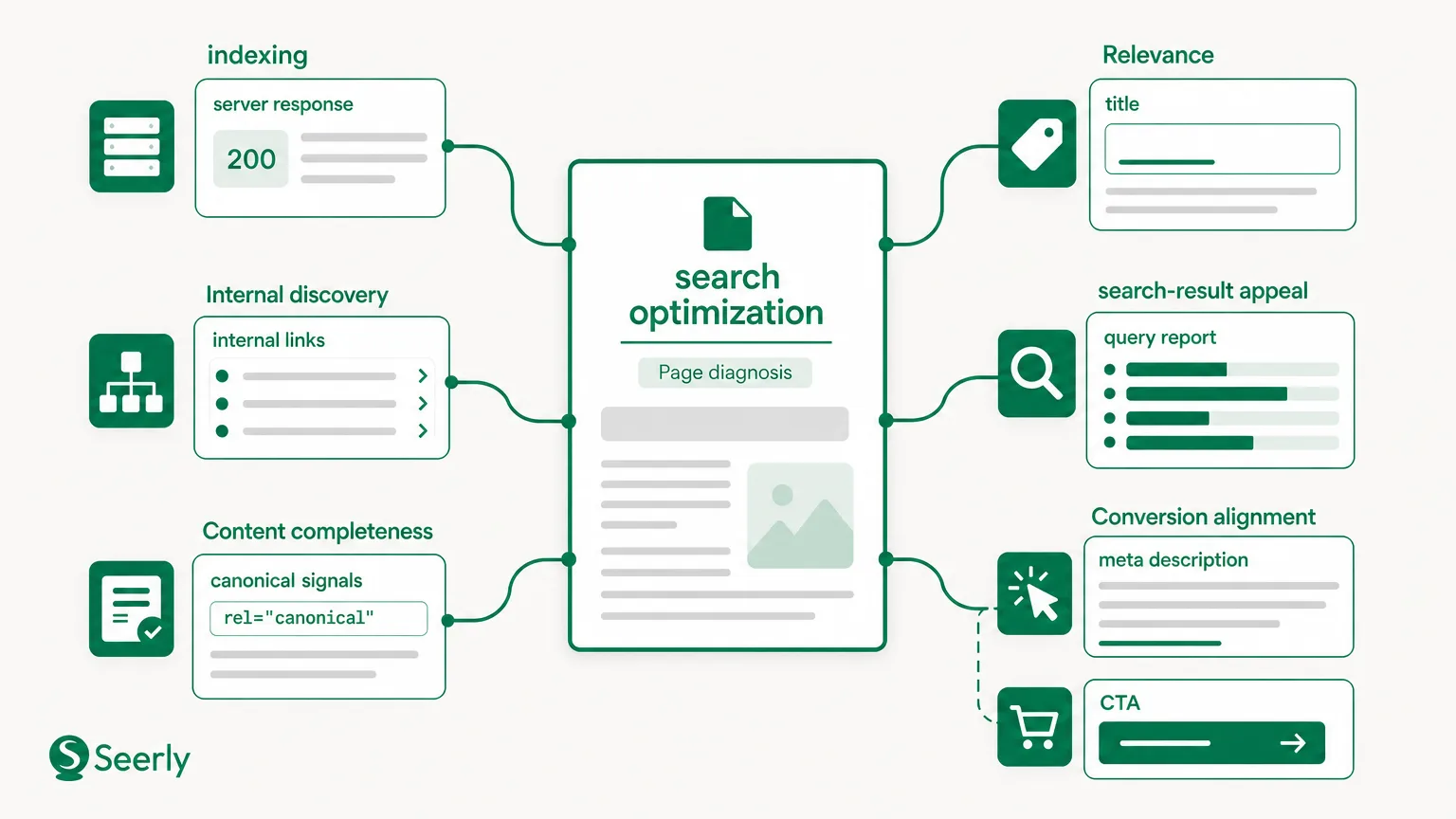
Crawlability is whether Google can reliably access the page and the resources that help interpret it. That includes status codes, robots directives, canonicals, renderability, and link paths that help crawlers reach the page efficiently. If an important page is buried, orphaned, or accidentally noindexed, searchability drops before content quality even enters the conversation.
For a lean team, this matters because maintenance issues often accumulate quietly. A redesign, a CMS template change, or a navigation cleanup can weaken crawl paths without anyone intending to damage SEO. Monthly checks do not need to be complex, but they do need to exist.
Index presence
A page must not only be crawlable; it must remain in Google’s index and continue being seen as worth keeping there. If a page is indexed but weakly differentiated, thinly updated, or unsupported by the rest of the site, it may remain technically present while losing practical visibility. Search Console impressions are often the first clue that index presence is becoming less valuable.
This is where index status and performance need to be read together. “Indexed” is not the same as “competitive.” A page can stay in the index and still fade from meaningful query coverage.
Query-match clarity
Query-match clarity is how clearly the page communicates what search need it solves. Strong pages align their title, headings, examples, framing, and language with the queries they are intended to win. Weak pages often drift: they still discuss the topic, but they stop matching the specific phrasing, comparison angle, or urgency that users now bring to Google.
That drift matters because search choice is partly behavioral. Research on search interaction has long shown that users rely heavily on ranking order and presentation cues when deciding what to click, including well-documented position and visibility effects in search behavior and bias toward prominently displayed results. If your page no longer looks like the best answer at a glance, discoverability weakens.
Internal links
Internal links are support signals. They help Google understand which pages matter, how topics connect, and what role each page plays within the broader site. They also help users continue their journey, which can reinforce usefulness. A once-strong page can decay simply because newer content stopped linking back to it or category pages no longer elevate it.
For teams trying to protect rankings with limited time, internal linking is one of the highest-leverage maintenance activities. Seerly has covered how weak internal links can cause ranking losses even when content itself is still solid, and that principle becomes even more important once publishing velocity slows.
Proof freshness
Proof freshness means the evidence inside the page still feels current, credible, and concrete. Outdated screenshots, old stats, unsupported claims, and references to features or workflows that no longer exist can weaken both trust and click value. A page does not need a new publication date every month, but it does need living proof.
This matters even more now because search visibility increasingly overlaps with machine-mediated summarization. Pages with crisp claims, up-to-date comparisons, and quotable evidence are easier for both users and systems to reuse.
Page usefulness
Usefulness is the simplest and hardest element. Does the page still solve the problem better than alternatives? Is it clear, specific, and actionable? Does it answer the follow-up questions someone will naturally have after the initial search? Google searchability tends to persist when usefulness deepens over time rather than sitting frozen after first publication.
The 30-minute monthly searchability review
A small team does not need an enterprise content audit every month. It does need a repeatable 30-minute review for the pages that matter most. Limit the process to your top 10 to 20 revenue-adjacent or traffic-critical pages.
1. Check freshness signals
Open the page and ask what has aged. Look for stale dates, obsolete product references, old screenshots, or examples that no longer match the current market. If a reader lands today, would the page still feel current within the first 30 seconds? If not, update the visible proof before worrying about a full rewrite.
2. Test supporting links
Click every internal and external support link on the page. Broken links, redirected references, or missing source pages subtly reduce trust and can weaken user experience. This is especially important on pages making claims backed by data or examples.
3. Audit claims and evidence
Highlight every factual claim, benchmark, or recommendation that depends on external reality. Then verify whether the claim still holds. For example, if your page assumes the same click landscape as two years ago, that may now mislead readers because search results behavior has shifted as zero-click features and AI summaries expand.
4. Add one missing example
Most decaying pages do not fail because the topic disappeared. They fail because the page stopped feeling specific. Add one current example, one short comparison, or one practical screenshot. Specificity strengthens both user trust and query-match clarity.
5. Reconfirm category alignment
Ask whether the page still belongs where it sits in your site architecture. If it targets a category or topic cluster that your site no longer reinforces, Google may receive a weaker signal about the page’s role. Review nearby category pages, hub pages, and recent posts to ensure the page is still contextually supported.
6. Review internal links in and out
Confirm that the page links to relevant supporting content and that newer related pages still link back to it. If you need a stronger measurement discipline around traffic sources while reviewing performance, Seerly’s guide to clean UTM rules for measuring organic, paid, and AI traffic together can help keep attribution cleaner over time.
7. Compare snippet competitiveness
Search the target query manually. Does your title still look compelling beside competing results? Is the angle dated, too generic, or too broad? Because CTR varies steeply by ranking position, even a page that holds approximate position can lose meaningful traffic if the snippet no longer earns the click.
Early signals of decay before traffic fully drops
The best time to fix searchability is before sessions collapse. Traffic is a lagging indicator. Decay usually appears first in query breadth, click behavior, and downstream action.
Shrinking query diversity
A healthy page often ranks for a widening set of related queries over time. A decaying page starts relying on fewer queries, usually a narrow core term plus branded or accidental variants. If impressions remain flat but the query mix narrows, that is a warning that Google sees the page as less broadly useful.
Lower click-through on stable impressions
If impressions hold reasonably steady but CTR slides, the issue may be snippet appeal, SERP competition, or intent drift rather than index loss. This is increasingly common in environments where search interfaces answer more questions directly. Competitive studies and emerging research both point to declining click opportunities as AI and answer-heavy interfaces change result selection patterns.
Rankings that no longer produce action
Some pages still rank, still get clicks, and still fail commercially. That is also a searchability problem. A page that earns visits without attracting signups, demos, or deeper engagement may be discoverable in a technical sense but no longer useful in a business sense. Searchability should be measured by findability plus fit.
Worked example: healthy page vs. decaying page
Imagine two similar pages targeting “CRM implementation checklist.”
A healthy page shows rising impression variety, stable CTR, and a refresh that added updated implementation steps, a 2025 screenshot, and clearer internal links from the CRM category hub. Users arrive, scroll, and click into related pages. The page remains aligned with current intent.
A decaying page still ranks on page one for a couple of legacy terms, but impressions are increasingly concentrated in those same terms. CTR falls because the title promises a generic checklist while newer competitors promise templates, timelines, and role-specific advice. The page still receives traffic, but conversions drop because the examples reference old software workflows and no longer match buyer expectations.
The important distinction is that the decaying page did not “disappear.” It became less competitive, less clickable, and less reusable.
When maintenance should expand into AI visibility monitoring
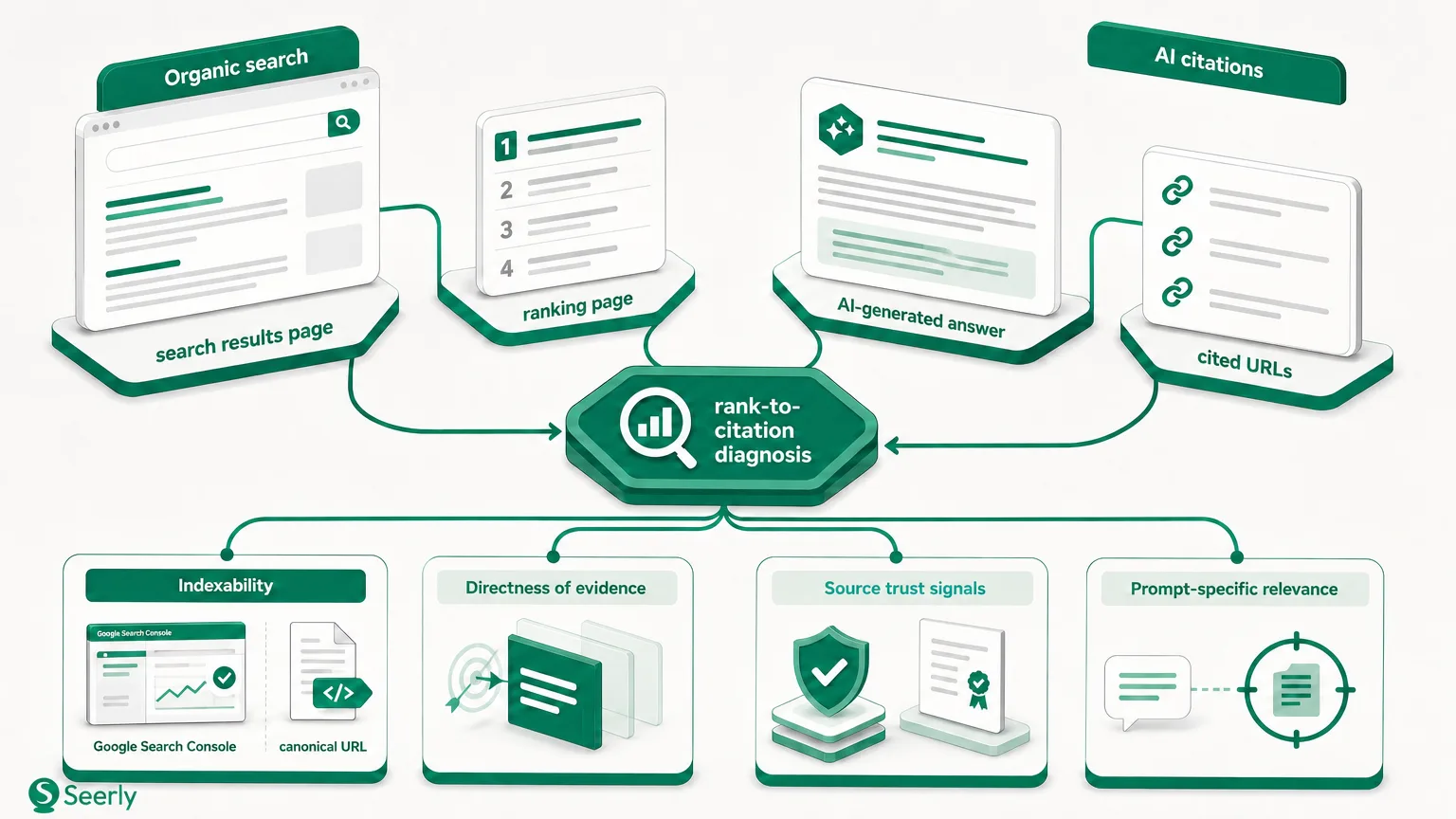
Classic Google maintenance is still necessary, but it is no longer sufficient for every important page. Some pages remain indexed and even rank decently while losing presence in AI-generated answers, summaries, and chat-style product research flows.
Classic search maintenance focuses on discoverability
Traditional maintenance asks: can Google crawl the page, index it, match it to the query, and present it in a way that earns the click? Those are still foundational questions.
AI-answer readiness focuses on reusability
AI systems often favor pages that contain clear claims, concise explanations, current proof, structured comparisons, and language that can be quoted or summarized with confidence. If a page is vague, unsupported, or buried in generic commentary, it may stay searchable in Google while becoming less likely to influence AI-mediated discovery.
This shift is consistent with broader evidence that local and entity visibility increasingly depend on structured, trustworthy information across surfaces, not just rankings alone; for example, search and AI discovery now rely heavily on consistent, high-confidence business and content signals. For software and B2B teams, that means maintenance should include a second question: if an AI assistant had to summarize this page, would it find sharp, current, evidence-backed statements worth reusing?
A good way to think about it is simple. Google searchability asks whether your page can be found. AI visibility asks whether your page can be reused. Those are related, but they are not identical. Seerly explores that overlap in its post on monitoring brand presence across Google, AI chats, and search rankings.
A lightweight 90-day cadence teams can actually keep
The maintenance system only works if a small team can sustain it. A practical 90-day cadence is enough for most early-stage companies and lean growth teams.
Every month: hygiene review
Run the 30-minute review on your top pages. Update proof, fix broken links, refresh one example, and strengthen internal links. This protects the pages already carrying visibility.
Every quarter: focused refreshes
Pick three to five core pages for deeper work. Revisit headings, tighten intent match, expand sections users care about most, and improve conversion paths. If Search Console shows weakening impressions for adjacent long-tail queries, add subheadings or examples that better cover those variants.
Quarterly refreshes work because search value often compounds when pages improve structurally rather than just cosmetically. Studies of content updating and republishing workflows consistently show that refreshes can outperform net-new publishing when the page already has authority and query history, including practical SEO observations such as updating existing pages often being faster and more effective than starting from zero.
Trigger-based rewrites
Do not rewrite pages on a fixed calendar alone. Escalate when a page shows clear symptoms: query diversity shrinks, CTR drops materially, the page still ranks but stops converting, or competitors have obviously changed the standard answer. Trigger-based rewrites are more efficient than blanket updates because they focus effort where decay is measurable.
Keep one shared log
Use a simple spreadsheet or dashboard to track page, issue, date reviewed, action taken, and post-update results. Searchability improves when teams can connect maintenance actions to outcome changes. That is also where a data-driven toolset helps: disciplined tracking turns upkeep from guesswork into an operating system.
FAQ
Do we need to publish constantly to stay discoverable in Google?
No. Publishing helps expand coverage, but maintenance protects and compounds what you already earned. Many teams lose visibility not because output slowed, but because the existing library stopped being refreshed, connected, and validated. If your core pages remain current and well-supported, you can preserve strong google searchability without weekly publishing.
Should old pages be merged?
Sometimes. Merge pages when they target the same intent, compete with each other, or split link equity across overlapping assets. Do not merge just because a page is old. Age is not the problem; weak differentiation is. If two pages can be turned into one stronger, clearer resource, merging is often the better maintenance move.
What if a page is indexed but visibility is flat?
Flat visibility despite indexing usually means one of three things: weak query-match clarity, weak snippet appeal, or weak site support. Check whether the title and headings reflect what users actually search, whether the page offers current proof, and whether relevant internal pages still point to it. If the page is technically present but not gaining traction, the issue is probably relevance or competitiveness rather than crawlability.
How do we know when to move from SEO checks to AI visibility checks?
Move when an important page still ranks or stays indexed but seems absent from AI-driven discovery, branded answer citations, or product comparison flows. That usually means the page needs stronger evidence, clearer comparisons, and more extractable language. If your buyers increasingly research through both search and AI interfaces, you need both layers of monitoring.
Can internal links really make that much difference after publication?
Yes. Internal links shape how authority and context move across your site. They help older pages stay connected to newer content and reinforce category relevance over time. For lean teams, internal link maintenance is often one of the simplest ways to preserve discoverability without creating more pages.
Google searchability after a content sprint is not about keeping up the illusion of constant momentum. It is about protecting the assets you already built so they remain crawlable, index-worthy, compelling, and useful as the market changes. Teams that treat searchability as a repeatable maintenance system tend to keep more of their gains than teams that treat publishing as the whole strategy.
The practical next step is to turn this into a tracked rhythm: review your core pages monthly, document weak spots, refresh proof and links, and monitor whether those improvements increase not only Google visibility but also reuse in AI-driven answers. If you want a clearer way to watch both, track how stronger searchability translates into broader search and AI presence over time.