A practical method for resolving keyword intent conflicts before rankings slip
A page can pull in more traffic just as it becomes less useful. I’ve seen this pattern on pages that rank for a learning query such as “what is a keyword ranker” and a purchase-oriented query such as “best keyword ranker Google.” At first, the blended traffic looks healthy. Impressions rise, query count grows, and the report feels reassuring.
Then the cracks appear. Educational visitors leave after reading the opening paragraphs, while evaluators scroll past a generic explainer looking for features, limits, and proof. Competing pages begin to rank above yours because each one speaks clearly to one job. Your page speaks vaguely to two.
A keyword intent conflict isn’t a cue to panic-rewrite a page. It’s a diagnostic problem. Before splitting, consolidating, or rewriting anything, determine which search need the page can satisfy with the strongest evidence, the most credible conversion path, and the clearest internal context. That decision should come before the copy changes.
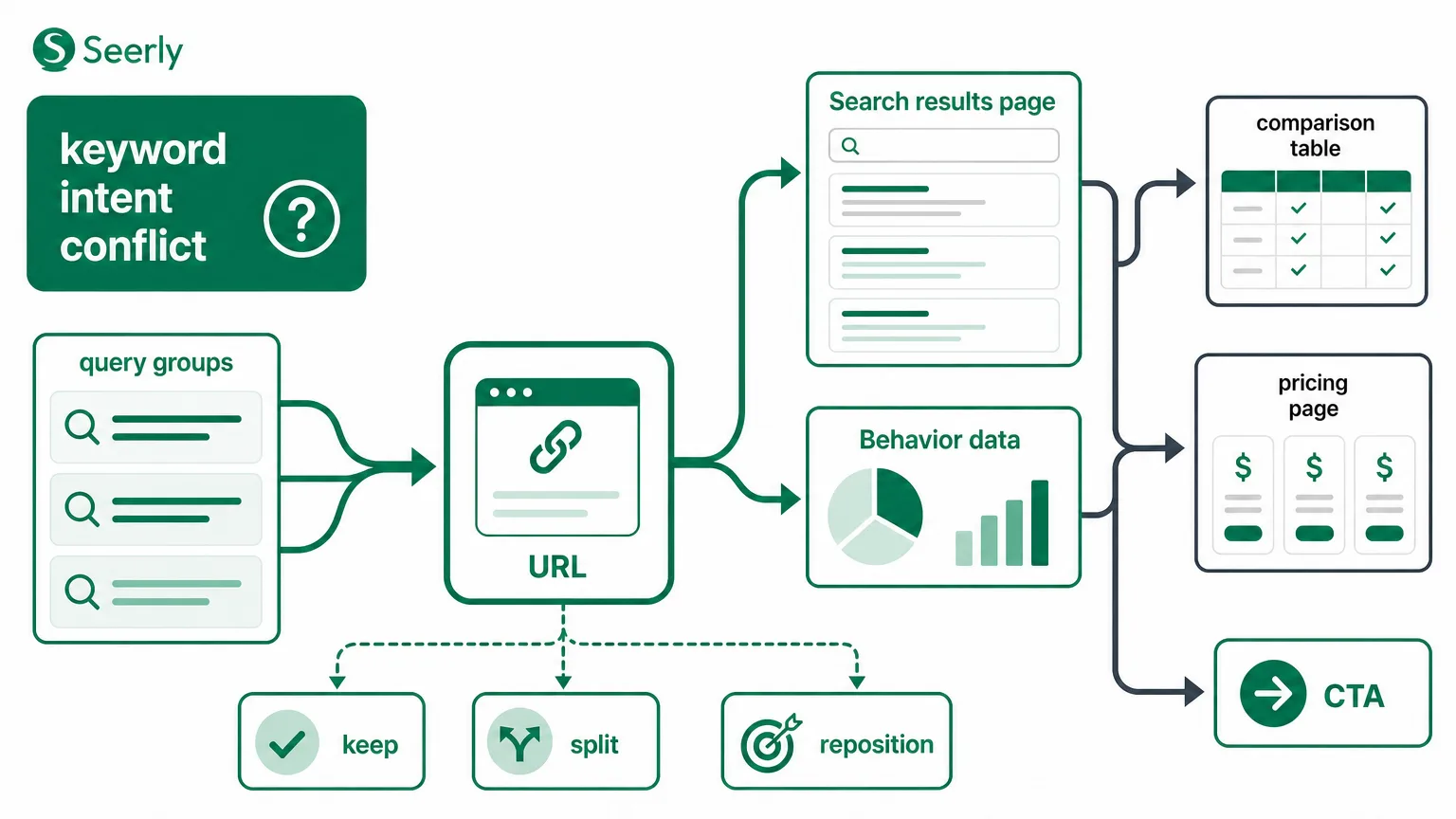
Keyword intent conflict: a single URL ranks for queries whose searchers expect materially different outcomes, such as learning a concept versus selecting a product.
What does a keyword intent conflict look like in practice?
Picture a SaaS company with a guide called “Keyword ranker: how to track search positions.” It has ranked for “how does a keyword ranker work” for months, attracting readers who need a plain-English explanation. Later, it starts gaining impressions for “SEO keyword ranker,” “keyword ranking tool,” and “keyword ranker free.”
Traffic climbs 24% over a quarter. The team celebrates, then notices a mess in the page data. Readers arriving from definition-style queries spend time with the tutorial but rarely visit the pricing page. Readers from tool-selection queries hit the article, see a broad explanation, and leave before reaching the comparison table parked near the bottom.
The page is caught between two promises. A researcher wants orientation: terminology, method, and perhaps a way to check a few terms. An evaluator wants selection help: data freshness, location settings, reporting, and a reason to trust the product. Those needs overlap around rankings, but they do not share the same finish line.
Look at query groups, not page totals. Google Search Console lets site owners review performance by query and page, though Google notes that some data may be omitted or aggregated to protect privacy. Search Console performance reports break results down by queries, pages, countries, and devices, which makes the conflict visible when you export and label the terms.
A traffic chart can hide this problem for a long time. A two-intent page may keep attracting clicks while losing its ability to persuade either group. Not ideal.
Which signals should a keyword ranker examine?
Start with evidence already present in the search results and on the page. Google describes ranking as a process that considers many factors, including the meaning of a query and the usefulness of content. Google’s explanation of ranking results is a useful reminder that a keyword string alone does not settle user intent.
Build a small evidence sheet for the top 20 to 40 queries driving impressions to the URL. A keyword ranker is useful here because it turns an uncomfortable hunch into a repeatable review of query groups and position movement.
Read the clues in the query and the results page
Modifiers expose intent quickly. “What is,” “how to,” and “examples” lean toward learning. “Best,” “alternative,” “pricing,” “software,” and “free” lean toward evaluation. Some queries will remain ambiguous. Mark them as mixed instead of forcing a neat label.
Then inspect the first page of results for a handful of terms from each group. Are the leading results tutorials, product pages, comparison articles, videos, or tool landing pages? A search result full of vendors and review sites tells a different story from one led by documentation and editorial explainers.
Check the ranking competitors, too. If your page competes against product-led pages for evaluative terms but against education publishers for learning terms, it has two separate contests underway. I personally prefer a manual result-page review over an intent label supplied by a tool. The labels are fast; the search page is the evidence.
Use behavior and site context as tie-breakers
On-page behavior adds the second half of the picture. Compare engaged sessions, scroll depth, exits, CTA clicks, and assisted conversions by query group where your analytics setup permits. Google’s own guidance on linking Search Console and Google Analytics explains how the two data sets can be read together, rather than treating rank position as the whole story.
Also inspect the conversion path. Does the page lead naturally to a demo, a trial, a template, or another educational article? Internal links matter because they tell readers what the site expects them to do next. A guide surrounded by product-navigation links may feel like a sales page in disguise. Readers notice that fast.
Keep, split, or reposition the page?
The answer is rarely “add 800 words and hope.” Choose one action after you score the conflict against five practical factors.
| Option | Use it when | Main trade-off |
|---|---|---|
| Keep one page | The audiences share a problem, the same proof answers both groups, and one conversion path makes sense | The page needs tight structure so the secondary need does not take over |
| Split into two pages | Search results and conversion goals differ sharply, and each page can earn distinct evidence and links | Two URLs create maintenance work and need careful internal linking |
| Reposition the existing page | One intent produces better engagement or business outcomes, while the other has weak fit | You may give up rankings for queries the page was never built to satisfy |
Audience overlap comes first. Someone learning what rank tracking is may later choose a platform, so one page can work if the learning section sets up the evaluation naturally. But a beginner seeking a free checker and an enterprise buyer comparing data sources often need very different depth and proof.
Existing authority complicates the call. A page with strong links and stable positions should not be discarded casually. Repositioning may preserve that authority while changing the introduction, evidence order, and CTA. Splitting makes more sense when the current URL cannot credibly carry both jobs without becoming a junk drawer.
Here’s the decision test I use: could the same page title make both visitors feel they got exactly what they came for? If the honest answer is no, separate the intent groups. If the answer is yes, keep one page and arrange it around the shared task.
For pages weighing an informational update against a more commercial rewrite, this analysis of rankings that do not translate into SEO results is a useful companion. Position alone doesn’t settle a content decision.
How to monitor the keyword ranker Google results after a change
A change without a baseline becomes folklore. Someone remembers that rankings “used to be better,” another person points to a good week, and nobody can separate normal movement from the effect of the new page strategy.
Use this four-step process:
-
Group queries before editing. Create two labels, such as “learn” and “evaluate,” and keep a mixed bucket for uncertain terms. Record current average position, impressions, clicks, engagement, and the conversion event that fits each group.
-
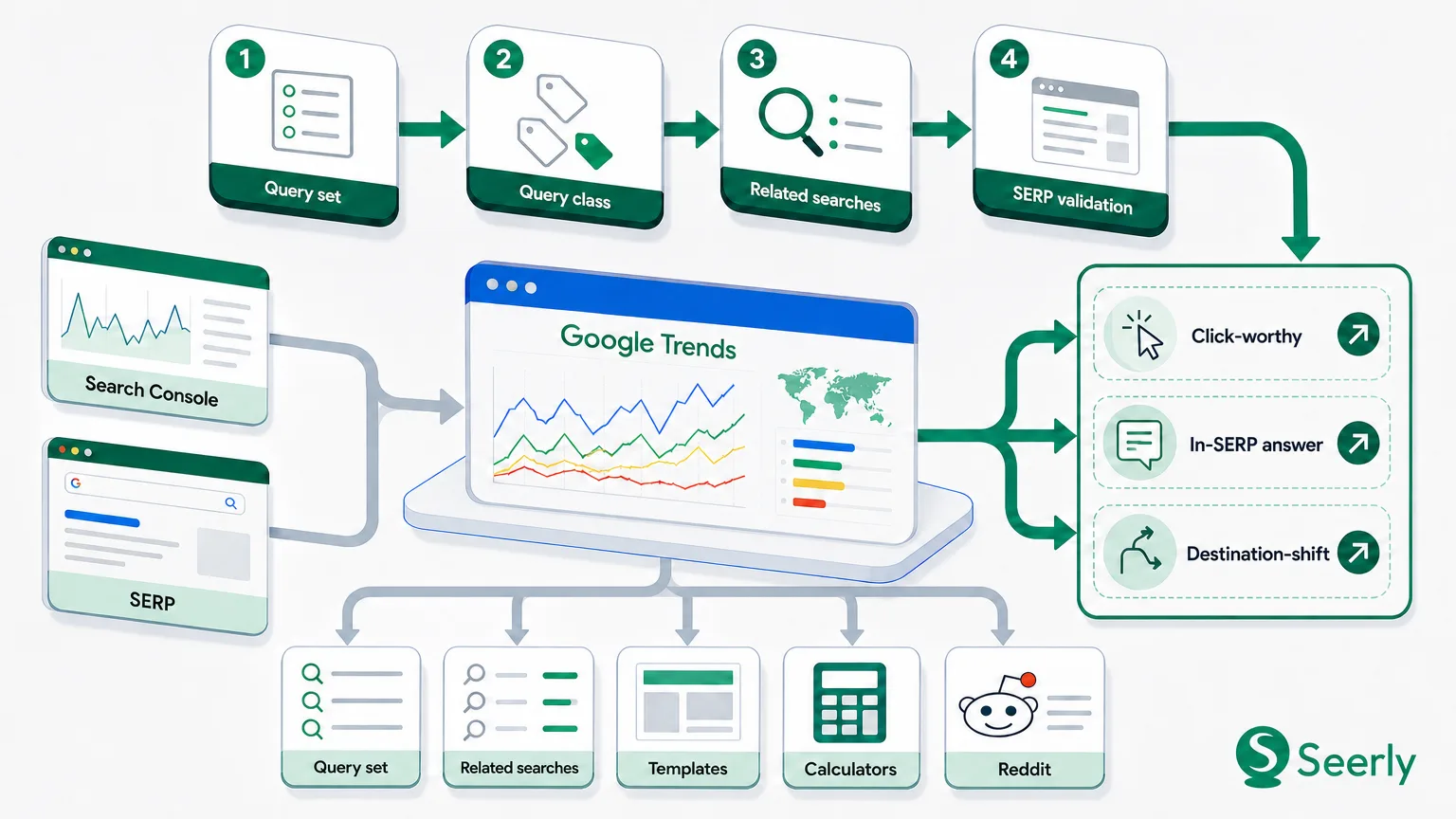
Save a pre-change window. Use at least four weeks when seasonality permits. Google Trends can help identify recurring spikes, and its help documentation explains that search interest is normalized rather than presented as raw volume. Google Trends data is scaled from 0 to 100 within the selected comparison, so use it for pattern checks, not market-size claims.
-
Annotate the release. Write down the date, URL changes, redirects, title edits, internal-link changes, and CTA changes. Include the intent decision in the annotation. Future-you will thank present-you.
-
Review weekly, judge monthly. Watch position distribution and clicks for each intent group, then read engagement and conversions beside them. A drop in evaluative-query traffic may be fine if the revised learning page now sends more qualified readers to the comparison page.
For an SEO keyword ranker, device and location settings also matter. A position recorded for one country or device may not match another searcher’s result. Google says search results can vary with factors such as language, location, and device, which is why Search Console includes country and device dimensions. Don’t let an unsegmented average score invent a problem.
What must change beyond the page copy?
Copy is only one signal. After choosing an intent, make the page’s surrounding elements agree with it. Mixed signals are how a sensible strategy turns into a confusing one.
For a learning-led page, rewrite the title and first screen around the question being answered. Place the definition, method, screenshots, and practical caveats early. Put product evaluation behind a clear “compare tools” link instead of wedging a sales pitch into paragraph three. Readers who want a keyword ranker free option can then reach a focused tool or comparison page without being misled by the guide’s title.
For an evaluation-led page, lead with selection criteria and proof. Explain data coverage, update frequency, reporting controls, and use cases before broad educational material. The introduction should make the decision task obvious, and the CTA should match it. A “start tracking” or “request a walkthrough” action makes more sense than “read more about rankings.”
Run through this checklist before publishing:
-
Titles and introductions: name the chosen task in plain language, then remove wording aimed at the abandoned intent.
-
Evidence blocks: move the proof that matters to the selected reader near the top. Tutorials need examples; evaluation pages need criteria and comparison logic.
-
Calls to action and links: point to one next step, then audit related-content modules and navigation labels for contradiction.
-
Internal anchors: update links from other pages so their anchor text describes the URL’s new role.
Teams rebuilding clusters around changing result pages may also find value in a workflow for rebuilding keyword clusters. The page cannot stand alone. Its neighbors shape the reader’s path.
What mistakes make intent-conflict fixes fail?
Should we publish two near-identical pages?
No. A split only works when each URL has a distinct job, audience cue, evidence set, and next step. Copying the same explanation onto two pages and changing the title creates a maintenance headache while giving searchers little reason to choose either page.
Is a wholesale rewrite the fastest route?
Usually, no. Sudden rewrites erase useful signals before the team has documented what worked. Keep the query baseline, preserve sections that support the chosen intent, and change one coherent layer at a time. The frustrating part is restraint.
Can rankings be the only success metric?
No. Rankings measure access to an audience, not whether the page met that audience’s need. Pair movement in each query group with engagement, CTA progression, and conversions. A lower average position can coexist with a better business outcome.
What if the page attracts visitors at different buyer stages?
Map the stages to separate destinations. A learning page can link forward to an evaluation page, and an evaluation page can link back to the underlying methodology for readers who need confidence. Trying to close every visitor on one URL usually makes the experience feel pushy and thin.
Pick one page this week. Classify its top queries into two intent groups, score the evidence with the decision matrix, and assign a single next action: keep, split, or reposition. Then measure what changes, rather than reacting to every wobble in the rankings.
Learn more at seerly.app.