How to compare AI search alternatives when buyer questions need different evidence
A marketing team can ask the same buyer question across several answer-oriented search products and get three very different versions of its brand. One answer names the company in a list. Another links to an old review. A third gives a confident but wrong description of pricing, features, or who the product suits.
That gap is easy to miss when reporting focuses on appearances alone. A mention can look like progress in a dashboard, even when the surrounding answer sends a buyer in the wrong direction. And a product that looks weak for a broad discovery query may be far more useful when someone is checking a technical detail or comparing two short-listed vendors.
That is the practical way to compare AI search alternatives. Don’t ask which product “wins” in the abstract. Ask which buyer research task each one handles well, what proof it exposes, and where a weak answer could create a sales problem. The stakes are real: Pew Research Center found that users clicked a traditional search result on 8% of visits with an AI summary, compared with 15% of visits without one. When an answer satisfies the searcher early, the framing inside that answer carries more weight.
Start with the buyer’s research job
A buyer does not wake up wanting “AI search.” They want an answer to a specific problem, often under time pressure. Someone choosing project-management software has different needs at the start of research than someone who has already heard a claim from a sales rep and wants to check it. Group prompts by that job before you compare results.
Here is a useful working definition:
Answer quality is the degree to which a response helps a buyer complete a particular research task with traceable, current, and appropriately qualified evidence.
Five research jobs appear again and again in customer conversations:
-
Discovery: “What tools help a 20-person marketing team manage content approvals?” The buyer wants a credible starting set and category language.
-
Comparison: “How does Brand A compare with Brand B for enterprise reporting?” Now the buyer needs differences, trade-offs, and fit.
-
Validation: “Does Brand A support SSO?” A short factual answer with current proof matters more than a polished overview.
-
Troubleshooting: “Why isn’t my integration syncing data?” The buyer needs accurate instructions, not a generic product pitch.
-
Reputation checking: “Is Brand A reliable?” Here, outside commentary, review patterns, and handling of known complaints can carry more weight than a company page.
The thing is, a single product may handle one job beautifully and stumble on another. I’ve seen teams panic because they were absent from a broad “best tools” response, while their much higher-intent comparison prompts were accurate, well-supported, and favorable. Not ideal if discovery is your growth constraint. Still, it’s a different problem from a broken decision-stage narrative.
What should a useful answer show?
A fluent answer can feel trustworthy before anyone checks it. That is the trap. Marketing teams should judge AI search alternatives with an evidence checklist that separates a tidy paragraph from a useful research aid.
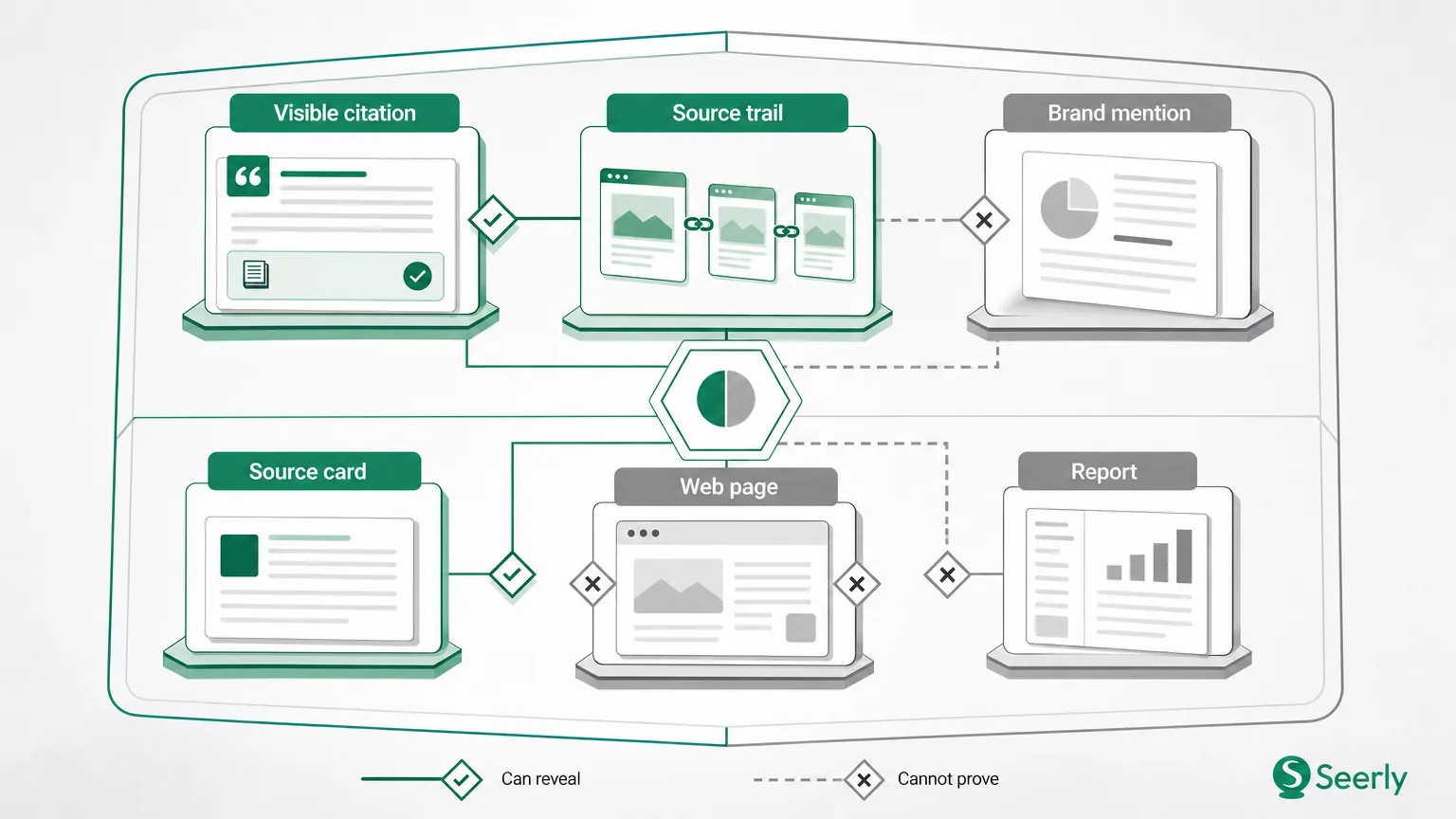
Start with source traceability. Can the buyer see where a claim came from and inspect it without detective work? Perplexity, for example, explains that it uses web search and places numbered references alongside statements, while its source labels help readers understand source types and quality signals in the answer. Its own explanation of how search and citations work is a good reminder that visible references are part of the product experience, not a decorative footnote.
Then check four questions:
-
Is the evidence recent enough? Pricing, integrations, policy details, leadership changes, and product availability age badly. A 2022 source may still explain your category well, but it cannot settle a 2025 pricing question.
-
Does the source support the exact claim? “Used by large companies” does not prove security controls. “Easy to use” does not prove deployment time. Read the cited passage, not just the domain name.
-
Does the answer show uncertainty where uncertainty exists? Honest language such as “check current plan limits” may be more useful than a crisp false statement. Buyers can forgive a caveat. They rarely forgive a surprise after signing.
-
Does the format fit the task? A discovery answer can offer a short list with reasons. A validation answer should get to the fact fast. Troubleshooting needs steps, version context, and a route to official documentation.
Look, evidence quality does not require every answer to read like a legal memo. It does require teams to notice when the answer has quietly swapped proof for prose.
Build a monitoring set across AI search alternatives
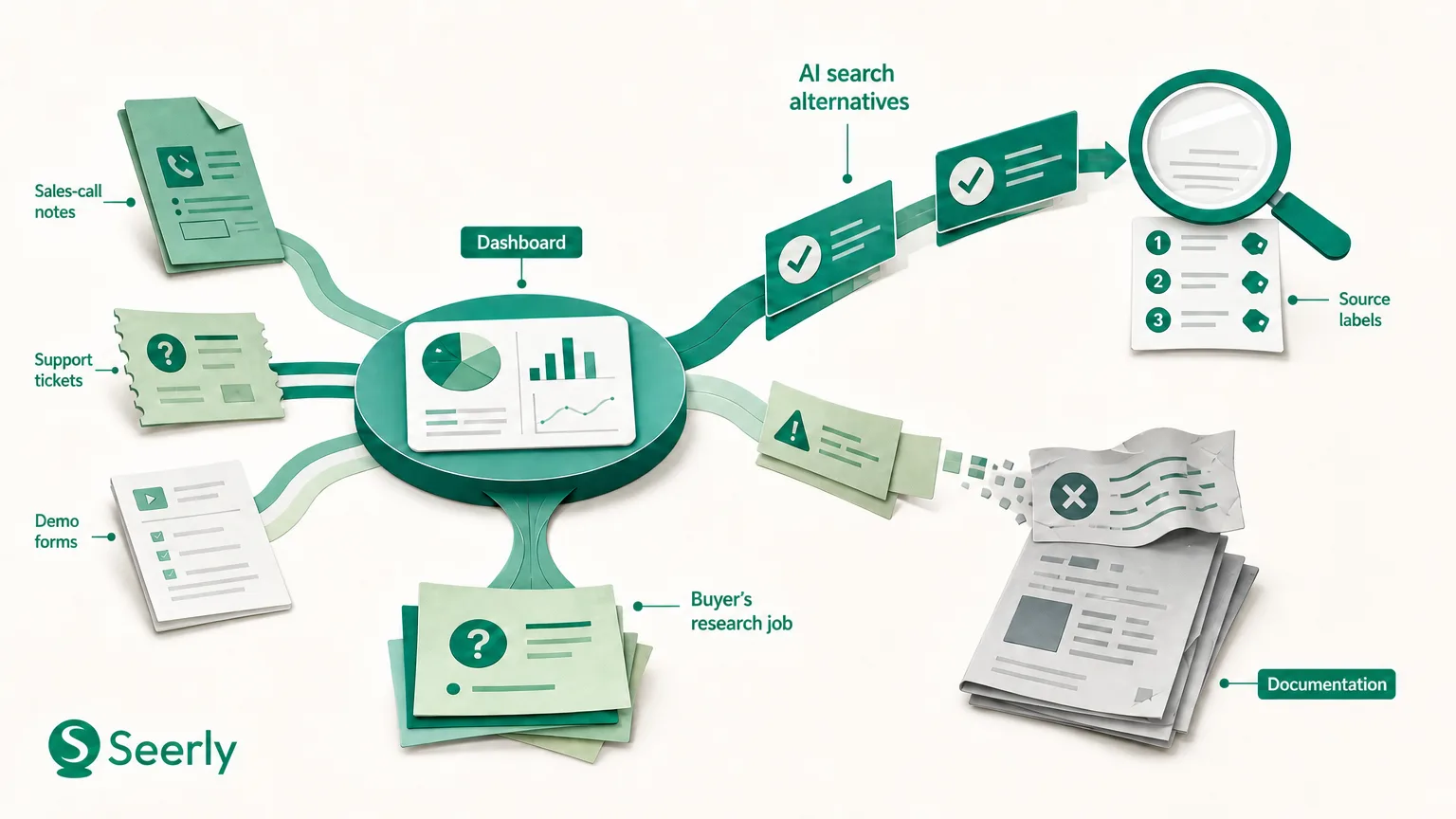
A monitoring list built from generic category keywords tells you very little about buyer decision-making. Start with language buyers already use. Pull it from sales-call notes, support tickets, demo forms, win-loss interviews, and the questions account managers hear after a proposal lands.
Use this four-step process:
-
Collect raw questions without cleaning them up. Keep awkward phrasing, brand misspellings, and loaded objections. “Is this too expensive for a five-person team?” carries more commercial meaning than “best software for small business.”
-
Sort each question into one research job. Use the five categories above. A prompt may sit in two groups, but force a primary label so the score later has a clear standard.
-
Pick five to ten prompts that recur and affect a purchase decision. Include a category question, a direct comparison, a factual check, and one objection. For software brands, the question “Does this tool have enough proof from existing users?” deserves a place too. Weak review coverage can alter the story, as discussed in Seerly’s look at what answer-oriented search sees when software listings have no reviews.
-
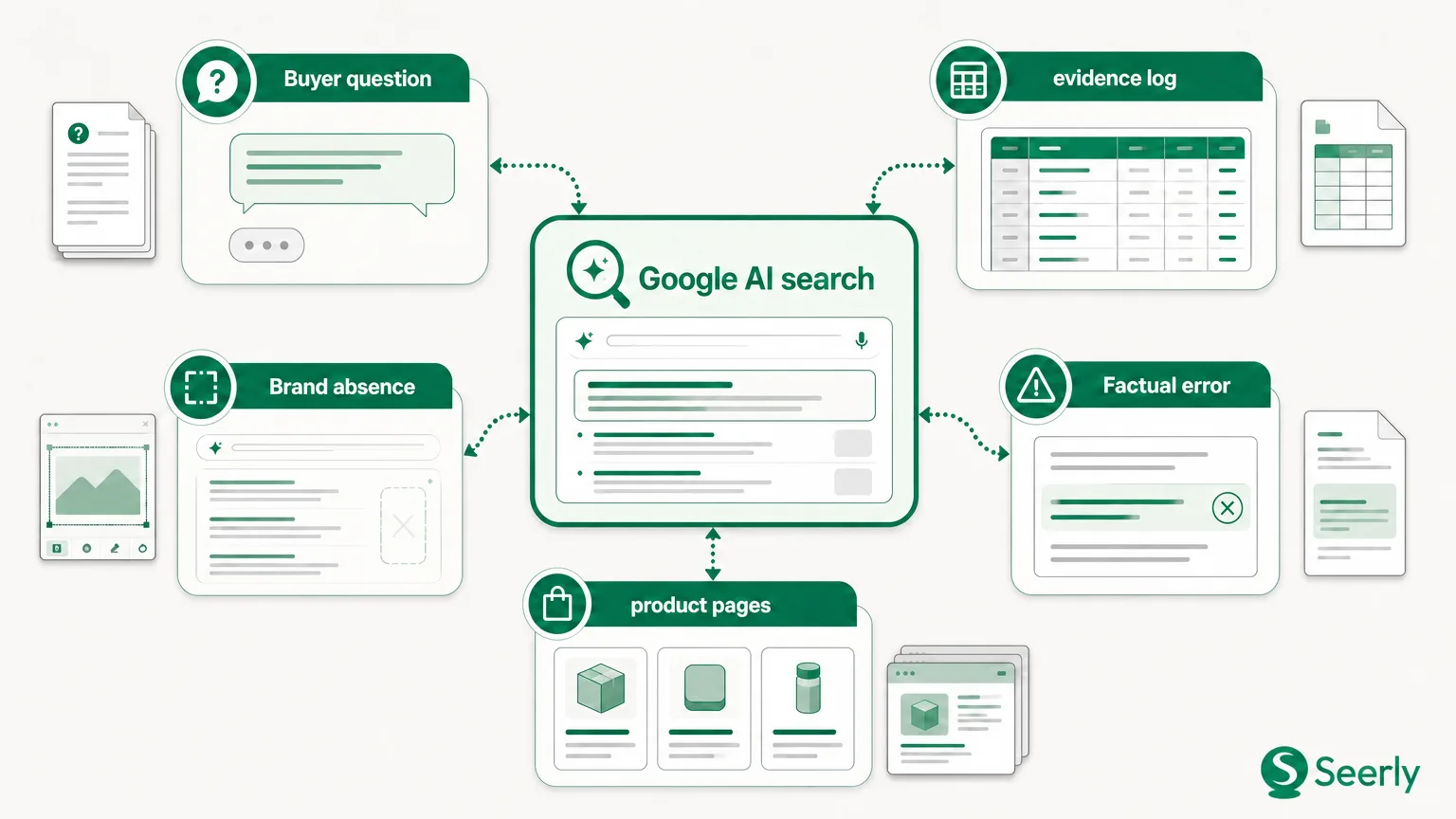
Run the same prompt across the search experiences your buyers use. Record the date, location, signed-in state where relevant, full answer text, cited sources, competitors named, and follow-up prompts suggested by the product.
Don’t test once and call it research. Answers change with source availability, product updates, and prompt wording. A monthly check works for stable category questions; a weekly check may make sense during a launch, pricing change, or public issue. The more I looked at this work, the more I realized that prompt tracking resembles message testing more than classic rank tracking. You are checking what story a buyer receives.
Teams that need a starting prompt library can borrow the structure in Seerly’s guide to building a buyer-question workflow for AI search. Keep the questions grounded in real conversations. Internal jargon makes lousy research prompts.
A mention is not accurate representation
Picture a B2B analytics company that appears in an answer to “best reporting tools for agencies.” At first glance, the result looks good: the brand is named second, ahead of two direct competitors. But the answer describes it as a social-media reporting product, cites a two-year-old directory page, and says it has a free plan when it does not.
That brand has presence. It does not have accurate representation.
Use a simple scorecard for every prompt and search experience. Score each item from 0 to 2, where 0 is absent or wrong, 1 is partial, and 2 is clear and supported.
| Check | What a score of 2 looks like |
|---|---|
| Presence | The brand appears where it genuinely fits the buyer’s question. |
| Context | The answer explains the right category, audience, and use case. |
| Evidence | Sources directly back the claims being made. |
| Competitive framing | Differences from alternatives are fair and specific. |
| Unsupported claims | No invented features, stale pricing, or broad claims without proof. |
A result scoring 8 out of 10 may deserve monitoring, not emergency content work. A result scoring 3 out of 10 for “Is Brand A secure enough for a regulated team?” needs attention fast because the question sits near a purchase decision. Weight the score by commercial impact, not by how annoying the error feels on a Monday morning.
Competitive framing needs extra care. Some answers mention a competitor because its positioning is clearer online, not because it is a better fit. That distinction is why brand citation monitoring should capture the answer’s wording and sources, rather than counting names alone. A screenshot without the cited material tells only half the story.
Match the response to the problem
Publishing a new article for every weak result is a noisy, expensive habit. Sometimes the answer lacks proof because the right product page is vague. Sometimes the public record is thin. Other times, the result is a temporary retrieval oddity and deserves observation before a team changes anything.
Here is a practical action matrix:
| What you find | Likely cause | Better response |
|---|---|---|
| Wrong product capability | Product page lacks a plain-language answer | Add a direct statement, current documentation, and a dated changelog reference. |
| Old pricing or plan details | Third-party pages outrank current information | Make pricing pages easy to verify and review high-traffic listings. |
| Weak trust narrative | Few independent reviews or unclear proof | Publish customer evidence where permitted and improve how existing proof is presented. |
| Competitor framed as the default | Category positioning is fuzzy | Tighten category descriptions across core pages and comparison material. |
| One-off false claim with no visible source | Unstable answer behavior | Log it, retest, and escalate through the product’s feedback route if it persists. |
A reputation issue may call for a response outside your content calendar. If an answer repeats an outdated legal claim, mixes your company up with another business, or presents a serious allegation as fact, save the prompt, answer, date, and sources. Verify the issue with counsel or communications leads before you publish a defensive blog post. Fast content is not always smart content.
For recurring category confusion, clearer source pages often beat more volume. Seerly’s article on how SaaS buyers find the right product through AI search makes the same practical point: buyer questions expose where a brand’s explanation has gaps.
Frequently asked questions
Should we choose one search product to monitor?
Start with the products your buyers mention or use, then add one contrasting experience with stronger source display. The goal is not to crown a universal winner. Different products surface different sources and answer styles, which reveals different messaging risks.
How often should we retest prompts?
Check decision-stage questions at least monthly, and revisit them after pricing, feature, policy, or reputation changes. Run more frequent checks when a launch or public event changes what buyers may ask.
Does every inaccurate answer require new content?
No. Fix the page that should have answered the question first. If the problem comes from stale third-party information, unsupported speculation, or an isolated response, monitoring or escalation may fit better than another article.
What is the first metric to report?
Report weighted answer quality for the buyer questions closest to revenue. Count mentions as a supporting measure, but pair them with context, evidence, and accuracy scores. A name in the wrong narrative is not a win.
Pick five buyer questions this week. Run them across the AI search alternatives your market uses, score the evidence in every answer, and fix the one weakness most likely to distort a purchase decision. That is a smaller project than a full content overhaul, and it gives your team a far clearer place to start.
Learn more at Seerly.