Checking SEO After an Organic Traffic Drop: A Practical Diagnosis Framework for Lean Teams

A traffic drop is easy to spot and hard to explain. One week your organic sessions look stable; the next, a core page is down 20%, branded queries are flat, and leadership wants an answer by Friday. The mistake most teams make at that moment is treating the symptom before identifying the cause. They rewrite headlines, expand copy, change titles, or blame a platform update without first confirming what actually changed.
Checking SEO to diagnose issues is crucial for effective troubleshooting.
That reactive pattern creates two problems. First, it makes diagnosis harder because multiple edits muddy the evidence trail. Second, it often turns a contained ranking issue into a broader quality or relevance problem. Properly checking SEO after a decline means isolating whether the loss is technical, content-related, intent-related, or caused by changes in the search surface itself.
For lean marketing teams, the goal is not a perfect forensic model. It is a repeatable workflow that helps you explain the drop, decide whether to act, and avoid random changes. If you need a structured process for checking a website for SEO optimization after performance falls, use the sequence below in order.
Start with confirmation, not assumptions
The first step in checking SEO is confirming that a real organic decline happened. That sounds obvious, but many teams react to noisy week-over-week swings, incomplete analytics, or page-level anomalies that do not reflect a true search visibility loss. Before you label the issue an SEO problem, compare at least two useful windows: recent performance versus the prior period, and recent performance versus the same period last year if seasonality matters.
Look beyond sessions alone. A page can lose clicks without losing rankings if impressions fall, or it can hold rankings while traffic drops because search demand changed. Similarly, a site can lose visits even when indexed coverage remains stable if the SERP now answers more of the query directly. In other words, checking keyword ranking on Google is necessary, but it is not sufficient.
For lean teams, this is where discipline matters most. Document the date range, the pages affected, the top query groups involved, and whether the drop appears sitewide, section-wide, or isolated to a few URLs. If you skip that segmentation step, every later conclusion becomes shakier.
The SEO diagnosis sequence for checking SEO after a drop
A useful website SEO checker process is less about tools and more about order of operations. Run the checks below sequentially so you do not confuse a symptom with a cause.
1. Confirm which pages actually lost visibility
Start by identifying the specific URLs responsible for the decline. On many sites, a small number of pages drive most of the loss. Separate high-intent commercial pages from top-of-funnel educational pages, because the causes and remedies are often different.
If only one or two URLs dropped, the issue is likely page-specific: content decay, internal-link erosion, query mismatch, or cannibalization. If an entire directory dropped, you may be dealing with template, crawl, indexing, or structural issues. If the whole domain declined, broaden the check to include technical changes, site migrations, or a wider shift in discovery patterns.
2. Check indexing and crawlability before touching content
A published page is not always a visible page. Confirm that affected URLs are indexable, canonicalized correctly, and still eligible to appear in search. A seemingly minor change to robots directives, canonicals, redirects, JavaScript rendering, or faceted navigation can weaken visibility without changing on-page copy at all.
This is the fastest place to find high-confidence causes. If rankings disappeared because the preferred URL changed or the page fell out of the index, rewriting content will not solve the problem. Fix the technical state first, then re-evaluate performance after recrawl and reprocessing.
3. Check whether the query mix changed
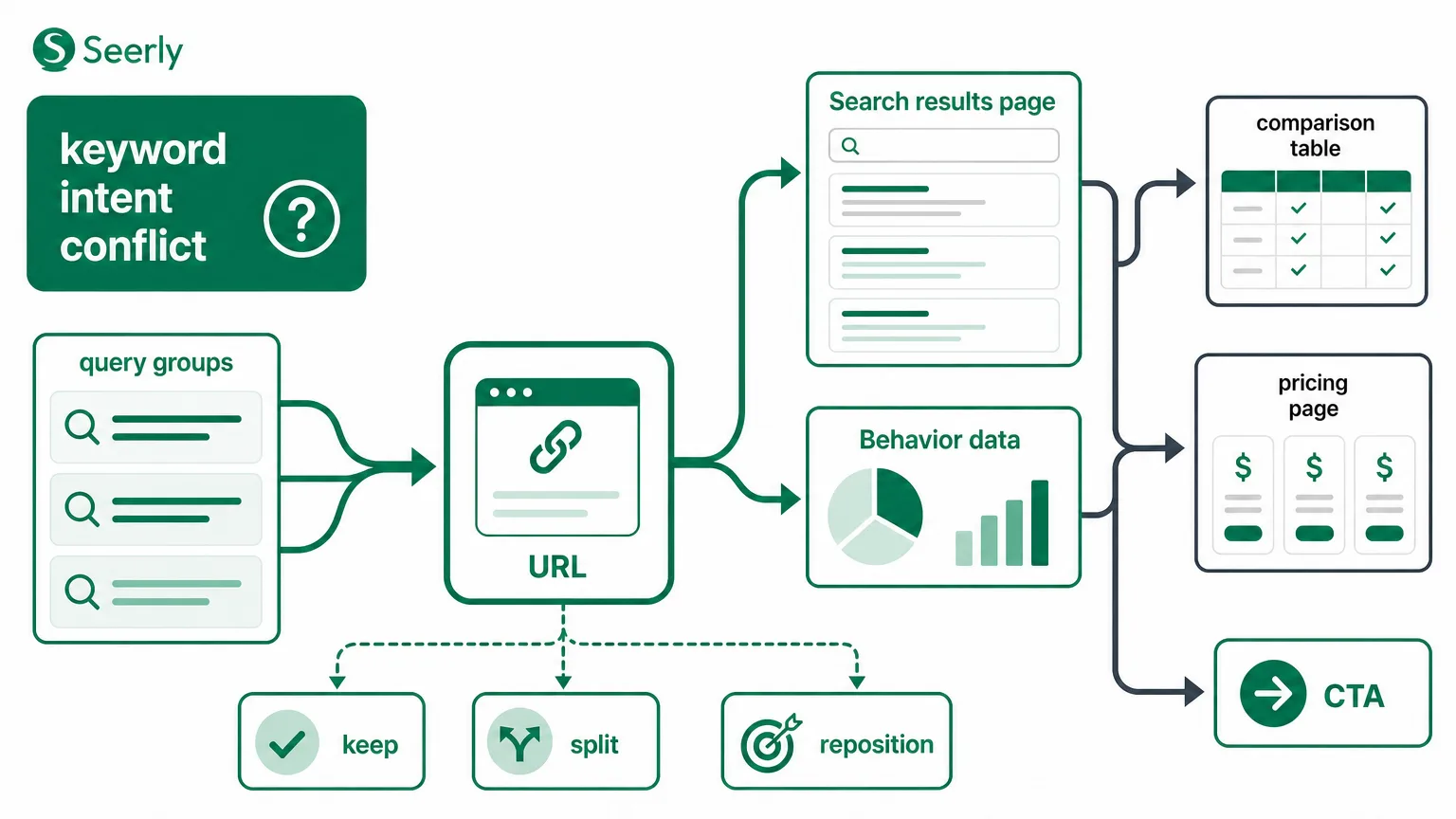
Once technical health looks stable, compare the queries the page ranked for before and after the drop. Do not just ask, “Did our average position fall?” Ask, “Which terms stopped generating impressions, and what replaced them?” A page can lose traffic because it no longer ranks for a valuable cluster even if it still appears for adjacent, lower-intent terms.
This is where keyword mismatch becomes visible. The page may still be relevant in a broad sense but no longer the best fit for what searchers want now. If the query set drifted from transactional to informational, or from product-comparison intent to definition intent, the drop may reflect an intent problem rather than a quality defect.
4. Evaluate internal-link support
Internal links are often the hidden variable in site rank checking. A page can be strong on its own merits yet lose performance because supporting links were removed, diluted, or pointed elsewhere during a redesign or content cleanup. When that happens, Google receives a weaker signal about the page’s importance and topical relationships.
Lean teams often over-attribute ranking loss to weak content when the actual problem is discoverability and reinforcement. If you need a deeper framework for this pattern, Seerly has covered how to find SEO ranking losses caused by weak internal links, not just weak content. The main diagnostic question is simple: did the page lose meaningful internal references from relevant, crawled, well-performing pages?
5. Assess whether the content became thin relative to the SERP
Thin content is not just short content. It is content that no longer resolves the decision, comparison, or task implied by the query. A page can have 2,000 words and still be thin if it lacks specificity, evidence, examples, or a strong information structure. In checking SEO page performance, compare your page against what currently ranks, especially for coverage depth, topical completeness, freshness, and proof.
This does not mean copying competitor structure. It means identifying whether the page still deserves to rank for the target query class. If others now answer the question faster, more credibly, or in a format better aligned with the search result, a refresh may be justified.
6. Check for SERP compression
Not every traffic drop is your fault. Sometimes the page holds a similar ranking band, but the available clicks shrink because the search results page changed. Rich snippets, AI summaries, comparison modules, videos, forums, and other result types can reduce organic click-through even when visibility appears stable.
That is why checking SEO properly requires separating ranking loss from click loss. If impressions and positions are relatively steady but clicks fall, the issue may be search-surface compression rather than page weakness. In that case, the best response is often to improve snippet value, sharpen the angle, or target queries where the page can earn stronger attention rather than rewriting everything.
What changed: the page, the query, or the search surface?
This is the framing question that keeps diagnosis clean. When traffic falls, one of three things usually changed.
First, the page changed. Maybe it was rewritten, trimmed, merged into a new template, slowed by technical changes, or weakened by removed links. These are the easiest cases to confirm because the evidence sits inside your own publishing history.
Second, the query changed. The page may still be live and indexable, but searchers now want something different. This is especially common for software, pricing, alternatives, workflow, and evaluation terms where buyer expectations evolve quickly. A guide written to educate may lose ground if the SERP now favors hands-on comparisons, proof, or sharper product selection intent. That is one reason rankings and visits can still fail to turn into pipeline: the query may no longer reward the format you built.
Third, the search surface changed. Even if your page and the query remain stable, AI search discovery and richer result layouts can intercept attention earlier in the journey. Searchers may get enough of an answer from the results page to skip a click, or they may split attention across new modules that did not exist when the page first gained traction. This is why average position alone can create false confidence. You need to check impressions, click-through rate, and result-page composition together.
A worked example: diagnosing one declining high-intent page
Imagine a lean SaaS team notices that its “CRM implementation checklist” page is down 28% in organic visits over six weeks. This page had been a steady commercial-assist asset, helping buyers move from research to evaluation. The team’s first instinct is to rewrite the page and add more keywords. Instead, they run a structured SEO checking workflow.
They start by confirming the decline is real at the URL level and not sitewide. Other templates are stable, branded demand is flat, and the loss is concentrated on this page and one related article. That narrows the issue away from a domain-wide technical failure.
Next, they review indexability and canonical status. The page is still indexed, load performance is acceptable, and no redirect or noindex issue is present. That allows them to move past technical triage without making unnecessary fixes.
Then they compare the page’s top queries before and after the decline. Historically, the page ranked for “CRM implementation checklist,” “CRM rollout checklist,” and “CRM onboarding plan.” Now impressions are shifting toward broader educational phrases like “what is CRM implementation.” That tells the team the page may have lost fit for higher-intent query variants, even though it still ranks for adjacent topics.
They review the current SERP and see that the top results now include more practical frameworks, downloadable assets, and implementation timelines. Their page still has decent information, but it reads like a general explainer rather than an operational checklist. They also discover that several internal links once pointing to this page were changed during a content hub refresh, weakening context and authority flow.
At this point, the team does not need a full rewrite. The evidence suggests two meaningful causes: reduced internal-link support and a weaker match to the current intent class. The best response is a targeted refresh. They restore strong internal links from related pages, restructure the article around step-by-step implementation stages, add clearer proof and examples, and keep the URL intact. They do not merge the page yet because it still serves a distinct query cluster and remains indexed with residual demand.
This kind of evidence-first process matters even more as AI-ready websites compete for both traditional rankings and broader discovery. If your team wants a more disciplined content review model before editing pages at scale, Seerly has also outlined a proof-first framework for evaluating SEO advice.
Decision matrix: when to fix, rewrite, merge, or monitor
Use this matrix after you identify the first confirmed cause. The point is not to do everything. It is to choose the smallest response that matches the evidence.
Confirmed patternWhat it usually meansBest responseAvoidIndexing, canonical, redirect, or crawl issueVisibility is blocked or diluted technicallyFix technical issue first and wait for recrawlRewriting content before technical recoveryQuery set drifted away from target intentPage still exists but no longer matches what searchers wantRefresh structure, angle, examples, and snippet positioningAdding volume without changing relevanceInternal links weakened or disappearedImportance and topical reinforcement declinedRestore relevant internal links from strong pagesAssuming content quality is the only issuePage is overlapping with another URLCannibalization or diluted authorityMerge, consolidate, or redefine page rolesKeeping near-duplicate pages live indefinitelyRankings mostly stable but clicks fellSERP compression or lower click shareImprove title/meta framing, target click-worthy angles, monitor SERP featuresDeclaring the page “broken” based on sessions aloneNo strong evidence of change yetNormal volatility or insufficient dataMonitor, annotate, and recheck on the next cycleMaking broad edits to “do something”
A practical checklist for lean teams
Before making any page change, confirm each of the following in writing. The page-level drop is real, not just seasonal noise. The affected URL and query cluster are clearly identified. Technical status is verified. Internal-link support has been reviewed. Current intent fit has been compared against the live SERP. A single primary cause, or at most one primary and one secondary cause, has been named.
That last step is important. If your diagnosis lists five equally likely causes, you probably have not finished checking SEO. A useful review process narrows uncertainty instead of expanding it.
FAQs
How long can recovery take after fixing an SEO issue?
It depends on the cause. Technical fixes may show movement after recrawl and reindexing, while content and intent corrections often take longer to reassess. In practice, lean teams should separate “we implemented the fix” from “the market has confirmed the fix.” Report both timelines differently so stakeholders understand that a change in page quality is immediate, but a change in visibility rankings is not.
What should we avoid changing all at once?
Do not change the URL, title, headers, copy, internal links, template, and schema simultaneously unless the issue is clearly structural and urgent. When too many variables move together, you lose the ability to attribute outcomes. A controlled workflow is better than a reactive approach because it preserves evidence and makes future diagnosis easier.
How should we report a traffic drop to leadership?
Frame it as a diagnosis in progress, not a verdict. Explain whether the loss is confirmed at the site, section, or URL level; what evidence has been checked; what the first confirmed cause is; and what action, if any, is justified. Avoid promising recovery on a fixed timetable. Promise a disciplined review process, documented findings, and a clear next decision point.
Conclusion
Checking SEO after an organic traffic drop is not about moving fastest. It is about reducing uncertainty before you intervene. Confirm the drop, isolate the affected pages, rule out technical blockers, compare query shifts, inspect internal-link support, and determine whether the problem is the page, the query, or the search surface.
The next step is simple: pick one page that lost visits, run it through this framework in order, and document the first confirmed cause before changing anything. Then turn that process into a monthly operating habit. Over time, traffic drops become less chaotic because your team has a repeatable system for explaining them. If you want to build a stronger ongoing workflow for AI search discovery and SEO review, explore more resources at Seerly.