When a trusted referring page disappears, what should your SEO team investigate first?
A trusted referring page disappears from your backlink report, and the reflex is familiar: find the editor, ask for the link back, then move on. Sometimes that works. More often, it treats the visible symptom while missing the reason the source stopped pointing to your page in the first place.
A backlink monitor can tell you that a relationship between two URLs changed. It cannot, on its own, tell you whether the referring page was deleted, rewritten, redirected, removed from indexing, or replaced by a competitor because their material now better answers the reader’s question. Those are very different incidents, and they call for different responses.
I’ve found that teams recover more useful insight when they treat a lost referral as a small investigation. The record may reveal a stale product claim, thin evidence, a misaligned landing page, or a relationship that simply needs attention. The goal isn’t to chase every link. It’s to learn what changed and decide where effort belongs.
What changed when a referring page vanished or stopped linking?
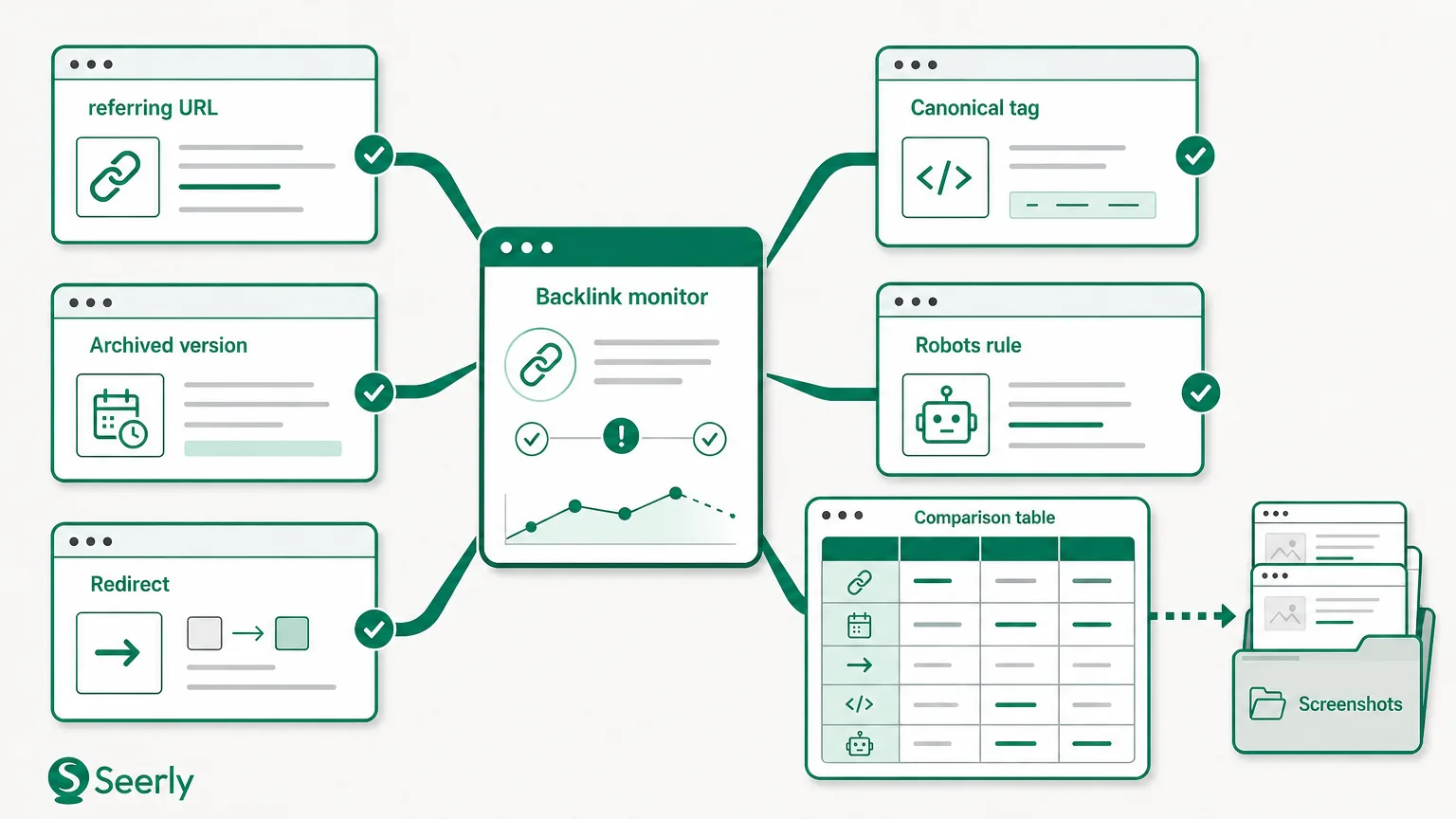
Start with the referring URL, not the lost-link count. A backlink alert catches a change after it happens, but your first task is to classify that change. This matters because a broken source page and a competitor substitution can look identical inside backlink monitoring tools, even though one needs no outreach at all and the other may point to a gap in your content.
Use this diagnostic checklist before assigning work:
-
The page was deleted or now returns an error. Check the live URL and an archived version. If the publisher removed the entire page, a replacement request may be pointless unless they have a relevant successor page.
-
The page moved to a new URL. Look for a redirect, canonical tag, or replacement article. Google’s documentation explains how redirects signal a page move, which helps separate a genuine disappearance from a URL migration that your data source has not yet reconciled. Redirects and canonical signals can help Google understand moved content.
-
The source is still live but no longer indexed. A
noindexdirective, a robots rule, or an accidental technical change may have reduced the page’s search presence while leaving it accessible to direct visitors. -
The article changed. Compare the old copy with the current version. Editors frequently refresh rankings, vendor lists, and research roundups. Your mention may have vanished because a claim became dated or the page shifted its angle.
-
A competitor replaced you. Don’t stop at “they took our link.” Read the alternative. Does it include fresher data, a clearer method, customer proof, or a page that answers the buyer’s question more directly?
-
Your measurement is wrong. Backlink databases crawl on different schedules and see the web differently. Semrush’s analysis of backlink databases found material variation in index coverage between platforms, so one alert should always be verified in the browser and, when the source matters, in a second data set. Backlink database size and freshness vary by provider.
That last possibility saves teams from a lot of awkward email. A tool saw a change. The web may not have.
Which lost sources deserve immediate attention?
Not every lost referral deserves the same response time. A forgotten link from a generic directory and a link from a respected buyer guide may both register as “lost,” but their practical value differs sharply. Put the source through a simple four-factor score before adding it to anyone’s weekly workload.
| Factor | Score 1 | Score 3 | Score 5 |
|---|---|---|---|
| Relevance to buyer questions | Broad or unrelated mention | Adjacent topic | Directly answers a buying or evaluation question |
| Source authority | Little audience evidence | Established niche publisher | Trusted publication or category reference |
| Destination-page importance | Low-priority archive page | Supporting resource | Revenue, category, or decision-stage page |
| Unique evidence | Generic citation | Some original framing | Exclusive data, test, quote, or methodology |
Add the four scores. A total of 16 to 20 deserves review within a day or two. A total below 10 can wait for the regular monthly audit unless it coincides with a broader decline. The score is not a ranking formula. It is a way to stop a noisy alert feed from choosing your priorities for you.
Authority deserves some skepticism. A source with modest domain metrics may matter more than a large publisher if it sits directly in the path of a serious buyer. Ahrefs’ research has also found that links from pages with organic traffic correlate more strongly with rankings than links from pages without traffic, which is a useful reminder to inspect the page itself, not only the referring domain. Links from pages that receive search traffic tend to carry more weight.
Unique evidence changes the calculation too. If the vanished page cited your original survey, benchmark, or technical test, its loss may signal that your evidence no longer feels current enough to be repeated elsewhere. That is a content issue with wider implications, not just a single missing link.
How can a backlink monitor separate a link problem from a page problem?
Here’s a worked example. A B2B software company loses a link from a 2023 “best project reporting tools” article. The former source linked to the company’s product page using language about “real-time client reporting.” Six months later, the article still exists, but the company has been replaced by a competitor.
The team’s first reaction is to ask the editor why. Pause. The old article named speed as the deciding feature. The destination page now opens with broad brand copy, puts reporting features several scrolls down, and contains no screenshots, report examples, or current proof. Meanwhile, the competitor’s replacement page has a two-minute demo, a downloadable sample report, and a dated comparison table.
The link did not fail in isolation. The destination page stopped carrying the same proof the original recommendation depended on. An outreach email that says “could you add us back?” asks the editor to ignore their own refreshed standard. That rarely lands well.
Compare three things side by side:
-
Former referring page: What exact claim did it make, where did the link sit, and what reader question was the article trying to answer?
-
Your destination page: Can a visitor verify the claim in under a minute? Is the proof current, specific, and easy to find?
-
Current alternatives: What do the replacement pages show that yours does not? Look at evidence and task completion, not only copy length.
The more I looked at cases like this, the more the pattern repeated: a lost link often exposes an evidence mismatch. Teams working through how to check backlinks that influence AI search visibility can apply the same discipline to sources that shape discovery beyond a traditional results page.
Definition: A lost-link incident is a documented change in a referring URL, paired with evidence about why the change happened and what the destination page needs next.
What evidence should the team preserve before making changes?
Speed matters, but changing your page before preserving the old state destroys the comparison you need. Screenshot the live source, save the HTML if possible, capture the destination page as it exists today, and record the dates. Link rot is common enough that archives and timestamps are part of ordinary web research, not bureaucratic decoration. Ahrefs’ large-scale research documents that links disappear over time across the web.
Use an incident record with these fields:
| Field | What to capture |
|---|---|
| Alert details | Detection date, tool, referring URL, destination URL, anchor text |
| Source status | Live, redirected, deleted, rewritten, noindexed, or uncertain |
| Archived evidence | Archived URL, screenshots, old link placement, surrounding copy |
| Destination claims | Claims the old source supported and proof now visible on your page |
| Replacement analysis | Competitor or alternate sources now named, plus the evidence they use |
| People involved | Content owner, relationship owner, product expert, and reviewer |
| Decision | Outreach, correction, page refresh, supporting asset, or no action |
| Review date | When the team will check referral traffic and source status again |
Keep the record short enough that someone will actually complete it. A spreadsheet row works for low-priority cases; a shared document is better for a source with commercial impact. Honestly, this part is a pain at first. After a few incidents, those records become a library of recurring weaknesses: old screenshots, unsupported claims, thin comparison pages, or a publisher relationship nobody owned.
When should outreach happen, and when should your site improve its own evidence?
Outreach is appropriate when the publisher has a factual reason to change the page. A broken link, an incorrect product detail, a missing update the editor requested, or a relationship with real editorial history all qualify. Keep the note specific: identify the exact page, the verifiable correction, and the page that supports it. Do not attach a generic “resource” pitch to a publisher who already chose another source.
Use this decision tree:
-
Was the source page removed or redirected?
If yes, find its replacement. Contact the publisher only if a relevant successor exists and your page still fits the new article’s purpose. -
Did the article retain a factual error about your company or product?
If yes, send a factual correction with evidence. Keep it calm and brief. Editors can spot a disguised link request from orbit. -
Did a competitor replace your citation because their page answers the question better?
If yes, improve your own page first. Add current proof, clear examples, original data, or a task-specific section that readers can use. -
Did the source once depend on evidence you no longer maintain?
Build a supporting asset. That might be a methodology page, a benchmark, a product-change log, or a research update worth referencing.
Google’s guidance is clear that links intended mainly to manipulate rankings violate its spam policies. Link schemes include buying or exchanging links primarily for ranking purposes. So don’t turn investigation into transactional link chasing. Make the page worth citing, then reconnect with editors when there is a real editorial reason.
How do you know the investigation improved the underlying problem?
A recovered link is a welcome outcome, but it is not the only measure of progress. Check whether the team improved the reason the source became vulnerable. If your refresh added proof, did visitors reach that proof? Did new referring pages begin using the updated resource? Did the same buyer question become easier to answer on your landing page?
Run a 30-, 60-, and 90-day follow-up:
-
Review whether referral visits resumed from the original source or a successor URL.
-
Check if the destination page gained fresh mentions from other relevant sources.
-
Re-read the page against the former article’s buyer question. Remove claims that now lack support.
-
Watch for repeat losses from similar page types, such as comparison articles or industry directories.
-
Record patterns in your monitoring workflow so the next alert arrives with context, not panic.
A backlink monitor software workflow becomes more useful when it connects to wider monitoring. For example, teams can pair referral incidents with cross-provider ranking monitoring to see whether a source change coincided with a broader shift in demand or discovery. The relationship may be indirect. Still, dates have a way of revealing patterns that a single dashboard view hides.
Frequently asked questions
How often should backlink monitoring run?
Daily alerts suit high-value commercial pages and fast-moving publisher coverage. Weekly reviews suit most content libraries, provided the team has a clear escalation rule for high-scoring losses. The real risk is not a slower alert. It is receiving alerts nobody investigates.
Should we ask every publisher to restore a lost link?
No. Contact publishers when you can correct a fact, point to an appropriate updated resource, or continue an existing editorial relationship. If the publisher chose a better alternative, fix the reason before asking them to reconsider.
What should a backlink monitor report include?
At minimum, track the referring URL, destination URL, anchor text, detection date, source status, estimated referral value, and assigned owner. Add archived proof for high-priority incidents. That turns a notification into a decision record.
Pick one recent referring-domain change this week. Complete the incident record before deciding on outreach or a content update. You may find you lost a link. Or you may find the source exposed something far more useful. Learn more at Seerly.