Why Gemini AI and ChatGPT cite different sources for the same buyer question
“Which customer data platform is best for a mid-market SaaS company that needs warehouse-native analytics?”
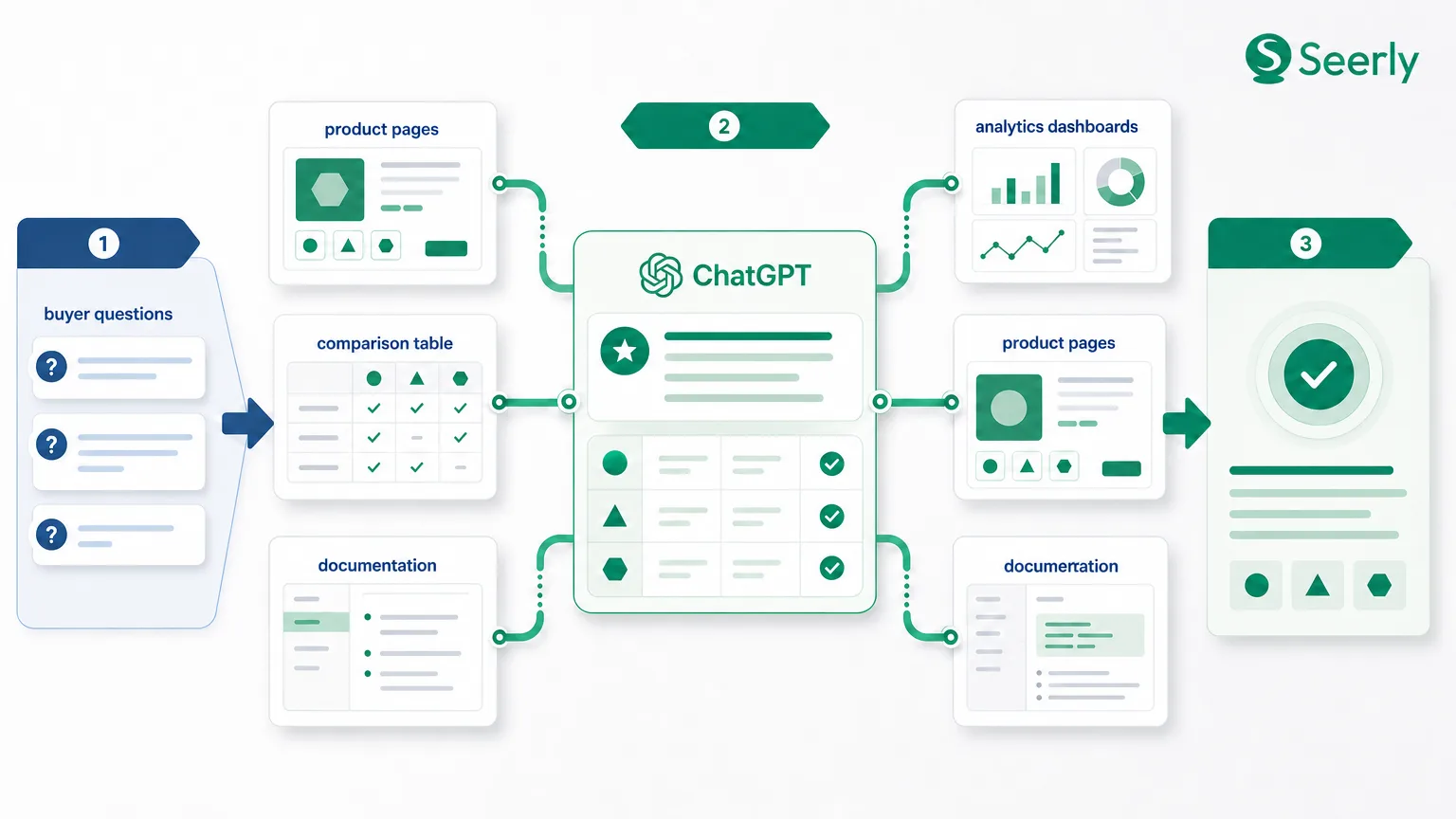
It is a buyer question with a clear commercial intent. Yet Gemini AI and ChatGPT may answer it with noticeably different source mixes: one may lean on vendor documentation and an analyst-style comparison page, while the other may surface a software directory, a community thread, and a vendor’s pricing or product page. Both answers can be useful, but they reveal different judgments about which sources best support the recommendation.
That difference matters for B2B visibility. A brand may appear in one system’s answer but not another’s, even when the buyer’s underlying need has not changed. The goal is not simply to track brand mentions. It is to understand the evidence, structure, and corroboration that make a page useful enough to earn inclusion when AI systems assemble an answer.
The same buyer question can produce different source mixes
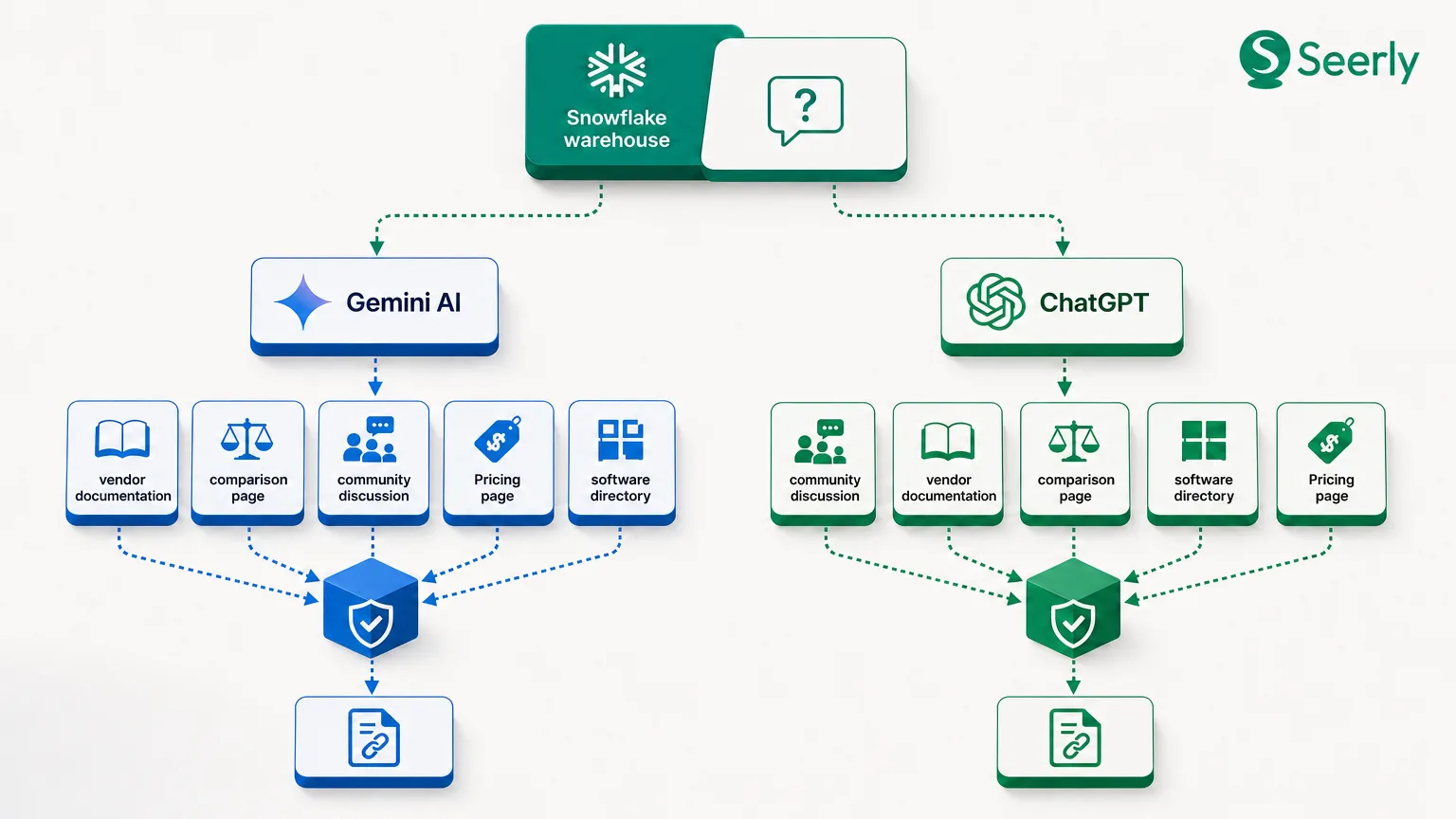
Consider this question: “What is the best customer data platform for a mid-market SaaS team with a Snowflake warehouse?”
A Gemini AI response could prioritize:
- A vendor’s technical documentation explaining Snowflake integration, data sync methods, and governance controls.
- A detailed comparison page that contrasts warehouse-native CDPs by implementation model, identity resolution, and activation.
- A third-party review or directory page that identifies the products commonly evaluated by mid-market teams.
ChatGPT might cite a different combination for the same question:
- A product comparison page that gives a direct “best for” recommendation.
- A community discussion where practitioners describe deployment tradeoffs, data-model limitations, and migration effort.
- A vendor pricing or feature page that clarifies packaging and availability.
Neither pattern is inherently better. The systems may interpret the question, select supporting material, and weigh available evidence differently. Product capabilities also evolve quickly: Google continues to update Gemini models and product experiences, including its Gemini 2.5 model family and enhanced reasoning capabilities. That means source visibility should be monitored as an operating discipline, not treated as a one-time ranking result.
The practical implication is straightforward: a single polished vendor page may not be enough. To earn visibility across AI search discovery surfaces, content must make the company, product, use case, and proof easy to identify - and easy to validate against other credible sources.
Four drivers behind source selection
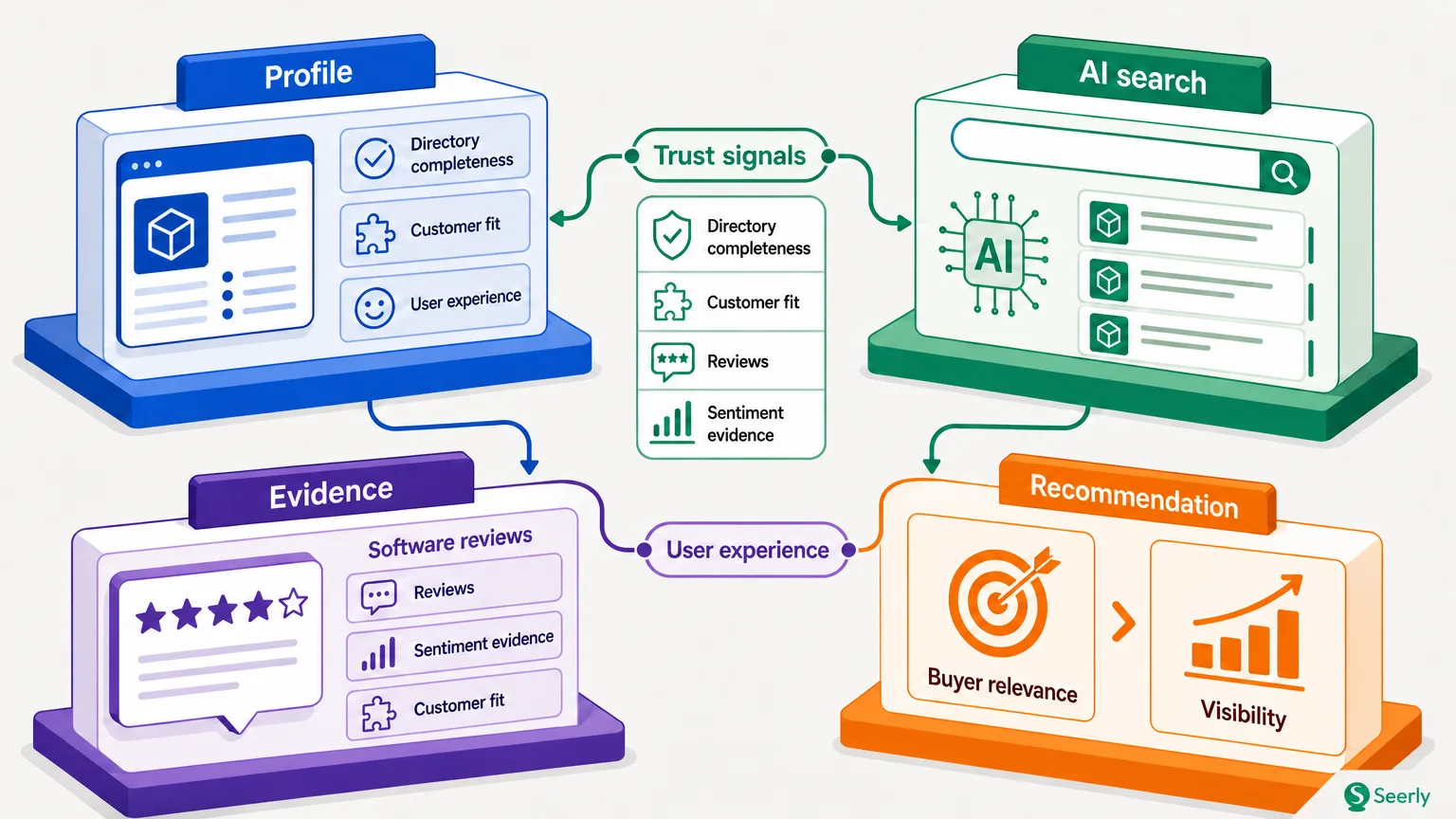
Source selection is not a simple popularity contest. It reflects the relationship between the buyer’s wording, the model’s confidence in relevant entities, the quality of available evidence, and how easily a page can be interpreted.
Prompt specificity changes what counts as relevant
Small wording changes can alter the kind of source an AI system needs. “What is the best CDP?” is broad and may lead to directories, broad roundups, or well-known vendors. “Which CDP supports Snowflake, product-led growth, and strict data residency requirements?” is narrower and gives technical documentation, security pages, and implementation guides more reason to surface.
The second question contains decision criteria, not just a category label. It asks the system to connect several claims at once: warehouse compatibility, a specific go-to-market model, and compliance requirements. Brands should therefore map buyer questions by stage and constraint, rather than optimizing only for short category terms.
Entity confidence affects whether a page is usable
An entity is the identifiable thing a system needs to understand: a company, product, feature, integration, customer segment, or method. Clear entity naming reduces ambiguity. A page that says “Acme CDP supports Snowflake through a managed connector” is more useful than a page that says “our platform connects to leading warehouses” without naming the product, warehouse, or implementation method.
This matters because models must distinguish between similarly named products, overlapping feature labels, and broad marketing language. Google describes Gemini as a multimodal model family designed to reason across different kinds of information, with its original technical report outlining its multimodal capabilities and evaluation approach. For publishers, the lesson is not to write for a model’s internal mechanics. It is to state key entities and relationships plainly enough that a reader or system can verify what the page actually claims.
Corroboration depth makes claims safer to use
A single vendor page can establish what a company says about its own product. It is less effective when the buyer needs an independent view of tradeoffs, market alternatives, or real-world implementation experience. Citation-ready content gives a system more than a claim: it provides details that can be checked against documentation, customer evidence, partner listings, technical references, and neutral third-party coverage.
For example, a vendor may state that its platform “reduces implementation time.” A stronger page specifies the implementation model, required data sources, typical team roles, documented prerequisites, and a named customer example where appropriate. The more concrete the claim, the easier it is to corroborate and the less the system must infer.
Page design determines how quickly evidence can be extracted
Page design is not only visual. It includes the order of information, heading clarity, tables, labels, definitions, and the connection between a statement and its proof. A long product page that buries its Snowflake support halfway through a feature narrative is harder to use than a page with an early summary, a clearly labeled integration section, implementation details, and links to supporting documentation.
This is especially important as AI products increasingly combine model reasoning with tools and current information. Google’s I/O 2025 announcements described expanding AI Mode in Search and Gemini-powered capabilities, reinforcing the need for web pages that answer specific questions cleanly. Structured, evidence-led publishing helps a page serve both the buyer who scans it and the system trying to support a concise answer.
Why independent pages often earn inclusion
Comparison pages, community discussions, and third-party pages frequently appear because they solve weaknesses inherent in vendor-owned content. That does not mean vendor pages are unimportant. It means each source type contributes a different kind of evidence to a buyer-oriented response.
Comparison pages provide direct contrast
A good comparison page puts products on the same decision frame. It can show whether two platforms differ by deployment model, integrations, ideal company size, governance features, or pricing approach. This contrast is valuable because buyer questions often ask for a choice, not a feature inventory.
The strongest comparison pages do not pretend that every option is equally suitable. They explain the conditions under which each product fits, cite or link to primary evidence for factual claims, and disclose commercial relationships where relevant. A vendor can create useful comparison content, but it should acknowledge genuine tradeoffs rather than presenting every alternative as inferior.
Community discussions capture operational reality
Forum threads and practitioner communities can surface because they contain questions buyers actually ask after the marketing page ends. Contributors may describe implementation complexity, support quality, limits in a particular workflow, or the skills required to operate a platform. Those details are often absent from polished vendor messaging.
Community evidence is uneven, however. A highly visible discussion may be old, based on a discontinued product version, or specific to one company’s stack. Treat it as a signal of the questions buyers need answered, not as a substitute for product documentation or verified customer proof.
Third-party pages offer breadth and independent framing
Directories, analyst-style explainers, partner pages, review platforms, and industry publications can help establish category context. They may show which vendors are commonly compared, identify common selection criteria, or explain terminology that buyers use inconsistently. Their independence can make them useful when an answer needs to balance a vendor’s claims with broader market framing.
For content teams, this creates a distribution requirement as well as a publishing requirement. The brand’s own website must clearly explain its product, but its claims should also be legible through credible external context. That is central to helping SaaS buyers find the right product through AI search optimization: visibility improves when a product can be understood from more than one page and more than one perspective.
A practical playbook for citation-ready publishing
Citation-ready publishing means creating pages that give an AI system a defensible reason to include them. It does not mean writing formulaic text or attempting to control a specific answer. The priority is to reduce ambiguity, place proof near claims, and make decision-relevant information easy to compare.
Start with a tighter answer summary
Open important product, solution, and comparison pages with two or three sentences that answer the buyer’s likely question. Name the product, primary audience, core use case, and meaningful limitation or condition. For example: “Acme CDP is designed for mid-market SaaS teams using Snowflake as their central customer-data warehouse. It supports audience activation and identity resolution, but implementation requires clean event and account data.”
This format gives the page a clear point of view without overselling. It also helps the rest of the content remain focused on proving the summary rather than repeating broad positioning statements.
Name entities and relationships explicitly
Use consistent names for the company, product edition, integration, feature, and target use case. Avoid switching among vague phrases such as “the solution,” “the platform,” and “our system” when the actual product name is needed. Specify relationships: which product integrates with which platform, what the integration does, and who is responsible for setup.
Clear naming supports brand reputation as well as discoverability. It reduces the chance that a buyer or system confuses an integration announcement with native functionality, or a general capability with a feature available only on a certain plan.
Build evidence blocks around important claims
For every claim that could affect a purchase decision, include a nearby proof element. That may be technical documentation, a methodology note, an implementation checklist, a customer example, a product screenshot with context, or a table defining plan-level availability. Avoid unsupported superlatives such as “most powerful” or “fastest” unless the page can explain the benchmark, comparison set, and date.
A useful evidence block answers four questions: what is being claimed, how it works, for whom it applies, and what the buyer should verify. This format helps content teams replace broad assurance with usable decision support.
Make comparisons explicit rather than implied
If buyers commonly compare your product with alternatives, publish pages that address the comparison directly. Explain selection criteria, areas of overlap, meaningful differences, and cases where another approach may fit better. A transparent comparison is more likely to satisfy a buyer’s question than a feature page that expects readers to make the comparison themselves.
Use this checklist on one high-intent page before the next update:
- Does the opening summary name the product, buyer segment, use case, and constraints?
- Are key entities - features, integrations, plans, and customer types - named consistently?
- Does each material claim have a nearby proof element or a clearly stated qualification?
- Can a buyer find implementation requirements, limitations, and ownership without scanning the entire page?
- Does the page compare relevant alternatives or explain when another option may be a better fit?
- Are dated claims reviewed so current product information remains accurate?
A three-update test matrix
Treat the next three content updates as controlled learning opportunities. The aim is not to find one universal format, but to see which page and proof combinations improve inclusion for the buyer questions that matter most.
| Update | Question wording to test | Page format | Proof element to add | What to compare |
|---|---|---|---|---|
| 1 | “Best CDP for mid-market SaaS” | Category solution page | Clear ideal-customer profile and feature table | Whether broad directories, vendor pages, or comparisons surface |
| 2 | “CDP for Snowflake with identity resolution” | Integration page | Technical architecture, setup steps, and limitations | Whether documentation and partner sources gain visibility |
| 3 | “Segment alternative for a SaaS team on Snowflake” | Comparison page | Decision matrix, migration considerations, and customer evidence | Whether comparison pages and community sources appear more often |
Run each question in Gemini AI and ChatGPT using the same wording, then record the cited domains, page types, product mentions, and evidence used in the response. Repeat the tests after publication and after meaningful product or page changes. The goal is not to treat either system as a static ranking report; it is to identify where your content lacks the proof, framing, or corroboration needed for credible inclusion.
FAQ
Can a brand force Gemini AI or ChatGPT to cite a page?
No. Brands cannot reliably force a specific system to cite a specific page. Source selection can vary with query wording, product updates, available information, and the system’s evaluation of relevance and support. The productive approach is to improve the page’s factual clarity, evidence, and usefulness for the buyer question.
Do community pages always win over vendor content?
No. Community pages are helpful when a question calls for lived experience, implementation concerns, or peer recommendations. Vendor documentation is often stronger for product specifications, supported integrations, security controls, and current feature availability. The best answers can draw on both, using each source type for the claim it is most qualified to support.
Should teams treat Gemini AI and ChatGPT as separate visibility surfaces?
Yes. They may overlap, but they should be monitored separately because their answer construction and source mixes can differ. Separate tracking helps reveal whether a visibility gap is caused by missing product proof, weak comparison content, limited third-party corroboration, or an unclear page structure. Those findings can then inform data-driven content updates rather than broad assumptions about AI visibility.
AI search discovery rewards pages that help buyers make a defensible choice, not pages that merely repeat category language. Pick one buyer question, compare which sources Gemini AI and ChatGPT cite today, and use the differences to prioritize the next content updates.