What a domain rating check can and cannot reveal about AI discovery
A domain rating check is often one of the first steps in an SEO review. It is quick, familiar, easy to benchmark, and gives stakeholders a simple number to discuss. But when the question shifts from traditional organic performance to AI search visibility, that simplicity can become misleading.
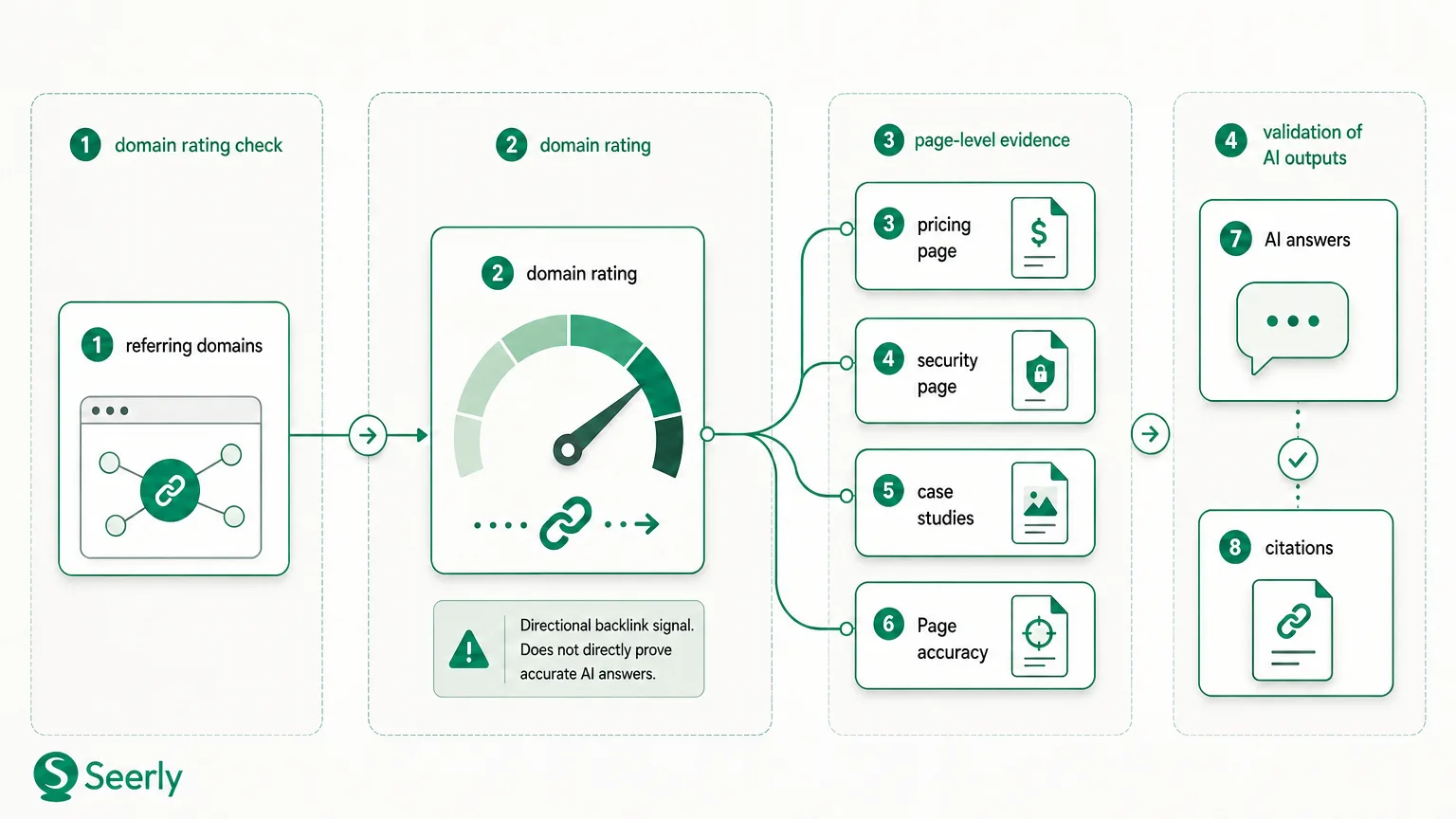
A strong authority metric may indicate that a site has earned links from other websites. It does not show whether the brand’s product information is current, whether key claims are supported by credible evidence, or whether an AI answer includes and cites the brand. Use domain rating as a way to prioritize investigation - not as proof that a site is accurately represented in AI-led discovery.
What a domain rating actually measures
Domain Rating (DR) is Ahrefs’ proprietary estimate of a website’s backlink-profile strength. Ahrefs calculates it on a logarithmic scale from 0 to 100, using the quantity and relative quality of referring domains that link to a target website. In practical terms, a higher score generally means a domain has acquired links from a stronger or broader set of websites than lower-scoring peers.
That definition matters because the metric is often described too broadly as “authority,” “trust,” or “credibility.” A domain rating check does not assess whether a business delivers a good product, whether the information on its pages is factually complete, or whether its experts are qualified. It is a third-party, link-based model - not a direct measurement of real-world reputation.
It is also not a Google metric. Search engines do not use Ahrefs Domain Rating as a ranking factor, and Google’s published guidance explains that its ranking systems use many signals and systems to surface useful results rather than a single public authority score. The same caution applies even more strongly to AI-generated answers, where a brand may be mentioned, omitted, summarized inaccurately, or cited alongside third-party sources.
When teams check domain rating online - whether through Ahrefs, Semrush, or another provider - they should treat the result as directional. Different platforms model authority differently. For example, Semrush describes its Authority Score as a composite metric that incorporates link signals, organic traffic indicators, and spam factors, rather than a direct equivalent of DR. Comparing scores across tools as if they were interchangeable produces false precision.
When a domain rating check is useful in a content or technical review
The score is still useful when it answers a narrow question. Its best role is comparative: spotting changes, identifying outliers, and deciding where an analyst should spend time next. It is less useful when it is used to declare that a page, brand, or campaign is “ready” for AI search.
| Review decision | How domain rating can help | What to check before acting |
|---|---|---|
| Investigate a sudden visibility change | A material change in referring-domain patterns can signal a need to review lost or gained links. | Confirm whether the change is real, relevant, and concentrated on important pages. |
| Compare a defined peer set | It can provide a broad view of relative link-profile strength among direct competitors. | Compare only genuine category peers and inspect source quality, not just the headline score. |
| Prioritize link-profile analysis | A low score versus close competitors may justify a deeper backlink review. | Review content gaps, technical accessibility, evidence, and customer-question coverage at the same time. |
| Assess a new or migrated domain | It can establish a starting benchmark before and after structural changes. | Track redirects, indexation, page-level link equity, and changes in actual search performance. |
| Plan outreach resources | It can identify pages or topics where credible external references may be particularly valuable. | Ensure the underlying page is accurate, distinctive, and useful enough to deserve links. |
A domain rating check is especially valuable as a trend line. If a domain loses high-quality referring domains after a site migration, that is a tangible diagnostic lead. It does not prove that the decline caused reduced visibility, but it tells the team which evidence to inspect. For migration work, pair the metric with crawl, redirect, indexation, and ranking baselines; Seerly’s guide to building a reliable SEO baseline before a site migration explains why comparison data needs to be captured before changes go live.
The same principle applies when teams use a free tool. A check Domain Rating free workflow can be useful for early triage, but the score alone is insufficient for a recommendation. Before reporting that a site “needs backlinks,” examine which pages have earned links, whether those pages support commercial or informational journeys, and whether the linked content still reflects the current offer.
Why a strong authority score can coexist with poor AI-search representation
AI discovery is an output problem as well as an authority problem. A brand may have substantial historical link equity while its current product pages are incomplete, its claims are outdated, or its comparison content does not answer the questions people actually ask. In those cases, a high domain-level score can sit beside weak prompt performance.
| Myth | Reality |
|---|---|
| “A high DR means AI tools will recommend us.” | DR reflects link-related signals. It does not validate whether the brand appears in relevant AI answers or is framed accurately. |
| “Links prove our product claims are credible.” | Links can point to content for many reasons. Current claims still need clear first-party evidence and trustworthy supporting sources. |
| “Our homepage has authority, so key pages are covered.” | AI answers may depend on the specificity and clarity of individual pages, product documentation, reviews, and cited third-party material. |
| “If competitors have lower DR, we should appear more often.” | A competitor may have clearer facts, stronger evidence, better category coverage, or more prominent third-party representation. |
| “No mention means we need more links.” | The immediate issue may be missing facts, weak formatting, stale copy, inaccessible content, or an untested user question. |
Consider a B2B software company with years of editorial mentions and a DR of 78. Its pricing page still shows an old plan structure, its security page lacks documentation, and its case studies make broad claims without sourceable details. An AI system asked to recommend tools for a tightly defined use case may instead name competitors whose documentation explicitly covers integrations, compliance, pricing criteria, and limitations.
This does not mean links no longer matter. Ahrefs’ analysis argues that links matter less in some contexts but still matter, particularly as part of a wider search strategy. The operational point is different: a link metric cannot tell you whether the available evidence answers the user’s question. Generative engine optimisation requires teams to evaluate representation, answer quality, and citation visibility directly.
What to review alongside authority metrics
Before making an AI-visibility decision, run an evidence-led audit. The goal is to turn a broad domain signal into page-level hypotheses that can be tested. A domain rating may indicate where investigation is warranted; the following checks determine what should happen next.
- Page accuracy: Verify pricing, features, availability, specifications, leadership details, and policies against internal sources. Remove stale claims rather than allowing historic copy to define the brand.
- Source quality: Identify whether high-value claims have credible supporting sources, such as documentation, independent research, regulatory material, or demonstrable case evidence. A link is not automatically evidence.
- Structured facts: Make essential information explicit and consistently formatted across core pages. Clear tables, definitions, dates, comparisons, and product attributes reduce ambiguity for users and systems.
- Customer-question coverage: Test the specific queries buyers ask before they buy: alternatives, use cases, limitations, pricing conditions, integrations, implementation requirements, and suitability by segment.
- Prompt results: Record how the brand appears across a stable set of relevant prompts. Capture mention status, description accuracy, competitors named, and answer gaps rather than relying on a single anecdotal result.
- Cited-source evidence: Note which sources are cited or referenced when answers mention competitors. This helps distinguish a visibility problem from an evidence-distribution problem.
- Competitor representation: Compare the facts, proof points, and third-party sources that support competitors’ positions. Visibility benchmarking is more useful when it explains why another brand is selected.
For backlink analysis specifically, focus on relevance and placement rather than volume alone. A practical backlink review for AI-search visibility should identify whether important pages earn references from sources that add contextual credibility. Links to outdated campaigns or generic homepage mentions may have far less diagnostic value than authoritative references to a current product capability.
A worked prioritization example
Imagine an agency is reviewing three pages for a cybersecurity client. Each page has a different combination of link evidence, factual completeness, and observed AI-answer performance. Looking at DR alone would produce the wrong action plan.
| Page | Authority and link context | Content evidence | AI-answer observation | Priority action |
|---|---|---|---|---|
| Compliance overview | Strong domain score; several reputable links to the company | Certification language is vague and dates are missing | Brand is mentioned, but answer says its compliance status is unclear | Fix facts and publish verifiable evidence first; pursue links to the improved documentation later |
| Integration guide | Moderate domain score; few deep links to this specific page | Accurate but thin documentation with no implementation examples | Competitors are recommended for integration questions | Expand the guide, add structured requirements and examples, then seek relevant technical references |
| Research report | Low domain score; no meaningful links to the report | Original methodology, current data, clear author credentials | Not yet visible in relevant answers | Preserve the evidence quality and build distribution through credible outreach; test representation after discovery improves |
The compliance overview is not a link-building problem first. Its high domain-level score has not overcome missing proof, because the core page does not make a precise, supportable case. The agency should correct dates, name applicable standards, explain scope, and link to documentation. Only then does outreach amplify something worth citing.
The integration guide needs both deeper content and carefully targeted authority-building. It answers the topic broadly but fails to resolve decision-stage questions, so adding links without improving substance may simply send more users to an incomplete resource. The research report is the closest case for dedicated distribution: its evidence is already strong, but it lacks external discovery signals and third-party references.
This is why AI-ready websites need a multi-signal review. Authority informs the priority, content evidence informs the remediation, and prompt performance tracking validates whether the remediation improved representation.
How to report authority metrics without presenting them as proof of visibility
Stakeholders need concise reporting, but concise should not mean overconfident. Separate what the metric observes from what the agency believes may be happening. This protects decision quality and makes the next investment easier to justify.
Use this reporting structure:
Observation: The domain’s DR increased from 52 to 58 during the review period, while referring domains to the integration section remained flat.
What this suggests: The site’s overall link profile strengthened, but that change may not have reached the pages most relevant to integration-related buyer questions.
Visibility evidence: In the tested AI-answer set, the brand appeared in 2 of 10 integration prompts and was not cited in the captured outputs.
Confidence level: Medium. The evidence supports a page-level gap, but results should be monitored across a larger, stable prompt set.
Next checks: Validate documentation accuracy, compare competitor evidence, improve implementation detail, and assess opportunities for relevant third-party references.
Avoid language such as “DR growth proves AI visibility will improve” or “our authority is higher, so we should outrank competitors.” A better statement is: “The authority metric supports further investigation into link distribution; it does not independently establish answer inclusion, citation visibility, or factual representation.”
FAQ
Should we stop tracking authority metrics altogether?
No. Domain rating remains a useful supporting metric for backlink reviews, competitive context, and trend monitoring. The risk is treating it as a standalone target, which can encourage teams to chase score movement rather than build accurate, useful, evidence-backed pages. Track it alongside page-level performance, referring-domain quality, prompt observations, brand citation monitoring, and competitor representation.
Is it useful to check domain rating Ahrefs data for competitors?
Yes, when the competitor set is limited and strategically relevant. Use it to form questions: Which competitor has stronger deep-page links? Which has a more diverse set of referring domains? Which content assets attract editorial references? Do not use it to assume that the highest score has the best AI search visibility.
Can a low DR domain appear in AI answers?
It can. A smaller domain may have precise first-party information, strong documentation, original research, specialist expertise, or useful third-party validation for a narrowly defined question. A lower authority score may constrain broader discoverability over time, but it does not automatically prevent accurate inclusion in an answer.
Use authority as a signal, then validate representation
A domain rating check can reveal relative link-profile strength and help teams prioritize where to investigate. It cannot confirm that a brand’s facts are current, that its content answers customer questions, or that it earns visible citations in AI-generated results. The useful decision is never “high DR or low DR?” It is “what evidence explains the brand’s current representation, and what should change next?”
Pair your authority review with Seerly’s Foundations > Smart Audit > Readiness Check, then evaluate representation signals in Monitoring > Visibility and Monitoring > Citations > Browse Citations. Explore Seerly to turn AI search visibility into measurable growth.