A 90-day backlink plan built on proof, partners and selective outreach

A startup can spend its first quarter collecting backlinks and still finish with little evidence that the work helped anyone discover or trust the business. The problem often starts with the target: acquire more links, regardless of what those links help readers understand. For a lean marketing team, that can consume the same time needed to publish something genuinely worth referencing.
Link building is the work of earning links from other websites to your own. But a useful early-stage program should serve a broader purpose: helping relevant audiences find credible evidence about your expertise, product or market. That matters whether someone discovers your business through a publication, a search result or an AI-generated answer.
This guide sequences the first 90 days around three priorities: publish one defensible evidence asset, identify a short list of relevant opportunities, and use selective outreach to connect that evidence with real reader needs. The objective is not a promised number of placements. It is a repeatable process for earning useful references and evaluating their business value.
Why is link volume the wrong starting metric for an early-stage team?
Backlinks matter, but counting them without context creates a weak operating target. Backlinko’s observational analysis found that the top-ranking Google result had, on average, 3.8 times more backlinks than results in positions two through ten. That association does not prove that acquiring a particular number of links will cause a startup’s rankings to improve.
The practical question is therefore not “How many links can we obtain?” It is “Which references would make our business easier to discover, evaluate or trust?” An editorial link that supports a relevant explanation has a different purpose from a placement arranged primarily to influence rankings. Your program should distinguish those purposes before allocating budget.
| Myth | Fact | Operating implication |
|---|---|---|
| More backlinks automatically mean more progress. | A count does not explain relevance, reader usefulness or business impact. | Review the referring page and its context, not just the total. |
| Any high-scoring domain is a good target. | A third-party domain score cannot establish whether a particular article serves your audience. | Evaluate the page, publication and reader need separately. |
| Partner outreach means trading links. | Partners can reference useful evidence without making publication conditional on reciprocity. | Offer something helpful, not a compulsory exchange. |
| Paying for a placement makes it an earned endorsement. | Advertising and editorial references have different purposes. | Separate paid distribution from earned coverage. |
Google defines link spam as creating links to or from a site primarily to manipulate search rankings, including buying links, excessive link exchanges and automated link creation. This does not mean every commercial relationship or cross-reference is prohibited. It means acquisition intent and implementation matter, and paid placements should use appropriate link qualifications such as rel="sponsored".
If you compare link building companies or link building agencies, ask them to explain this distinction using their proposed targets. Request the intended audience, editorial rationale, payment arrangements and reporting approach. A placement quota without that context is not enough to assess the work.
What evidence can a small team create that other sites have a reason to reference?
The strongest starting point is usually evidence the team can explain and maintain without commissioning a large research project. That might be a narrowly scoped benchmark, a documented process or a reusable template with transparent assumptions. Its value comes from helping someone answer a specific question - not from calling it an “industry report.”
Consider a hypothetical startup that sells onboarding software to operations teams. Its audience wants to identify handoff failures before they delay implementation. The following are possible assets, not reported customer findings or actual performance results.
| Evidence available | Potential linkable asset | What makes it defensible |
|---|---|---|
| Product data | An anonymized analysis of onboarding-stage completion | Defined events, eligible records, exclusions and privacy safeguards |
| Original benchmarks | A repeatable comparison of onboarding workflow designs | Consistent test conditions, disclosed inputs and clear limitations |
| Customer patterns | A taxonomy of recurring handoff problems | Documented coding rules, consent where needed and no unsupported prevalence claims |
| Expert methodology | A step-by-step onboarding risk assessment | Named authorship, explained reasoning and worked calculations |
| Transparent templates | A handoff audit worksheet | Visible scoring logic, instructions and a completed illustrative example |
Select one asset using three tests
Score each candidate from zero to two for audience relevance, proof strength and update feasibility. Zero means weak or unavailable, one means workable with limitations, and two means strong. This is a planning heuristic, not an industry benchmark; its purpose is to expose tradeoffs before production begins.
For the hypothetical startup, a product-data benchmark might be highly relevant but premature if event definitions are inconsistent. A handoff audit worksheet may be more defensible because the team can explain every assessment criterion and update it cheaply. Choose the worksheet if it clears all three tests, rather than stretching incomplete data into a stronger-sounding claim.
Build the asset around a claim someone can verify
The worksheet could explain how to identify an unassigned handoff, distinguish missing ownership from missing documentation, and prioritize a corrective action. Include an illustrative completed worksheet, clearly labeled as fictional, so readers understand the method without mistaking it for customer evidence. Add authorship, publication date, assumptions and a change log.
Keep the central claim proportionate to the evidence. “A framework for checking onboarding ownership” is supportable through a transparent method; “the framework that reduces onboarding delays” requires outcome evidence. Publish the asset at a stable URL with readable HTML, a useful title and accessible supporting material so an editor can inspect it before referencing it.
Which opportunities deserve outreach before a team spends time pitching?
A target list should start with reader problems, not a database export of websites. Identify articles, resource libraries, partner documentation and specialist publications where your evidence would answer an existing question. Then score the specific opportunity rather than assuming every page on a relevant domain deserves a pitch.
Use the checklist below with a zero-to-two score for each criterion. Record one sentence of justification and the page or editorial brief that supports your judgment. This makes the assessment reviewable by a colleague or agency instead of leaving it as an unexplained “quality” label.
| Criterion | 0 points | 1 point | 2 points |
|---|---|---|---|
| Partner or publication relevance | Unrelated topic | Adjacent subject | Directly addresses the asset’s problem |
| Editorial fit | No credible place for the evidence | Possible fit requiring substantial reframing | Clear article, section or commissioned topic |
| Audience overlap | Little connection to intended users | Some relevant readers | Strong overlap with users, buyers or advisers |
| Claim-evidence fit | Placement requires unsupported claims | Evidence supports part of the angle | Asset directly substantiates the proposed point |
| Usefulness beyond rankings | No clear reader benefit | General awareness potential | Useful referral, explanation, evaluation or reuse opportunity |
As an initial rule, prioritize opportunities scoring eight to ten, investigate those scoring six or seven, and defer the rest. These thresholds are suggested workflow rules, not validated predictors of coverage. Reject an opportunity regardless of score if it requires misleading claims, concealed payment or a link exchange designed to manipulate rankings.
For example, an implementation consultant’s guide to onboarding responsibilities could use the hypothetical worksheet to help readers audit ownership. A general business directory might offer a backlink but no comparable reason for someone to use the asset. The consultant’s guide therefore deserves attention first, even if the directory has a more impressive third-party score.
Before approving outreach, finish this sentence: “A reader of this page would benefit because…” If the answer is only “our website would gain a link,” the opportunity is not ready. A placement should support a real reader need rather than merely add a link.
What should happen in each month of the first 90 days?
The sequence matters because outreach cannot compensate for weak evidence. Month one establishes something worth referencing, month two tests its usefulness with relevant partners and editors, and month three improves the asset based on observed responses. Assign one accountable owner, with bounded contributions from a subject expert and an analyst or reviewer.
Month one: build the evidence asset and target list
During days one through seven, choose the reader problem and inventory the evidence already available. Score candidate assets, select one and write down the narrow claim it can support. Also record a baseline for relevant referral traffic, branded search activity and existing third-party references.
During days eight through twenty, produce and review the asset. Check definitions, calculations, permissions and limitations before polishing the presentation. Make the page discoverable from relevant parts of your website, using crawlable links and descriptive anchor text rather than relying only on a downloadable file.
During days twenty-one through thirty, build a shortlist of 20 opportunities and apply the scoring checklist. Mix existing partners, specialist publishers and relevant resource owners rather than filling the list with one easy category. Record the contact, reader need, proposed contribution, evidence match and next action for each opportunity.
Month-one deliverables: one published asset, a documented methodology, a baseline measurement sheet and 20 scored opportunities.
Month two: run partner-led outreach and contribution pitches
Begin with relevant relationships where feedback is easier to obtain: integration partners, consultants, professional communities or complementary service providers. Ask whether the asset addresses a problem their audience actually encounters. Do not make a reference conditional on a reciprocal link, and treat a useful objection as information rather than a failed conversion.
Next, approach editors with a specific contribution rather than a generic guest-post offer. Explain which question their readers face, what your asset contributes and what it cannot establish. For the onboarding example, an offer to explain “how to audit ownership between implementation stages” is more useful than a broad pitch about productivity.
Use digital PR selectively when the evidence contains a genuinely timely or distinctive finding. A transparent template may suit a practical resource column, while an original benchmark may support a reported story. Do not manufacture a news angle or imply that a small, self-selected dataset represents an entire market.
Work through the shortlist in small batches so feedback can influence later pitches. Send a concise follow-up when appropriate, then stop if there is no interest. Maintain a log of replies, objections and editorial requests so the team can separate an unsuitable target from an unclear asset.
Month-two deliverables: a completed outreach log, documented feedback and any independently accepted references or contributions.
Month three: refresh the strongest asset and review signals
Use days sixty-one through seventy-five to improve the asset with the clearest evidence of usefulness. That evidence might be substantive editor feedback, relevant referral activity or requests for clarification - not necessarily the highest link count. Fix ambiguous definitions, add missing instructions and preserve the stable URL.
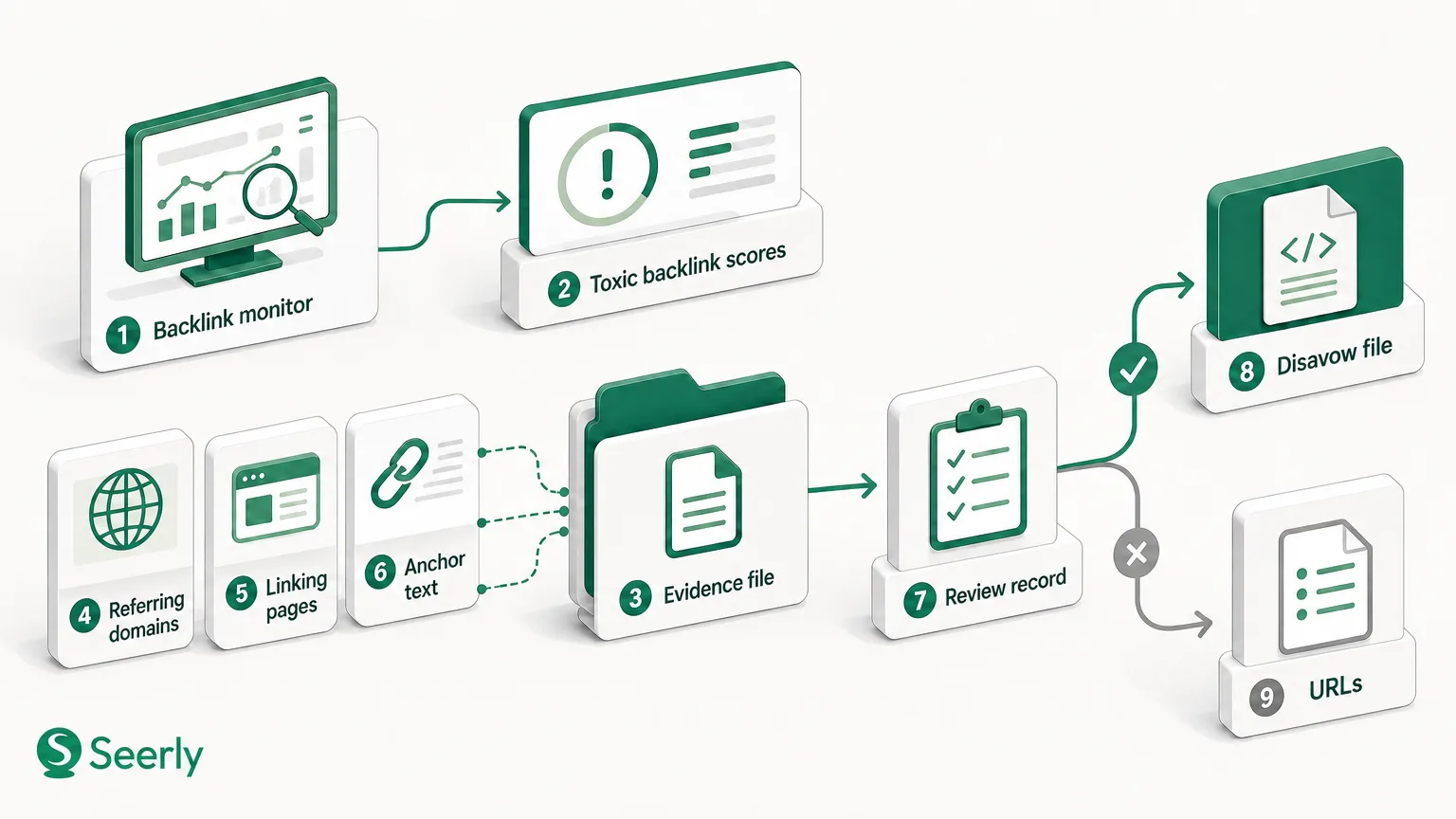
Use days seventy-six through ninety to review both accepted and rejected opportunities. Examine whether references accurately represent the evidence, whether visitors take relevant next steps and whether any publication creates a sensible follow-on opportunity. Avoid treating every unfamiliar backlink as a cleanup task; a toxic backlink score is not proof of harm.
Month-three deliverables: an updated asset, a quarterly evaluation and a decision to continue, revise or stop each outreach approach.
How can a team tell whether earned references are improving discoverability and trust?
Measure the program at the level of the reference, the audience response and the claim being communicated. Google’s guidance emphasizes unique, compelling content that people want to link to and warns that unnatural link schemes can do more harm than good. That supports an evidence-first approach, but it does not make any individual placement a guaranteed ranking or discovery improvement.
Use the following table as a quarterly review framework. Establish definitions before outreach so a positive-looking result does not change the criteria afterward. Where the sample is small, report actual counts and context rather than presenting unstable percentages as a trend.
| Signal | What to record | How to interpret it |
|---|---|---|
| Referring-page relevance | Topic, intended reader, surrounding text and reason for inclusion | Assess whether the reference helps someone understand or evaluate the subject |
| Referral engagement | Visits, asset interactions and relevant next steps where tracking permits | Look for useful behavior, while acknowledging that some references generate few clicks |
| Branded discovery changes | Search Console branded queries, impressions and clicks over comparable periods | Treat changes as directional; campaigns, launches and seasonality can also contribute |
| Corroboration of key claims | Which claim is repeated, whether it is accurate and what evidence is cited | Distinguish independent evaluation from simple repetition of your own material |
| Follow-on citation opportunities | Requests for interviews, updates, reuse or related contributions | Identify relationships worth maintaining without assuming future coverage |
For AI search visibility, monitor a consistent set of discovery questions and record whether your brand appears, how it is described and which sources are referenced. Keep the engine, date and testing conditions alongside each observation because generated answers can vary. A backlink and an AI citation are different observations; neither should be treated as proof that one caused the other.
A web presence review connecting backlinks with sources used by AI engines can help keep those observations organized. Combine that view with referral analytics and a manual check of important claims rather than relying on a single visibility score. If visibility rises during the quarter, describe the relationship cautiously: it coincided with the program unless stronger evidence establishes causation.
Start with one asset and 20 relevant opportunities
A useful link building program begins with something another person has a reason to reference. Partners and publications then become distribution choices, not inventory to fill a link quota. The first quarter should reveal which evidence resonates, which audiences respond and which relationships deserve continued investment.
Choose one evidence asset, create a 20-opportunity relevance shortlist and track the resulting references alongside brand visibility and citations over the following quarter. Keep the scope small enough to inspect every placement and learn from every substantive response. The goal is a repeatable process for earning discovery and trust - not a larger backlink count without a clear purpose.