How to Turn Customer Questions Into Search-Ready Blog Briefs With AI

Why generic AI drafts underperform when the brief is weak
Search engine optimization related content writing works best when it gives people a satisfying answer rather than imitating a ranking formula. Google’s guidance emphasizes content that is created to help people rather than primarily manipulate search rankings. A customer-informed brief gives the writer a concrete reason to cover the topic: it addresses a known question from a defined audience, with evidence and constraints that generic competitor summaries cannot supply.
Weak inputs also produce weak differentiation. AI can restate public information quickly, but it does not automatically know your customers’ vocabulary, the context behind a lost deal, or the product tradeoff a prospect misunderstood. That context is what turns a common search topic into a useful point of view. It also creates original material that can help pages earn trust signals when readers and answer engines assess whether the content is worth reusing.
Collect customer language every month
Treat customer language as a recurring input to your content system, not an occasional research project. The goal is not to document every sentence verbatim. Instead, capture the questions and phrases that recur across conversations, then identify the underlying task the customer is trying to complete.
Build a simple six-source collection process
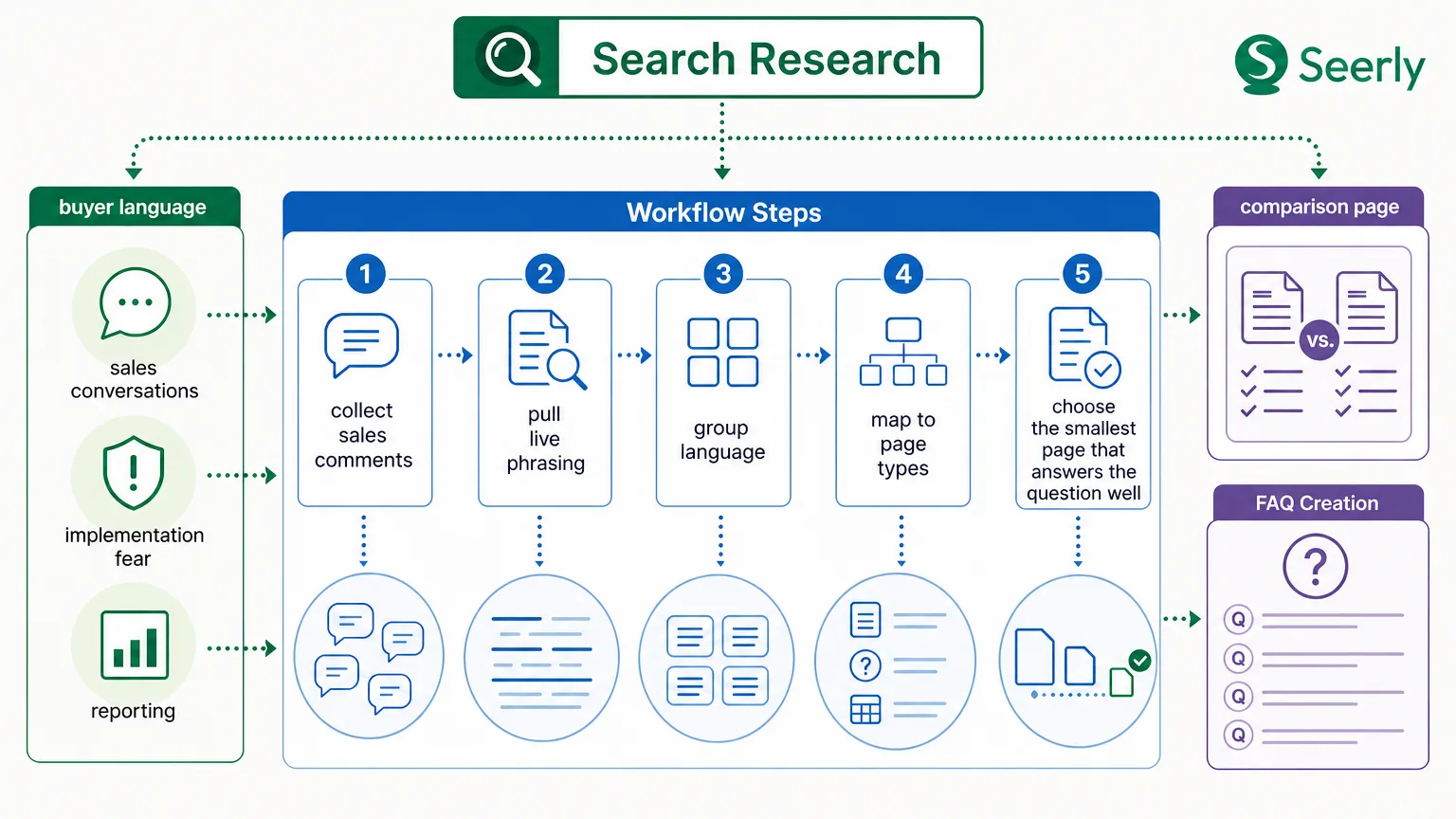
Start with sales-call notes and recordings. Look for questions that appear after prospects understand the product but before they commit: “How long will this take to implement?” or “How do we prove this is working?” These questions tend to expose high-value commercial and operational concerns that generic top-of-funnel research may miss.
Next, review support tickets and onboarding notes. Support questions identify friction after purchase, while onboarding notes reveal what customers must understand to reach value quickly. Add demo objections, community discussions, review comments, and internal site-search logs to the same collection. Internal search is especially useful because it shows what visitors expected to find on your site but could not locate easily.
A practical monthly target for a small team is 20 to 30 raw questions. Keep each entry short and preserve the customer’s wording, along with the source and context. For example, “How do I know our content appears in AI answers?” is more useful when tagged as a late-stage demo question than when stored as an anonymous keyword idea.
Sort questions by theme and intent
Once collected, group similar language into three to five themes. A theme might be “measuring AI search visibility,” “planning content with limited resources,” or “building original content that earns trust.” Then assign each question an intent bucket: learn, compare, solve, evaluate, or implement.
This process prevents a common planning mistake: treating near-identical questions as separate article ideas. “How do I grow our blog without a content team?” and “What should one marketer publish first?” may belong in one practical guide, while “Which SEO tool tracks AI search?” belongs in a product-evaluation page. Grouping reveals the topic cluster; intent determines the page’s angle and call to action.
Use a brief template before AI writes anything
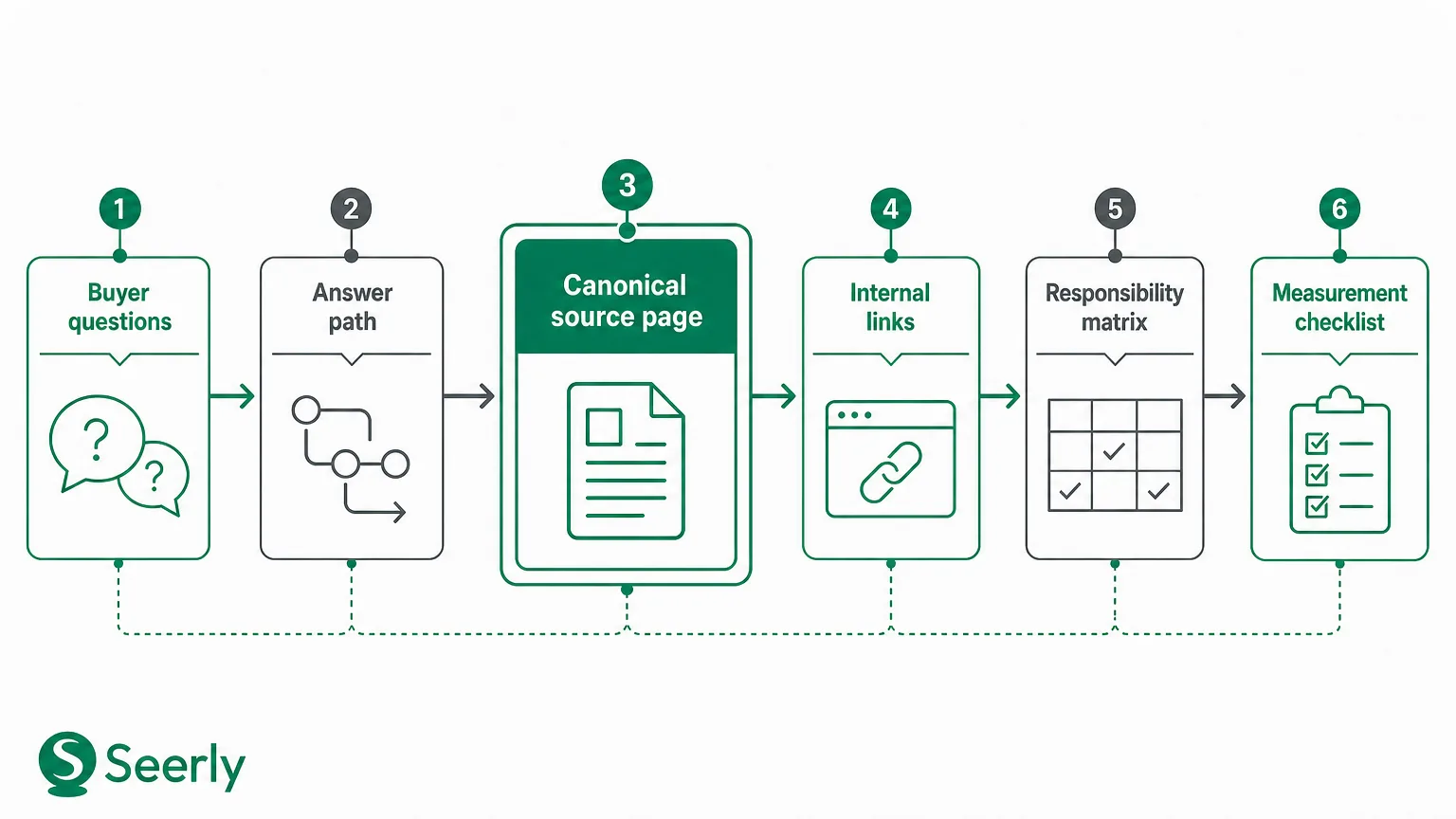
A strong brief converts raw language into editorial decisions. It is the bridge between customer research and a publishable article structure. It also makes review faster because everyone can assess the draft against the same criteria rather than debating whether it merely “feels good.”
Use the following fields for every priority topic:
-
Audience: Who is asking this question, and what role, maturity level, or constraint shapes their needs?
-
Job to be done: What decision or outcome should the reader achieve after reading?
-
Core question: State the question in the customer’s own language.
-
Search angle: Define the specific promise of the page, not just the broad keyword.
-
Misconceptions: List the assumptions the article needs to correct.
-
Proof required: Identify product evidence, examples, screenshots, expert input, or authoritative documentation needed to support claims.
-
Practical examples: Specify scenarios that make the advice usable for the target audience.
-
Objections and tradeoffs: Address what could prevent the reader from following the recommendation.
-
FAQ targets: Add two to four related questions that deserve direct, standalone answers.
-
Desired next step: Decide what the reader should do after applying the advice.
This structure supports clearer pages for both people and search systems. Google explains that ranking uses multiple systems designed to surface helpful and reliable information, not a single checklist. A brief that clearly defines the audience, evidence, and question helps the final page demonstrate relevance and experience instead of relying on repeated terms.
For readability, draft headings that state the answer before expanding on it. Web readers scan first, so concise, descriptive headings and front-loaded answers reduce the effort required to find useful information. This aligns with usability research showing that people commonly scan web pages instead of reading every word.
From messy questions to a focused brief
Imagine a B2B software team collects these questions in one month:
-
“How do we get our blog to bring in qualified leads?”
-
“Can one marketer keep up with SEO content?”
-
“Why are AI-written posts getting little traffic?”
-
“What should we write about if we do not have a keyword research specialist?”
-
“How can we tell whether AI search tools mention our brand?”
At first glance, these look like five different topics. In reality, the first four share a central problem: lean teams need a way to plan search content without producing generic articles. The fifth question can become a related measurement article, rather than distracting from the planning guide.
Turn the theme into a precise article angle
A weak angle would be “How to grow a blog with SEO.” It is broad, heavily covered, and gives little direction to the writer. A stronger angle is: “How lean marketing teams can use customer questions to prioritize and brief SEO content before using AI to draft it.”
That angle defines the audience, method, and constraint. It also creates an article structure with answer-ready subheads:
-
Why AI-written posts fail when the source material is generic
-
Where a small team can find recurring customer questions
-
How to group questions into one search topic
-
The SEO content brief template to complete before drafting
-
Which tasks AI can accelerate - and which require human judgment
-
A monthly workflow for publishing a small, high-quality queue
The FAQ section could answer: “Can AI write SEO content?”, “How many customer questions do I need for a blog brief?”, and “How do I choose between two customer-requested topics?” Each answer should begin directly, then explain the conditions or tradeoffs. This structure makes the page easier to scan and strengthens its usefulness when systems extract concise responses.
Use AI for acceleration, not editorial judgment
AI is valuable after the team has defined the brief. It can cluster similar customer questions, identify repeated wording, propose outline variations, turn notes into a first-pass draft, and suggest FAQ phrasing. These are production tasks: they reduce time spent organizing material without determining what your brand should say.
Humans must retain ownership of prioritization, claims, and positioning. A marketer or founder needs to decide whether a topic supports a revenue goal, whether an example is representative, and whether a statement has adequate proof. They must also preserve the distinctions that matter to buyers: your implementation model, ideal customer profile, constraints, and point of view.
This division of work is particularly important for AI-ready websites. Original examples, transparent evidence, and clear answers make content more credible than pages assembled from general patterns. For a deeper framework, see how original content affects whether AI search systems reuse or recommend it.
Run a monthly content cadence a lean team can sustain
A sustainable system does not require publishing every day. It requires a reliable sequence that converts customer insight into a focused queue. One operator can run the following process in a few concentrated blocks each month:
-
Week 1: Collect and tag. Pull recent questions from calls, tickets, onboarding, communities, and internal search. Tag source, audience, and intent.
-
Week 2: Group and prioritize. Consolidate questions into themes, then choose one or two topics based on recurrence, business relevance, proof available, and current discoverability gaps.
-
Week 3: Build the briefs. Complete the template, gather examples and subject-matter input, and use AI to prepare an outline and draft.
-
Week 4: Review and publish. Verify every claim, strengthen examples, improve headings, add internal links, and publish only when the article answers the core question fully.
After publishing, review how the page contributes to visibility rather than treating publication as the finish line. Monitor which questions emerge in search, sales, and support, then feed new language back into next month’s collection. Teams can pair this workflow with ongoing AI search visibility tracking to connect content decisions to discoverability outcomes over time.
FAQ
Can AI write SEO content effectively?
AI can produce useful drafts when it receives a detailed, evidence-backed brief. It is less reliable when asked to invent the audience context, differentiators, and proof that make a page credible. Use it to accelerate production, then apply human review for factual accuracy, positioning, and customer relevance.
How many customer questions are enough to create a blog brief?
Ten recent questions are enough to identify early patterns, especially for a focused audience. Group them into three themes, choose the theme with the clearest business value and strongest evidence, and create one full brief before drafting. The goal is not statistical certainty; it is a defensible reason to solve a real recurring problem.
Should every customer question become a separate article?
No. Many questions are different expressions of the same underlying need. Combine questions that share intent into one comprehensive article, then use direct subheads and FAQs to address variations. Separate them only when the reader’s job, decision stage, or required evidence changes materially.
Start with the questions, not the draft
Better search engine optimization content writing begins with a disciplined choice: customer language shapes the brief, and AI accelerates execution after that foundation is in place. Collect ten recent questions this month, group them into three themes, and turn the strongest theme into a complete brief before asking AI to write a word.
Over time, that practice builds a more coherent content library, stronger brand authority, and clearer signals for AI search discovery. To connect this planning discipline with proactive visibility monitoring and trusted AI-ready content, explore Seerly’s approach to AI search discovery.