SEO, AEO and GEO: the metrics that belong in each scorecard
Your organic rankings improve, website visits decline, and your brand appears in more AI-generated answers. Is visibility improving or deteriorating? A monthly report cannot answer that question if it folds rankings, traffic, mentions, and citations into one score.
The practical challenge in SEO vs AEO vs GEO is separating evidence that describes different outcomes. A search impression measures an opportunity to be seen; an AI citation records a source reference; neither proves a sale. This article explains how to build distinct but connected scorecards that help leadership understand what changed, what remains uncertain, and what to do next.
What is the practical difference between SEO, AEO, and GEO?
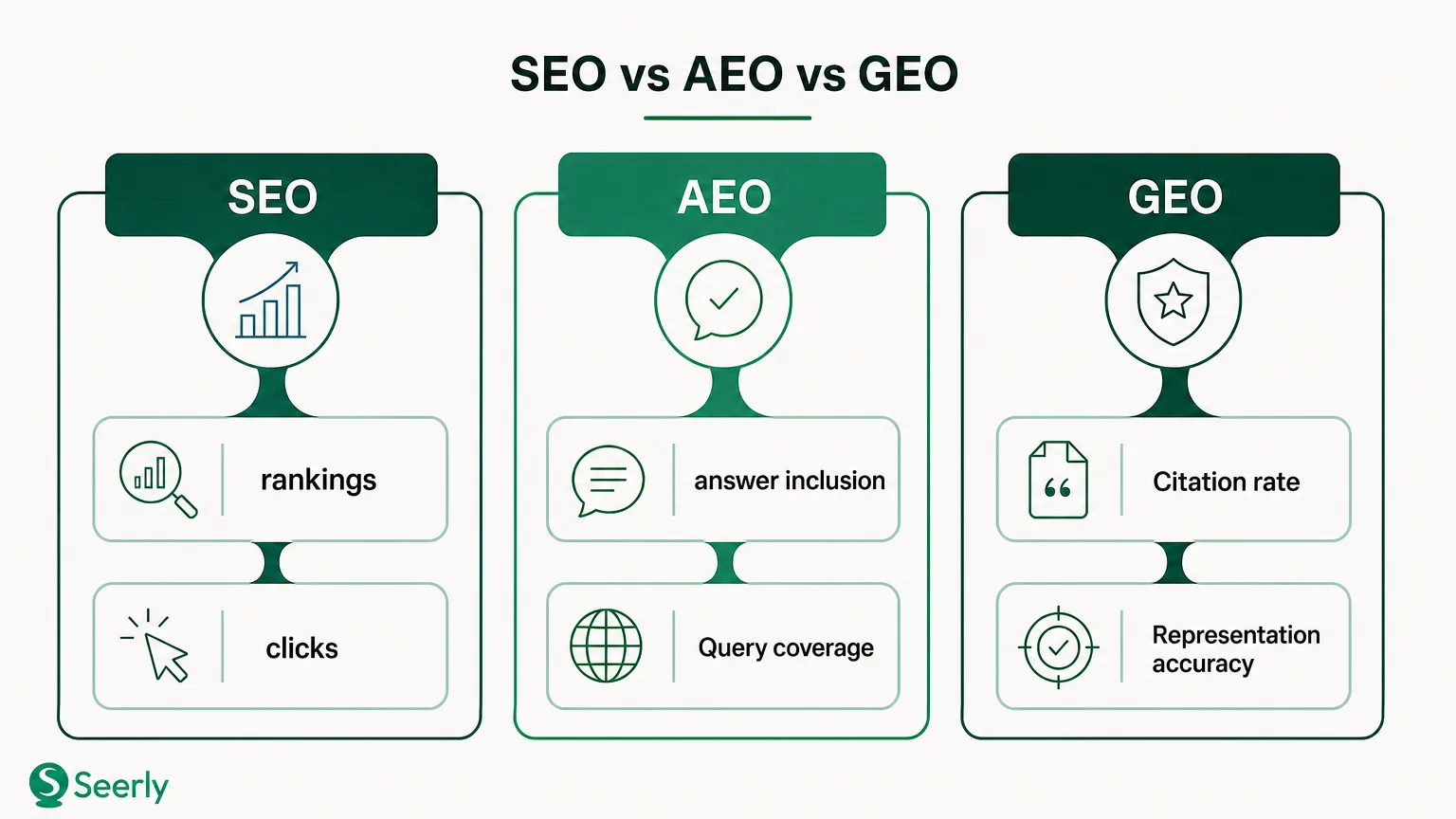
SEO, or search engine optimisation, helps people discover your pages in search results. AEO, or answer engine optimisation, helps your content or brand become part of a direct answer. GEO, or generative engine optimisation, focuses on how accurately and credibly your brand appears in generated responses, including explanations, comparisons, and recommendations.
These are useful reporting distinctions, not universally standardised boundaries. An AI-generated answer can simultaneously provide evidence of answer inclusion and brand representation. Classify the observation by the question it answers, rather than counting the same appearance as multiple independent wins.
| Discipline | Customer outcome | Primary reporting question |
|---|---|---|
| SEO | Discover a relevant page | Can people find and visit us through search? |
| AEO | Receive an answer using our information | Are we selected when someone asks a relevant question? |
| GEO | Encounter a credible account of our brand | How are we described, sourced, and recommended? |
The underlying work overlaps: accessible pages, clear explanations, and reliable evidence support discovery. Google says its existing SEO fundamentals remain relevant to AI Overviews and AI Mode. That overlap does not make the resulting metrics interchangeable.
Build the SEO scorecard around discovery and visits
Traditional search reporting should connect visibility to visits, then examine what those visits accomplish. Keep branded and non-branded queries separate where possible, because they answer different demand questions. Segment important markets, devices, and landing-page groups before interpreting an overall trend.
| Metric | What to record | What it cannot prove |
|---|---|---|
| Rankings | Position changes for a stable query set | That people saw, clicked, or trusted the result |
| Impressions | Search appearances by query and page | That the result received meaningful attention |
| Clicks and click-through rate | Visits initiated from results and clicks relative to impressions | That visitors were qualified |
| Traffic quality | Relevant engagement, key events, and qualified enquiries | That every visit contributed equally |
| Landing-page performance | Organic entrances, conversion rate, and relevant outcomes by page | That search visibility alone caused the outcome |
| Technical health | Indexability, crawl access, canonical issues, and page experience | That technically sound pages deserve selection |
Technical health is an enabling condition, not a substitute for performance. Google describes SEO as helping search engines crawl, index, and understand content. Report critical blockers separately from commercial outcomes so a resolved indexing problem does not masquerade as revenue growth.
Search visibility and traffic can also diverge. Pew Research Center observed traditional-result clicks on 8% of visits with an AI summary, compared with 15% without one in its March 2025 browsing data. This association is context, not a forecast for your website or proof that AI caused a particular traffic decline.
Build the AEO scorecard around answer selection
AEO reporting asks whether your information is selected to answer relevant questions. Compared with SEO, the unit of observation shifts from a page’s position to its inclusion in an answer. Google notes that publishers cannot mark a page as a featured snippet; its systems determine selection.
| Evidence | Practical measurement | Interpretation limit |
|---|---|---|
| Answer inclusion | Answers containing your brand or identifiable sourced content, divided by eligible observations | Inclusion does not establish endorsement |
| Query coverage | Tracked questions producing at least one qualifying inclusion | One successful observation does not show consistency |
| Answer accuracy | Supported factual statements compared with reviewed statements | Requires an explicit checking standard |
| Source visibility | Whether the source is identifiable, linked, and correctly matched | A visible link does not establish a visit |
| Recurring question themes | Coverage grouped by pricing, suitability, implementation, or alternatives | Your selected questions may omit important demand |
Define inclusion before collecting data. A named brand mention, a linked source, and an unattributed passage are different observations; report them separately rather than assuming they are equivalent. Recurring question themes then reveal whether gaps concern a specific buyer need or the entire answer surface.
Build the GEO scorecard around credible representation
GEO reporting goes beyond whether the brand appears. It examines what the answer says, whether the supporting sources are appropriate, and how the brand compares with alternatives. A positive mention containing an invented capability should trigger an accuracy review, not be reported as an unqualified success.
Use the following as a scorecard template, not example performance results. Each row should contain the current period, prior comparable period, denominator, and evidence link. Keep provider-level results visible even if leadership also receives a summary.
| Metric | Operational definition | Review question |
|---|---|---|
| Mention rate | Responses naming the brand ÷ eligible responses | Are we present? |
| Citation rate | Responses linking to the brand’s owned sources ÷ eligible responses | Are our pages visibly referenced? |
| Recommendation presence | Responses explicitly recommending the brand ÷ eligible recommendation responses | Are we being suggested for relevant needs? |
| Sentiment | Positive, neutral, negative, mixed, or unclear treatment | What evaluative language surrounds us? |
| Representation accuracy | Verified claims ÷ reviewed factual claims about the brand | Are capabilities and limitations described correctly? |
| Competitor share | Brand mentions ÷ mentions of all tracked brands | How does presence compare within this sample? |
Track third-party sources about the brand separately from citations to owned pages. Also distinguish a citation’s existence from whether it supports the associated statement. The Tow Center’s examination of AI search found substantial problems with source identification and citation accuracy, making source checks an important reporting safeguard.
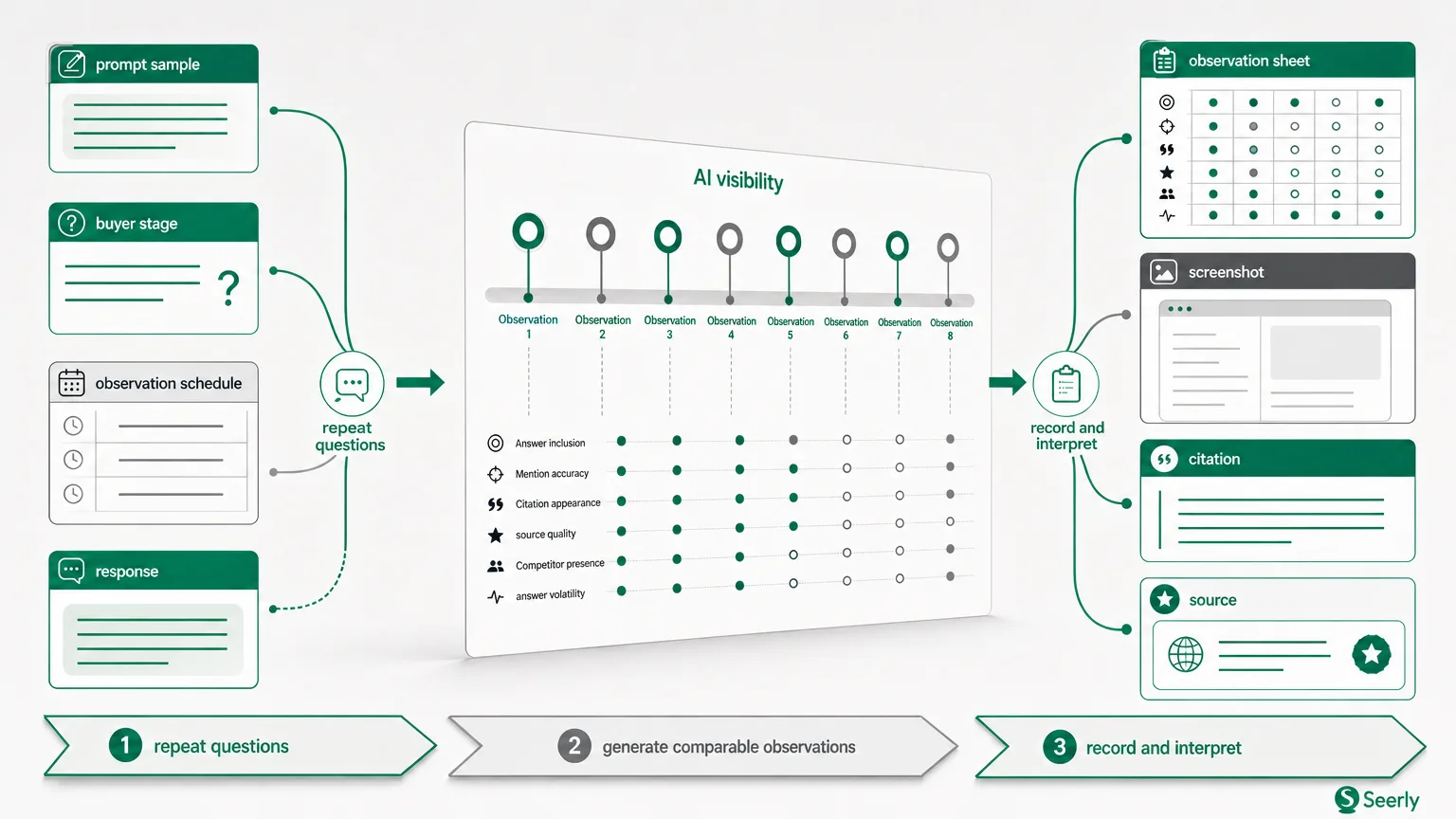
Use a consistent prompt set, repeat observations, and record provider, model where disclosed, date, language, location settings, and search mode. Label sentiment rules clearly and manually review ambiguous or commercially sensitive answers. An AI visibility metric glossary can support consistent terminology, but your report still needs its own explicit denominators.
Which metrics should not be combined?
A citation count cannot be converted into ranking improvement, traffic, or revenue without additional evidence. These measures describe different stages and behaviours, with different collection methods. Present them together for interpretation, but do not add them together as though they share a unit.
| Myth | Fact | Reporting safeguard |
|---|---|---|
| “One citation equals one visit.” | An answer can reference a page without generating a click. | Keep citations, referral sessions, and conversions separate. |
| “An AI mention is equivalent to a top ranking.” | A mention has no universally comparable ranking position. | Record answer placement descriptively, not as an organic rank. |
| “All providers can be pooled.” | Their answer formats and citation opportunities differ. | Show provider-level results and disclose any weighting. |
| “Our question set represents the market.” | Selected questions reflect your sampling choices, not necessarily demand. | Document intent coverage and distinguish branded from unbranded questions. |
| “A higher score proves revenue impact.” | Co-occurring changes do not establish attribution. | Add analytics and CRM evidence without claiming unsupported causation. |
Preserve source-level evidence: the exact question, full response, cited URLs, collection time, and reviewer labels. Without that record, teams cannot distinguish a genuine change from a changed sample or interpretation. Google also states that AI-feature traffic is included in Search Console’s overall Web search reporting, so do not present that aggregate as a clean split between conventional results and AI answers.
Show leadership a concise monthly view
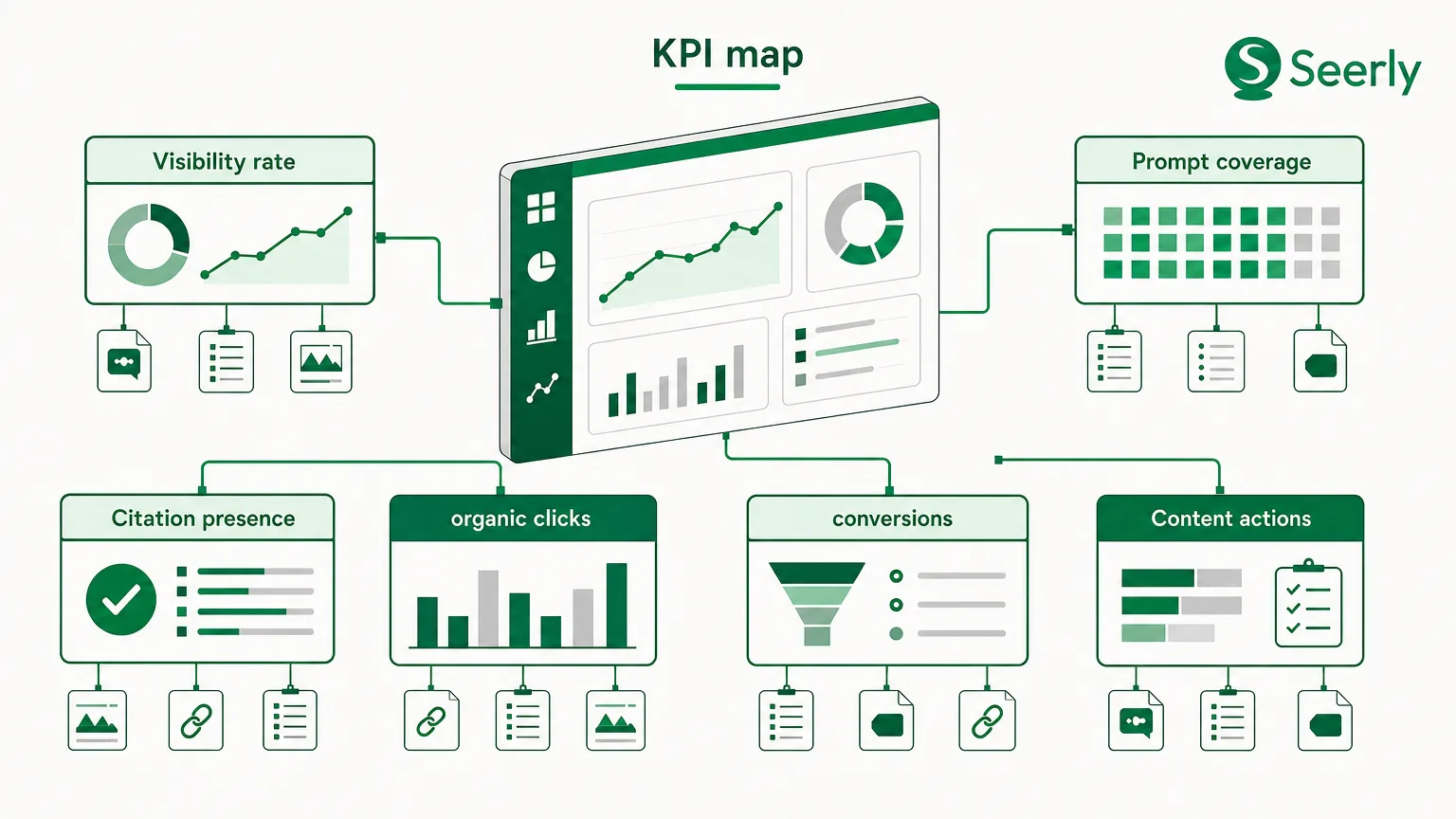
An executive report should make the decision clear without concealing uncertainty. Use four sections, retain the same measurement windows, and compare only like-for-like samples. The reporting mock-up below uses placeholders rather than invented results.
| Section | What the monthly report displays | Decision it supports |
|---|---|---|
| Search performance | Organic clicks: [current/prior]; non-branded impressions: [current/prior]; qualified enquiries: [current/prior]; affected landing pages | Whether to prioritise discovery, click-through, or conversion work |
| AI-answer evidence | Inclusion: [count/observations]; owned-source citations: [count/observations]; recommendation presence; accuracy issues | Whether to improve answer coverage, sourcing, or factual clarity |
| Competitive movement | Brand and competitor presence by provider and question theme, using the unchanged comparison set | Where competitors are gaining relevant visibility |
| Actions and assumptions | Named owner, next action, expected evidence, review date, sample changes, and limitations | What happens next and how progress will be evaluated |
Explain movement through evidence rather than speculation. If clicks decline while mentions increase, investigate affected queries, pages, answer surfaces, and referral data before drawing a conclusion. A process for reconciling AI visibility, organic traffic, and SEO data helps keep dates and definitions aligned.
Implementation FAQs
Where should a team start?
Start with a small, high-intent question set covering needs such as suitability, pricing, implementation, and alternatives. Include unbranded discovery questions as well as branded checks, since branded questions make inclusion easier. Expand only after reviewers can interpret the evidence consistently and maintain reliable records.
How often should answers be checked?
Choose a repeatable collection schedule and run important questions more than once per reporting period. Describe observed variation rather than treating a single response as a stable result. Keep the baseline set unchanged, and report newly added questions separately until they have comparable history.
How should teams handle overlapping evidence?
Store each observation once, then attach the relevant labels. A response can demonstrate AEO inclusion and GEO accuracy without becoming two separate appearances. The leadership scorecard framework provides a useful structure for keeping evidence connected without collapsing its meaning.
What should change in the next monthly report?
Audit every existing metric and label it SEO, AEO, GEO, or shared context. Add a definition, denominator, source, and decision for each, and remove blended metrics that cannot support a clear action. Rankings, traffic, mentions, citations, sentiment, and competitor presence are complementary signals - not interchangeable proof of performance.