Using Google Trends for Keyword Research When AI Overviews Change What People Click
A familiar SEO pattern is becoming less reliable: impressions rise, rankings hold, yet clicks soften. In one team review of the AI Overview traffic debate, a single discussion drew 5.0K upvotes and 404 comments - a useful signal of how urgently search teams are trying to explain this disconnect. The issue is not that keyword research has stopped working. It is that a monthly-volume-led keyword list cannot show whether a searcher still needs to leave Google to complete their task.
Google Trends for keyword research helps close part of that gap. It shows relative changes in interest, related searches, and emerging language - signals that can reveal where curiosity is moving. Combined with Search Console, SERP reviews, and AI search visibility reporting, trend data can help you regroup a topic around likely post-search behavior rather than semantic similarity alone.
The practical objective is straightforward: build clusters based on where users are likely to get their answer and what type of destination they still need.
Why keyword volume no longer tells the whole story
Traditional keyword clustering groups phrases because they share entities, modifiers, or an apparent ranking target. That remains useful for identifying topical coverage, but it assumes every relevant query creates a comparable opportunity for organic clicks. When an AI Overview, featured result, or rich SERP delivers a concise definition or list, the same ranking position can produce a different traffic outcome.
Google Trends is not a volume database. Its charts use a normalized scale from 0 to 100, where 100 represents peak search interest for the selected time, geography, and query. That distinction matters: use Trends to compare direction, seasonality, and relative momentum - not to forecast exact traffic.
The more valuable question is therefore not, “Which terms belong together?” It is, “What happens after a person searches these terms?” A cluster that appears unified in a keyword tool may contain definitions that are increasingly resolved on the results page, comparisons that still send buyers to websites, and experience-led questions that move toward Reddit, specialist forums, or answer engines.
This is also why a page can rank well without delivering the commercial result leadership expects. Seerly’s guide to why Google rankings alone may not mean SEO is working provides a useful measurement principle: visibility, clicks, and business outcomes should be evaluated together rather than treated as interchangeable.
Use a post-AI clustering model
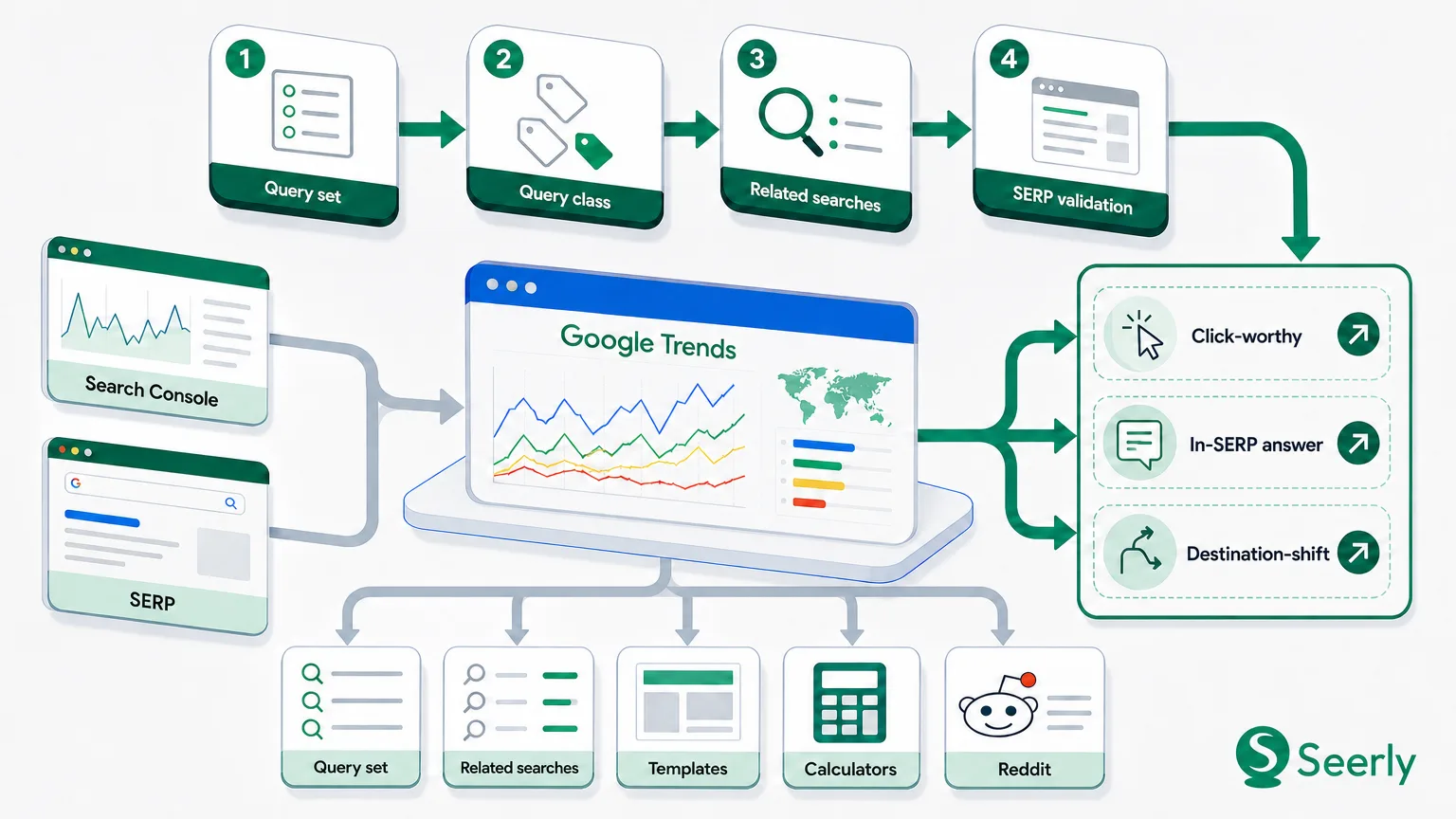
Instead of one broad semantic cluster, classify queries into three behavior-led groups. The classification is a planning model, not a permanent label. A query can move between groups as search features, consumer familiarity, and the competitive landscape change.
| Cluster type | Likely search behavior | Best strategic response |
|---|---|---|
| Click-worthy queries | The user needs detail, evaluation, proof, or a usable next step. | Build depth: guides, comparisons, templates, calculators, product pages. |
| In-SERP answer queries | The user seeks a short definition, fact, or simple process. | Earn visibility and trust signals with concise answers, then connect to deeper tasks. |
| Destination-shift queries | The user wants lived experience, debate, current recommendations, or peer validation. | Create useful owned content and distribute or participate where the discussion occurs. |
Click-worthy queries
These are searches where a summary is rarely enough. “Best AI visibility platform for enterprise teams,” “Google Trends vs keyword tools,” and “how to measure AI Overview referral traffic” require comparisons, decision criteria, methodology, or implementation detail. The user may read an AI-generated summary first, but they still have a reason to click: they need evidence and a decision-ready resource.
For these clusters, invest in pages with a clear destination value. Include original frameworks, tables, screenshots, downloadable templates, transparent limitations, and links to supporting resources. Your goal is not merely to be mentioned in AI search discovery; it is to give searchers a compelling reason to continue to your site.
In-SERP answer queries
Queries such as “what is Google Trends,” “what does breakout mean in Google Trends,” or “how is Google Trends data calculated” often have a narrow information need. Google explains that its related queries report can surface “top” and “rising” searches, while “breakout” generally indicates growth above 5,000%. That can be useful for discovery, but it also means simple explanatory content may fulfill intent before a visitor reaches your page.
Do not automatically abandon these terms. Use them to build concise, accurate FAQ sections, glossary entries, and introductions that support a broader click-worthy page. These assets can strengthen topical clarity and earn citations, but forecast their traffic separately from high-consideration content.
Destination-shift queries
Some questions are not looking for a single authoritative answer. Searches such as “AI Overview traffic drop Reddit,” “best way to report AI search visibility forum,” or “SEO manager experience with AI Overviews” signal a need for peer evidence and recency. Searchers may prefer a community thread because disagreement and context are part of the value.
Treat this as a distribution problem as well as a content problem. Publish a research-backed perspective on your site, then make it useful in appropriate communities through genuine contribution - not repetitive promotion. Track whether discussions introduce new wording, objections, or use cases that deserve pages on your AI-ready website.
Rebuild clusters with Google Trends for keyword research
1. Start with your existing query set
Export 90 to 180 days of Search Console data by query, page, impressions, clicks, CTR, and position. Add your current keyword cluster, page type, and business priority. Then flag terms with stable or improving visibility but falling CTR, because these are candidates for changed search-result behavior.
Avoid assuming that every CTR change is caused by AI Overviews. Seasonality, rankings, paid ads, news cycles, and SERP features can all change outcomes. The purpose of the review is to identify patterns worthy of investigation, not assign a cause from one metric.
2. Compare trends by query class, not one keyword at a time
Place the head term and its major intent variations into Google Trends comparisons. For example, compare “AI keyword research,” “AI keyword research tools,” “AI keyword research template,” and “AI keyword research Reddit.” Google Trends allows you to compare terms over a selected time and location, helping reveal whether interest is moving toward tools, templates, communities, or a different vocabulary.
Review both a 12-month view and a five-year view. The shorter range reveals current momentum; the longer range prevents a temporary spike from being mistaken for a durable change. Keep geography aligned with the market your content serves, since trends in a global view may not reflect demand from your buyers.
3. Investigate related and rising searches
For each priority topic, export or record the related queries and related topics Google Trends surfaces. Google’s guidance notes that related topics can include concepts that share a search journey, not only close keyword variants. This is especially useful when search behavior changes faster than your existing taxonomy.
Look for migration clues. A rise in “vs,” “alternative,” “template,” “calculator,” or “pricing” modifiers usually supports a stronger destination page. A rise in “Reddit,” “community,” “review,” or “experience” modifiers indicates that peer validation may be shaping the journey. A rise in short “what is” queries may justify FAQ coverage, but not necessarily a standalone article.
4. Validate the SERP and assign a destination
Open representative results for each query group in an incognito browser and document what the page presents: AI Overview, featured snippet, video, shopping units, discussion forums, or standard blue links. Record whether the answer appears complete on the SERP and whether successful pages offer something the result cannot summarize.
Then assign one primary format per cluster. A cluster cannot be actioned simply because it has search demand; it needs a defined destination and success metric. For teams adapting featured-snippet content, Seerly’s analysis of how AI answer rules differ from featured snippet rules can help separate visibility tactics from click-generation tactics.
Worked example: splitting the “Google Trends” theme
Imagine an SEO software company starts with one cluster: “Google Trends for keyword research.” A conventional plan might create one long guide and add every related term as a heading. A behavior-led plan separates the theme into four destinations.
Definition intent: “What is Google Trends?” and “what does Google Trends data mean?” belong in a concise glossary or FAQ expansion. Answer the question precisely, explain the normalized index, and link to a deeper workflow. Their value is visibility and topical trust, not necessarily high click volume.
Comparison intent: “Google Trends vs Keyword Planner” and “Google Trends vs Semrush” warrant a comparison page. Visitors need distinctions, use cases, limitations, and a recommended workflow. This is a click-worthy cluster because the decision cannot be resolved credibly in a two-sentence answer.
Community intent: “Google Trends keyword research Reddit” suggests users want practitioner experience or examples. Create a point-of-view article with original data and participate where the conversation already exists. Measure referral quality, branded search lift, and new language collected from discussion - not only organic sessions.
Tool intent: “Google Trends keyword research template” or “keyword trend tracker” calls for an operational asset. Build a downloadable worksheet, dashboard template, or interactive tool. The destination should reduce effort for the user, giving it a clear advantage over a static AI-generated answer.
Use this planning checklist before publishing
Before committing a topic to your editorial roadmap, ask the following questions. Each answer should be documented at cluster level, not guessed from the head term.
-
Does the searcher need depth, proof, or a decision? If yes, create a blog post, guide, comparison page, or tool with original utility. Define the conversion action and the evidence that makes the page worth visiting.
-
Can Google answer the core question in a few sentences? If yes, add a precise FAQ or concise section to an existing pillar page. Track impressions and AI answer visibility, but set realistic traffic expectations.
-
Is the user seeking peer experience or current debate? If yes, create an owned perspective and a community-distribution plan. Include subject-matter experts who can contribute credibly, then monitor recurring questions for future content opportunities.
-
Is interest rising, seasonal, or geographically concentrated? Use Trends’ filters before assigning production resources. A fast-rising query may be an emerging opportunity, while a predictable annual peak may require refreshing an existing asset ahead of demand.
-
What would prove this cluster is working? Choose a primary outcome: qualified organic visits, comparison-page conversions, AI answer citations, referral traffic, or assisted pipeline. This avoids reporting all clusters against a click metric they were never designed to improve.
FAQ
How often should keyword clusters be rebuilt?
Review priority clusters quarterly and recheck high-volatility topics monthly. Rebuild when Search Console shows a sustained mismatch between impressions, rankings, and clicks; when Trends reveals new modifiers; or when SERP layouts change materially. Treat clusters as a living demand model, not a one-time content architecture exercise.
What should we do with ranking terms that stop sending traffic?
Do not remove them immediately. First determine whether the term still creates visibility, contributes to topical authority, assists conversions, or appears in AI answers. If it mainly satisfies in-SERP intent, consolidate it into an FAQ or support section and redirect production effort toward adjacent queries that still require a destination.
How do we explain this shift to leadership?
Show the relationship among rankings, impressions, clicks, and downstream outcomes by cluster type. Explain that some visibility is now a brand-reputation and trust-signal outcome, while other queries remain direct traffic opportunities. The leadership decision is not whether to “stop SEO”; it is how to allocate resources across click-worthy content, answer visibility, and community presence.
Turn trend signals into a measurable roadmap
Google Trends for keyword research is most useful when it helps you detect changing intent - not when it simply generates more terms for a spreadsheet. Cluster by likely behavior and destination: pages people need to visit, answers Google can satisfy, and conversations users prefer to have elsewhere.
Use Seerly as the reporting layer for monitoring which topics gain visibility in AI answers and which still generate site visits. That evidence lets your team validate whether rebuilt clusters are strengthening AI search discovery, trusted authority, and measurable organic performance.