How to measure AI-assisted signups when organic traffic gets the credit
A demand-generation lead opens the monthly pipeline review and sees a familiar story: organic traffic is up 12%, demo requests are flat, and direct traffic produced a few serious opportunities. It looks tidy enough to present. Then a salesperson forwards a call note from a prospect who says, “I found you after asking ChatGPT for vendors in this category.”
That discovery may not appear anywhere in the standard acquisition report. The prospect might have searched the brand name afterward, clicked a result, returned days later through a bookmarked page, or pasted the URL directly into a browser. Analytics records a session. It rarely records the whole thought process that led to it.
That gap matters because buyer research is changing faster than attribution conventions. Adobe reported that traffic from generative AI sources to US retail sites rose 1,200% year over year between July 2024 and February 2025, but direct referral traffic is only one part of the picture. Plenty of AI-assisted journeys never retain a clean referrer.
You don’t need perfect source attribution before you measure AI-assisted pipeline. You need a layered method: behavioral data, buyer-reported context, and plain-language caveats about what the numbers can and cannot say.
Why organic traffic is absorbing AI-influenced discovery
Organic traffic tells you how a visitor reached a site from an unpaid search result. It does not tell you what triggered that search, which answer shaped the shortlist, or whether a buyer saw your company mentioned before they searched for you. That distinction gets lost when a prospect’s first meaningful interaction happens in an AI answer, then their measurable click happens later through Google.
AI-assisted signup: a conversion where credible evidence indicates an AI tool influenced discovery, evaluation, or return-to-site behavior, even if analytics cannot assign the first visit to that tool.
The pattern often looks like this: a buyer asks an AI tool for product options, learns a brand name, searches that brand later, reads a comparison page, then requests a demo. Your analytics platform may call that last entry “organic search.” Your CRM may call it “inbound.” Neither label is wrong. Both are incomplete.
The more I look at these journeys, the less useful a single-source mindset feels. Search Console can connect search performance with Google Analytics data, but Google also warns that the two products use different metrics and reporting methods, so totals will not line up perfectly. Their guidance on joining Search Console and Analytics data is useful precisely because it treats the systems as related evidence, not interchangeable truth.
There’s another wrinkle. Many searches now end without an open-web click. SparkToro’s 2024 study found that only 374 of every 1,000 US Google searches resulted in an open-web click. A buyer can learn enough to form a preference before any visit occurs. AI-assisted research adds another layer of dark matter to an already imperfect click trail.
So when organic traffic rises alongside branded search and sales teams start hearing “I saw you recommended,” don’t force a false choice. The organic session may be real. AI influence may be real too. Your reporting should make room for both.
Where AI influence leaves usable evidence
Clean referrer data is nice when you get it. It’s also a flimsy plan for measuring a behavior that often happens before the first trackable visit. Better evidence appears at several moments across the journey, and each source answers a slightly different question.
Ask at the point of conversion
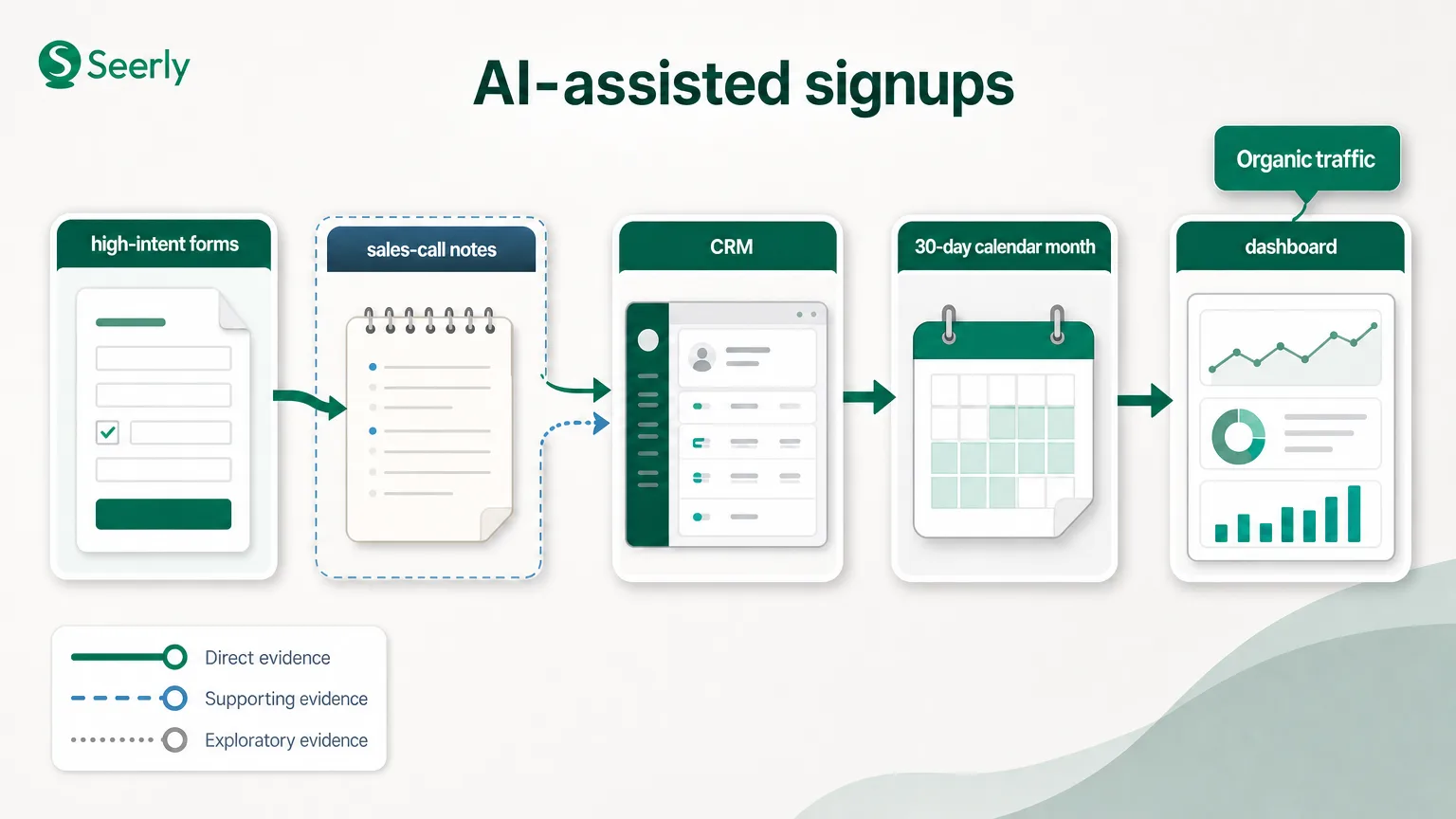
Start with a short, optional form field: “How did you first hear about us?” Use a dropdown, then include an “Other” option with free text. Keep the list short enough that someone who wants a demo doesn’t have to do homework to submit it.
A practical dropdown might include “Search engine,” “AI tool such as ChatGPT, Claude, or Gemini,” “Recommendation from a colleague,” “Social post,” and “Other.” The field captures recalled discovery, not forensic proof. That’s fine. Buyer memory has gaps, but a repeated pattern in hundreds of responses is worth more than pretending the only valid signal is a referrer string.
Free-text responses matter most. “ChatGPT mentioned you” and “I asked Claude to compare platforms” are high-confidence signals. “Found you online” is not. Someone should review these responses weekly, normalize obvious variants, and retain the original wording in the CRM. Don’t bury that work in a spreadsheet no one opens.
Listen when the form cannot speak
Enterprise buyers often do not complete a standard demo form, or their first form submission happens long after research began. Sales-call notes can catch the story. Add a required discovery prompt to the first-call template: “What sources influenced your shortlist?”
The answer should be recorded as a structured field plus a brief note. A rep might select “AI-assisted research” and write, “Prospect used Perplexity to identify vendors, then searched our brand.” That one sentence gives marketing a defensible influenced-conversion signal without claiming the AI tool directly sent the visit.
Branded search movement is supporting evidence, not a verdict. When mentions in AI answers rise, a lift in brand-name queries may follow. But brand search also moves after a webinar, press coverage, or a salesperson’s outbound sequence. Pair the trend with other signals before telling leadership a causal story. Otherwise, you’re reading tea leaves with a spreadsheet.
Read the path, not only the last click
Assisted conversion paths can reveal patterns that last-touch reports flatten. Look for people who first arrive on educational pages, return via branded searches, and convert later through direct or email. Then compare that cohort with form responses and sales notes.
One clue by itself can mislead. Four related clues create a usable case. That’s the working standard.
Build a measurement layer around organic traffic
Set this up in a month, not a quarter. The mechanics are simple. The discipline is in agreeing on definitions before the numbers appear in an executive dashboard.
-
Add a self-reported attribution field to high-intent forms.
Put the question on demo, contact, trial, and pricing-request forms. Make it optional if your form completion rate is fragile, but make it consistent across forms. Map the selected value and free-text answer into the CRM so the data survives beyond the marketing automation platform. -
Create an AI-assisted conversion tag.
Tag a contact when they explicitly mention an AI tool in a form response, email, chat transcript, or sales-call note. Keep a field for evidence source, such as “form free text” or “discovery call.” An explicit mention gets the tag. A marketer’s hunch does not. -
Set a reporting window.
Use a fixed 30-day calendar month for the first report. Track signup date, first known visit, and AI mention date if one exists. A longer 60- or 90-day window may fit an enterprise sales cycle, but changing the window each month turns trend reporting into mush. -
Define confidence levels before reporting upward.
I prefer three labels: high confidence for direct buyer mention, medium confidence for a clustered pattern such as brand-search growth plus relevant sales notes, and exploratory for traffic movement without a buyer-reported signal. Do not total exploratory cases into influenced signups. Keep them in a watchlist. -
Annotate the dashboard.
Label the metric “AI-assisted influenced signups, reported evidence” rather than “AI-generated pipeline.” That wording is less flashy and much more honest. Add a small note stating that a person can belong to both organic acquisition and AI-assisted influence.
A useful companion exercise is a UTM audit. Campaign tags cannot solve untagged AI research, but they stop paid, partner, and email visits from leaking into misleading buckets. Seerly’s guide to clean UTM rules for measuring organic, paid, and AI traffic together can help teams tighten that layer.
A monthly report that leadership can actually read
Suppose a B2B software company reports the following for April. The numbers below are illustrative, but the layout is suitable for a real monthly operating review.
| Metric | March | April | What to say about it |
|---|---|---|---|
| Organic visits | 18,400 | 20,610 | Up 12.0%; acquisition channel, not proof of AI influence |
| Brand-name search clicks | 2,100 | 2,540 | Up 21.0%; supporting context |
| Form responses mentioning an AI tool | 9 | 22 | High-confidence, self-reported discovery signal |
| Sales-call notes with AI research mentioned | 4 | 11 | High-confidence when notes name the source or use case |
| AI-assisted influenced signups | 11 | 28 | De-duplicated count of explicit mentions |
| Signups with only pattern-based evidence | 17 | 24 | Watchlist; excluded from influenced-signup total |
The report opens with the cleanest number: 28 de-duplicated signups had an explicit AI-related mention. Of those, 22 came from form answers and 11 from call notes, with five people appearing in both sources. You subtract the overlap. Simple, but people skip this step more often than they should.
Then show the context. Organic visits rose 12%, while branded search clicks rose 21%. That does not prove AI caused the increase. It does give the 28 explicit mentions a more believable backdrop, particularly if the team did not run a major brand campaign in the same period.
Now for the sentence that protects credibility: “April data shows 28 signups with direct evidence of AI-assisted discovery. Organic and branded-search movement are consistent with broader influence, but we are not assigning that movement to AI.” Leadership can work with that. They need a directional measure they can trust, not a fake precision number with two decimal places.
If organic performance suddenly falls, investigate technical or content changes separately before tying everything to buyer behavior. Seerly’s organic traffic drop diagnosis framework is a sensible starting point for separating site issues from shifts in demand.
Where this method can mislead you
Self-reported attribution has bias. Some buyers will name the last source they remember, while others will name the tool that helped them write a business case even if they discovered the company elsewhere. Sales notes have their own problem: reps vary in how carefully they ask and record discovery questions.
So don’t use AI-assisted signups as a replacement for your acquisition reporting. Keep the original source, the last-touch channel, and the AI-assisted tag as separate fields. The goal is to understand influence across the path, not to overwrite the channel that brought in the measurable session.
Use this checklist before publishing the monthly number:
-
Check for duplicates. Match form mentions, sales notes, and CRM records at the contact level. Count a person once per reporting window, even if they enthusiastically mention ChatGPT three times.
-
Check for alternative explanations. Look at campaigns, events, PR, partner activity, and seasonality before treating branded search movement as an AI effect.
-
Check the wording. “Influenced” is defensible when you have direct evidence. “Caused” asks for experimental proof that most teams do not have.
-
Check response coverage. If only 15% of demo requests answer the attribution question, report the response rate beside the mention count. Silence cannot be counted as “no AI influence.”
Revisit the framework after three months. You’ll know which form choices confuse people, which reps capture useful notes, and whether the 30-day window matches reality. The method should get sharper over time, but it will never become a time machine. That’s okay.
FAQ: reporting AI-assisted signups without double counting
Do AI-assisted signups belong in SEO reporting?
They belong beside SEO reporting, not inside organic conversion totals as a replacement category. Organic traffic measures a recorded acquisition channel. AI-assisted signups measure an observed influence. Put both on the same dashboard, explain the overlap, and avoid adding them together as if they were separate people.
Who should own the metric?
Demand generation should own the definition and dashboard, while sales leadership owns call-note compliance. Analytics or operations should maintain the CRM fields and de-duplication logic. One accountable owner is better than a committee where everyone assumes someone else checked the numbers.
How do we avoid double counting?
Assign one unique contact ID, one reporting window, and one AI-assisted flag per person. Store multiple evidence records underneath that flag, but report the contact once. If a lead converts, later becomes an opportunity, and then closes, treat those as funnel stages for one influenced record, not three AI-assisted wins.
What if direct AI referral traffic is tiny?
Keep tracking it, but don’t treat it as the whole market. Direct referrals measure only the visits whose referrer survives the journey. Self-reported attribution and sales evidence reveal research that happened before the click, after the click, or without any click at all.
Audit one recent month of conversion data this week. Pull the form responses, scan discovery-call notes, compare branded search movement, and count only the cases with clear evidence. Then use Seerly to pair visibility and citation signals with the reporting framework you build.