How to investigate a spike in brand mentions without mistaking noise for demand
A sudden increase in brand mentions can look like a marketing success: more people appear to be talking about the company, a product, or a campaign. But volume alone cannot tell you whether that attention is creating demand, damaging trust, or simply echoing across low-value channels.
To monitor brand mentions effectively, treat every material spike as an investigation. The question is not “How many mentions did we receive?” It is “Where did the conversation start, what is being claimed, who is repeating it, and is it affecting how prospective buyers evaluate us?” This approach helps marketing teams and agencies respond proportionately instead of amplifying noise or overlooking reputation risk.
A mention spike is an investigation, not a result
More discussion is not automatically more awareness in the sense that matters to the business. A spike can come from a respected publication independently reviewing your product, but it can also result from a reseller copying your product description across dozens of listings. Both create volume. Only one may improve buyer confidence.
Consider a company that receives 500 new mentions after an industry news site covers its funding round. The increase may be valuable if the coverage reaches relevant customers, sparks original discussion, and drives visits to high-intent pages. By contrast, if 450 of those mentions are syndicated copies of the same press release, the apparent growth is largely distribution activity rather than a broader shift in market interest.
The same principle applies to negative attention. A product complaint from a credible customer may be repeated by other users who have experienced the same issue, creating a meaningful early-warning signal. However, a cluster of near-identical posts from recently created accounts may point to automated amplification, coordinated criticism, or irrelevant spam. The volume is real, but its business meaning is still unproven.
Other common sources of misleading spikes include:
- Press pickup: One announcement is republished by news aggregators or trade sites with little original reporting.
- Copied claims: Affiliates, resellers, and low-quality content sites repeat product benefits that may be outdated or exaggerated.
- Campaign-driven attention: A paid partnership or giveaway creates short-term social activity without attracting likely buyers.
- Bot activity: Automated accounts repeat a brand name, hashtag, or complaint at a speed and consistency that organic discussion rarely matches.
- Genuine customer conversation: Buyers compare alternatives, share usage experiences, ask implementation questions, or recommend the brand to peers.
The distinction matters because trust is built through credible context, not raw exposure. Research into consumer trust consistently shows that people evaluate information differently depending on the messenger and channel; trusted recommendations and reviews influence purchase research more meaningfully than undifferentiated repetition. A mention spike should therefore trigger analysis before it triggers celebration.
Capture the baseline before interpreting the change
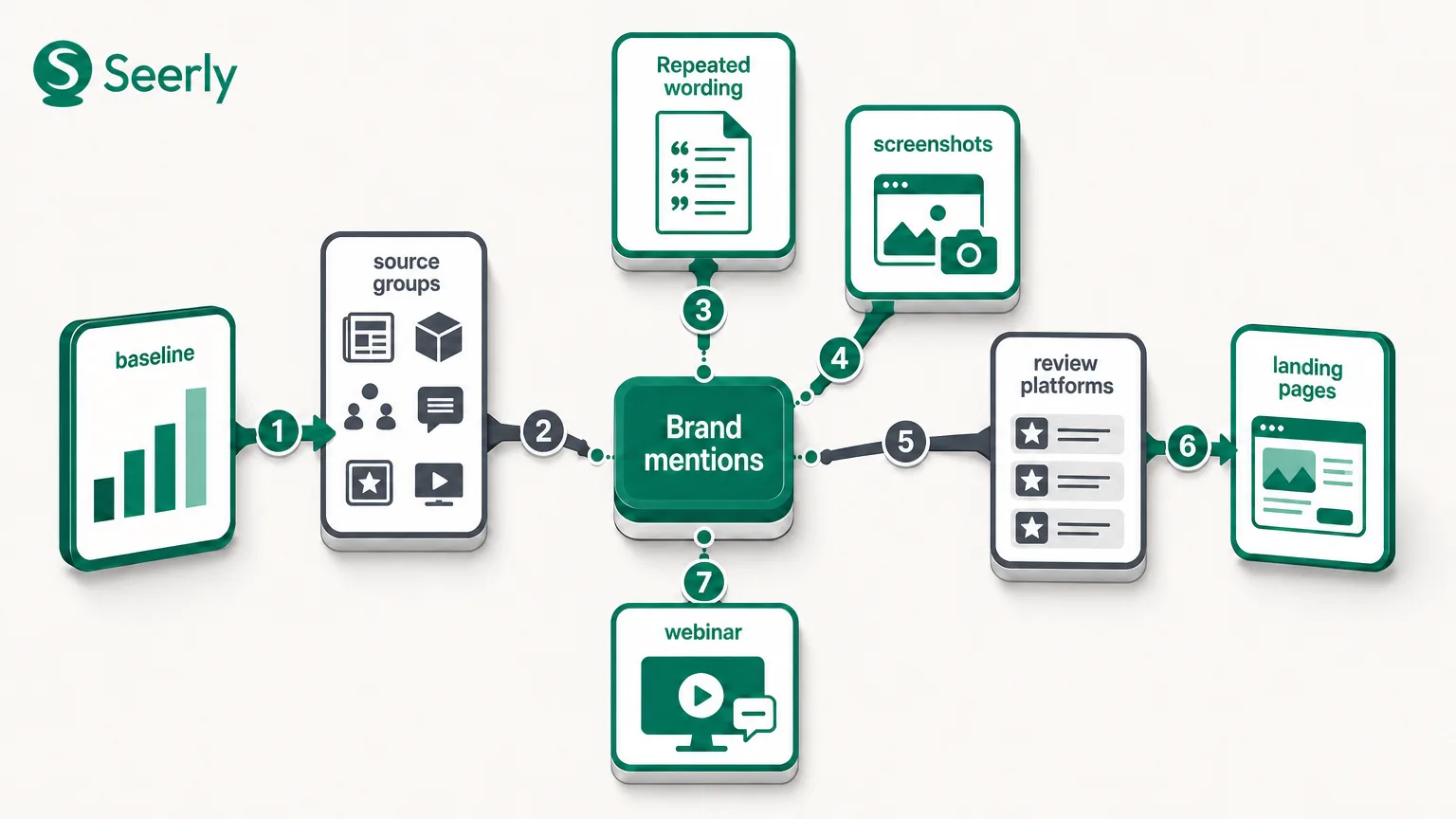
A spike only exists relative to a baseline. If your brand normally receives 20 mentions a day and receives 80 today, that is a notable change. If it routinely fluctuates between 50 and 100 mentions after weekly newsletters, the same number may be ordinary variation.
Start by selecting a comparison period that reflects the business cycle. For most teams, that means looking at the previous four to eight weeks, then comparing the same weekday, campaign phase, and market context where possible. Seasonal businesses should also compare with the equivalent period last year; otherwise, a predictable demand cycle can be misclassified as a sudden reputation event.
Create a simple baseline record containing the following fields:
| Signal | What to record | Why it matters |
|---|---|---|
| Volume | Daily and weekly mention count | Establishes whether the movement is unusual |
| Sources | Social networks, forums, publishers, review sites, reseller pages, search results | Reveals where the increase is concentrated |
| Wording | Repeated phrases, product claims, questions, hashtags, and competitor comparisons | Identifies the narrative behind the count |
| Geography | Countries, regions, and languages | Shows whether attention is reaching relevant markets |
| Audience | Customers, prospects, employees, journalists, partners, creators, or unknown accounts | Distinguishes buyer interest from general exposure |
| Sentiment | Positive, negative, mixed, neutral, and uncertain | Prevents a single sentiment label from hiding nuance |
| Owned activity | Recent launches, campaigns, partnerships, site changes, or support incidents | Connects the spike to plausible causes |
Do not rely on automated sentiment alone. A post saying “This tool is expensive, but it saved our team hours every week” contains both a potential objection and a strong recommendation. Likewise, a neutral-looking headline can spread an unverified claim that later damages perception. Review a representative sample manually before deciding the overall direction of the conversation.
It is also useful to map mentions against the pages and campaigns involved. If attention rises after a webinar, check whether referral traffic, branded search, demo requests, or product-page engagement changed at the same time. A rise in discussion without an accompanying movement in relevant buyer behaviour may still matter for visibility, but it should not be reported as demand generation. Teams assessing this relationship can also use a framework for reading organic search lift after AI mentions without confusing correlation with proof.
Classify the sources behind the spike
Once the baseline confirms a meaningful change, group mentions by source type rather than reviewing one long, unstructured feed. This makes patterns visible: a hundred reposts from small accounts may look substantial in aggregate but carry less weight than five detailed discussions from relevant practitioners.
Begin with four practical source groups: first-party sources, credible third-party sources, customer or community sources, and low-confidence amplification. First-party sources include your own website, executive accounts, employees, official partners, and campaign materials. They explain where a narrative may have originated, but they should not be treated as independent validation.
Credible third-party sources include established publications, recognised analysts, subject-matter experts, and reputable review platforms. Customer and community sources include discussion threads, user groups, comparison conversations, and reviews. These sources can be especially informative because they reveal how people interpret your message when the brand is not controlling the framing; consumer review research tracks how review recency, quantity, and response behaviour shape evaluation.
Use this diagnostic checklist for each cluster of mentions:
- Is the author identifiable and relevant? Review account history, professional context, audience fit, and whether the author has direct experience with the category.
- Is the wording original? Near-identical sentences, identical errors, and repeated links often indicate syndication, templated content, or coordinated amplification.
- Does the source add evidence? Give greater weight to firsthand use, screenshots, data, demonstrations, and transparent methodology than unsupported assertions.
- Is the mention first-party or independent? A partner repeating a launch announcement may be useful distribution, but it is not equivalent to an unsolicited customer recommendation.
- What is the referral context? Check the link destination, UTM parameters, referring domains, and landing pages. A spike that sends visitors to an affiliate page has different implications from one that sends qualified visitors to documentation or a product comparison page.
Source classification also prevents social metrics from flattening important differences. A Reddit thread with detailed peer responses may have fewer posts than a viral short-form video, yet exert more influence on a technical buyer’s decision. For that reason, teams should examine why community discussions can become a trust layer in brand discovery, not merely count how often the brand name appears.
Trace the claim that is actually travelling
The useful unit of analysis is often not the individual mention but the claim being repeated. A claim might be “Brand X has the lowest implementation time,” “Brand X raised its prices,” or “Brand X does not support a required integration.” Each can spread through multiple channels while becoming less accurate with every repost.
Imagine that a B2B software company sees 70 new mentions stating that its platform “cuts onboarding from six weeks to two days.” The marketing team may assume the figure is a successful campaign message. A closer review finds that the wording first appeared in a partner webinar months earlier, where the speaker described one customer’s unusually simple deployment - not an average result and not a universal promise.
To trace the narrative, export the mentions and sort them by publication time, exact phrase, and source authority. Search for distinctive wording in quotation marks, then locate the earliest credible appearance. The first indexed page is not always the original source, so compare publication timestamps, archived versions where available, author context, and linked references.
Next, separate the claim into three labels:
- Verified: Supported by current first-party documentation, customer evidence, or reliable independent reporting.
- Partly supported: Based on a real fact but missing conditions, scope, date, or important caveats.
- Unsupported or inaccurate: Cannot be substantiated, misstates the source, or reflects an outdated product, policy, or event.
In the worked example, “two days” may be a valid customer anecdote but not a defensible performance benchmark. The appropriate response is not necessarily a public correction. The company could update partner guidance, publish clearer implementation ranges, and ensure its own pages explain the conditions that affect onboarding. This preserves accuracy without escalating a narrative that has limited reach.
Test whether AI answers repeat the narrative
Buyers increasingly encounter brand narratives through AI-powered search and chat experiences, where responses may summarise material from across the web. That makes it important to test whether a claim visible in social, press, or community discussion is also shaping the answers potential customers receive.
Use a small, repeatable set of buyer queries rather than testing one vague question once. Include category queries, comparison queries, problem-led queries, and reputation-focused queries that resemble real research. For example: “What are the leading tools for [use case]?”, “What should I know before choosing [brand]?”, and “How does [brand] compare with [competitor] for [audience]?”
For each test, log the date, platform, query wording, full answer, tone, claims about the brand, and linked sources where available. Note whether the response repeats the exact narrative you identified, adds caveats, presents it as fact, or attributes it to a source. This turns anecdotal checking into prompt performance tracking that can be reviewed over time.
Do not treat a single response as conclusive evidence of broad AI search visibility. Answers can vary by platform, location, account state, question phrasing, and time. The goal is to detect recurring patterns across representative tests, then compare those patterns with your wider mention data and owned-site accuracy. A broader brand presence monitoring approach across AI chats and traditional search helps keep these channels distinct while still measuring their combined reputation impact.
Choose the right response path
The final decision should reflect source quality, claim accuracy, reach, and buyer relevance - not the emotional intensity of the team’s first reaction. A practical decision tree can keep marketing, communications, support, legal, and agency teams aligned.
If the spike is positive and independently validated, amplify it selectively. Thank credible customers or creators, share the evidence through appropriate owned channels, and build the validated point into sales enablement or content. Avoid overstating one positive anecdote as a universal outcome.
If the claim is inaccurate but limited in reach, correct the source at the point of origin where possible. Update the relevant web page, partner material, help centre article, or reseller listing, and document the action. A measured correction is usually more effective than a broad public response that introduces the claim to a larger audience.
If the issue is credible, negative, and gaining momentum, escalate quickly. Assign an owner, preserve source evidence, validate the underlying facts with the relevant team, and agree on a response timeframe. The response may involve customer support, product communications, legal review, or leadership depending on the issue; what matters is that the team addresses the actual concern rather than only the visible posts.
If the activity is irrelevant noise, continue monitoring but do not feed it. Repeated bot-like posts, unrelated name collisions, and low-quality copied content may warrant filtering rules rather than public engagement. Record why the trend was classified as low priority so future analysts can recognise the pattern.
Build a repeatable investigation habit
A spike in brand mentions is a signal to investigate, not proof that demand or reputation has improved. The most reliable interpretation comes from validating the origin, claim, source credibility, amplification pattern, and effect on buyer behaviour.
Create a shared mention-investigation log now, before the next spike arrives. Include the date, evidence links, source category, claim status, sentiment context, owner, response decision, and follow-up date. A consistent record turns reactive monitoring into a data-driven reputation practice - and gives your team a clearer basis for protecting trust as brand discovery spreads across search, communities, and AI-powered answers.