The AI crawler access experiment: measure the trade-off before changing controls
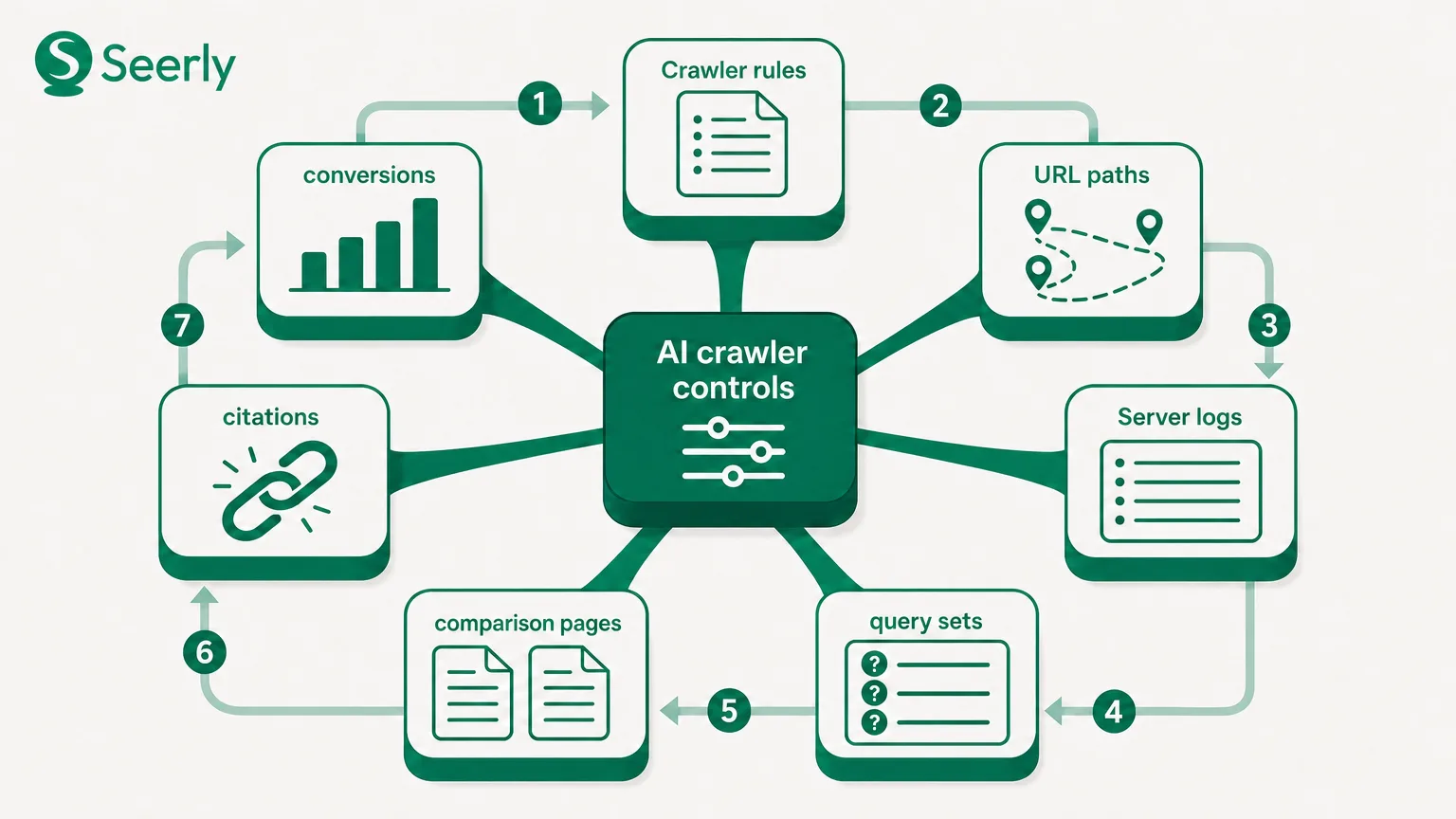
Blocking an AI crawler can look like a simple technical decision: update a rule, deploy it, and protect your content. But the business consequences depend on what that rule controls. A restriction on model-training use is not necessarily a restriction on search discovery, while a broader access block may affect several uses at once.
For marketing leaders, technical SEO teams, and web owners, the practical question is not whether AI access is universally good or bad. It is how to quantify the traffic, citations, and commercial outcomes associated with each access decision. That requires a documented baseline, a bounded experiment, and clear limits on what the evidence can establish.
This guide provides a measurement framework for AI crawler controls, from identifying the permission being changed to deciding whether to retain, reverse, or expand it. The objective is to make crawler policy a tested business decision - not an unexamined default.
1. Start with the decision inventory
“Allow AI” and “block AI” are too broad to describe a useful policy. Search-surface exposure concerns whether content can be discovered or presented in search experiences. Model-training permissions concern using content to develop models, while grounding concerns retrieving or using sources to support answers at response time. These uses can share infrastructure without sharing identical controls.
Provider documentation matters because crawler names do not reliably explain every downstream use. OpenAI, for example, documents separate roles for OAI-SearchBot, GPTBot, and ChatGPT-User. Google documents its own crawler and product-token distinctions. Build the inventory around the documented use, not around a generic category of “AI bots.”
| Decision | Content and markets to inventory | Potential commercial consequences | Evidence to collect |
|---|---|---|---|
| Search-surface exposure | Public guides, product pages, comparison pages, and supported languages | Discovery, citations, referral visits, and assisted demand | Answer inclusion, cited URLs, clicks, and conversions |
| Model-training permission | Original research, proprietary editorial content, and licensed material | Content-use preferences, licensing considerations, and legal obligations | Applicable permissions, policy scope, and compliance checks |
| Grounding permission | Documentation, factual resources, pricing information, and localised pages | Source attribution, answer accuracy, and downstream discovery | Citations, factual accuracy, referrals, and buyer evidence |
| Network-level access | Paths protected by CDN, firewall, or application rules | Several uses may be affected; legitimate access may also be interrupted | Verified requests, response codes, challenged requests, and blocked paths |
Record the provider, token, control mechanism, affected URL paths, languages, and commercial owner for every proposed change. A control may operate at property level rather than page level, so confirm its scope before designing a page-cohort experiment. Market-level reporting also does not imply market-level enforcement: a language directory can be a test cohort, but it is not automatically a geographic restriction.
Verification note: The supplied brief attributes to Google a worldwide rollout of a Search Console generative-AI control on August 31, 2026, and says that control does not affect AI training. That rollout claim has not been independently verified here, and its cited Help page is outside this article’s permitted external-source list. Confirm the date, availability, scope, and training distinction in current Google documentation before relying on it for implementation.
Finally, separate a declared permission from an enforced access restriction. The Robots Exclusion Protocol specifies that robots rules are not a form of access authorisation. Google likewise explains that robots.txt is not a mechanism for keeping a page out of Google Search. Sensitive content needs appropriate access protection; a crawler preference is not a security boundary.
2. Build a pre-change evidence baseline
A baseline should describe both technical access and business performance. Without both, a team may mistake a correctly deployed directive for a commercially successful policy. Capture comparable reporting periods, retain the underlying exports, and document missing data rather than treating it as zero.
Use the following template for the proposed cohort and its comparison group. Break results down by page group, market, and platform wherever the data supports it. Keep metric definitions fixed throughout the experiment so a reporting change does not masquerade as a policy effect.
| Baseline field | What to record |
|---|---|
| Affected URL groups | Exact URLs or path rules, content type, language, market, and business purpose |
| Current crawl access | Robots directives, relevant product tokens, CDN/WAF rules, and application restrictions |
| Server-log observations | Where available: verified bot requests, timestamps, paths, response codes, and request volume |
| Organic impressions and clicks | Search Console page-group and query-group exports, segmented consistently |
| Conversion outcomes | Sessions, qualified leads, purchases, revenue, and conversion rates where measurable |
| AI-answer inclusion | Eligible answer observations in which the brand or content appears |
| Citation appearances | Linked source URLs, citation frequency, prominence, and accuracy |
| Branded-query coverage | A fixed set of brand, product, and brand-plus-category queries |
| Page changes | Date-stamped edits, redirects, canonical changes, structured-data updates, and deployments |
| Measurement conditions | Platforms, query wording, language, location settings, collection cadence, and failures |
Distinguish three observations that are often blended together: a brand mention, a citation to your site, and a visit to your site. A mention need not contain a source link, and a source link need not generate a click. Record citation correctness as well as frequency, since attribution to an irrelevant or outdated page may create risk rather than useful visibility. The framework for measuring answer inclusion, citation quality, accuracy, and risk helps keep these outcomes separate.
Use fixed query sets and repeated observations rather than a handful of screenshots. Calculate inclusion and citation rates against successfully collected, eligible observations, and record collection failures separately. Keep platform-level results visible instead of averaging away a decline on one surface with an increase on another. A single answer is an observation, not an impact estimate.
Why a comparison group matters
A holdout page set helps distinguish the experiment from changes affecting the whole site or market. Select unchanged pages with similar intent, historical traffic, content age, and commercial function, then compare their pre-change trends with the test cohort. Avoid a holdout that differs materially in seasonality or buyer intent. If the control is property-wide, use another defensible comparison and clearly acknowledge its weaker comparability.
A useful directional calculation is the test group’s post-minus-pre change, minus the comparison group’s equivalent change. For rates, compare percentage-point changes; for traffic counts, account for different baseline sizes. This adjustment does not establish causation when the groups behave differently or other changes intervene. It does, however, provide a stronger reference than an isolated before-and-after chart.
3. Design the access experiment
Consider an illustrative publisher that wants to restrict a documented content use while preserving ordinary search access. The experiment below is a proposed design, not a customer case study or an observed result. Its purpose is to show how to bound the change and make the eventual interpretation defensible.
Google documents Google-Extended as a standalone product token for managing future Gemini training and specified Gemini grounding uses. It is not a separate HTTP request user agent, and Google says it does not affect inclusion or ranking in Google Search. Because the token covers more than training alone, an experiment using it must acknowledge the grounding dimension rather than describe the change as training-only.
Step 1: Select a narrow, eligible cohort
Choose a stable directory of informational guides rather than the entire domain. Check whether the relevant mechanism supports path-level control and whether those paths contain shared resources or commercially critical pages. Select comparable unchanged guides outside the directory as the holdout. Exclude pages undergoing redesigns, redirects, or major editorial work.
Step 2: Write a hypothesis and guardrails
A suitable hypothesis is: restricting the uses governed by Google-Extended for the selected directory will not produce a material deterioration in the tracked discovery and commercial signals during the observation period. Define “material” using historical variability and business tolerance before deployment. Select primary outcomes, such as qualified conversions and valid citation rate, alongside diagnostic measures. Recognise that short-term visibility monitoring cannot measure the full consequences of future model-training choices.
Step 3: Freeze unrelated changes
Pause avoidable changes to content, templates, internal links, canonicals, and structured data in both groups. Security fixes and necessary business updates should still proceed, but they must enter the experiment log. Record migrations, campaigns, pricing changes, outages, and provider announcements even when they occur outside the cohort. If a major competing release is unavoidable, postponing the experiment may produce more useful evidence.
Step 4: Log and validate the exact directive
For this hypothetical directory, the intended robots change could be:
User-agent: Google-Extended
Disallow: /research-guides/
Save the complete before-and-after robots.txt files, deployment timestamp, approval, and rollback version. Review how the rule interacts with existing groups and confirm that ordinary search access has not accidentally changed. Do not infer that a successful deployment proves downstream systems have already applied the preference. Validation should establish what changed technically, while monitoring evaluates the subsequent observations.
Step 5: Predefine the observation window
Choose a window long enough to collect repeated observations and meaningful traffic, taking historical variability and recrawl timing into account. For planning, a team might propose several weeks of baseline collection followed by a six-week observation period, but those are illustrative choices - not validated benchmarks. Record deployment and evidence of implementation separately where available. Extend the window or report an inconclusive result if the event volume remains too low.
Step 6: Keep measurement conditions stable
Run the same query set, reporting segments, conversion definitions, and collection schedule throughout the experiment. Log unavoidable changes rather than removing inconvenient observations after seeing the results. Review how to distinguish a real trend from ordinary variation before interpreting individual spikes. A useful experiment ends with a documented decision, even when that decision is to collect more evidence.
4. Interpret outcomes without overclaiming
The strongest interpretation follows the sequence from implementation to observable discovery signals to commercial outcomes. First ask whether the intended control was deployed correctly, then whether the relevant surface changed, and finally whether a measurable business consequence followed. A missing link weakens the conclusion rather than proving that nothing happened.
The comparison matrix below separates plausible evidence from claims that go beyond it. Apply it to each provider and surface, since a single sitewide average can conceal opposing effects. Include observation counts and uncertainty alongside percentage changes. Low-volume results deserve particular caution.
| Observed pattern | Reasonable interpretation | Next action |
|---|---|---|
| Crawl activity remains unchanged | A downstream-use token may not change fetching; deployment or enforcement issues are also possible | Validate the mechanism and documented scope before judging impact |
| AI citations increase while referrals stay flat | Measured source visibility improved, but additional visits have not been demonstrated | Check citation accuracy and report visibility separately from traffic |
| Organic traffic changes similarly in test and holdout | A broader search, demand, or site effect is a plausible explanation | Investigate common causes; avoid attributing the whole change to policy |
| Conversions change without supporting discovery or traffic evidence | The commercial movement is not yet tied convincingly to access | Examine campaigns, conversion tracking, sales cycles, and buyer evidence |
| The test cohort deteriorates while the holdout is stable | A policy effect is plausible if timing and implementation also support it | Investigate confounders and apply the predefined rollback rule |
| Differences remain within ordinary variation | No measurable effect was detected in this window | Report uncertainty; do not claim permanent equivalence |
Keep direct AI referrals separate from assisted influence. Referral analytics can document attributable visits when the source is available, but it cannot capture every earlier interaction with an AI answer. Supplement it with consistently collected buyer-reported discovery and CRM evidence, retaining confidence labels. The approach to measuring AI-assisted signups when organic traffic receives the credit provides a useful attribution structure.
Translate business effects using observed qualified leads, purchases, revenue, or contribution margin where available. If using an expected value per lead, disclose the historical basis and avoid presenting it as realised revenue. Do not assign an arbitrary monetary value to every citation or add estimated assisted value to direct revenue without checking for overlap. Training preferences and legal obligations may also remain decisive when short-term commercial impact cannot be measured.
Set escalation criteria before deployment: accidental restriction of critical search access, a sustained decline beyond the agreed commercial tolerance, or breach of a content-use obligation. Technical errors warrant immediate investigation; noisy metrics do not automatically warrant reversal. When several search surfaces change together, attribution remains directional rather than causal. A rollback also should not be assumed to restore downstream behaviour immediately.
5. Establish an ongoing governance routine
Crawler controls belong in the same change-management discipline as indexing rules and commercially significant releases. Marketing owns the business objective, while web and technical SEO teams own deployment and validation. Content and legal stakeholders determine whether the proposed permissions fit editorial priorities, licensing terms, and risk requirements.
Assign a named approver, implementer, analyst, and rollback owner rather than relying on informal agreement. Maintain a change log containing the control, documented purpose, URL scope, markets, approvals, timestamps, baseline exports, competing changes, and outcome. Review whether provider documentation or infrastructure settings have changed since approval. This creates an auditable policy rather than a collection of forgotten rules.
Use an operational checklist at each review:
- Web and technical SEO: Validate effective directives, request handling, search access, and rollback readiness.
- Content: Review affected assets, citation correctness, and scheduled editorial changes.
- Legal: Confirm licensing constraints, content-use preferences, and obligations that override experimentation.
- Marketing and analytics: Review discovery signals, conversions, commercial value, and uncertainty.
- Decision owner: Approve retention, reversal, extension, or a staged expansion.
Set a recurring review cadence that fits traffic and decision urgency, with immediate alerts for technical failures. Require wider rollout to pass predefined gates: validated implementation, sufficient observations, acceptable commercial guardrails, and stakeholder approval. Expand in stages so the next cohort can test whether the initial finding generalises. Preserve the option to conclude that evidence is insufficient.
AI crawler controls are a business decision whose effects should be tested against a documented baseline, not changed blindly. Start by running an AI-readiness baseline in Foundations > Smart Audit, then track post-change discovery signals in Monitoring > Visibility before expanding any policy sitewide. Keep permission choices, discovery outcomes, and commercial evidence distinct throughout the review. The result is not a universal answer about AI access, but a defensible decision for your content and business.