The monitoring specification for ChatGPT search visibility
A marketing team asks ChatGPT for a shortlist of suppliers and finds its brand missing. A colleague asks a similar question later and sees the brand recommended. Neither observation is necessarily wrong, but neither establishes whether visibility has improved, declined or remained broadly unchanged.
That distinction matters because ChatGPT search combines generated answers with information retrieved from the web. Its responses can include links to relevant web sources, making both the answer and its supporting evidence important measurement objects. A brand mention alone does not establish that the description is accurate, the recommendation is relevant or the linked material supports the claim.
Dependable ChatGPT search visibility monitoring therefore needs more than screenshots or a mention counter. It requires a controlled question set, repeated observations, source capture, competitor context and a documented path from detection to action. This guide sets out what to capture, how to summarize it and how to turn findings into accountable work.
1. Separate isolated checks from ongoing monitoring
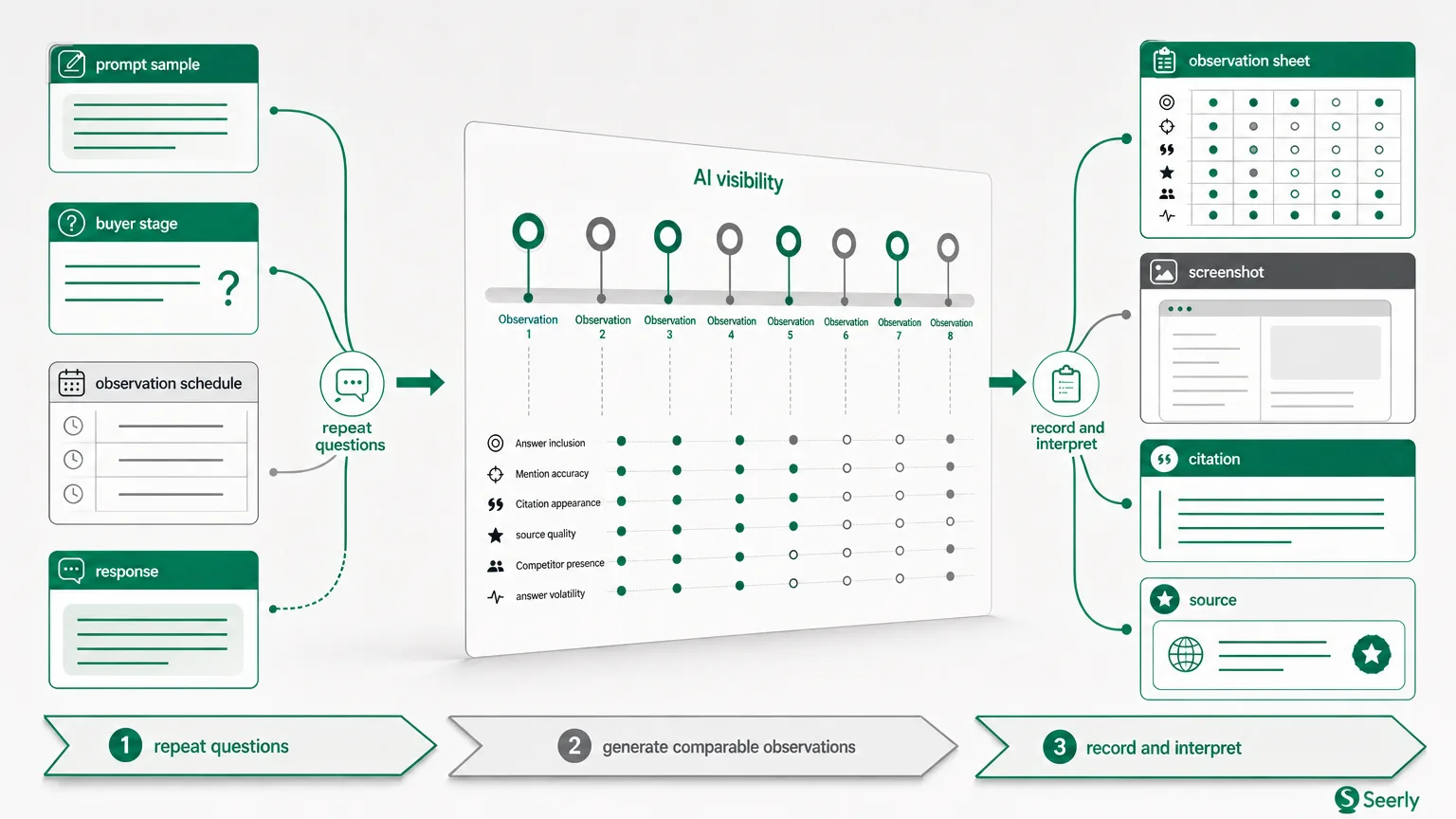
An isolated check answers a narrow question: “What appeared in this response under these conditions?” Ongoing monitoring answers a different question: “How consistently does our brand appear across a defined set of commercially relevant questions?” The second requires a documented baseline and comparable observations over time.
Prompt wording, conversational context and available sources can change what an answer contains. OpenAI describes ChatGPT search as using follow-up context to help determine subsequent searches, so a fresh conversation and an extended discussion should not be treated as equivalent tests. Record the experience tested rather than assuming every ChatGPT response represents the same search environment.
| Measurement choice | Isolated check | Monitoring program |
|---|---|---|
| Question selection | Whatever someone asks | Versioned portfolio tied to business priorities |
| Test conditions | Often undocumented | Recorded interface, context, language and market |
| Repetition | Usually one observation | Predetermined checks across reporting periods |
| Evidence | Screenshot or recollection | Saved answer, sources and structured labels |
| Interpretation | Present or absent | Frequency, accuracy, context and uncertainty |
| Follow-through | Ad hoc discussion | Assigned action and scheduled retest |
Establish a baseline before interpreting movement
Start by fixing the question wording, test environment and observation schedule. Record the product or interface, displayed model where available, search setting, language, geographic context and whether memory or personalization is enabled. Use fresh conversations for baseline checks unless multi-turn research is explicitly part of the scenario.
A practical starting protocol is to run each priority question several times across separate days, then repeat the same schedule in subsequent reporting periods. This is an operating recommendation, not a statistically validated minimum. More observations can reveal variation, but repeated outputs from one platform should not automatically be treated as independent samples.
Define failure states before collecting data. A timeout, blocked session or incomplete capture is a failed observation; a completed answer that omits the brand is a valid absence. If search activity cannot be verified, label that observation accordingly rather than silently pooling it with confirmed search responses.
2. Design a priority prompt portfolio
The monitoring set should reflect decisions your buyers actually make, not questions engineered to produce favorable mentions. Sales conversations, site-search terms, customer research and support requests can all inform selection. Treat these inputs as evidence of question relevance, not as proof of how frequently people ask ChatGPT the same question.
Build the portfolio in four steps: identify buyer decisions, draft representative questions, classify their intent and assign responsibility. Maintain a stable core for trend reporting while keeping exploratory questions separate. This prevents a changing question mix from masquerading as a visibility improvement.
Cover five types of question
| Question type | Illustrative question template | What it tests | Likely business owner |
|---|---|---|---|
| Category | “Which platforms help distributed teams manage projects?” | Discovery without naming the brand | SEO or demand generation |
| Comparison | “How does [brand] compare with [competitor] for enterprise reporting?” | Differentiation and trade-offs | Product marketing |
| Use case | “What software suits a small agency managing client approvals?” | Fit for a specific task and audience | Content or segment marketing |
| Brand-specific | “Does [brand] support single sign-on?” | Product and entity accuracy | Product marketing or product operations |
| Reputation-sensitive | “What limitations should buyers investigate before choosing [brand]?” | Risk framing and supporting evidence | Brand, communications or legal |
Assign each question an intent, an audience and a business owner. Intent might be discovery, evaluation, validation or risk assessment; audience should describe the buyer and relevant constraints. The owner should be the person able to investigate and improve the underlying information, not merely the person preparing the report.
Brand-specific questions need separate interpretation because they already supply the brand name. Counting them alongside unbranded discovery questions can inflate the apparent strength of visibility. Similarly, a comparison question that names two vendors tests their representation, not whether either would have been discovered independently.
Prioritize questions using business relevance, buyer-stage importance and potential harm from inaccurate answers. Keep experimental variations outside the core scorecard until their value is established. When wording changes materially, create a new version and preserve the previous version’s history rather than overwriting it.
3. Capture the evidence behind each observed answer
A useful monitoring record lets another analyst reconstruct what happened without rerunning the question. That requires the complete response and its visible supporting material, not just a dashboard label. Screenshots help preserve presentation, while structured fields make comparison and review possible.
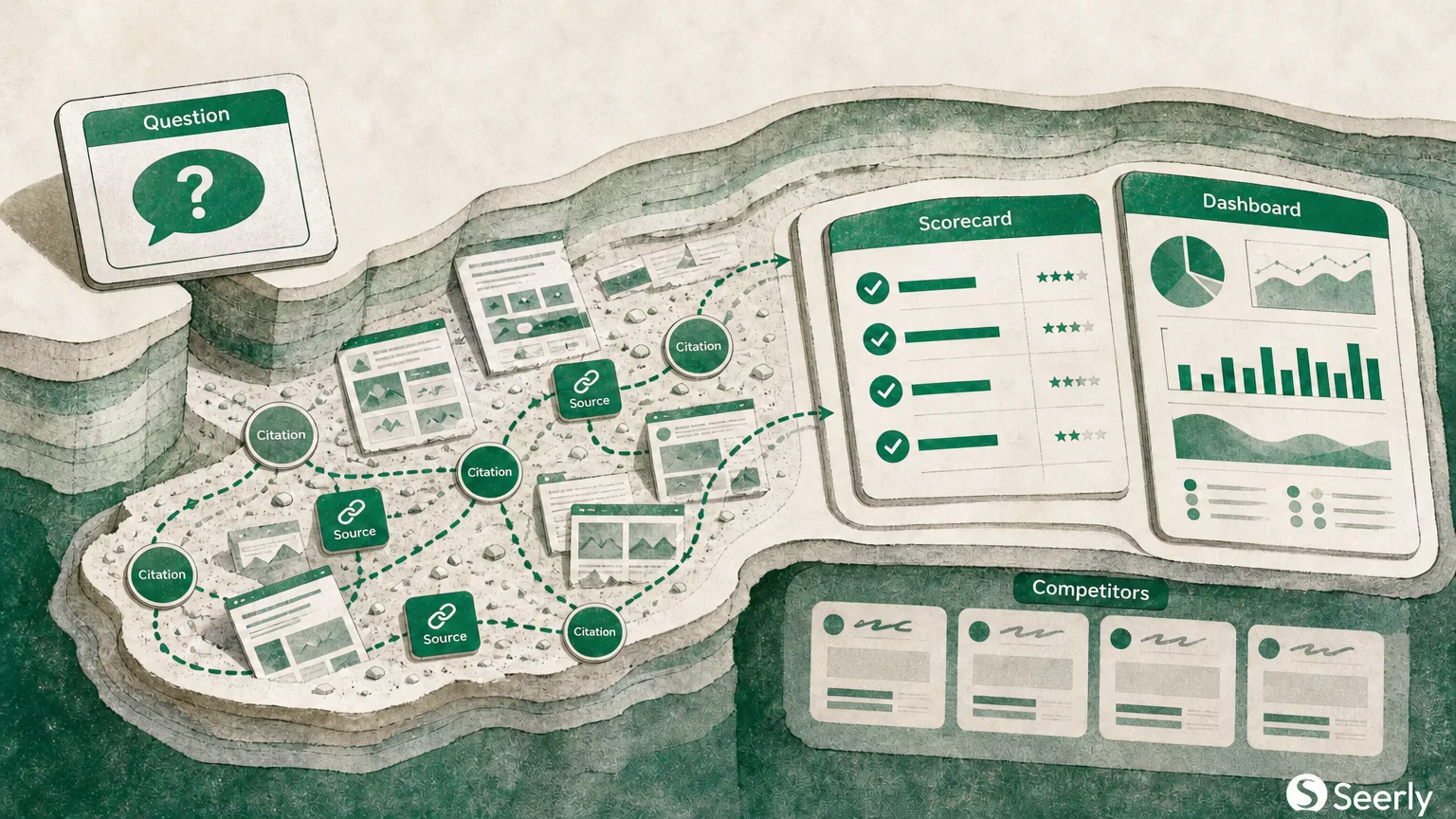
ChatGPT search can display inline citations and a Sources button containing source links. Capture both where available, but do not assume every listed source supports every statement in the answer. A source’s presence and its relevance to a particular brand claim are separate observations.
Use the following checklist for each completed check:
- Observation identity: Unique record ID, exact timestamp, reporting period and collection method.
- Question identity: Exact wording, question ID, version, category, intent and audience.
- Test conditions: Interface, displayed model, search status, language, market and conversation context.
- Answer evidence: Full response text, screenshot or export, and completion status.
- Brand presence: Whether the brand appears, recognized aliases and the context of the mention.
- Representation: Product claims, recommendation language, qualifications, sentiment and possible inaccuracies.
- Source evidence: Visible links, citation placement, page title and publisher where available.
- Competitor appearances: Named competitors, their described strengths and whether they appear alongside the brand.
- Change notes: Differences from earlier observations, reviewer comments and linked action records.
Separate mention, recommendation and source support
A brand may appear as a recommended option, a cautionary example or a passing reference. These are not equivalent outcomes, even though all could trigger a basic mention detector. Use explicit labels such as “recommended,” “described,” “criticized” and “incidental,” and allow human review when the wording is ambiguous.
Also distinguish a citation to the brand’s website from a citation that substantiates the answer’s claim. A homepage link may confirm the organization’s identity without supporting a statement about integrations or security. The measurement task is to inspect the relevant passage, record what it supports and mark anything that cannot be verified.
Treat list position cautiously. An answer’s first-mentioned brand is not necessarily a stable search ranking, especially when the response is narrative or unordered. Store order when useful, but describe it as answer placement rather than presenting it as a universal rank.
For implementation planning, connect these requirements to brand and competitor visibility tracking. The evaluation question is whether a workflow preserves enough underlying evidence to explain a change. A headline metric should be a route into the records, not a substitute for them.
4. Turn observations into a defensible scorecard
The scorecard should summarize evidence without erasing how it was collected. A practical data model separates question definitions, individual observations, source records, reviewed claims and remediation actions. Stable IDs connect those records so an analyst can move from a trend to the exact answer and supporting page.
Keep the metric definitions visible and consistent across reporting periods. Report numerators and denominators alongside percentages so readers can distinguish sparse evidence from broad coverage. Segment results by question type, audience and market before presenting an overall figure.
| Metric | Operational definition | Interpretation safeguard |
|---|---|---|
| Prompt coverage | Core question versions meeting the planned observation schedule ÷ all scheduled core question versions | Report partial completion and failed checks separately |
| Share of brand presence | Valid responses mentioning the brand ÷ all valid responses in the defined segment | Separate branded from unbranded questions |
| Source support | Reviewed brand claims supported by captured sources ÷ all reviewed brand claims | Keep inaccessible or ambiguous evidence visible |
| Accuracy issues | Reviewed claims flagged as incorrect, outdated or misleading | Separate severity levels and unverified claims |
| Competitor overlap | Brand-present responses also naming a selected competitor ÷ all brand-present responses | Also report competitor-only appearances |
| Trend direction | Change in comparable metrics between matched periods | Flag changes in portfolio, environment or coverage |
| Confidence notes | Description of evidence completeness, repeatability and review limits | Do not imply statistical confidence without a valid method |
Make denominators and uncertainty explicit
“Share of brand presence” is an observation rate within your monitored portfolio, not market share or audience reach. It does not tell you how many people saw those answers or how often the same questions occur in real usage. Avoid “share of voice” unless the report clearly defines its restricted meaning.
Calculate presence rates for each question first, then summarize across questions if you want equal weighting. Otherwise, questions checked more frequently will contribute disproportionately to the aggregate. If business weighting is useful, fix those weights in advance and publish both weighted and unweighted views.
Accuracy review needs an authoritative reference, such as current product documentation, published pricing or an approved company fact sheet. Classify findings as verified accurate, verified inaccurate, outdated, ambiguous or unverified. Automated labels can help prioritize review, but consequential reputation findings should receive human assessment.
Confidence notes should explain limitations in plain language. Relevant notes include a small observation count, mixed search status, inaccessible sources or an environment change. A formal confidence interval requires defensible assumptions about sampling and dependence; attaching one to convenience checks does not make the underlying measurement representative.
Keep the scorecard multidimensional rather than collapsing everything into one score. A brand can appear more frequently while accumulating inaccurate claims, or receive fewer mentions while gaining stronger source support. Those patterns require different decisions and should remain visible.
5. Create an action path from detection to remediation
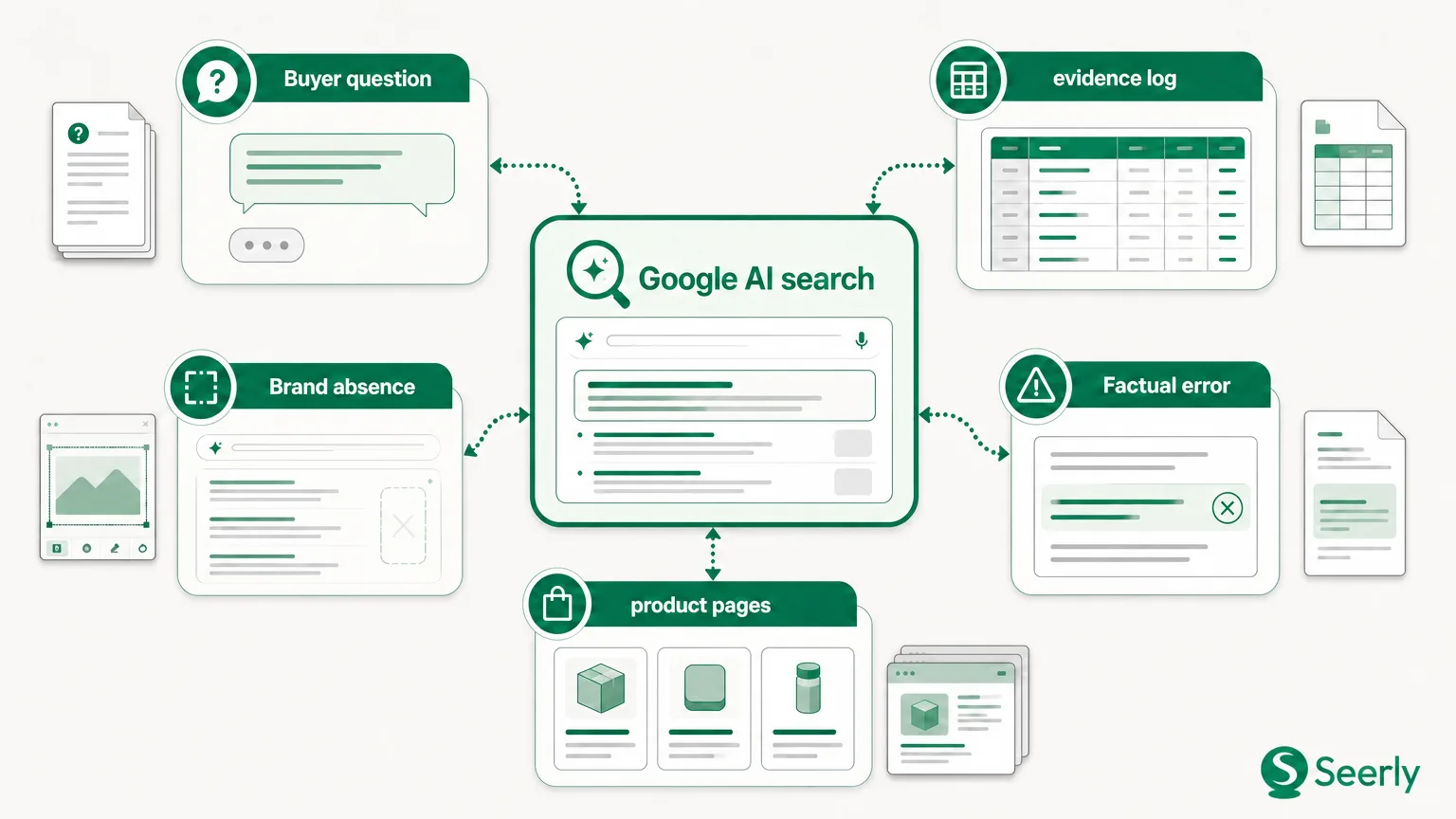
Detection becomes useful when it changes a specific page, evidence asset or operational decision. Each material alert should therefore produce a reviewable issue with an owner, supporting records and a retest date. Prioritize by potential harm and commercial relevance rather than by the size of a dashboard movement alone.
The following operating example is hypothetical; it describes a workflow, not a customer result. Suppose a team repeatedly finds that its brand is missing from an important use-case answer, while a brand-specific answer describes a currently available integration as unsupported. During review, the team also notices that a previously visible supporting page is no longer linked.
Verify the change before choosing the fix
The analyst first checks question versions, collection failures and test conditions. They inspect repeated observations and compare the current answers with the baseline, rather than treating a single response as a confirmed trend. The owner then checks the integration claim against current documentation and inspects the captured source pages.
These checks separate confirmed problems from plausible explanations. A missing brand does not prove a technical access problem, and a lost link does not prove that a page has been excluded. The next action should follow the evidence available, with unresolved causes recorded as hypotheses.
| Observed issue | Investigation | Candidate remediation | Retest requirement |
|---|---|---|---|
| Missing from relevant use-case answers | Compare buyer needs with the coverage and clarity of relevant pages | Improve a use-case page with explicit fit, limitations and supporting evidence | Repeat the unchanged core question |
| Incorrect integration or company fact | Check current documentation and conflicting public descriptions | Correct authoritative pages and review inconsistent entity facts | Recheck the claim and its visible support |
| Previously visible source disappears | Inspect availability, redirects, access controls and content changes | Repair confirmed technical faults and preserve useful content | Check access separately from answer inclusion |
| Competitors receive stronger external support | Review the evidence actually cited for competitor claims | Develop legitimate research, documentation or independent proof | Monitor source support and presence over time |
| Harmful characterization persists | Examine the exact wording and whether criticism is substantiated | Correct factual errors; address valid underlying issues | Retest with brand or legal review where appropriate |
A page-level AI-readiness check can help organize a technical and content investigation. It should complement direct inspection of the affected page and observed answer. Passing a readiness check does not establish that ChatGPT will retrieve, cite or recommend that page.
Record the original evidence, proposed explanation, chosen change, responsible owner and publication date in an action log. Add a retest window using the same core questions and comparable conditions, with follow-up checks rather than a single immediate rerun. Preserve unsuccessful interventions as well as successful ones so future decisions can build on what the team has actually learned.
Interpret post-change movement cautiously. An improvement after publication is useful evidence of sequence, but it does not establish causation because sources, competitors and platform behavior may also change. The defensible conclusion is what changed, what remained stable and how consistently the new pattern appeared.
Start with ten questions and an evidence trail
A dependable ChatGPT search visibility program begins with measurement discipline, not a larger dashboard. Select ten high-intent questions, assign owners and establish a documented baseline under recorded conditions. Save the complete answers, inspect their sources and separate discovery, accuracy and competitor measures.
Then connect each material finding to the page or evidence asset that could address it. Give that work an owner, a publication record and a scheduled retest, while preserving uncertainty about the cause. The result is a repeatable way to understand how the brand is represented - and to make better-supported decisions about what to improve next.