How JSON-LD Reduces Ambiguity When AI Systems Decide Whether to Cite a Page

A strong page can be skipped even when its writing is accurate, useful, and technically indexable. The issue is not always ranking position. In AI search discovery, systems must rapidly determine what a page is about, which organization stands behind it, who created it, what claims it supports, and whether its entities connect coherently to the user’s question.
That challenge is becoming more important as marketers focus on how answer engines choose sources to search, open, interpret, summarize, and cite. Structured data is already a meaningful part of the web’s machine-readable layer: JSON-LD adoption is tracked across the public web, while large-scale Web Data Commons research continues to document how publishers deploy Schema.org annotations at scale. The practical opportunity is not to add markup in hopes of forcing a citation. It is to reduce the interpretation work required before a system decides whether your page is usable.
JSON-LD will not guarantee rankings, inclusion in AI Overviews, or citations in chat-based search. It can, however, make the identity, scope, authorship, and evidence behind a page more explicit. For SEO leads, content strategists, and technical marketers, that makes JSON-LD a foundational part of building AI-ready websites rather than an isolated technical SEO task.
What JSON-LD actually does
JSON-LD stands for JavaScript Object Notation for Linked Data. In practical terms, it is a machine-readable way to describe the people, organizations, products, articles, questions, and relationships represented on a web page. The W3C JSON-LD specification describes it as a format for expressing linked data, meaning it can connect a page’s entities to consistent identifiers and recognized vocabulary.
Most teams encounter JSON-LD through Schema.org. Schema.org provides a shared vocabulary for describing common things on the web, such as an Organization, Article, Product, FAQPage, or Person. Its getting-started documentation outlines the core purpose of structured data: make page information more explicit for systems that process the web.
The distinction between visible content and JSON-LD is important. They serve different audiences, but they should describe the same reality.
| Visible page copy | JSON-LD schema markup |
|---|---|
| Explains an idea to human readers through headings, prose, examples, and visuals | States defined facts about the page and its entities in a machine-readable format |
| May imply who wrote the page or which product it discusses | Can directly identify the author, publisher, product, publication date, and related organization |
| Provides evidence through citations, data, methodology, and quotes | Helps systems classify the evidence-bearing page as an article, product page, FAQ, or other content type |
| Can be interpreted differently when context is weak | Reduces ambiguity by connecting entities and labels to recognized properties |
A page may clearly say “we help SaaS brands improve visibility” in its body copy. But without stronger signals, a machine still has to infer whether “we” refers to the publisher, a partner, a product team, or a generic editorial voice. JSON-LD can associate the page with a defined organization, clarify its URL and logo, identify authors, and connect profiles that represent the same entity elsewhere.
This is why schema markup in SEO should not be viewed only through the narrow lens of rich results. Google explains that structured data can help it understand page content and enable eligible search features. That is useful, but it is not a promise of a visual enhancement, higher ranking, or AI citation. The more durable benefit is structured clarity: supplying unambiguous signals that complement, rather than replace, clear page content.
Where JSON-LD can help during source selection
AI systems and search engines use different retrieval, ranking, and answer-generation methods. No marketer can see every decision inside those systems. Still, the moments where ambiguity commonly appears are visible: identifying a publisher, determining page type, resolving a named entity, and judging whether content answers a question directly.
1. Confirming organization identity
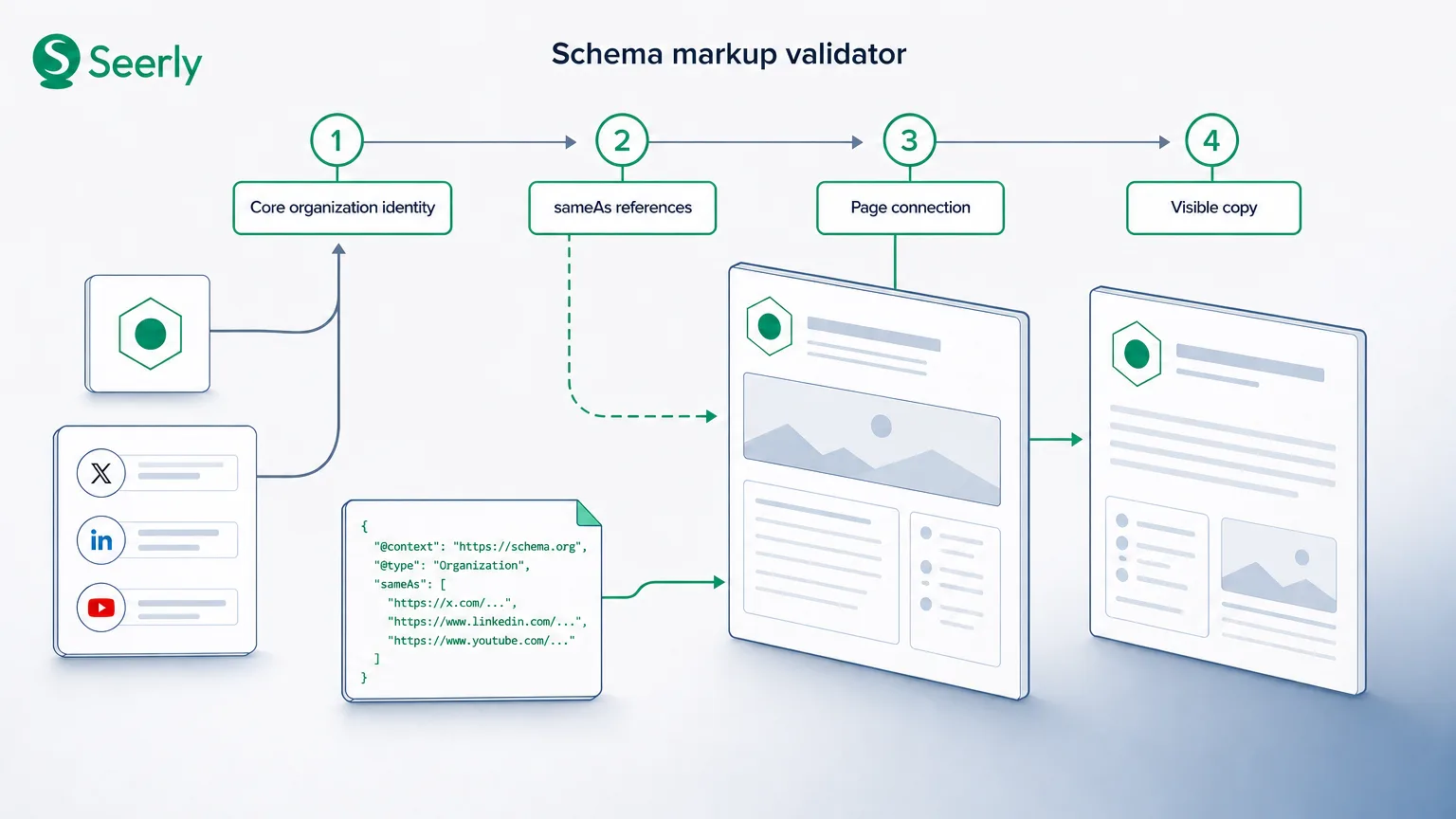
Start with the organization publishing the content. An Organization schema object can identify the brand name, canonical website, logo, contact points where relevant, and links to established profiles using sameAs. This helps distinguish your company from similarly named businesses, product names, or unrelated social profiles.
For example, a cybersecurity firm named “Signal” may publish a technical guide on threat intelligence. If the page only uses “Signal” in its header and footer, systems must infer which Signal it represents. A consistent organization entity that points to the company’s official site and verified profiles gives machines a clearer identity reference.
The markup must match the visible website identity. Do not use sameAs to point to loosely related publications, dormant social profiles, or partner pages simply because they share terminology. Entity clarity comes from consistency across the page, site, and external references - not from accumulating links.
2. Clarifying authorship and editorial accountability
For research-heavy or strategic content, authorship helps define who is responsible for the claims on the page. Article markup can identify an author and publisher, while Person markup can describe a real contributor with a role, profile URL, and connection to the publishing organization.
This does not mean every article needs an executive byline to be credible. It means pages should not obscure who created the material, especially when they offer original analysis, technical recommendations, or claims that a reader may need to evaluate. A visible author page, a publication date, and a clearly named editorial owner reinforce the information that structured data communicates.
If a team uses an editorial brand byline, the markup should reflect that accurately. Avoid presenting a generic marketing department as an individual expert, or attaching an author entity to a page they did not meaningfully create. These shortcuts add conflicting signals instead of trust signals.
3. Identifying whether the page is an article, product, or support resource
Page type shapes interpretation. A long-form guide about implementation should generally be represented as an Article or a more specific subtype where appropriate. A commercial product page should use Product markup only when it describes a genuine product with accurate, visible details, rather than treating every landing page as a product.
Google’s product structured data guidance illustrates why this distinction matters: product markup is designed around specific properties such as offers, pricing, reviews, and availability. Marking a general “solutions” page as a product without those substantiated attributes creates a mismatch between machine-readable meaning and reader-visible content.
For AI source selection, this clarity helps a system understand whether it is looking at a product specification, editorial explanation, documentation page, category hub, or FAQ. That classification alone will not earn visibility. It can prevent a relevant page from being misunderstood as the wrong kind of resource.
4. Connecting FAQs to the content they explain
FAQ sections are valuable when they answer genuine questions that are also supported by the page’s core content. FAQPage markup can make question-and-answer pairs explicit, but it should never be used to manufacture breadth through repetitive or promotional questions.
Consider a guide on identity resolution. A useful FAQ might ask, “Does JSON-LD improve rankings directly?” The answer should be concise, accurate, and consistent with the article: no direct ranking guarantee exists, but structured data can improve machine interpretation and eligibility for certain search features. That question connects a common objection to the article’s central explanation.
A weak FAQ, by contrast, answers “Why is our platform the best?” with sales copy. It is neither a meaningful informational question nor a reliable source of structured clarity. The objective is to make real page information easier to parse, not to repackage promotional language as markup.
5. Disambiguating entities and relationships
The most strategic use of JSON-LD is often relationship mapping. An article can connect to its publisher, author, primary topic, product discussed, or referenced organization. When that information is consistent with visible headings and evidence blocks, the page becomes easier to interpret as part of a wider knowledge graph.
For instance, a Seerly article about AI visibility can identify Seerly as its publisher, name the author, define the article title and canonical URL, and reference the relevant topic using consistent terminology. A reader sees the explanation in the article; machines receive a clearer map of the entities behind it. The two layers should reinforce each other.
This is particularly relevant for brands in crowded categories. If several companies use overlapping phrases such as “AI search optimization,” “visibility platform,” or “answer engine monitoring,” entity relationships help establish who is making a claim and which product or organization the claim concerns.
A practical before-and-after example
Imagine a SaaS company has published a page titled “The Complete Guide to Customer Data Quality.” The writing is strong, but the page begins with a broad introduction, lists no author, and references its platform only in a vague closing paragraph. Its evidence consists of unlinked assertions such as “data quality affects revenue” and “leading teams use automation.”
In this version, a machine can identify some keywords, but key questions remain unresolved. Is the page independent editorial content or a product landing page? Who made the claims? Is “data quality” referring to CRM data, analytics pipelines, or identity resolution? Which company owns the platform being mentioned? The page has useful content, but its context is diffuse.
Now consider an improved version. The visible page includes a precise H1, an introductory definition of customer data quality, named sections for common causes and measurement methods, a real author byline, and evidence blocks that cite the source or explain the methodology behind each major claim. The conclusion describes the company’s relevant product in a separate, clearly labeled section rather than blending product promotion into the research.
Its JSON-LD mirrors that clarity. The page is marked as an Article; the author is connected to a Person profile; the publisher is a defined Organization; and the content references the company’s product only where the page genuinely discusses it. If it includes a short FAQ, those questions match the on-page answers exactly.
The improvement is not the volume of markup. Adding twenty schema types to a vague page would not solve the underlying problem. Clear headings establish scope for readers, evidence blocks support specific claims, and JSON-LD makes key relationships explicit for machines. Together, they make the page more interpretable and more suitable for retrieval or summarization when its content is relevant.
This is also why schema work should sit alongside content operations. Teams improving AI search discovery should evaluate whether priority pages have clear page purpose, evidence quality, author accountability, and entity consistency - not just whether a validator returns zero errors.
JSON-LD checklist for citation readiness
Use this checklist to prioritize high-value pages first. The goal is not maximum markup coverage; it is accurate, maintainable structured data that reflects the visible page.
-
Organization: Define the publishing company with its canonical URL, name, logo, and relevant official profiles. Use
sameAsonly for profiles that genuinely represent the organization. Keep this entity consistent across the website so brand identity does not fragment between templates. -
Article: Apply
Articlemarkup to substantive editorial pages, including the headline, canonical URL, publisher, author where applicable, and accurate publication or modification dates. Ensure that the page visibly shows the same title, author, and dates. A machine-readable date should never contradict the editorial history a reader sees. -
Author or contributor: Connect expert-led content to a real person or a clearly identified editorial entity. Include a profile page when possible, with role and relevant expertise stated in plain language. This is most useful when the subject matter requires professional judgment, original research, or technical accountability.
-
Product, where relevant: Use
Productmarkup for a specific product with real, on-page attributes. Do not apply it to every homepage, service page, or blog article merely because a product is mentioned. Accurate implementation matters more than broad deployment. -
FAQPage, where useful: Mark up genuine questions that appear visibly on the page and have complete, non-promotional answers. Keep the FAQ tightly aligned with the article’s intent. If the section exists only to repeat keywords, it is unlikely to improve understanding for users or systems.
-
Related entity references: Use
sameAs,about,mentions, or other appropriate properties to clarify important relationships where the vocabulary supports them. Prioritize entities that genuinely help disambiguate the page: the publisher, author, named product, or clearly discussed organization. Do not create semantic connections that the visible content does not support.
Before deployment, validate syntax and inspect the rendered page to ensure markup survives JavaScript, tag managers, and template changes. JSON-LD can be technically valid while still being semantically weak. The stronger test is whether a person reviewing the markup would conclude that it accurately describes the page they can read.
Validate clarity before expanding markup
If developer time is limited, begin with a small set of pages that matter commercially and already contain credible information. This could include a high-intent product page, a flagship research guide, a comparison page, and a documentation resource that answers recurring buyer questions. Audit each page for ambiguity before writing a schema ticket.
Ask five questions: Can a reader immediately identify the publisher? Is the page type obvious? Are authors and publication dates clear where they should be? Does the page make supported claims with visible evidence? Could a system distinguish the company, product, and topic from similarly named entities? The answers reveal whether the larger issue is markup, content structure, or both.
Then use official testing and documentation as a technical baseline. The Google structured data introduction is useful for understanding search feature requirements, while the JSON-LD processing reports from the W3C community provide a reference point for implementation behavior. Validation is essential, but it is only the starting point; valid markup still needs to be accurate and aligned with the page.
For broader AI visibility work, structured data should feed a measurement loop. Monitor important prompts and topics, assess which pages appear as supporting sources across providers, improve ambiguity where it exists, and observe whether the page earns stronger visibility over time. That is a more disciplined approach than treating a schema deployment as a one-time fix. For a related framework, see how AI search optimization can help SaaS buyers find the right product.
Frequently asked questions
Does JSON-LD improve rankings directly?
JSON-LD does not directly guarantee higher organic rankings. Search engines use many signals to determine relevance, quality, and ranking, and structured data is only one input into how content is understood. Its practical value is that it can clarify meaning and, when it meets applicable requirements, support eligibility for specific search features.
Treat JSON-LD as infrastructure for comprehension, not as a ranking lever to pull in isolation. A vague, thin, or unsupported page will not become authoritative simply because it has valid schema markup. Strong content, evidence, technical accessibility, and clear entity signals need to work together.
Does JSON-LD help with AI Overviews and chat-based search?
There is no public rule stating that JSON-LD guarantees selection for AI Overviews or any chat engine. Answer systems can use different source retrieval and synthesis approaches, and visibility can vary by query, provider, and time. Markup should therefore be framed as a way to reduce ambiguity, not a mechanism for forcing inclusion.
That said, AI systems and search engines still need to interpret web pages efficiently. Consistent organization, article, author, product, and entity information gives them fewer reasons to misclassify the page. For teams monitoring cross-provider outcomes, a cross-provider rank-tracking workflow can help separate isolated appearances from repeatable visibility patterns.
What should a team validate first with limited developer resources?
Start with the organization entity and the markup on the pages most likely to influence revenue, trust, or category understanding. Confirm that the canonical URL, publisher identity, logo, author information, page type, and dates align with visible page content. These foundational details often provide more value than adding niche schema types across the entire site.
Next, remove contradictions. An outdated date in markup, a generic author name in the template, or product data that differs from the visible page creates confusion. A smaller number of accurate, well-maintained JSON-LD implementations is more valuable than sitewide markup that no longer reflects reality.
Build clarity, then measure the outcome
JSON-LD is not a shortcut to AI citations. Its value is more practical: it gives machines a clearer account of who published a page, what the page represents, which entities it discusses, and how its information fits together. When combined with direct headings, credible authorship, and visible evidence, it reduces interpretation errors that can keep a strong page from being trusted, summarized, or selected.
Start by auditing a handful of high-value pages for ambiguity, not schema volume. Then use Seerly to monitor whether clearer structure and stronger supporting evidence improve AI visibility over time across providers. The next step is measurement and iteration - not hype.