AI Search Performance Reporting: How to Prove Value in AI Discovery

Marketing teams have spent years using rank tracking as a shorthand for search performance. That model is no longer sufficient in AI search discovery. In answer-driven environments, a brand can influence an AI-generated response, earn a citation, appear repeatedly across prompts, or disappear entirely without that change showing up clearly in a traditional keyword position report. If your reporting still stops at rankings, it will miss the signals that increasingly shape discovery, trust, and shortlisting.
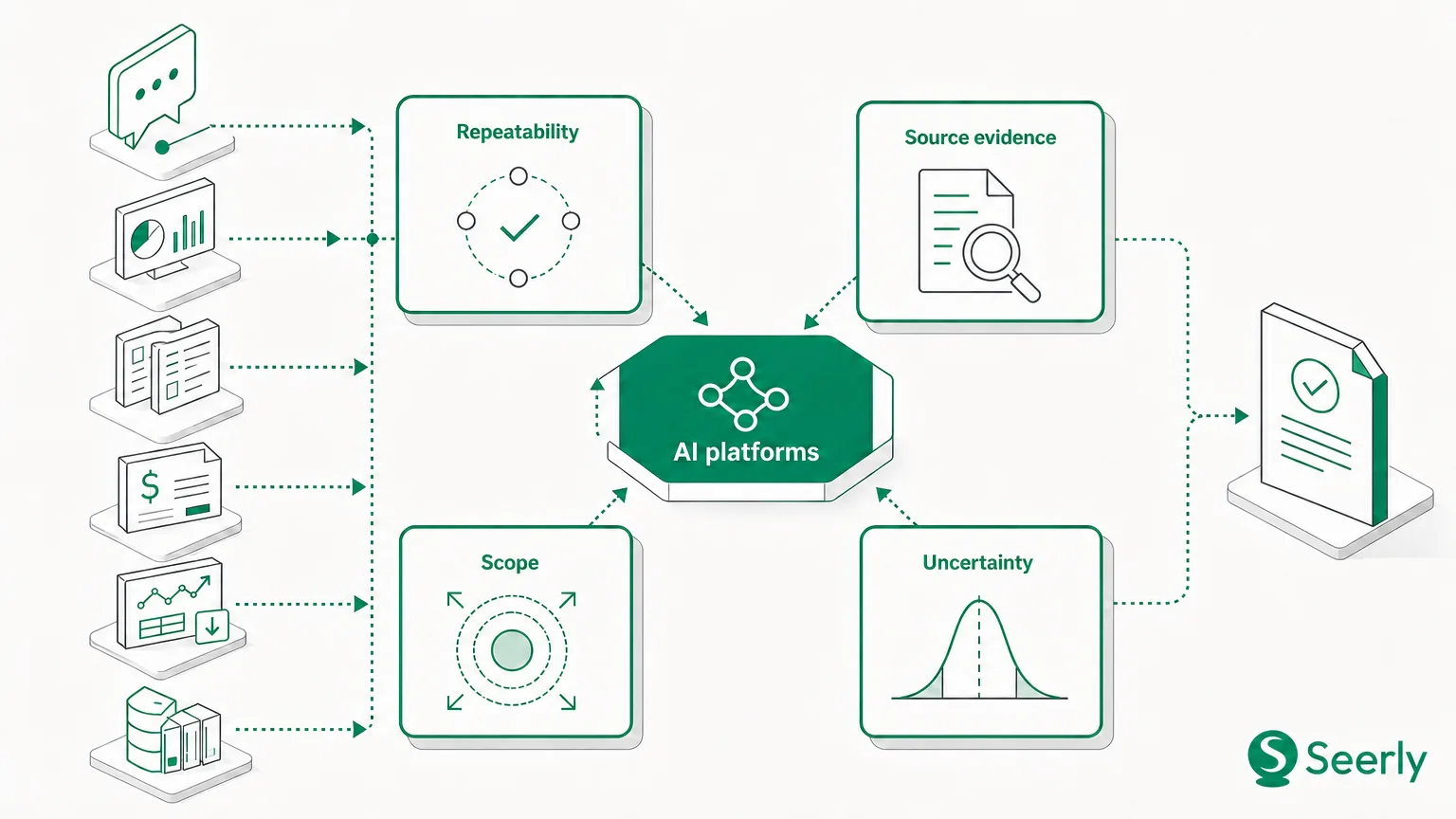
That is why the better question is not whether rankings still matter, but what should marketing teams track besides rank tracking to measure AI visibility? The answer is a broader reporting framework: visibility rankings across AI environments, citation behavior, trust signals, brand entity recognition, and prompt-level validation. Together, these metrics give marketing leaders a clearer way to evaluate whether AI search work is improving discoverability and supporting business outcomes.
This guide outlines a practical model for AI search performance reporting. It is designed for marketing teams, agencies, and brand managers who need an executive-ready way to explain progress internally without relying on incomplete SEO-era indicators.
Why rank tracking falls short in AI search discovery
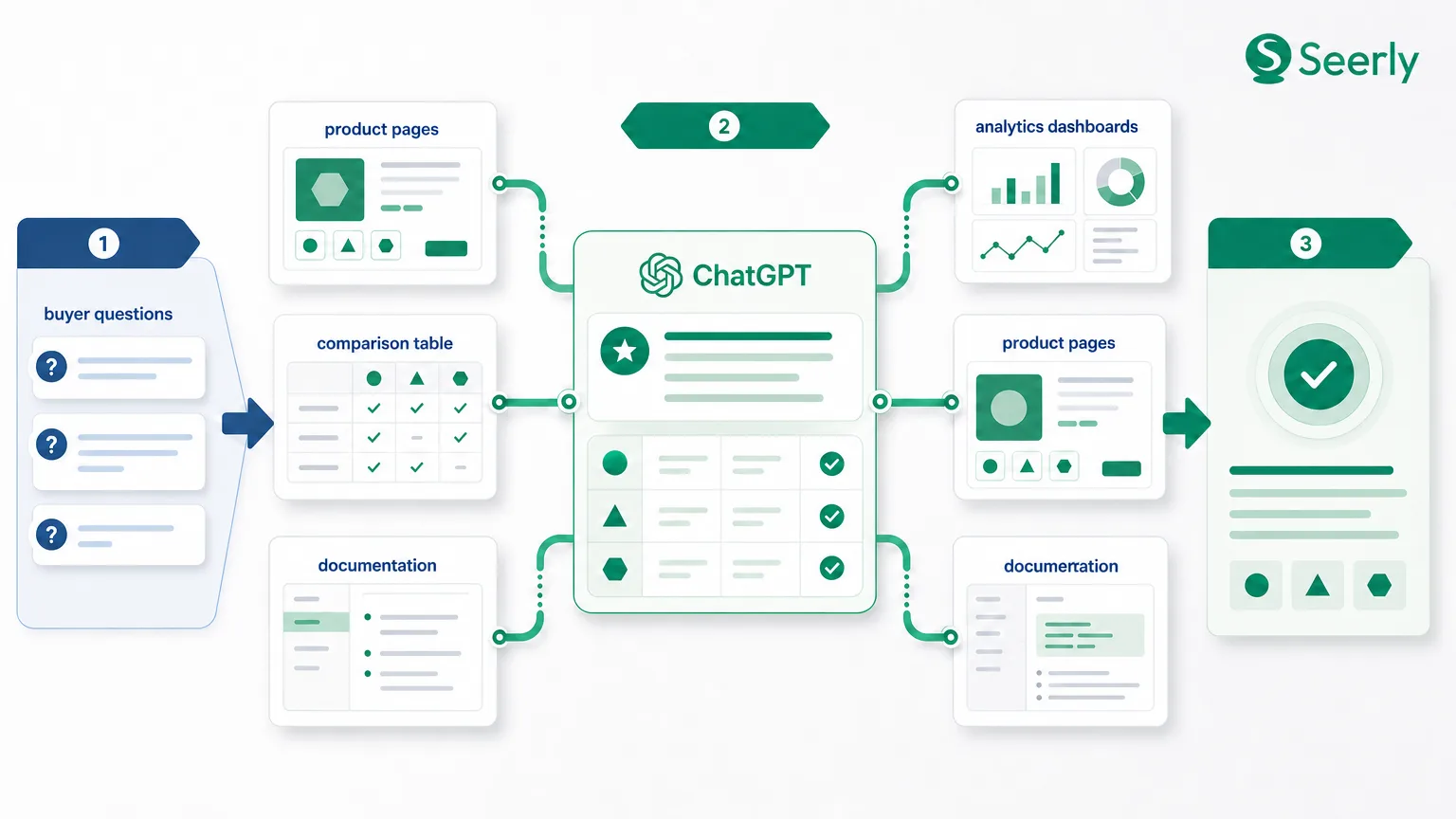
Classic rank tracking assumes a familiar search journey: a user enters a query, receives a list of links, and clicks one of the top results. AI search systems compress that journey. Instead of ten blue links, users increasingly receive synthesized answers, recommendations, summaries, and cited sources. In that environment, brands are judged not only by where they rank, but by whether they are included, referenced, and trusted.
This shift is not theoretical. Reporting guidance from Semrush notes that AI visibility measurement now needs to account for citation share, presence in AI answers, and branded mention patterns, not only organic positions, because answer engines may mention brands even when they do not hold a top classic ranking for the underlying query. Their framework for measuring AI visibility beyond conventional rankings reflects how discovery has become less linear and more answer-mediated.
The problem for marketing teams is that rank trackers were built for URL positions, not answer inclusion. An AI system may summarize your category using competitor language, cite a third-party source instead of your own site, or mention your brand name without driving a visible click. Traditional SEO reports often miss all three outcomes. That creates a reporting gap: teams may be improving presence in AI-generated discovery while leadership sees no obvious signal in standard ranking charts.
This is also why AI visibility should be treated as its own measurement discipline, not as a light extension of legacy reporting. On Seerly’s own resource base, the distinction between search rankings and AI answer presence is already central to tracking AI search visibility as a separate performance layer. The underlying issue is simple: if the search interface changes, the reporting model has to change with it.
What should marketing teams track besides rank tracking to measure AI visibility?
The most effective answer is a three-layer framework. Marketing teams need proactive monitoring of brand presence, prompt-level validation of how AI systems interpret their content, and ongoing measurement of trust and reputation signals that influence answer inclusion over time. Looking at only one of these layers produces partial visibility. Looking at all three creates a usable operating model.
1. Proactive monitoring of AI search discovery
The first layer measures whether your brand appears across AI surfaces at all. This includes answer box presence, inclusion in summaries, citation frequency, and repeat visibility across multiple providers. A useful reporting system should not ask only, “What do we rank for?” It should also ask, “Where are we being surfaced, in what context, and how consistently?”
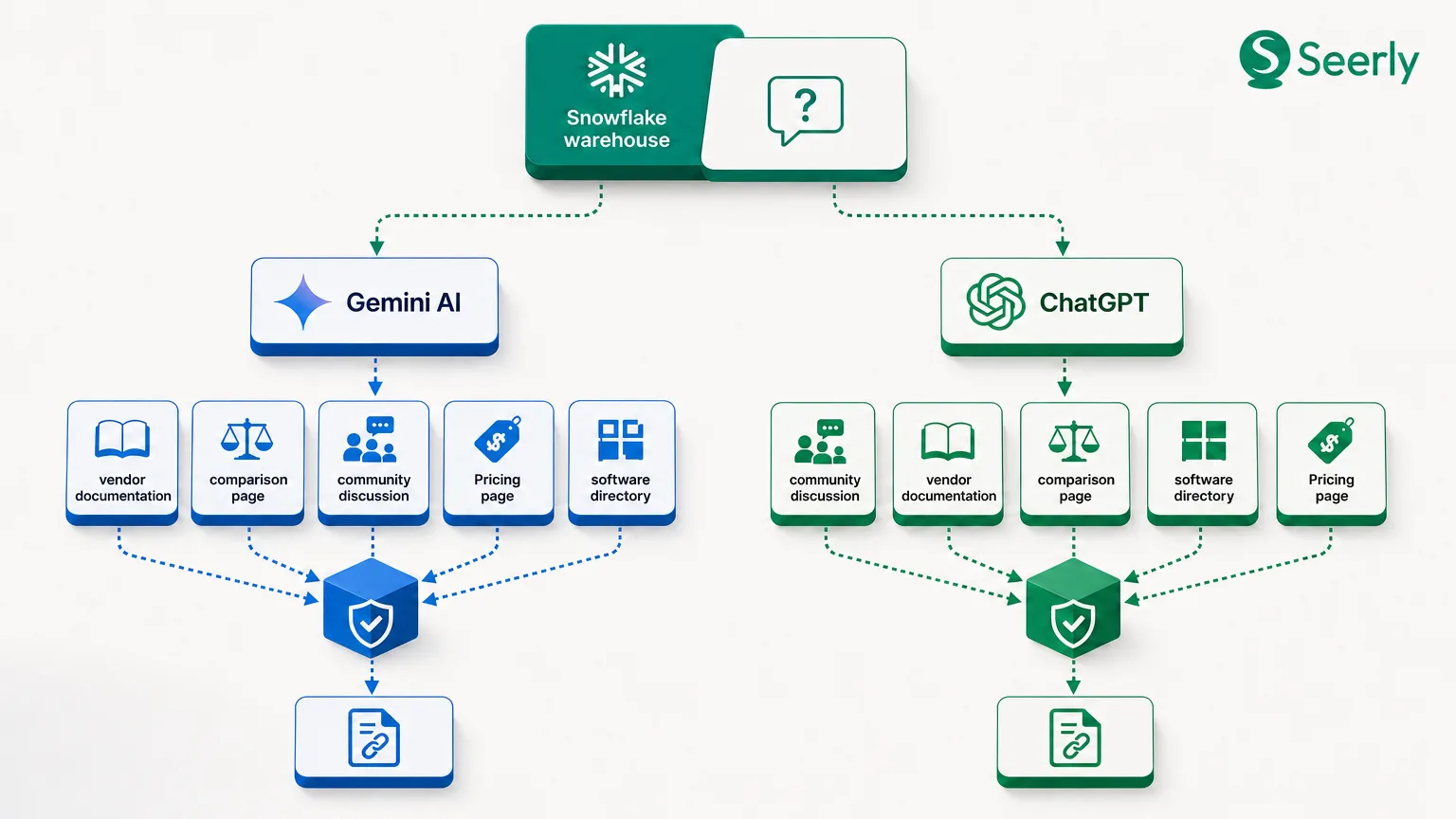
This matters because AI discovery is fragmented. Different providers can produce different recommendations for the same category prompt. A marketing team might be cited in one environment and omitted in another. That is why repeat visibility across providers is a more meaningful KPI than a single rank snapshot. If a brand appears consistently across multiple AI systems, it suggests stronger entity recognition and broader authority signals.
2. Prompt testing and validation
The second layer evaluates whether AI systems actually understand your content. This is the reporting discipline many teams skip, but it is essential. Prompt testing is not just research for content teams; it is evidence of whether changes in site structure, copy, supporting content, and authority signals are improving answer inclusion and citation quality.
A dashboard built for this purpose should track prompt coverage over time: how often your brand appears for priority commercial, comparative, educational, and category prompts. If leadership asks, “Which dashboard helps marketing teams report AI search visibility to leadership?” the answer should be: one that translates prompt-level outcomes into trend lines, not one that simply republishes old ranking data. A practical example of this reporting logic appears in a model AI search reporting dashboard built around visibility, mentions, and outcomes.
3. Data-driven management of trust and brand reputation
The third layer focuses on why inclusion happens. AI systems often rely on signals that imply authority, consistency, and credibility. Marketing teams should therefore measure the inputs that support brand reputation and trust, not just the final appearance outcome. These include third-party citations, authoritative references, structured brand consistency, and the broader pattern of mentions associated with the company.
This becomes especially important as AI-mediated brand perception grows. Akamai’s 2026 brief on AI brand presence argues that brand presence in AI systems is becoming an operational reputation issue, not just a traffic question. For marketing leaders, that means visibility rankings should sit beside trust signal acquisition and sentiment-oriented mention monitoring in the same reporting structure.
The KPIs that matter more than rankings alone
Once teams adopt this broader framework, the next question is which metrics belong on the dashboard. The most useful KPIs are the ones that show inclusion, authority, consistency, and movement over time.
AI citation velocity
AI citation velocity measures how often and how quickly your content or brand begins appearing as a cited source across tracked prompts. This helps teams distinguish between static visibility and momentum. If citations increase after content updates, digital PR wins, or structural improvements to AI-ready websites, the change suggests that AI systems are finding your materials more usable or trustworthy.
Trust signal acquisition
Trust signal acquisition tracks the external and on-site indicators that strengthen perceived authority. This can include earned mentions, publisher references, product review coverage, and structured credibility assets. For many teams, this KPI belongs next to classic off-page authority reporting because AI systems frequently rely on corroborating sources, not just on-page optimization. Seerly’s related analysis of how trust signals are changing in Google AI search is especially relevant here.
AI answer box presence
This KPI measures whether your brand is present in AI-generated summaries, recommendations, or answer modules for target prompts. It is often the clearest executive-facing measure because it reflects actual user-facing discovery, not a behind-the-scenes assumption. A brand can hold decent organic rankings and still have weak answer box presence. When that happens, the reporting story should show the gap clearly.
Brand entity recognition
Brand entity recognition measures whether AI systems correctly identify your company, category, attributes, and associations. This matters because a brand that is poorly understood by the model may be omitted from relevant answers even when its content is technically strong. Research into LLM behavior and ranking consistency has shown that answer selection patterns can vary substantially based on retrieval and interpretation choices, which makes entity clarity a meaningful reporting dimension.
Prompt coverage
Prompt coverage tracks how many of your priority prompts produce inclusion, mention, or citation. This should be segmented by intent type: branded, non-branded, comparison, problem-aware, and purchase-adjacent prompts. Coverage is one of the best ways to move from anecdotal screenshots to a repeatable reporting model. If a team improves from 18% to 41% coverage across tracked prompts, leadership can understand that as measurable progress.
Repeat visibility across providers
No single AI provider gives a complete picture. Repeat visibility across providers measures whether your brand appears consistently in multiple AI environments. That matters because buyers do not all use the same interface. Consistency across providers is often a better proxy for durable authority than isolated wins in one system. It also reduces the risk of over-reporting progress from a narrow sample.
How prompt testing proves impact over time
Prompt testing belongs inside reporting because it validates whether optimization work changes outcomes in the environments that matter. Without testing, teams can say they published better content or improved site structure. With testing, they can show that those changes led to stronger inclusion, more accurate summaries, or higher-quality citations across tracked prompts.
This is especially important because AI systems do not evaluate pages in exactly the same way as classic search engines. They may synthesize across sources, compress brand attributes, or choose a third-party citation over a first-party page. Prompt testing reveals whether your site is supplying language, evidence, and trust signals that are actually making it into answers. In practice, that means recording baseline visibility for a set of prompts, implementing improvements, and then comparing inclusion and citation patterns over time.
For teams wondering which is the best tool to monitor my brand's presence in AI chats, the answer depends on whether the platform supports more than screenshots. A useful system should store prompt histories, compare providers, detect changes in mentions or citations, and show trends. Several platforms now address parts of this need. For example, AI brand monitoring tools focus on tracking generated mentions and visibility changes, while broader mention platforms such as brand monitoring systems built for web-wide conversation tracking can complement AI-specific analysis. Some teams also explore vendors in the emerging category of AI visibility monitoring, including specialized AI search analytics companies, but the key requirement is the reporting model, not just the vendor label.
A related issue is data reliability. Academic work on LLM evaluation and retrieval variation indicates that model outputs can shift meaningfully across prompts and system configurations. That is exactly why prompt testing has reporting value. It creates a structured sample, reduces anecdotal interpretation, and helps teams separate one-off appearances from repeatable visibility.
Connecting AI visibility to business impact
AI search performance reporting becomes valuable when it helps leadership connect visibility to commercial outcomes without overstating causation. Better AI visibility can support brand authority, strengthen qualified traffic patterns, improve the quality of sales conversations, and increase inclusion in buyer shortlists. But teams should report this as contribution and correlation, not as a simplistic one-to-one revenue claim.
A practical model is to connect upstream and downstream metrics. Upstream metrics include prompt coverage, answer presence, citation velocity, and trust signal acquisition. Downstream indicators include branded search lift, higher direct traffic from informed buyers, better conversion rates on category pages, and improved sales feedback on market awareness. This is the same logic behind reading organic lift after AI mentions as a directional signal rather than a standalone proof point.
Consumer trust data supports the importance of this connection. Brandwatch research found that consumers are increasingly influenced by digital brand perception signals during decision-making. In AI-mediated discovery, that influence can begin before a click ever happens. If a brand is repeatedly surfaced as credible and relevant, it enters the consideration set earlier. Reporting should reflect that strategic role.
What clients and leadership teams should be able to report
An effective AI visibility report should make progress legible to non-specialists. It should show whether the brand is appearing more often, being cited more credibly, and improving its presence across the prompts that matter to pipeline and perception.
At a minimum, reporting outputs should include progress snapshots, prompt coverage trends, citation monitoring, trust signal changes, and provider-level visibility comparisons. This is the answer to another common question: which platforms monitor AI-generated brand mentions? The best platforms are the ones that convert mention detection into an interpretable management view. A list of mentions alone is not enough. Teams need to know whether mentions are increasing, whether they are positive or neutral, whether they include source citations, and whether they occur on the prompts tied to commercial intent.
Leadership-ready summaries should also translate technical movement into strategic language. Instead of reporting only that “visibility increased,” teams should be able to say that answer box presence rose across high-intent prompts, citation quality improved, and trust signal acquisition expanded supporting authority. For organizations building a more mature reporting stack, Seerly’s perspective on moving beyond dashboards toward a layered AI visibility architecture offers a useful operating model.
FAQ
What should marketing teams track besides rank tracking to measure AI visibility?
They should track AI answer presence, citation velocity, trust signal acquisition, brand entity recognition, prompt coverage, and repeat visibility across providers. Those metrics explain whether a brand is being surfaced, cited, and understood in AI search discovery. Rank tracking can still be one input, but it is no longer the main reporting lens.
How is AI visibility reporting different from standard SEO reporting?
Standard SEO reporting centers on rankings, clicks, and page-level performance. AI visibility reporting focuses on whether AI systems mention, summarize, recommend, or cite your brand across prompts and providers. It also requires more validation because answer outputs can vary, meaning teams need prompt-level monitoring rather than only SERP position tracking.
How does prompt testing work in practice?
Teams begin with a set of priority prompts based on category, comparison, problem-aware, and branded intent. They capture baseline answer inclusion, citations, and brand framing, then retest after content, authority, or site improvements. Over time, this creates a measurable history of how AI systems interpret the brand and whether optimization work is improving outcomes.
Which dashboard helps marketing teams report AI search visibility to leadership?
The best dashboard is one that combines visibility rankings, prompt coverage, citation patterns, and trust signals into a leadership-readable view. It should show trends over time, not isolated screenshots. Executive teams need evidence of movement, consistency, and business relevance, not just lists of prompts.
Which platforms monitor AI-generated brand mentions?
AI-specific monitoring vendors and broader web monitoring platforms can both help, depending on the use case. The strongest option is usually a system that tracks generated mentions, provider-level visibility, prompt histories, and citation context in one place. The goal is not only to detect mentions but to understand what they mean for brand reputation and discovery.
Conclusion
AI search discovery has changed what performance reporting needs to prove. Rankings still matter, but they no longer explain whether your brand is being surfaced, cited, trusted, and repeated across AI-driven answers. Marketing teams that want a defensible reporting model should expand measurement to include prompt coverage, citation velocity, trust signals, entity recognition, and cross-provider visibility.
That is the difference between reporting old search mechanics and managing modern discovery. If your team needs a clearer framework for proactive monitoring and leadership-ready AI visibility reporting, Seerly is built around that measurement challenge.