How a schema markup validator reduces risk in AI visibility reporting
A schema markup validator can reduce meaningful risk in AI visibility reporting - but not because valid structured data automatically makes a brand more visible, cited, or recommended. That assumption confuses technical eligibility with discoverability. Structured data gives machines a clearer representation of what a page, organization, product, or location claims; it does not prove those claims, establish authority, or compel an AI system to use the page as an answer source.
Still, validation matters more now that marketing and analytics teams are comparing AI search discovery outcomes across multiple prompts, platforms, and reporting tools. At web scale, structured data is no longer a niche implementation detail: the 2024 Web Almanac’s structured-data analysis shows how widely schema vocabulary and JSON-LD are used across the web. The operational advantage is not “schema equals citations.” It is that consistent, machine-readable organization data reduces ambiguity before your reporting workflow tries to interpret visibility results.
For technical marketers, SEO managers, and analytics teams, that distinction is essential. Validate schema to make brand signals easier to ingest, reconcile, and audit - not as a shortcut around evidence, content quality, or third-party trust.
Validation is not the same as visibility
A schema markup validator checks whether your structured data is syntactically valid and whether its properties align with the vocabulary you declared. It can flag invalid JSON, unsupported property values, missing required fields for a rich-result feature, and mismatches in how a schema type is expressed. The Schema.org validator, for example, evaluates structured data against Schema.org vocabulary, while Google’s tools assess eligibility for Google-supported rich-result experiences.
That is useful, but it is a technical quality check - not a visibility guarantee. Google explicitly states that correct structured data does not guarantee rich results, because search systems still evaluate page quality, relevance, policy compliance, and many other signals. The same logic applies to AI answer sourcing: clean markup may help systems interpret a page, but it cannot make unsupported claims credible or make an irrelevant page the best answer.
The practical value is reliability. If an organization is represented as “Acme Analytics” in page copy, “Acme, Inc.” in Organization markup, and a differently named entity in a monitoring platform, the team has a reporting problem before it has an AI visibility problem. Validation helps remove avoidable technical inconsistencies so subsequent analysis is based on cleaner inputs.
The reporting risks a schema markup validator can reduce
Organization-level schema is most valuable when it creates a stable identity layer across your site. It should help machines connect your brand name, canonical website, logo, social profiles, and relevant pages without forcing them to infer which of several similar entities is being referenced.
Entity confusion
Entity confusion occurs when the same company is described in several incompatible ways. A short brand name may be shared by another business, a parent company may be confused with a product line, or a regional office may be treated as the organization itself. These issues are especially common when teams use different naming conventions in CMS fields, press materials, social accounts, and analytics dashboards.
Validation does not solve entity resolution across the entire web. It does, however, force a useful internal question: does every key organization page identify the same organization, website, logo, and official profiles? A consistent @id and canonical url provide a more durable reference point than a company name alone.
Inconsistent organization details
Seemingly minor differences can become reporting noise. An old logo URL, outdated customer-support email, previous headquarters address, or discontinued social profile may remain in markup long after the visible page has changed. Marketing teams may then see inconsistent brand details in crawls or tool outputs and spend time diagnosing a “visibility issue” that is actually a data-maintenance issue.
Google recommends providing accurate, up-to-date structured data that reflects the visible page. Treat that principle as a reporting control. If page copy and markup disagree, neither your technical team nor your analytics team has a dependable source of truth.
Malformed markup and silent implementation failures
A missing comma, unescaped quote, duplicate @context, or incorrectly nested object can invalidate an entire JSON-LD block. In other cases, the markup parses but uses properties on the wrong type, contains invalid URLs, or references an image that returns an error. These failures are often introduced during template changes, tag-manager edits, CMS migrations, or localization work.
A schema markup validator makes these problems observable before a crawler or downstream reporting process encounters them. Google’s Rich Results Test documentation also explains that the tool can identify structured-data issues for Google-supported features. Use it alongside Schema.org validation rather than assuming one checker covers every possible purpose.
Reporting mismatches between the page and tool ingestion
AI visibility reporting depends on careful interpretation. If a page says one thing, its structured fields say another, and an ingestion tool extracts a third version, teams can overstate errors or misattribute changes. A valid schema object will not make every tool extract information identically, but it narrows the range of avoidable inconsistencies.
This is where schema validation contributes to reporting trustworthiness. It helps teams document what the site intended to publish, verify that the implementation is accessible, and distinguish a genuine retrieval or answer-sourcing gap from a broken technical signal.
What to validate first on organization pages
Start with pages that establish the brand’s identity: the homepage, about page, contact page, location pages, and core solution pages. The goal is not to mark up every sentence. It is to ensure the organization data that anchors your reporting is consistent, factual, and connected to the pages where users can verify it.
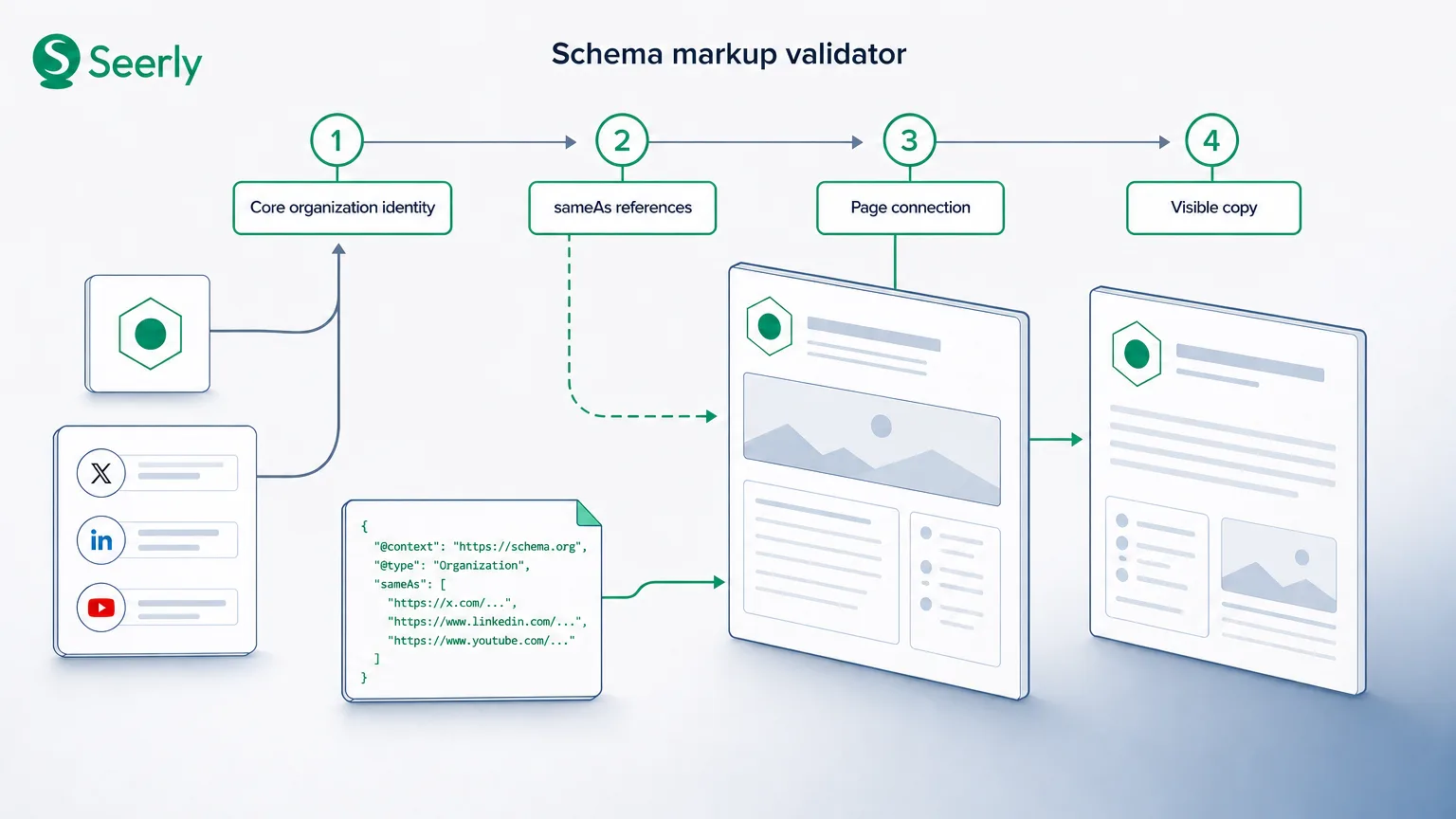
Step 1: Confirm the core organization identity
Review name, url, logo, description, and @id. The name should match the primary brand name used in visible navigation, title elements, and corporate communications. The url should be canonical, and the @id should be a stable identifier that does not change with campaign parameters, language variants, or temporary page paths.
For a business with physical locations, use the most specific legitimate type. A local business can use a relevant subtype when it accurately reflects the operation, but do not select a type merely because it appears more commercially attractive. Schema vocabulary is a semantic description, not a ranking tactic.
Step 2: Audit sameAs references
The sameAs field should link to official, maintained profiles that genuinely represent the organization. Do not include an employee’s account, an abandoned community page, a reseller profile, or every directory where the brand has ever appeared. Each URL is an identity assertion and should be reviewed with the same care as a canonical tag.
Check that each linked profile uses the same organization name, logo where possible, and website URL. When ownership or naming differs, document why. This prevents analytics teams from treating an intentional distinction - such as a regional brand account - as a markup defect.
Step 3: Connect the organization to the page being described
An organization object should not float independently from the page context. Use WebSite and WebPage relationships where appropriate, and ensure the page’s primary subject is clear. On a solution page, for example, the WebPage can identify the publisher or provider organization while the visible copy clearly explains the solution.
This relationship reduces ambiguity for internal auditing. It makes it easier to answer, “Which entity made this claim, and where can a user verify it?” That is a stronger reporting question than “Did we add enough schema?”
Step 4: Compare markup with visible copy
Perform a field-by-field comparison of the page and the JSON-LD. Pay particular attention to organization name, description, address, phone number, service area, logo, product claims, and social profiles. If a reader cannot find or substantiate a structured-data claim on the page or through an official source, revise or remove it.
A before-and-after validation pass
Consider a fictional local consultancy, Northstar Data.
Before validation, its homepage includes this pattern:
{
  "@type": "Organization",
  "name": "Northstar Data Inc.",
  "url": "https://northstardata.example",
  "sameAs": [
    "https://www.linkedin.com/company/northstar-data-old"
  ],
  "address": {
    "@type": "PostalAddress",
    "addressLocality": "Boston"
  }
}
The visible site calls the company “Northstar Data,” its current LinkedIn page uses a different URL, and the business moved from Boston. The markup may parse, but it creates conflicts with the page and official profiles.
After validation, the team updates the entity name, current profile, location, and stable identifier:
{
  "@context": "https://schema.org",
  "@type": "Organization",
  "@id": "https://northstardata.example/#organization",
  "name": "Northstar Data",
  "url": "https://northstardata.example/",
  "sameAs": [
    "https://www.linkedin.com/company/northstar-data"
  ]
}
The improvement is not a promise of richer results or AI citations. It is a cleaner, auditable identity signal that aligns with what the site actually presents.
Build a lightweight validation workflow
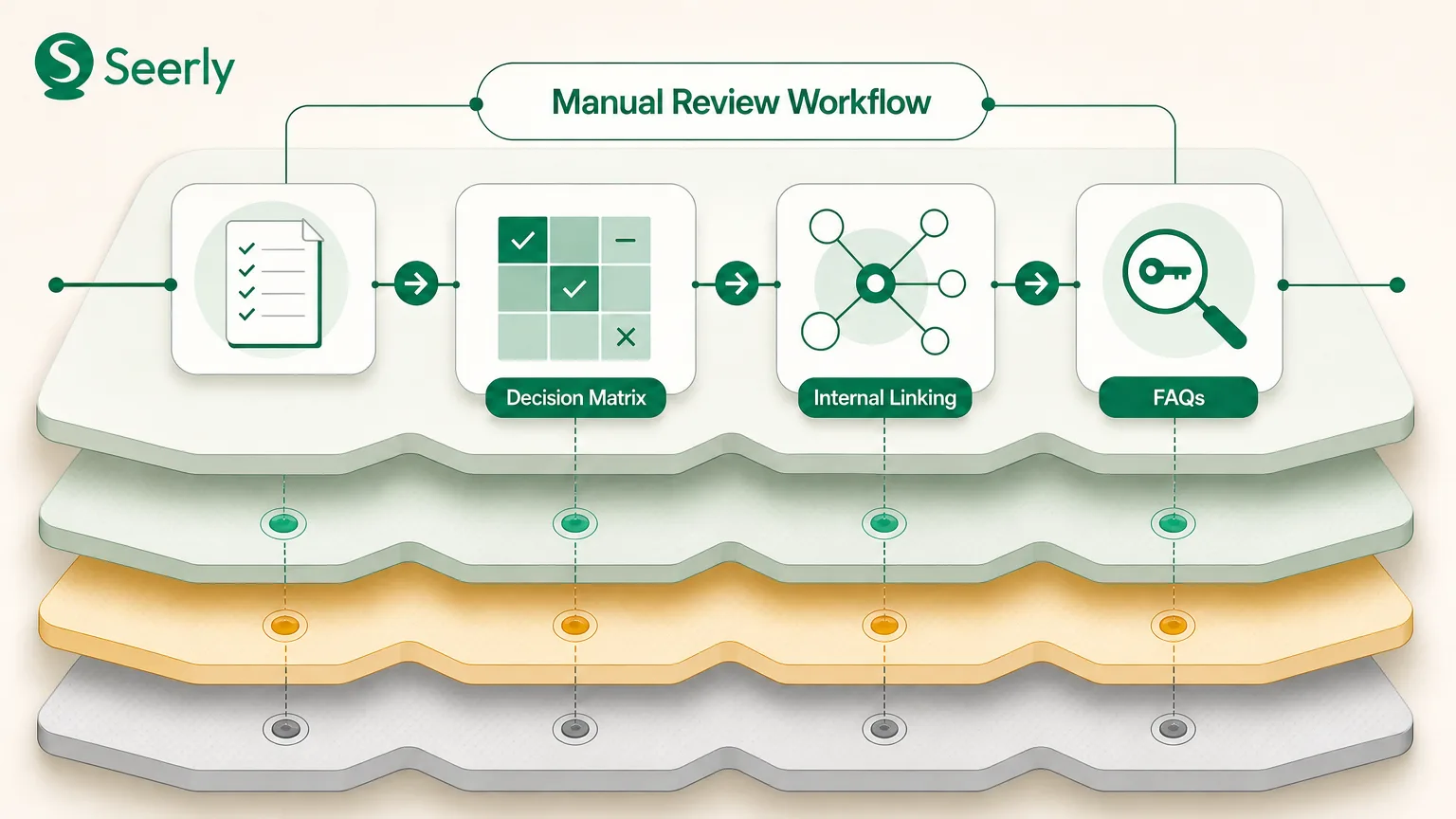
Schema reliability should be a shared publishing control, not a once-a-year technical cleanup. A lightweight workflow is enough for most teams if it has clear ownership and is applied to high-value templates.
Before publishing
Use this checklist for new organization, location, solution, and product pages:
-
Content owner: confirms that organization names, claims, contact details, and profile links match approved brand information and visible page copy.
-
SEO or technical owner: runs the JSON-LD through a schema markup validator, checks Google-supported enhancements where relevant, and verifies canonical URLs, image references, and page relationships.
-
Analytics owner: records the page URL, template type, implementation date, and material schema changes so later visibility movement is not interpreted without context.
-
Final reviewer: confirms that no structured field overstates proof, certifications, reviews, availability, or market position.
Each role should be able to identify what changed and why. That documentation matters when a visibility report later shows a difference in entity recognition, page extraction, or answer phrasing.
Monthly QA reviews
Run a monthly sample audit across core templates, then prioritize full checks after redesigns, CMS releases, domain changes, rebrands, and location updates. Google Search Console can surface structured-data reports and detected issues, but it should not be the only check. It reflects Google’s supported features and processing, while your broader QA should assess organization consistency across the site.
Keep a short change log with the affected page, schema type, field changed, validation status, and owner. This creates a defensible connection between technical implementation changes and reporting trends. For teams building more resilient technical workflows, Seerly’s engineering resources can help frame machine readability as part of an AI-ready website strategy rather than an isolated SEO task.
What validation does not solve
Validation cannot repair weak proof. If a solution page makes broad performance claims without methodology, customer evidence, documentation, or independent support, wrapping those statements in correct markup does not make them more trustworthy. The same applies to unclear positioning: machines cannot reliably resolve a brand’s category if the brand itself describes its offering inconsistently.
It also cannot create third-party trust signals. AI systems and search engines may rely on a range of sources and quality assessments, and valid on-page markup is only one input. For a deeper explanation of the distinction, see why schema markup does not automatically produce AI citations.
The strategic sequence is simple: establish accurate claims, publish verifiable evidence, maintain consistent entity details, then validate the machine-readable implementation. That approach reduces reporting uncertainty without overstating what schema can deliver.
FAQ
How often should schema markup be rechecked?
Recheck schema whenever a page template, CMS component, organization detail, location, product offering, logo, or social profile changes. In addition, run a monthly QA sample and a broader review after major site releases. High-value organization and solution pages deserve more frequent attention because small inconsistencies there can affect many downstream reports.
Does valid markup guarantee rich results?
No. Google explains that structured data must meet technical and quality requirements but still does not guarantee a rich-result display. Eligibility, indexing, relevance, and search-system decisions remain separate from validation. Use validators to remove defects, not to forecast a specific search appearance.
How does schema relate to AI answer sourcing?
Schema can make it easier for systems to interpret explicit details such as organization identity, page type, and relationships between entities. It does not determine whether an AI system retrieves, trusts, cites, or recommends the page. Answer sourcing depends on relevance, evidence, authority, freshness, and the system’s own retrieval and generation behavior.
Run a validation pass on your organization and core solution pages first. Then use Seerly to monitor whether cleaner machine-readable signals correspond with real changes in AI search discovery, citation patterns, and visibility outcomes over time.