Enterprise rank tracking: how to govern thousands of keywords without losing decision context
A rank-tracking programme can become less useful as it grows. When an enterprise monitors thousands of terms across countries, brands, devices, product lines, and agencies, a single “visibility” score may look authoritative while concealing the changes that matter most. A decline in a small but strategic product category can disappear inside broad portfolio gains. Conversely, routine movement across a large set can trigger work that has no material business value.
That is the central governance challenge of enterprise rank tracking: turning a large volume of search data into accountable decisions. The goal is not to create the largest possible keyword inventory or react to every position change. It is to ensure that every material movement can be interpreted in context, assigned to an owner, and evaluated against a defined business outcome.
This guide explains how enterprise SEO leaders, in-house teams, and agencies can build that system. It focuses on portfolio taxonomy, escalation thresholds, evidence standards, AI-search visibility reporting, and an operating rhythm that makes rankings useful for both practitioners and executives.
Why scale changes the rank-tracking problem
At a small scale, rank tracking is relatively straightforward. A team may monitor a few hundred high-priority terms, know the destination pages, and recognise which marketing manager or SEO specialist owns each category. At enterprise scale, that familiarity disappears. The same product can be represented by several keyword variations, multiple teams may target overlapping queries, and country-level priorities can conflict with global reporting.
Duplicate and near-duplicate terms are a common source of distortion. For example, “enterprise payroll software,” “payroll software for enterprises,” and “global payroll platform” may all serve similar commercial intent. Tracking each term is not inherently wrong, but reporting them as three independent opportunities can inflate apparent coverage and create false confidence. Teams need to distinguish between keyword-level measurement and decision-level reporting.
Location, device, and SERP composition also make a universal rank unreliable. Google’s own documentation explains that Search Console records impressions when a link appears in a result page, while position is based on the topmost position of a site’s result rather than a simple, universal placement for every searcher. Search performance metrics are therefore aggregated measures with important interpretation limits. A position change may reflect a different result layout, local market conditions, or a shift in which URL Google selected.
Large portfolios also expose ownership gaps. An agency may manage technical SEO, a regional team may own local content, a product group may approve page changes, and a central brand team may control messaging. If a ranking decline has no accountable owner, it will either be ignored or repeatedly discussed without a decision. If it has too many owners, the organisation can overcorrect before it understands the cause.
Finally, scale increases noise. Search results are dynamic because Google uses many ranking systems and signals to match content to a query and context. Google describes ranking as a process designed to surface relevant, useful results from many possible pages. That does not mean teams should disregard movement; it means they should separate expected variation from evidence that warrants investigation.
Design a portfolio taxonomy that reflects business decisions
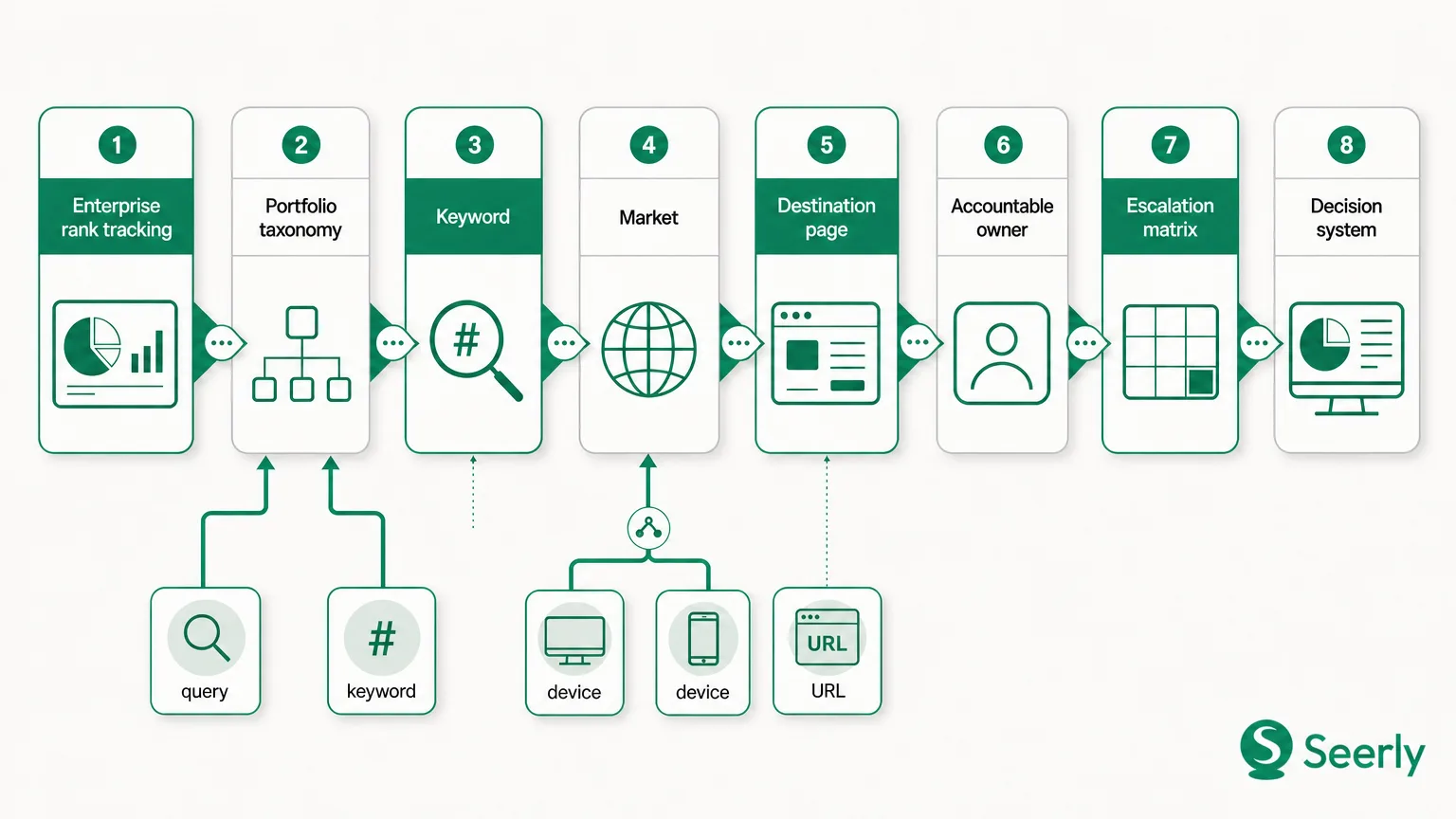
A useful enterprise portfolio is not merely a keyword list with tags. It is a governance model that answers three questions for every tracked query: why it matters, what page or experience it represents, and who can act when performance changes. Enterprise rank tracking tools should support segmentation, but teams must define the operational logic before they build dashboards.
Start with the business unit and accountable owner
Assign every tracked term to a business unit, market, and named accountable owner. The owner should be a role or team that can initiate a decision, not simply the person who exported the report. For example, a global SEO lead may own technical investigation, while a regional demand-generation manager owns approval for localised content updates.
Ownership should also include an escalation partner. A product-led query may need a product marketing owner, while a transactional query may require an ecommerce lead. This prevents rank-tracking reports from becoming passive status documents. When a significant movement occurs, the team already knows who can evaluate the commercial implications.
Add market, language, and localisation dimensions
Country and language should be separate fields, even where they appear similar. English-language searches in the United States, United Kingdom, Australia, and Singapore can have different competitors, terminology, product availability, and regulatory requirements. Likewise, Spanish-language content may serve Spain, Mexico, or broader Latin American markets but require different local intent assumptions.
Track the exact location and language configuration used for measurement. This matters because results can differ by geography, and because a query’s destination page may change between markets. Teams planning migrations should protect this history: a pre-migration ranking baseline helps distinguish a true visibility loss from a reporting discontinuity.
Classify product line, funnel stage, and search intent
The next layer should connect queries to the decisions the business needs to make. At minimum, classify terms by product line, funnel stage, and intent. A practical framework can use awareness, consideration, evaluation, purchase, retention, and support stages, alongside informational, commercial, transactional, navigational, and support intent.
These labels make it possible to identify meaningful patterns. A five-position decline in a support query may require no immediate action if the business goal is self-service coverage and the page still ranks prominently. The same decline in a category-defining commercial term could affect qualified demand and deserve escalation. Where multiple pages compete for the same intent, use a documented resolution process rather than asking teams to optimise everything at once; keyword intent conflicts often indicate that the portfolio needs a clearer primary page and purpose.
Create a decision-ready keyword record
Each tracked term should have a consistent record. The fields below create enough context for aggregation without making portfolio maintenance unmanageable.
| Field | Decision value |
|---|---|
| Keyword and query cluster | Preserves the exact term while linking close variants to one topic |
| Market, location, language, and device | Shows the conditions under which the rank was measured |
| Business unit and product line | Connects visibility to commercial responsibility |
| Funnel stage and intent | Differentiates research visibility from conversion-focused demand |
| Primary destination URL | Identifies the page expected to satisfy the query |
| Strategic tier | Defines the level of monitoring and escalation |
| Accountable owner | Ensures a named team can evaluate and act |
| Reporting group | Supports executive-level aggregation without losing detail |
This taxonomy should not be static. New products, changing search behaviour, acquisitions, and international expansion can alter the meaning of a keyword set. Treat taxonomy maintenance as an operating responsibility, not a one-time implementation project.
Set monitoring thresholds that distinguish action from routine movement
A rank change is an observation, not a diagnosis. The right threshold depends on the strategic importance of the query, the volatility expected in that SERP, the movement of competitors, and the business impact of the destination page. A blanket rule such as “investigate every three-position decline” generates too many alerts for volatile queries and too few for strategically important ones.
Start by placing each query cluster into a strategic tier. Tier 1 should include category terms, high-value solution pages, core markets, launch priorities, and queries with a strong relationship to pipeline or revenue. Tier 2 can cover meaningful supporting themes, while Tier 3 includes monitoring terms that provide market intelligence but do not justify immediate intervention.
Use an escalation matrix
The following example matrix illustrates how teams can turn rank movements into proportionate actions. The precise thresholds should be calibrated against each organisation’s historical volatility and commercial model.
| Signal | Typical context | Recommended response |
|---|---|---|
| One- to two-position movement within a stable ranking band | Non-strategic term or historically volatile SERP | Log and monitor; no action unless corroborated by other evidence |
| Loss of top-three or first-page placement for a Tier 1 query | Strategic commercial page, key market, or launch category | Escalate within the weekly triage; compare competitors, page selection, and SERP changes |
| Sustained decline across a query cluster for two or more review periods | Several related terms and URLs lose visibility | Open an investigation with SEO, content, and relevant business owner |
| Rank decline alongside traffic, conversion, or indexation change | High-business-impact page | Prioritise diagnosis and remediation; report expected impact and decision owner |
| Competitor gain on a stable, high-value SERP | Direct competitor displaces the enterprise page | Review competitor page type, content proposition, and SERP features before changing content |
Thresholds should include both absolute positions and relative changes. Moving from position 38 to 28 is encouraging, but it may have limited practical impact compared with moving from position 4 to 9 on a high-intent query. Click behaviour is highly concentrated near the top of results; CTR research shows that organic click-through rate varies sharply by ranking position. That is why strategic reporting should focus on meaningful ranking bands, not only average position.
Check the cause before changing a page
Before revising content, teams should check whether the movement is isolated or systemic. Compare the query against its cluster, inspect whether a different page is ranking, and determine whether major competitors moved at the same time. Review SERP features, localisation, and device differences, as a lost blue-link position may coincide with an expanded shopping module, local pack, video result, or answer feature.
This approach avoids a common enterprise failure mode: changing pages in response to a single data point. Good governance requires a documented hypothesis, a proposed action, and a clear success measure. It also preserves the ability to learn whether a change improved the intended business outcome or simply moved an isolated term.
Preserve the context behind a ranking change
A ranking event should be stored as an evidence package, not a line in a spreadsheet. Executives should not have to ask whether a reported decline occurred on mobile in one city, across all tracked regions, or because Google selected a different URL. Practitioners should not have to reconstruct the evidence weeks later when a page owner requests an explanation.
A worked example: diagnosing a category-page decline
Assume a global software company sees its “enterprise workforce management platform” cluster decline from positions 3-5 to positions 8-11 in the United Kingdom. The initial dashboard alert alone does not establish a problem. It indicates a material movement in a Tier 1 commercial cluster, which is enough to trigger investigation but not enough to prescribe a content rewrite.
The investigation record should include the measurement date and comparison period, United Kingdom location, English language, desktop and mobile results, query class, current and former destination URLs, and named owner. It should also capture the visible SERP context: whether an AI-generated result, paid placements, review sites, video modules, or competitors now occupy more prominent space. Where Search Console data is used, teams should remember that its query and page data can be filtered and grouped in multiple ways, making consistent reporting configurations essential; Google’s performance-data guidance explains how aggregation changes the way Search Console metrics should be interpreted.
The team may find that rankings declined only on mobile, the destination changed from a category page to a blog article, and two competitors improved after publishing comparison-focused pages. In that case, the likely decision is not “optimise the page” in the abstract. It may be to restore the category page’s relevance signals, resolve internal-link ambiguity, assess mobile experience, and brief the product marketing owner on the competitor content pattern.
The evidence package should also record related AI-search visibility observations separately. For example, the brand may still appear in AI-generated responses for evaluation prompts, but with a weaker or less prominent citation pattern than competitors. That observation can inform a content and credibility review, but it should not be translated into a conventional organic ranking or averaged into the same score.
Connect conventional rankings with AI-search visibility without combining unlike metrics
Leadership needs a complete view of discovery, but a combined score can create false precision. Conventional rankings measure placement for a defined query, search engine, location, device, and date. AI-search visibility measures whether and how a brand, page, or source appears in responses to a defined set of prompts or search experiences. They are related signals, not interchangeable measures.
Google describes AI Overviews as generated summaries that can include links supporting the information presented. AI Overviews may surface links to supporting web content, but appearing in those experiences is not the same as holding a particular organic position. Different prompt phrasing, source selection, response composition, and model behaviour can affect the result.
Report separate measures on the same cadence
The most useful executive report presents both measures with common reporting dates and shared business segments. For rankings, report coverage in key position bands, movement by Tier 1 cluster, page-level changes, and competitor comparisons. For AI-search visibility, report prompt coverage, brand mentions, citation presence, sentiment or representation patterns, and competitor visibility benchmarking.
The narrative should explain the decision implication. For example: “Organic visibility for the UK workforce-management category declined out of the top three for six Tier 1 commercial queries, driven by a category-page displacement on mobile. AI-search testing still identifies the brand in evaluation-oriented responses, but competitor citations appear more consistently for implementation questions. The proposed action is a category-page and supporting-evidence review, owned by the UK product marketing and SEO teams.”
This framing helps leaders avoid two mistakes: treating AI mentions as proof of organic performance, and treating strong organic rankings as proof that a brand is accurately represented in AI-generated answers. The reporting system should show the relationship while preserving the distinction.
Establish an operating rhythm for in-house teams and agencies
Governance works when the review cadence matches the speed and consequence of decisions. Daily reporting is rarely useful for every query, while quarterly reviews are too slow for serious Tier 1 visibility losses. Establish a rhythm that makes room for triage, learning, and strategic reprioritisation.
Weekly triage
Weekly triage should include the enterprise SEO lead, relevant analysts, and agency counterparts where applicable. Review only threshold breaches, unresolved investigations, technical incidents, major competitor movements, and imminent launches. Each item should leave the meeting with a status: monitor, investigate, act, or close.
The output is a short action register, not a broad report. It should identify the query cluster, market, affected page, evidence summary, owner, next action, and review date. This keeps agencies and in-house teams aligned on decisions rather than debating raw position data.
Monthly portfolio review
Monthly reviews should look for patterns that cannot be seen in weekly alerts. Examine whether one market is underperforming, whether a product line has declining first-page coverage, whether the tracked portfolio has grown without clear ownership, and whether multiple teams are targeting overlapping intent. This is also the right time to retire obsolete terms and add newly relevant clusters.
Executive reporting belongs here, but should remain selective. Report the business units and strategic themes that changed, the likely causes, actions underway, and risks requiring leadership decisions. Avoid presenting a single enterprise-wide average as the primary performance indicator.
Quarterly strategic reset
Quarterly, reassess taxonomy, strategic tiers, competitor sets, and measurement configurations. Product launches, changed commercial priorities, site restructures, and new markets can make an existing portfolio misleading. Review whether the tracked set still reflects the organisation’s current growth agenda and whether owners have the authority to act.
This is particularly important for agency-client handoffs. The agency should provide documented assumptions, query definitions, historical baselines, unresolved investigations, and access to evidence - not just a final dashboard export. The client should confirm business priorities, page ownership, approval paths, and success measures for the next quarter.
Frequently asked questions
Who should own enterprise rank tracking?
The central SEO or digital performance team should own the measurement framework, taxonomy standards, and escalation process. However, it should not own every corrective action. Business-unit leaders, regional marketers, product teams, content owners, and agencies need explicit roles based on the page and commercial objective involved.
How many keywords should an enterprise track?
Track enough queries to represent strategic products, markets, funnel stages, and customer language, but do not treat volume as a quality measure. A keyword should remain in the active portfolio only if it supports a decision, a performance benchmark, a launch, or market intelligence. Broader discovery lists can be maintained separately from the governed reporting set.
When should a team act on a ranking drop?
Act when the movement crosses a defined threshold and is supported by context. The strongest triggers combine a Tier 1 query or page, a meaningful position-band loss, persistence across review periods, competitor movement, and a likely business consequence. A single isolated decline without corroborating evidence is usually a monitoring event, not an optimisation mandate.
Turn rank tracking into a decision system
Enterprise rank tracking becomes valuable when teams stop treating every keyword as equally important. A governed portfolio links each query to a market, intent, product line, destination page, strategic tier, and accountable owner. Thresholds then determine which changes deserve attention, while evidence packages prevent premature conclusions.
Start with one business unit rather than rebuilding the whole programme at once. Apply the taxonomy and escalation rules to its current tracked set, test the weekly triage process, and refine the thresholds using real decisions. Then use Seerly to bring rank, prompt, and citation evidence into the same review cadence - so search visibility reporting supports accountable action rather than another undifferentiated dashboard score.