How to validate AI-assisted SEO gains before calling them sustainable
AI for SEO can make a content team faster, but speed is not evidence of sustainable performance. A page may gain impressions after an AI-assisted rewrite because it covers more queries, uses clearer headings, or simply benefits from a changing search landscape. That same page can still lose qualified visitors, introduce unsupported claims, weaken the brand’s expertise, or become less useful to the audience it was meant to serve.
The stakes are higher as search journeys change. Google states that the same core SEO foundations apply to its AI search features, including crawlability, helpful content, and clear structured information; there is no separate technical shortcut for appearing in AI features. Meanwhile, users are less likely to click traditional search results when an AI summary appears, which means rankings and raw traffic alone are increasingly incomplete measures of content value.
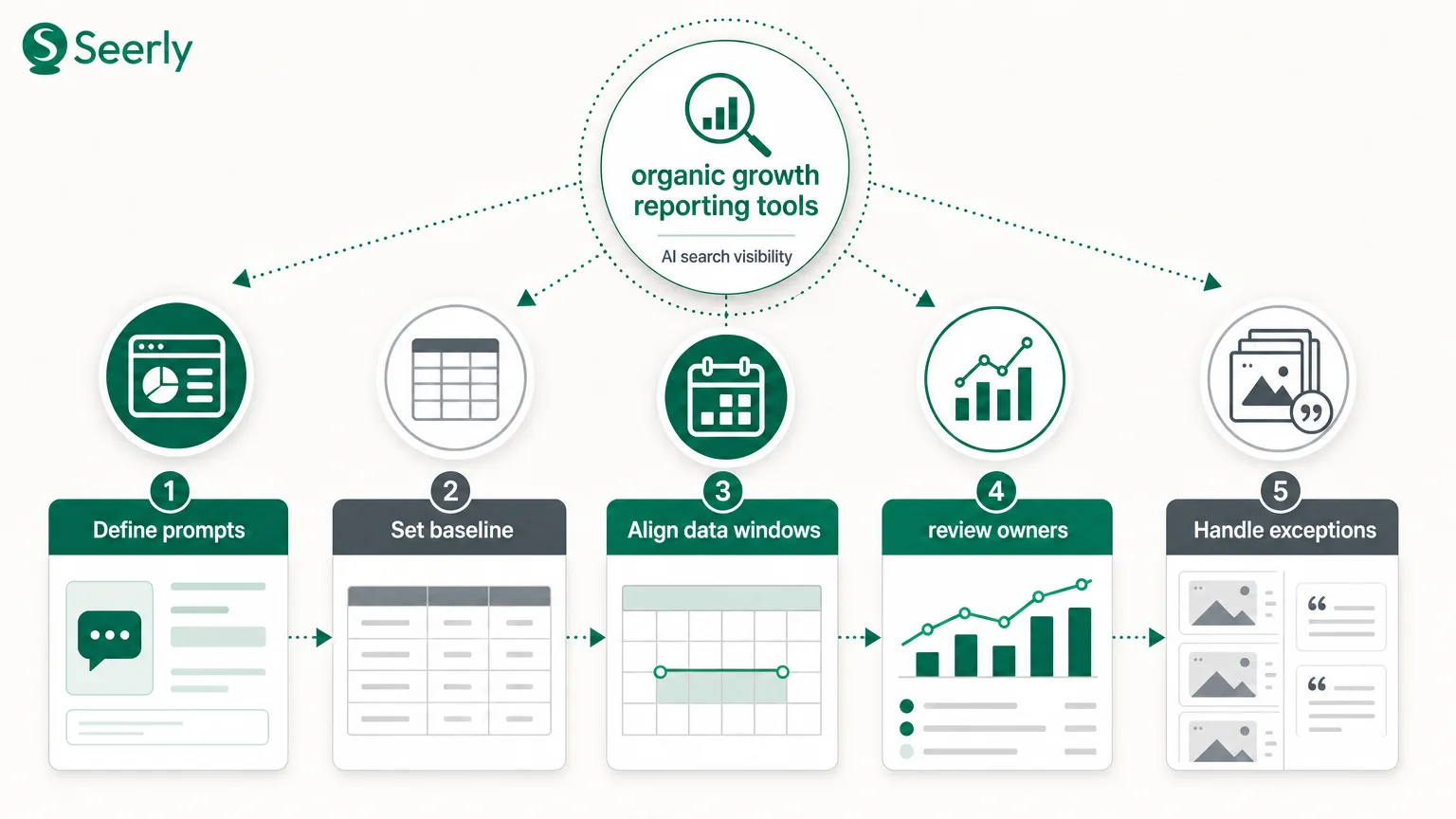
A responsible AI-assisted SEO workflow should therefore operate as a documented experiment. Before expanding a process, teams need a baseline, a specific hypothesis, quality controls, and a defined period in which to review results. The goal is not to prove that AI produced more pages. It is to prove that a carefully reviewed AI-assisted change improved discoverability and business outcomes without reducing trust.
Identify the claim your team is trying to prove
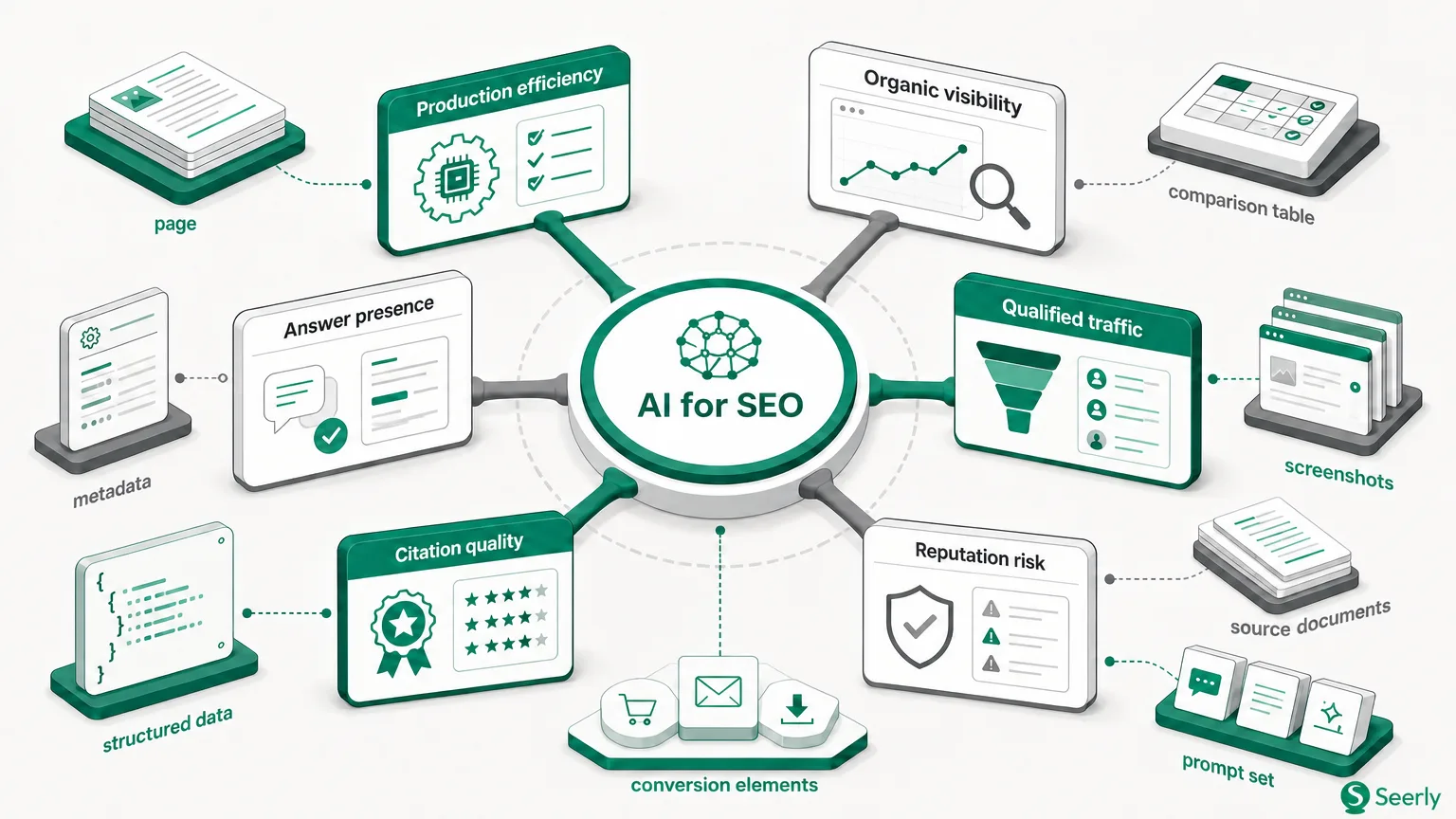
Before changing a page, define success in one sentence. “Use AI to improve SEO” is not a testable claim because it combines several outcomes that may move independently. A faster drafting process may improve production efficiency without improving organic visibility. A rise in impressions may not create qualified traffic. A page may be quoted in AI-generated answers while still presenting an inaccurate or poorly supported version of the brand.
The worksheet below separates the outcomes that marketing teams and agencies should evaluate. Choose one primary claim for each test, then add one or two guardrail metrics that must not deteriorate. This creates a decision framework that is useful for both a single high-value page and a wider content programme.
| Outcome to validate | Testable claim | Primary evidence | Guardrail to monitor |
|---|---|---|---|
| Production efficiency | AI assistance reduces the time needed to produce a review-ready update. | Brief-to-approval hours, revision rounds, editorial capacity. | No increase in factual corrections or reviewer workload. |
| Organic visibility | The revised page earns stronger visibility for its intended query set. | Impressions, average position trends, ranking distribution and relevant query coverage. | No loss of visibility for high-intent queries the original page already served. |
| Qualified traffic | The page attracts visitors who match the intended audience need. | Engaged sessions, conversion paths, assisted conversions and lead quality. | No increase in irrelevant query traffic or rapid exits. |
| Answer presence | The brand or page becomes more present in relevant AI-search responses. | Prompt performance tracking across a documented set of questions and regions. | Answers must represent the brand accurately and link claims to support. |
| Citation quality | The page contains material that can be responsibly cited or quoted. | Verifiable sources, named authors, original evidence and clear claim-to-source mapping. | No unsupported statistics, vague attribution or copied consensus language. |
| Reputation risk | The change preserves trustworthy, audience-appropriate brand representation. | Expert review, sentiment monitoring, complaint patterns and claim audits. | No legal, compliance, product or brand escalation. |
A good primary claim is narrow enough to be disproved. For example: “Adding an expert-reviewed comparison table and source-supported definitions will improve non-brand impressions for three decision-stage queries within 60 days, while maintaining demo-request conversion rate.” That is materially different from “rewrite the article with AI and see what happens.”
This distinction matters because AI-generated content is not inherently rewarded or penalised based on its origin. Google’s guidance emphasises that generative AI can support research and structure, but using it to create many pages without adding value may violate spam policies. The practical implication is clear: treat AI as part of the production method, not as proof of quality. The page still needs an identifiable purpose, demonstrated experience or expertise where appropriate, and information readers can verify.
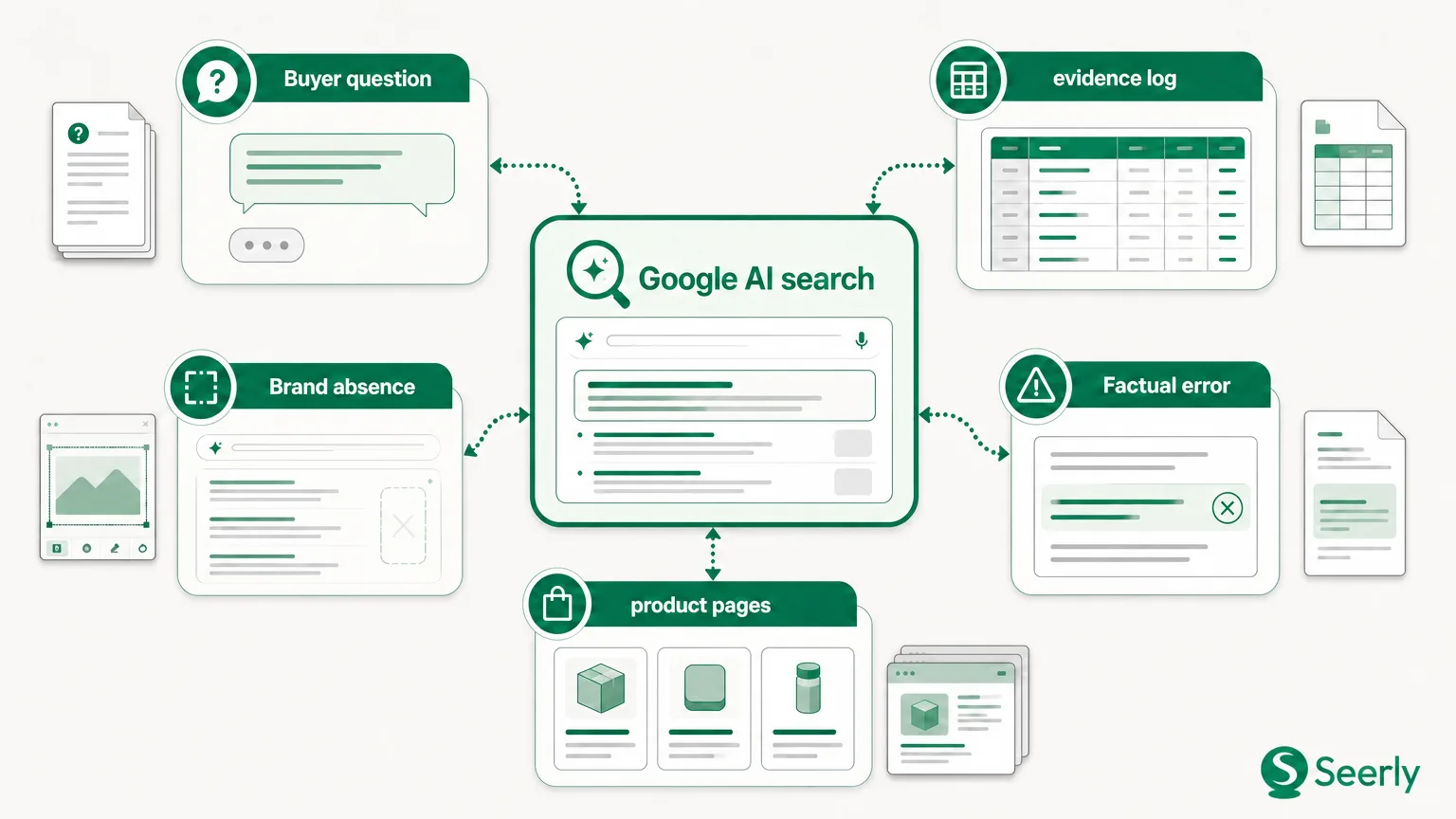
For answer presence, avoid treating a single AI response as a result. AI answers can differ by prompt wording, location, user context, model version, and retrieval state. Build a small prompt set that reflects actual customer questions, such as “What should a marketing team measure before scaling AI content?” Record whether the brand appears, whether it is cited or linked, what claim it is associated with, and whether that representation is accurate. This is the kind of evidence that turns AI search visibility into an operational metric rather than an anecdote.
Establish a defensible baseline
A baseline is the record of what was true before an AI-assisted change. Without it, a team cannot separate the effect of a rewrite from seasonality, an algorithm update, a campaign launch, an indexing issue, competitor changes, or a general shift in search demand. It is also the most reliable way to prevent a visually improved page from quietly losing its original conversion role.
Record the page’s job before editing it
Start with the page’s intended purpose. Is it designed to educate an early-stage researcher, support a product evaluation, capture a demo request, retain existing customers, or serve as a reference source for journalists and AI systems? Write down the audience need in plain language, then identify the action a successful visitor should take next.
Next, preserve the current version of the page. Save the copy, title, metadata, headings, internal links, structured data, screenshots, author details, publication and update dates, and conversion elements. If an agency is managing the work, store these assets in a shared experiment record rather than in an individual contributor’s workspace. A baseline that cannot be inspected later is not defensible.
Capture performance and conversion context
Use a fixed lookback window, typically the previous 28, 60, or 90 days depending on traffic volume. Record impressions, clicks, click-through rate, average position, relevant queries, landing-page sessions, engagement, and conversions or assisted conversions. Segment branded and non-branded traffic, and distinguish the target query cluster from incidental traffic that happens to reach the page.
Do not interpret average position in isolation. A page can appear to improve because it gained impressions for many low-ranking queries, while losing visibility for the few commercial queries that matter. Likewise, a traffic increase can be misleading if the page’s next-step conversion rate declines. For a fuller measurement approach, connect page-level search signals to business outcomes using an AI visibility and organic traffic KPI reporting model rather than treating search-console metrics as the final result.
Audit sources and existing brand claims
Before an AI-assisted rewrite, list the substantive claims in the current page: statistics, product comparisons, pricing statements, legal or health-related guidance, performance assertions, customer outcomes, and definitions that could influence a buying decision. For each claim, record its source, publication date, source type, and whether the page explains the relevant limitations.
This matters because an AI rewrite can accidentally make a qualified statement sound universal. “Many teams see faster review cycles after standardising briefs” is different from “AI reduces review time.” The latter requires evidence, context, and a definition of what counts as review time. A claim audit also helps experts review the highest-risk statements first instead of proofreading every sentence with equal effort.
Worked example: an AI-assisted refresh of a comparison page
Imagine a B2B software company has a comparison page that ranks between positions 8 and 14 for a group of category queries. The page earns 1,800 organic clicks and 24 demo requests in the previous 60 days. Its content is useful but inconsistent: definitions are thin, several claims lack current sources, and the product comparison table does not explain who each option is best for.
The team proposes using AI to identify missing subtopics, draft a clearer information architecture, and create first-pass comparison copy. Before publishing, the product marketer verifies every product claim, a subject-matter expert adds decision criteria based on customer conversations, and an editor removes generic language. The baseline records the 24 demo requests, the query set, the existing conversion path, 17 substantive claims, and the five sources supporting them.
The experiment claim becomes: “A source-verified, expert-reviewed decision framework will improve qualified non-brand organic traffic and preserve demo-request conversion rate over 60 days.” Notice that the claim does not credit the AI tool. It credits a documented content change. That is the level at which teams can make useful decisions.
Test one meaningful change at a time
When a page changes in five ways at once - new copy, a new template, fresh links, revised calls to action, and a different title - teams cannot credibly identify what affected performance. For high-stakes pages, make one meaningful intervention per review cycle. If several changes must ship together, label the result as a package test rather than attributing gains to AI-generated copy alone.
Use an experiment template
Create a record that every stakeholder can understand and review:
| Experiment field | What to document |
|---|---|
| Page and audience | URL, page type, funnel stage, target user need and priority query cluster. |
| Change | A precise description of what changed, including the AI-assisted tasks and human review steps. |
| Hypothesis | The predicted outcome, the metric expected to move, and the reason it should move. |
| Baseline | Time period, performance metrics, conversion context, source audit and saved page version. |
| Review plan | Start date, 30-, 60-, and 90-day review dates, plus known events that may affect results. |
| Owner | Named content owner, SEO owner, subject-matter reviewer and final approver. |
| Decision rule | The threshold for keeping, revising or rolling back the change. |
For example, a decision rule could be: keep the update if non-brand clicks rise by at least 15% against the baseline and conversion rate remains within an agreed tolerance; revise if impressions rise but engaged sessions fall; roll back if expert review identifies an unsupported high-impact claim or if conversion performance falls materially without another explanation. The numbers should reflect page volume and business value. A low-traffic page may need a longer observation period, while a high-traffic commercial page may justify a more formal split test.
Use control pages where practical
A control is a comparable page that does not receive the tested change during the same period. It will not eliminate every variable, but it gives context for broad demand shifts and sitewide events. A sensible control page has a similar topic, traffic range, intent, and conversion role. Avoid comparing a seasonal how-to article with an evergreen product page.
Where a true control is impossible, compare the page against its own historical trend and the wider query category. Record confounders such as a new paid campaign, an email promotion, a site migration, a major product announcement, or a search feature rollout. Google recommends focusing on users and helpful content rather than attempting to optimise specifically for AI features, so a review should ask whether the page became more complete and usable - not whether it matched an assumed AI-ranking formula.
One source of noise is the changing relationship between search visibility and clicks. Research on AI Overviews has found that their presence can reduce clicks to traditional organic results, although impact varies by query and layout. This is why an experiment should report impressions, clicks, conversions, and answer presence together. A decline in clicks may reflect a changing results page, but it does not excuse weak content or remove the need to assess whether the remaining traffic is more qualified.
Review quality alongside growth
Traffic growth becomes risky when it is driven by vague, overbroad, or sensational content. AI can make it easier to expand topic coverage, but it can also make unsupported claims sound confident and make distinct pages converge on the same generic language. A durable SEO review therefore needs quality indicators that sit beside performance metrics, not beneath them.
| Quality area | Healthy signal | Warning sign | Review action |
|---|---|---|---|
| Source support | Important claims link to relevant, current and authoritative evidence. | Statistics, quotes or comparison claims cannot be traced to an original or reliable source. | Remove, qualify or substantiate the claim before scaling. |
| Factual accuracy | Expert reviewers confirm product, legal, technical and market statements. | AI-generated wording changes the meaning or certainty of a fact. | Escalate to the appropriate subject-matter owner. |
| Expert review | A qualified reviewer materially contributes where expertise affects trust. | Review is limited to grammar and formatting. | Add domain review and document decisions. |
| Engagement quality | Visitors progress to relevant sections, internal resources or conversion actions. | More visits, but poor engagement and no evidence of audience fit. | Reassess query targeting and page purpose. |
| Citation readiness | Definitions, evidence and original insights can be quoted without losing context. | Claims rely on filler language, unattributed consensus or unclear authorship. | Add sources, author context and explanatory qualifiers. |
| Audience-fit language | The page uses the terminology, constraints and decisions of its intended reader. | Generic copy could apply to any company or buyer. | Add real questions, examples and expert perspective. |
Citation readiness is particularly important for AI-ready websites. A page does not need to be written “for robots,” but it should make its evidence easy to interpret: clear definitions, directly supported statements, transparent authorship, and useful context around data. Teams can learn more about structuring pages that answer engines can quote in this guide to writing answer-ready content without flattening brand voice.
Quality review should also include a reputation lens. Ask: would the sales team, customer success team, legal reviewer, or product lead stand behind this wording in a customer conversation? If the answer is no, a traffic lift is not enough. The page may be attracting attention by promising more certainty, simplicity, or capability than the business can substantiate.
Turn results into a repeatable workflow
An AI-assisted SEO workflow is ready to scale only after it has repeatedly met pre-agreed performance and quality thresholds across more than one page type. A successful refresh of a low-risk informational page does not automatically validate AI use on pricing, health, legal, financial, product-comparison, or reputation-sensitive content. Scale the proven process, not the assumption that every task is equally safe to automate.
Scaling checklist
Before expanding the workflow, confirm that the team can answer yes to each of the following questions:
- Has each test documented a page purpose, audience need, baseline period, specific change and named owner?
- Have the reviewed pages met their primary success criteria without failing conversion, quality or reputation guardrails?
- Can the team show a claim-to-source record for high-impact statements and identify who approved them?
- Have prompt performance and brand representation been reviewed for the queries where AI-search discovery matters?
- Is there a clear route for legal, product, compliance, or subject-matter escalation?
- Has the workflow been tested across enough pages and time to rule out one-off demand changes?
- Can the agency or in-house team reproduce the process without relying on undocumented individual judgement?
Documentation is not bureaucracy for its own sake. It is what allows an agency to explain results to a client, enables a new team member to follow the process, and makes a rollback possible when evidence changes. It also creates a learning loop: which page types benefit from AI-assisted research, where expert input has the greatest impact, and which claims repeatedly create review risk.
FAQ
How long should an AI-assisted SEO test run?
Use at least 30 days for an initial quality and indexing check, then review again at 60 and 90 days when traffic volume permits. Search performance can take time to stabilise, and a short period may capture temporary volatility rather than a durable shift. For low-volume pages, extend the window or evaluate a cohort of comparable pages using the same documented workflow.
What should trigger an immediate escalation?
Escalate immediately when a page contains claims that cannot be substantiated, advice in regulated areas, inaccurate product comparisons, sensitive reputation issues, or language that contradicts official company policy. Do not wait for performance data to decide whether these risks matter. The appropriate response may be a correction, temporary unpublishing, or a full review by a qualified owner.
Can a page be successful if traffic falls?
Yes, if the decline reflects reduced low-intent traffic while qualified actions, conversion rate, sales conversations, or accurate answer presence improve. However, that conclusion requires evidence from the page’s conversion context and query mix. Do not use “better traffic quality” as a convenient explanation unless the data shows it.
Should we scale based on AI search mentions alone?
No. Mentions and citations can indicate discoverability, but they should be evaluated with representation accuracy, source quality, organic performance, and commercial relevance. A brand appearing in an answer with an incorrect claim is not a visibility win. Sustainable growth requires the brand to be discoverable, credible, and accurately represented.
Make the next update an evidence review
The sustainable use of AI for SEO is not a publishing-volume initiative. It is a disciplined way to test whether assisted research, drafting, restructuring, or optimisation makes a page more useful and more discoverable without compromising source quality or trust.
Choose one recently AI-assisted page this week. Document its purpose, baseline, claims, source support, audience metrics, and AI-search presence. Then run a 30- to 90-day evidence review before expanding the workflow. Teams that need a more structured way to monitor visibility, representation, and content readiness can start that process with Seerly.