The AI-era SEO skills ladder: what marketers should learn before automating content
SEO skills for marketers: a practical learning order for turning search visibility into business outcomes.
A marketing manager opens an AI writing tool, enters a product description, and gets a polished article before the next meeting. The draft has headings, a tidy introduction, and a confident conclusion. Yet nobody has checked whether the page can be indexed, whether customers search for that problem, or whether its claims survive scrutiny.
The production bottleneck has moved. The judgment bottleneck hasn’t.
For anyone learning SEO skills for marketers, that distinction changes where to start. Faster writing can help a team execute a sound plan, but it can also multiply pages that answer the wrong questions. A full publishing calendar isn’t evidence of customer demand.
The search environment makes measurement more important, too. Pew Research Center’s analysis of browsing data from U.S. adults found that users clicked a traditional search result in 8% of visits with an AI summary, compared with 15% without one. Those observations don’t predict every website’s traffic, and they don’t establish causation. They do challenge the assumption that search exposure automatically becomes a visit.
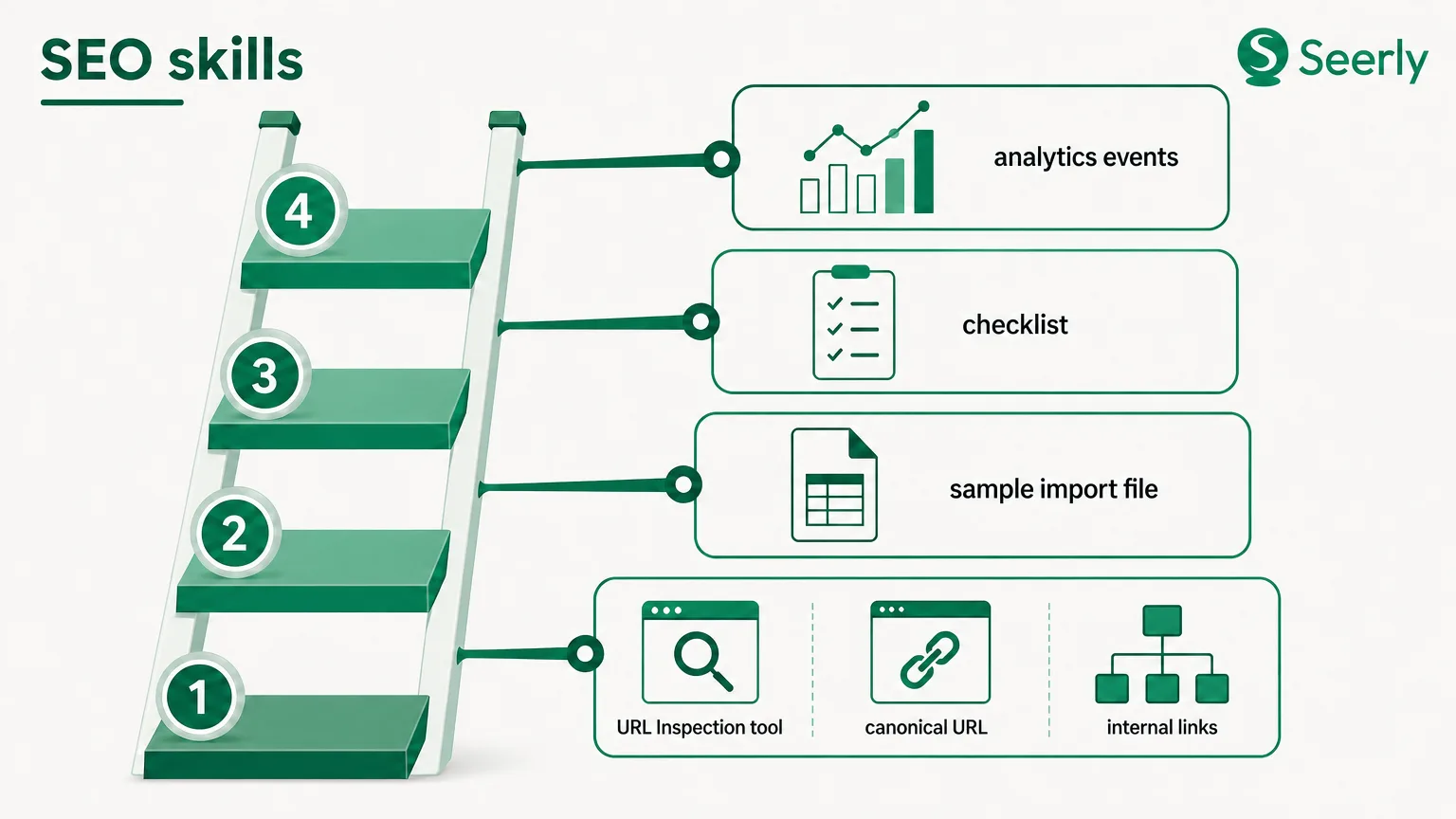
My preferred learning order is straightforward: technical accessibility, demand interpretation, evidence-led content design, then performance measurement. Learn the ladder in that order, but establish measurement before changing a live page. Otherwise, even a useful improvement becomes difficult to evaluate.
What has AI changed about the value of SEO skills?
Myth: If AI can write articles, learning SEO mostly means learning better prompts. Fact: Drafting is one production task; deciding what deserves publication requires a different set of capabilities. A fluent answer can still target the wrong customer problem or sit on a page search engines can’t access.
SEO capability is the ability to make relevant pages discoverable, answer a real audience need with credible evidence, and evaluate their contribution to business goals.
Google Search Central states that all existing technical SEO best practices continue to be worthwhile for its generative search features. Beginners don’t need to abandon ordinary website diagnostics for a mysterious new discipline. They need to understand those diagnostics well enough to distinguish an access problem from a content problem.
Look, an AI draft can save time. But what exactly did it save time doing? Until you can answer that question, production speed is a weak measure of marketing capability.
Which four SEO skills for marketers create business impact first?
1. Technical accessibility: can search engines reach the answer?
Start with crawling and indexing. Crawling means fetching a page; indexing means processing it for possible inclusion in search results. A working URL alone proves neither, so learn to inspect access restrictions, indexation directives, canonical URLs, and internal links.
Practice on one live page using Google Search Console’s URL Inspection tool. Compare the intended page with the URL Google treats as canonical, and investigate any reported exclusion. After learning this rung, you can diagnose a basic discoverability problem and write a precise developer request, rather than reporting that “SEO isn’t working.”
2. Search-demand interpretation: what decision sits behind the query?
A payroll software team might see searches for “payroll migration checklist” and “payroll software pricing.” Both mention the same category, but the searchers need different help. One is reducing implementation risk; the other is assessing cost.
Learn to group queries by the underlying customer decision, using search results alongside sales questions or support records. Search volume is an input, not a business case. After this rung, you can explain which problem a page should answer, why it matters commercially, and what useful next step belongs on it.
3. Audience-first content design: what evidence makes the answer useful?
Build the answer before polishing the prose. For a migration checklist, that might mean documented prerequisites, a sample import file, and an explanation of common validation errors. Without evidence, a confident draft is still an unsupported draft.
Google’s guidance asks publishers to assess original information, clear sourcing, and evidence of expertise. Translate that into an editorial habit: flag unsupported claims and identify who can verify them. After this rung, you can create a brief that specifies the answer and its proof, then use AI to assist with expression.
4. Performance measurement: did anything useful happen?
Separate search presence from website behavior and business outcomes. Impressions show exposure; clicks show visits from search; qualified enquiries or purchases describe a different level of value. Treating them as interchangeable leads to cheerful dashboards and unanswered budget questions.
Learn to connect page-level search data with analytics events and, where appropriate, CRM records. Record the baseline before publishing changes, and annotate other campaigns that might affect the comparison. After this rung, you can report what changed, what remains uncertain, and which decision the evidence supports.
Which popular tasks should not be mistaken for an SEO strategy?
A team can spend a week breaking articles into small sections while leaving an important page orphaned. The work looks organised. The original discoverability problem remains untouched.
Google Search Central advises teams to prioritise effective SEO strategies over content chunking, unnecessary AI text files such as llms.txt, or inauthentic mentions. Clear headings still help readers, but a useful reading structure is different from formatting solely to chase presumed AI preferences. And an AI-related file cannot substitute for accessible pages or credible information.
| Durable practice | Shortcut mistaken for strategy | Better test |
|---|---|---|
| Diagnose crawling and indexation | Add llms.txt without a documented need | Can the intended page be accessed and indexed? |
| Interpret customer demand | Generate articles from a keyword list alone | Which customer decision does each page support? |
| Support answers with evidence | Rephrase competing articles or manufacture mentions | What can a reader verify here? |
| Organise content for readers | Chunk text to satisfy speculative AI rules | Can someone complete their task without hunting? |
| Measure business contribution | Count drafts or celebrate visibility alone | What happened after exposure or a visit? |
Honestly, I’d rather review one well-supported page than approve a queue of interchangeable drafts. Speed earns its place after the team can explain the work’s purpose.
What does a beginner’s first measurable SEO project look like?
Use a small project with a short evidence trail. The following is a hypothetical workflow, not a customer case study, and it assumes no positive result. A payroll software business wants to help prospective customers answer: “Can I move payroll systems without losing historical records?”
-
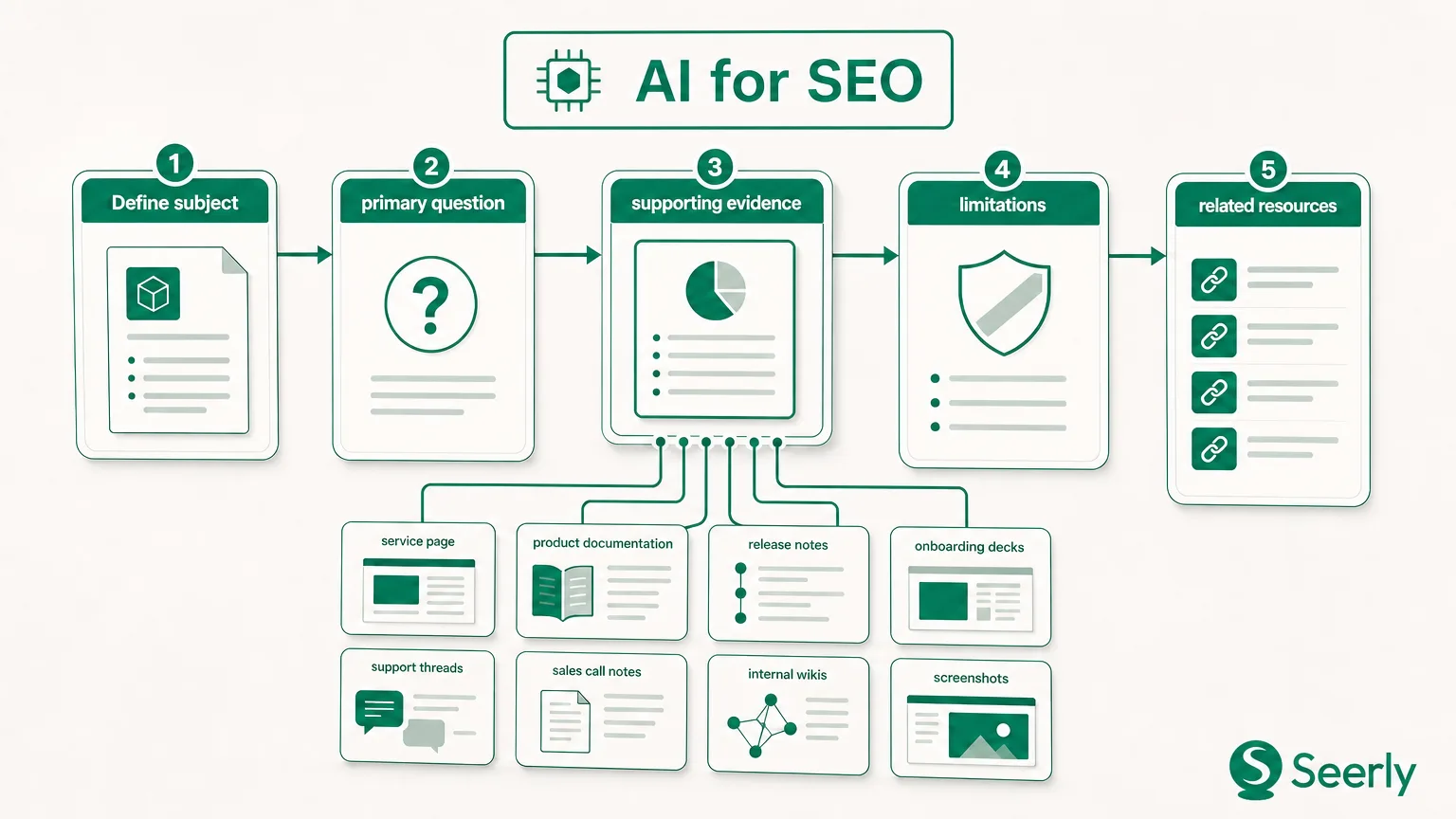
Start with one customer problem. Gather actual migration questions from sales or support, then inspect relevant search queries and results. Write down the audience’s decision and the product team’s verified answer. Choose a business outcome, such as a qualified migration consultation, before drafting.
-
Create one answerable page. Build a guide explaining which records can transfer and how validation works. Include a verified sample checklist and limitations that a buyer needs to know. The call to action should follow the task naturally: request a migration review, not subscribe to an unrelated newsletter.
-
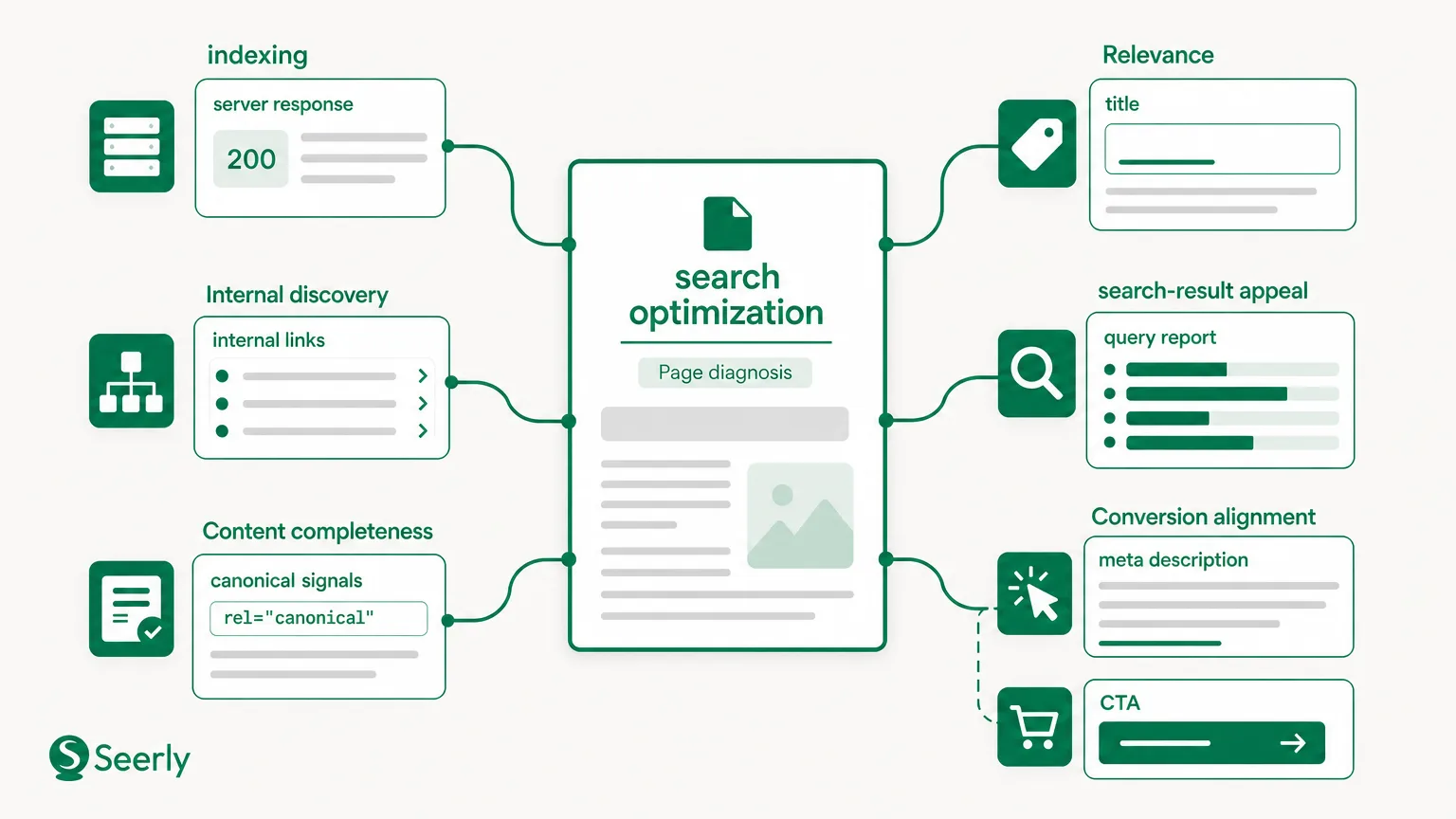
Verify discoverability. Check that the page loads successfully, has no unintended indexing restriction, and links from a relevant product or help page. Inspect its canonical URL and indexation status in Search Console. Record the findings separately from requests for recrawling, which don’t promise inclusion.
-
Track search presence. Save baseline page-level impressions, clicks, and relevant query groups, then review comparable periods. For AI search visibility, use a documented set of relevant prompts and record the answers alongside their cited sources. Seerly’s marketing-team visibility tools can support that monitoring, but sampled answers are observations, not a census of customer exposure.
-
Record the business outcome. Track consultation requests associated with visits to the page, then ask sales to classify their relevance. Report the observed total, including zero, alongside the attribution method and its limitations. Without a stronger experimental design, describe the result as an association rather than proven incremental revenue.
At the review, resist changing everything at once. If the page is indexed but attracts mismatched queries, revisit intent. If relevant visitors arrive but don’t act, inspect the answer’s usefulness and the next step.
How can a manager assess whether SEO learning is producing useful capability?
Ask a learner to explain one underperforming live page without opening a writing tool. Their response should distinguish facts from hypotheses and name the next check. That conversation tells you more than a certificate or a count of published articles.
Use this checklist during a page review:
- Can they diagnose indexation? Ask for the inspected URL, its reported status, and the evidence behind the proposed fix. “Submit it again” isn’t a diagnosis.
- Can they explain query intent? They should connect a query group to a customer decision. Ask why the page format fits that decision.
- Can they identify evidence gaps? Have them flag a claim that needs verification. A useful review names the missing proof and who could supply it.
- Can they connect visibility with outcomes? Request a report that separates exposure from qualified actions. Look for explicit attribution limits.
Seerly’s guide to AI-assisted SEO with human QA extends this distinction into production workflows. Keep approval tied to intent fit and proof, not simply a finished draft. A learner who notices uncertainty is doing useful analytical work.
Frequently asked questions
Is SEO still worth learning if AI writes the content?
Yes, because writing doesn’t resolve access problems or establish demand. SEO learning helps you decide what to publish and how to judge its contribution. AI can assist with drafting once those decisions have support.
Does a beginner need to learn coding first?
No, start with page inspection and clear diagnostic notes. You should understand what an indexation directive does before attempting complex implementation work. Learn enough HTML to recognise common issues, then collaborate with developers when the fix exceeds your experience.
Should AI citations become the main success metric?
Only if citations directly match the project’s objective. For most business projects, record them as visibility evidence alongside qualified actions. A citation alone doesn’t prove a visit or a sale.
Choose one page before commissioning ten more
Choose one live page and run a retrospective using the four-rung ladder. Identify where capability is missing: access, demand interpretation, evidence, or measurement. Then invest in that gap before increasing AI-assisted production.
What would your team learn from fixing one uncertain page instead of drafting another ten? Use that question at the next content review, and make the answer your next assignment. For support connecting AI search visibility with measurable growth, learn more at Seerly.