The AI Visibility Dashboard Leadership Actually Needs: What to Report Beyond Rankings, Traffic, and Backlinks

Marketing leaders still ask for the same monthly SEO summary they asked for three years ago: rankings, sessions, conversions, and a quick way to check backlinks. Those numbers still matter, but they no longer answer a newer executive question: is the brand actually showing up inside AI-generated answers, and if so, how credibly and how often? That gap is becoming harder to ignore as search behavior shifts toward answer engines and conversational discovery.
The change is visible in market behavior as much as in analytics. Practitioners are increasingly discussing ChatGPT, Perplexity, and other answer tools as part of the search journey, not as side experiments. Even community discussion reflects that change, with one Reddit thread on ChatGPT as a search engine drawing 175 upvotes and 44 comments, a useful signal that search habits and reporting expectations are both evolving. At the same time, analysts focused on AI visibility are advising teams to build dashboards specifically for leadership reporting, because classic SEO scorecards do not reveal whether a brand is being cited, recommended, or omitted in AI answers.
That is the core problem this guide addresses. If your team still reports visibility through rank tracking, traffic, and backlink checks alone, leadership is likely missing the performance layer that now shapes discovery earlier in the buying journey. The solution is not to stop measuring traditional SEO. It is to add an executive-ready AI visibility scorecard that explains answer presence, citation quality, competitive share, sentiment, and business impact in a way leadership can actually use.
Why legacy SEO reporting leaves leadership with blind spots
Traditional SEO reporting was designed for a click-first web. It assumes users search, scan links, choose a result, and visit a website. Under that model, rank improvements, traffic growth, and stronger authority signals made a clean story for executives. If rankings rose and organic sessions followed, leadership could reasonably infer better visibility.
That logic weakens in AI-assisted discovery. A prospect may now ask a large language model for “best enterprise analytics tools,” “top HR software for distributed teams,” or “which cybersecurity vendor is trusted for mid-market healthcare.” In those moments, the platform may synthesize an answer before a click happens. The brand can influence the decision without receiving the visit, or miss the recommendation entirely while still holding respectable rankings in traditional search.
This is why a team can look healthy in a legacy SEO dashboard and still underperform in AI search discovery. Leadership sees green arrows on traffic and maybe a stable domain profile, but has no line of sight into recommendation coverage. That is a strategic blind spot, not a reporting nuance. If executive reporting does not capture whether your brand appears in AI answers, how often it is cited, and against whom it is being compared, the dashboard is no longer aligned with how discovery actually works.
What teams usually report today: rankings, traffic, and backlink checks
Most SEO teams still build their monthly updates around three familiar inputs: keyword rankings, organic traffic, and authority proxies such as links or domain strength. There is a good reason for that. Backlinks remain useful in organic search, and the evidence still supports their role as one trust signal among many. Search Engine Land notes that backlinks are still important for SEO even if they are no longer the sole deciding factor, while Ahrefs argues that links matter less than they used to, but they still matter. If you manage organic performance, it is entirely reasonable to check backlinks regularly.
But the operational habit of checking backlinks often gets overstretched into an executive story. A backlinks report can show whether your site is attracting references from reputable domains, whether your authority profile is improving, and whether a competitor is outpacing you in link acquisition. It can also support content quality and trust signal analysis, particularly because quality backlinks carry more weight than raw volume. None of that, however, tells you whether an AI system is naming your brand in category-level answers.
The same limitation applies to traffic. Organic sessions reveal click behavior after discovery, not necessarily visibility within answer interfaces. A brand may be cited in AI summaries yet see muted referral data because the user got enough information without clicking. Conversely, a site may receive traffic for legacy informational queries while being absent from high-intent AI recommendation prompts. Traffic is still valuable, but it is downstream evidence, not direct proof of AI answer presence.
Rank tracking has a similar problem. A number-one ranking for a head term does not guarantee inclusion in an AI-generated comparison. Modern answer systems synthesize across multiple sources, entities, reviews, brand mentions, and trust signals. That means you need reporting that sits alongside ranking data rather than assuming rankings explain everything.
Why checking backlinks is still useful, but no longer sufficient
Executives do not need a lecture on why links matter. They need clarity on what links can and cannot answer. That distinction is where many monthly reports break down.
From a classic SEO perspective, link analysis remains foundational. Backlinko explains that backlinks function as signals of trust and authority, and broader industry summaries continue to show that strong link profiles correlate with search performance. In other words, if your team wants to check backlinks to monitor authority growth, benchmark competitors, or identify high-value referring domains, that is still smart practice.
What those checks cannot do is answer leadership questions such as these:
-
Are we being recommended in AI answers for our highest-value category prompts?
-
When we are cited, are the cited pages current, strategic, and conversion-relevant?
-
Which competitors appear with us most often?
-
Are AI platforms describing our brand accurately and favorably?
-
Is increased AI visibility producing any measurable downstream commercial signal?
This is the reporting shift. Backlinks are now one layer of the visibility story, not the story itself. Teams that keep over-indexing on link growth without measuring answer coverage risk presenting activity instead of outcome.
The five AI visibility metrics leadership should add now
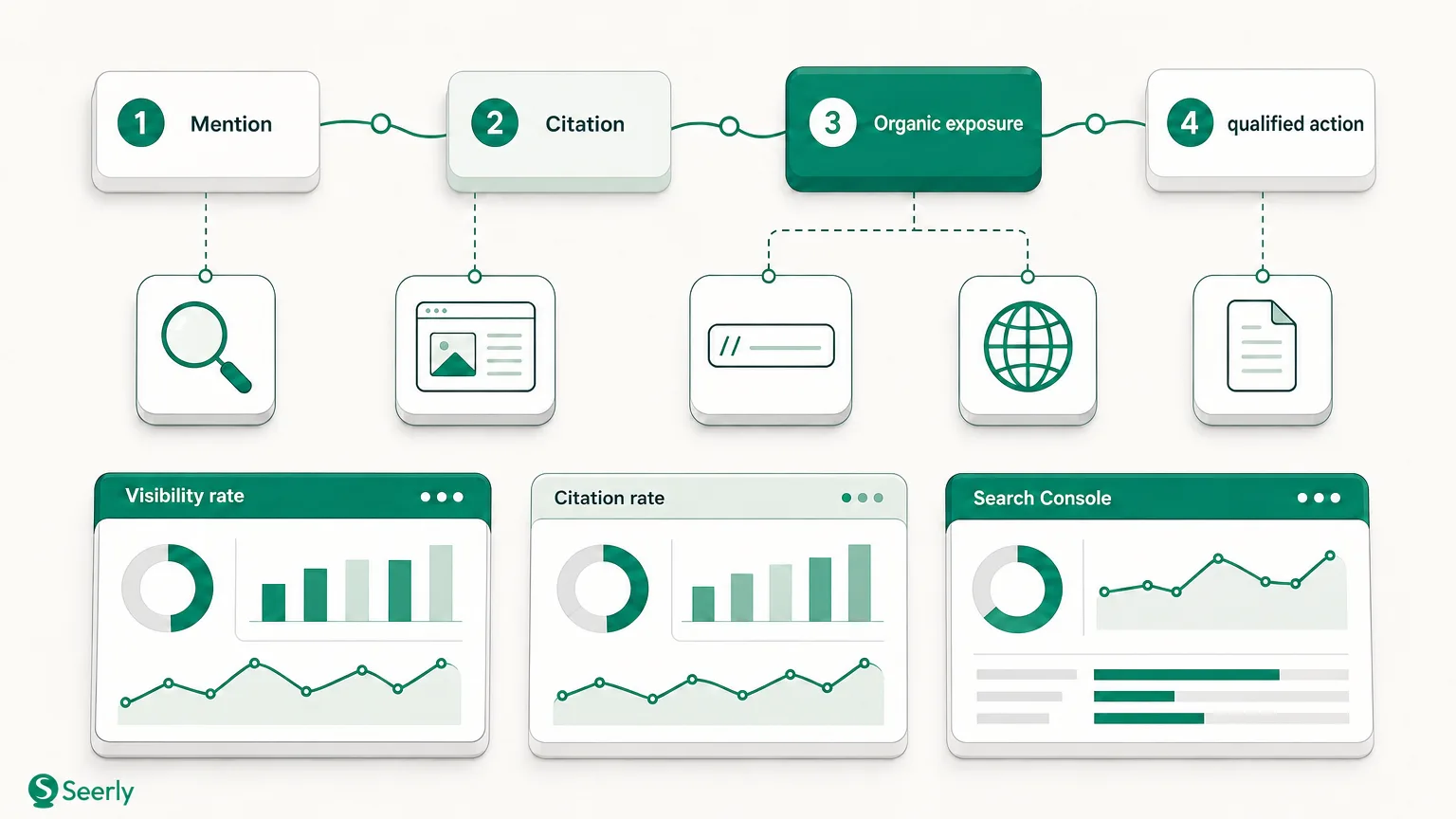
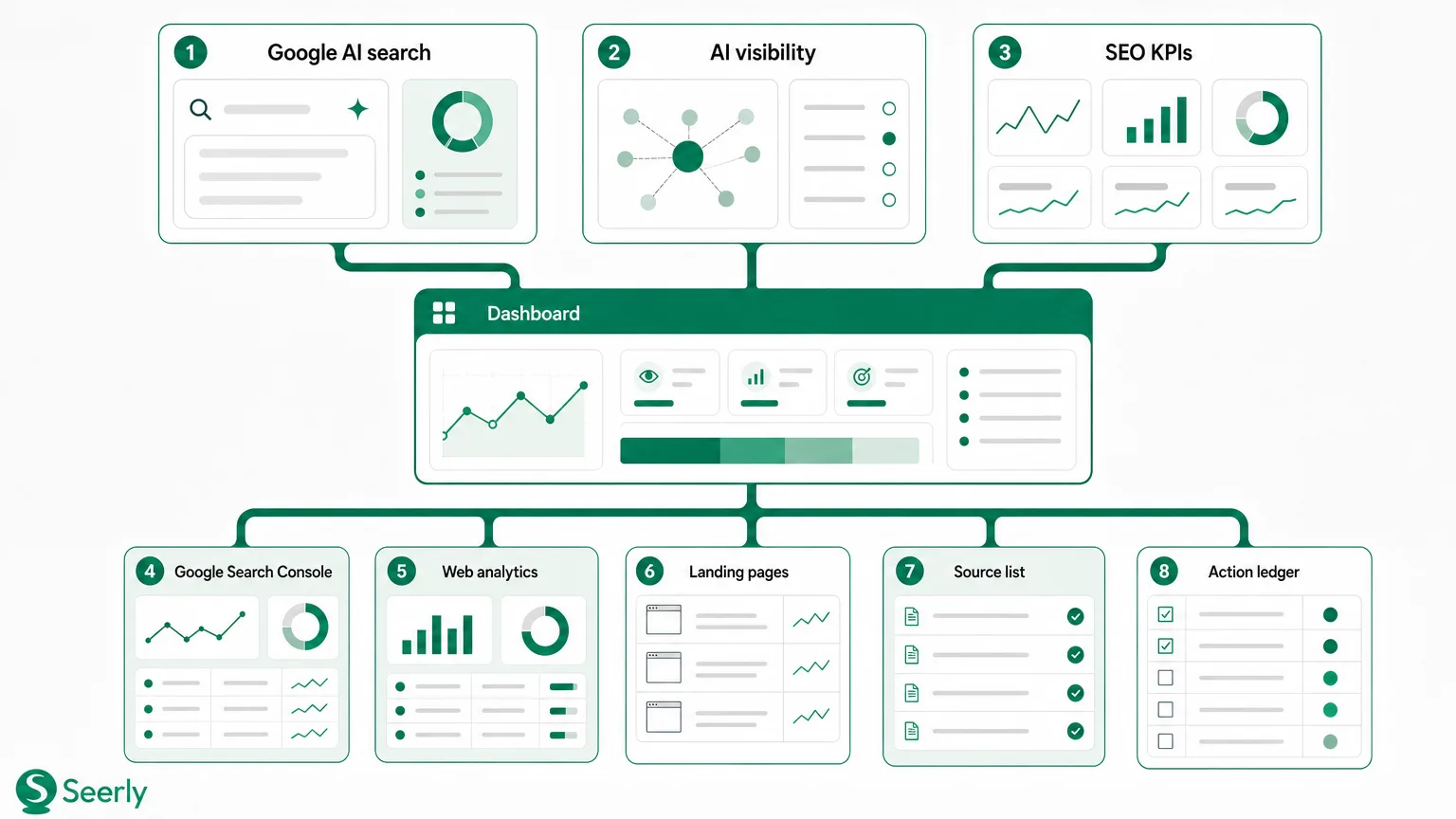
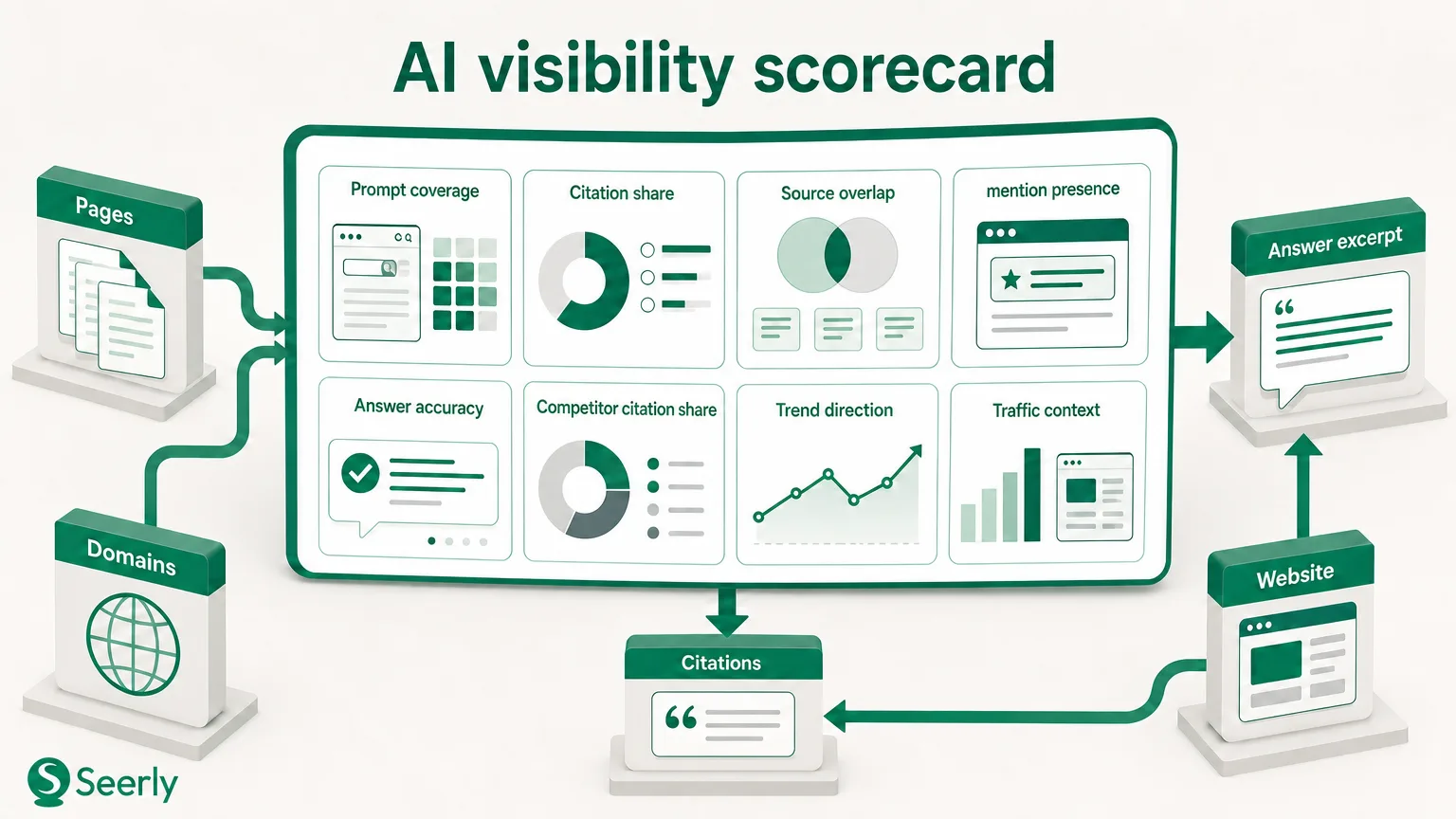
A leadership-ready dashboard should preserve legacy SEO metrics but elevate five AI-specific additions. Together, they create a scorecard executives can use for prioritization, risk review, and investment decisions.
1) Answer presence
Answer presence measures whether your brand appears at all in a defined set of AI prompts that matter to your market. This is the baseline visibility metric. If you are not present, other metrics do not matter yet.
The executive question it answers is simple: are we in the conversation when buyers ask AI tools the questions that shape vendor discovery? A leadership-friendly version is a percentage, such as “brand present in 38% of tracked commercial prompts, up from 24% last month.” That gives executives immediate directional insight without forcing them into prompt-level detail.
2) Citation frequency
Citation frequency tracks how often your brand or your owned assets are cited across monitored prompts and answer engines. Unlike answer presence, which is binary, frequency shows repetition and consistency. A brand that appears once in a narrow prompt set is different from a brand that repeatedly shows up across comparison, evaluation, and problem-solution queries.
For leadership, this answers: how consistently are AI systems associating our brand with the category? The dashboard version might say, “Our pages were cited 61 times across 120 tracked prompts this month, versus 39 last month.” That phrasing is clearer than reporting a pile of screenshots and gives a scalable trend line.
3) Citation quality
Citation quality evaluates whether the pages or mentions driving visibility are actually the ones you want representing the brand. An AI system might cite an outdated blog post, a third-party directory, a forum complaint, or a generic homepage. That is visibility, but not necessarily helpful visibility.
The business question here is: when we appear, are we being represented by strong trust signals and strategically useful content? A leadership-friendly cut might classify citations into tiers such as high quality, acceptable, and weak. High-quality citations could include original research, clear product pages, documentation, or authoritative category content. This aligns well with Seerly’s broader perspective on what AI search engines need from original content before they reuse or recommend it.
4) Competitive inclusion
Competitive inclusion measures who appears alongside you and who is absent. This matters because AI answers are often comparative by design. If your brand shows up only when directly named, but competitors appear in generic “best tools” prompts, leadership should treat that as a category-level visibility problem.
The executive question is: are we winning share of recommendation within our competitive set? A clear reporting format might state, “We appeared in 42% of category prompts, compared with Competitor A at 67% and Competitor B at 49%.” This makes AI visibility legible in the same way share-of-voice reporting did for search and media. If you already run monthly competitor content gap analysis for AI search, this metric becomes much easier to explain and operationalize.
5) Outcome alignment
Outcome alignment connects AI visibility to business evidence without overstating direct attribution. This is where many teams either become too vague or too aggressive. Leadership does not need inflated claims that one AI mention caused pipeline. They need a disciplined view of whether AI visibility is moving in the same direction as qualified visits, branded search lift, assisted conversions, sales feedback, or shortlist inclusion.
The business question is: is improved AI visibility producing meaningful commercial signals? A leadership-friendly version might read, “AI answer presence improved 11 points month over month, while branded search grew 9% and sales teams reported more category-educated inbound prospects.” That is directional proof, not false precision.
A worked monthly reporting template leadership can read quickly
The best executive dashboard is concise, comparative, and narrative-driven. It should fit into a monthly business review without requiring the CMO to translate SEO jargon in real time.
Example: monthly AI visibility summary
Visibility trend
In June, the brand appeared in 41% of tracked AI answers across 80 commercial and evaluation prompts, up from 32% in May. Citation frequency rose from 46 total citations to 63, with strongest gains in mid-funnel comparison prompts. Presence improved most in Perplexity and ChatGPT category summaries, while coverage remained weak in “best [category] for enterprise” prompts.
Top-cited pages
The most cited owned assets were the category landing page, two use-case guides, and a recent original research post. This is a healthy sign because the citations are pulling from conversion-relevant and trust-building content rather than low-context pages. Teams working on AI-ready content often see stronger recommendation consistency when their most cited assets are also the most structurally clear and original, a pattern explored in analysis of originality signals before AI systems treat content as interchangeable.
Missed prompts
The brand did not appear in 19 high-value prompts related to implementation complexity, pricing transparency, and category leadership. Those gaps matter because they often reflect weaknesses in source coverage, clarity, or reputation signals rather than simple keyword targeting.
Competitor movement
Competitor A increased answer presence from 51% to 64%, driven largely by stronger inclusion in “best tools” and “alternatives” prompts. Competitor B stayed flat but gained more favorable descriptive language. Our brand closed the gap in technical-use-case prompts but lost share in broad recommendation prompts.
Narrative explanation
Overall AI visibility improved, but the gains were uneven. The team expanded inclusion where product-specific content was already strong, yet broad recommendation coverage still trails the category leader. Traditional SEO metrics remain stable, including rankings and traffic, but backlink growth alone does not explain the AI gap. The more relevant issue is that recommendation-oriented prompt coverage remains underreported compared with authority metrics.
That last point deserves emphasis. Many teams still dedicate more report space to whether they check backlinks monthly than to whether they were recommended in the prompts leadership actually cares about. That is a measurement imbalance. Authority indicators belong in the dashboard, but they should support the story, not replace it.
Trust, sentiment, and ROI need their own section
AI visibility without trust can become a liability. A brand may appear often but be framed as expensive, unclear, risky, or second-tier. That is why sentiment and representation quality should sit near visibility metrics in leadership reporting.
This matters even more because ROI conversations around AI search are still unsettled. In the available sentiment sample you referenced, concerns around ROI measurability were entirely negative, with Perplexity cited as the provider. That is not surprising. AI discovery frequently influences consideration before a click, which makes attribution harder than standard organic reporting. If teams fail to acknowledge that complexity, executive trust erodes fast.
The answer is not to avoid ROI reporting. It is to define outcome alignment carefully. Pair AI visibility metrics with downstream indicators such as qualified organic visits from AI-relevant landing pages, branded search lift, assisted conversions, self-reported “how did you hear about us” inputs, and sales-team observations about whether prospects reference AI-generated recommendations. You can also track whether more opportunities are arriving already informed about your category positioning.
Importantly, present this as contribution evidence rather than deterministic attribution. A disciplined leadership report says, “AI answer presence improved and several downstream indicators moved favorably,” not “AI mentions generated $400,000 in pipeline.” The second claim usually overreaches the data.
Trust signals matter here too. As the web becomes more answer-oriented, source quality, reputation context, and recommendation proof become more influential. Seerly’s perspective on online reputation signals as proof for AI search recommendations is especially relevant for teams trying to explain why sentiment belongs in the same room as visibility.
FAQ: Common leadership questions about AI visibility reporting
How often should teams report AI visibility?
Monthly is the best default for leadership reporting because it balances signal quality with operational usefulness. Weekly updates are often too noisy for executives unless there is an active launch, reputation event, or sharp competitive change. Internally, teams may monitor prompts more frequently, but the board- or leadership-level summary should focus on monthly trend lines, major shifts, and priority actions.
Which numbers matter most in board updates?
Boards usually need only a few metrics: answer presence, competitive inclusion, citation quality trend, and one or two outcome-alignment measures. They do not need a dense operational dashboard. If you have five minutes, report whether the brand is appearing in the right AI answers, whether competitors are gaining share, whether the sources cited are strategically strong, and whether business indicators moved with visibility.
What should we do when rankings look fine but AI answer presence is weak?
Treat it as a content and trust-signal gap, not as proof that SEO is failing. Strong rankings can coexist with weak answer-engine inclusion because the systems evaluate and synthesize differently. Start by identifying which high-value prompts exclude your brand, which competitors are included, what sources are being cited, and whether your best pages are clear, original, and recommendation-ready. Then review whether your reputation footprint, source diversity, and category framing are strong enough to earn inclusion.
Should leadership still ask the team to check backlinks?
Yes, but in the right role. Backlinks remain useful for authority monitoring, competitive benchmarking, and diagnosing whether your content is earning credible external references. Industry coverage still supports that role, including findings that quality and authority of linking domains matter more than raw link counts. The mistake is assuming those checks reveal AI recommendation performance on their own.
What is the simplest first version of an AI visibility dashboard?
Start with one tracked prompt set, one competitor set, and five metrics: answer presence, citation frequency, citation quality, competitive inclusion, and one downstream business signal. Add a short narrative section explaining what changed and why it matters. That gives leadership a decision-ready view without forcing the team into a sprawling measurement program on day one.
Conclusion
If your current reporting stack is built to check backlinks, monitor rankings, and summarize traffic, it is not wrong. It is just incomplete for the way discovery now works. Leadership needs to know not only whether the site is authoritative, but whether the brand is actually present, cited, and trusted inside AI-generated answers that shape consideration.
The practical next step is to audit your current dashboard against the questions executives are already asking. Which answers can you provide confidently, and which ones are still invisible because the report was built for a click-only search model? If that gap is real, it is time to move from fragmented SEO metrics to a blended AI visibility scorecard. To see how this approach can be operationalized, explore Seerly as a next step for proactive monitoring, reporting, and data-driven management of AI search discovery.