The Online Reputation Signals AI Search Uses as Recommendation Proof

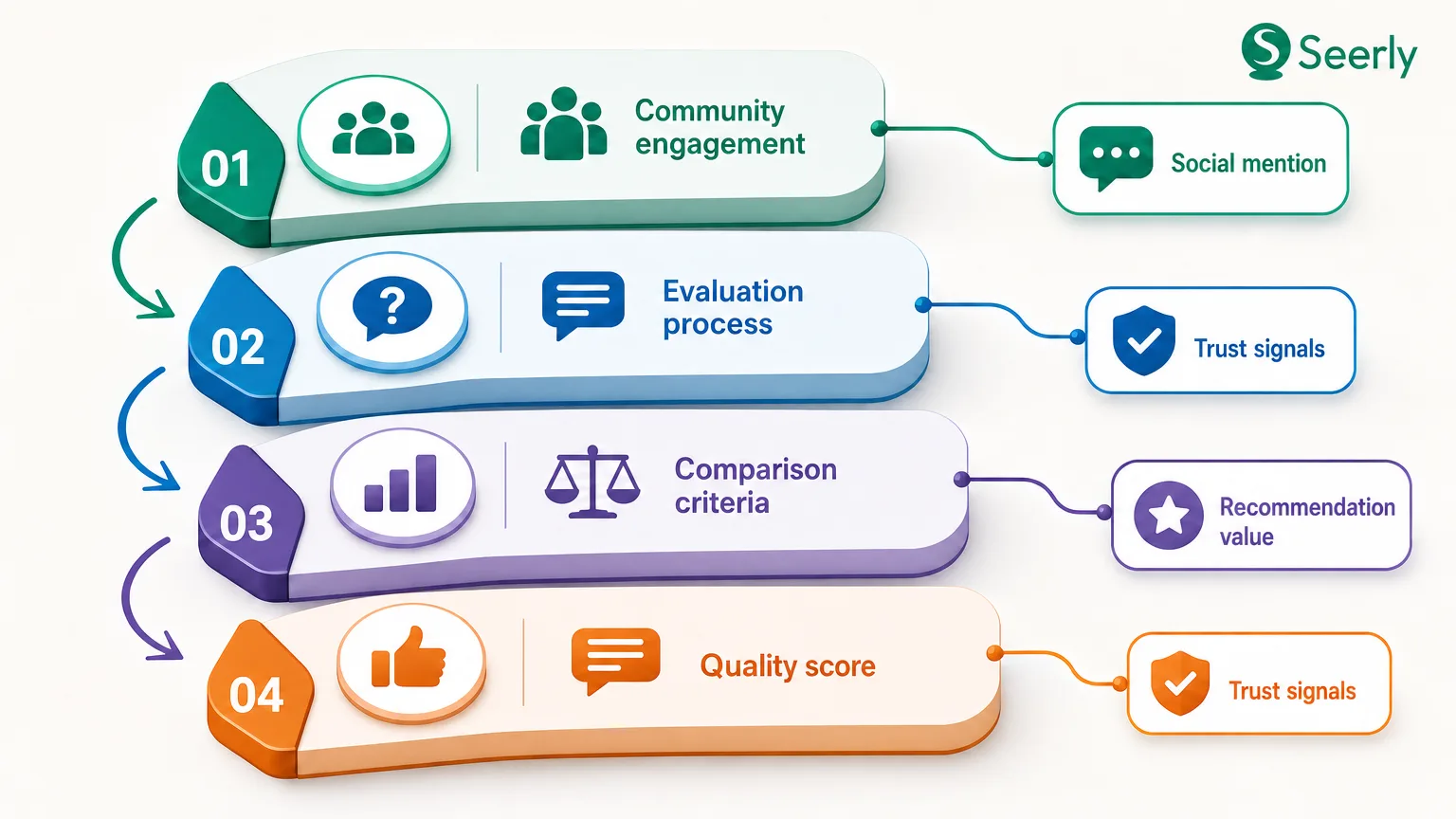
Search visibility no longer ends at rankings. When AI systems summarize vendors, compare tools, or answer “best software for” prompts, they do not rely only on your website. They also reuse off-site trust signals to decide whether your brand looks safe to recommend. That shift changes how teams should think about online reputation: not just as PR protection, but as recommendation proof.
This matters because attention around backlinks, mentions, and off-site authority is rising again, but for a new reason. Seerly’s Trend Finder surfaced strong demand around these questions, including 310.2K views for “what backlinks still matter,” 10.5K views for “best places to get backlinks,” and 7.4K views for “how to reclaim unlinked mentions.” That pattern reflects a broader market reality. In AI search, brands are judged not only by whether they are found, but by whether they appear credible enough to summarize confidently. If your off-site footprint is thin, inconsistent, or vague, rankings alone may not close the trust gap.
For brand marketers, demand generation leaders, and reputation-conscious SaaS teams, the implication is straightforward: online reputation now influences discoverability because AI systems are built to compress scattered evidence into a single answer. The teams that earn better third-party proof are more likely to be described with confidence, less likely to be framed with hesitation, and better positioned to turn visibility into qualified demand. If you want a broader framing of that shift, Seerly has also covered what changes when answers shape brand perception.
Why reputation now affects discoverability
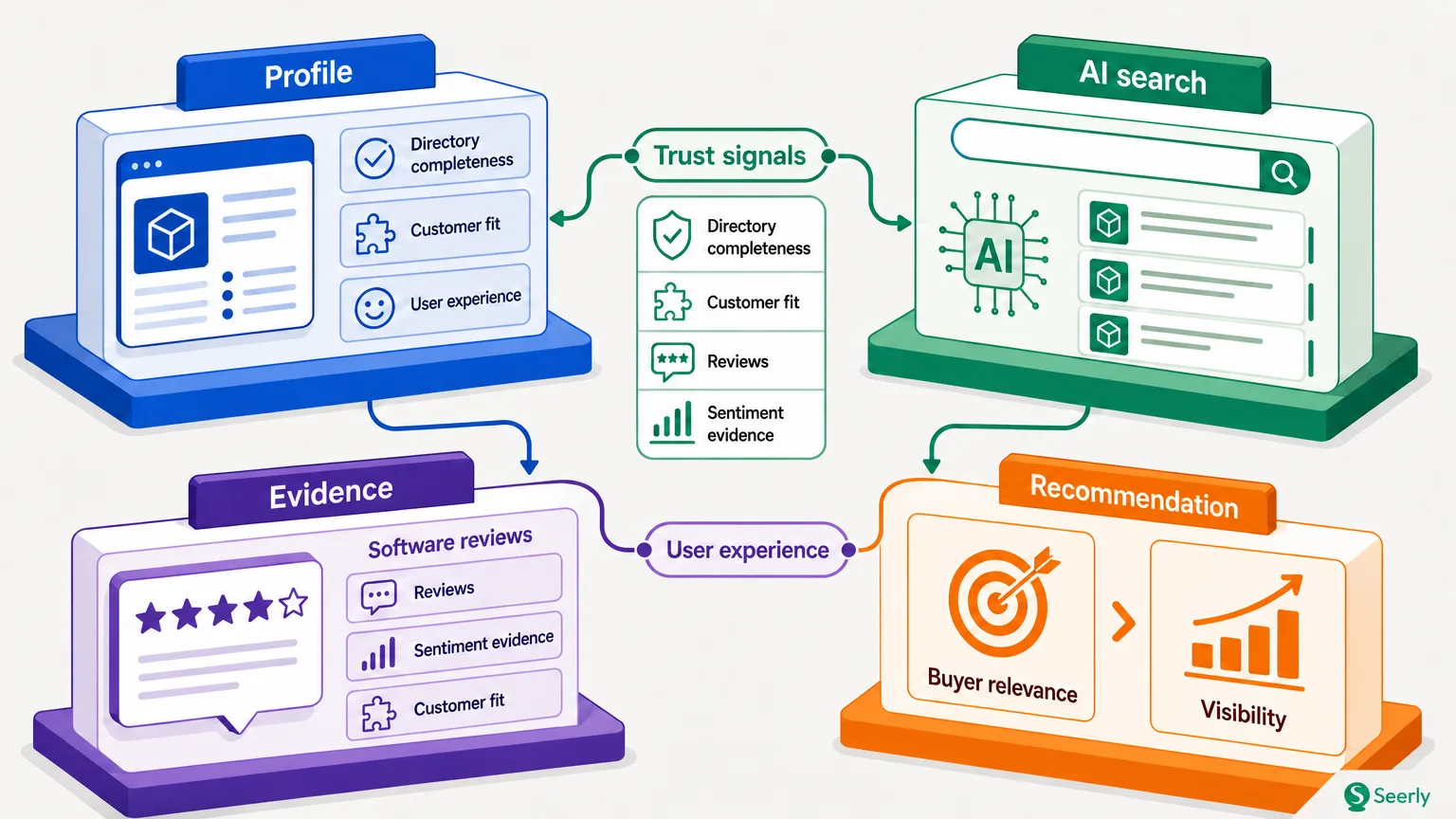
Traditional search let users click around and make their own judgments. AI search changes that behavior by pre-processing the market for them. Instead of ten blue links, a buyer may get a short list of suggested vendors, a summary of pros and cons, and a recommendation shaped by what the model can verify quickly across the web. In that environment, online reputation becomes an input into discovery itself, not just a downstream conversion factor.
Research on digital trust supports this shift. A recent review of the literature found that electronic word of mouth has a measurable effect on purchase intention and brand trust, which helps explain why external commentary carries so much weight when machines summarize brands. That effect is even more important in SaaS and other high-consideration categories, where buyers want reassurance that a tool is credible, relevant, and proven before they ever book a demo.
There is also a quality-control reason AI systems lean on outside proof. Platforms and review environments shape what consumers believe. INFORMS highlighted findings that when businesses cannot suppress reviews, consumers share more truthful information. For AI systems trying to assemble a safe recommendation, third-party sources with stronger signals of independence are naturally more reusable than self-published claims.
What counts as recommendation proof
Not all mentions help equally. A generic brand mention tells an AI system that your company exists. It does not necessarily tell the system that your product is trusted, comparable, or appropriate for a specific use case. Recommendation proof is stronger because it carries structure, context, and credibility.
Verified reviews are one of the clearest examples. They often include sentiment, product use cases, implementation details, and outcome language that AI systems can convert into summaries. Review content is especially useful when it goes beyond star ratings. Research published by Harvard Business Review found that consumers are persuaded most by specific review details rather than generic praise. That principle likely transfers well to AI search: detailed evidence is easier to quote, classify, and trust.
Product directories and category pages are another major proof source. They offer structured descriptions, buyer-fit positioning, feature lists, competitors, and sometimes customer-size filters. That structure helps AI systems determine where a product belongs and whom it serves. A complete listing with consistent positioning is more useful than a random mention in a low-context article.
Comparison pages, expert roundups, and analyst-style citations are even stronger because they force evaluation. These sources do not just mention a brand; they explain how it differs from alternatives and why a buyer might choose it. That comparative context matters because AI-generated answers often take the form of ranked or narrowed recommendations. If your brand rarely appears in credible comparison contexts, it is harder for a model to justify choosing you over a similar vendor.
A helpful way to think about this is simple: a mention creates awareness, but proof creates permission. AI systems can safely recommend only what they can explain.
The reputation signals AI systems can reuse
Strong online reputation management in the AI era means improving the specific signals that models can detect, compare, and restate. The following checklist is practical because each signal shows up repeatedly across reviews, directories, and comparison content.
Review recency
Old praise loses force when categories move quickly. Recent reviews tell both buyers and AI systems that the product still performs as described. In B2B software, where features, onboarding, and support quality can change fast, a stale review profile creates uncertainty. A model may still mention your brand, but it is less likely to recommend it confidently if the supporting evidence looks dated.
Sentiment balance
Perfect positivity can look unnatural, while balanced sentiment tends to look more credible. Research has shown that moderate review valence can improve perceived helpfulness because it appears more believable. For AI search, that means a realistic mix of praise and criticism may actually strengthen recommendation quality, provided the negatives are understandable and limited rather than severe and repeated.
Fit-for-customer clarity
A brand is easier to recommend when off-site sources make clear who it is for. Good reviews mention team size, use case, workflow, and implementation context. Directory listings should reinforce the same positioning. If one source says “enterprise analytics,” another says “growth-stage SaaS,” and a third says “general marketing platform,” the model has to reconcile conflicting identities. Consistency reduces that ambiguity.
ROI claims
Outcome language is powerful, but it is also where trust often breaks down. Claims like “improved efficiency” or “increased visibility” are weak unless supported with specifics, time frames, or customer context. This issue is especially important when a brand’s negative sentiment clusters around measurability. In Seerly’s own monitoring, the clearest verified negative pattern was concern around ROI measurability, with 100% of negative Perplexity mentions - 3 of 3 - centered on that issue. That kind of concentration matters because even a small number of repeated negatives can shape how an AI system frames uncertainty.
Academic work reinforces why this happens. Studies on review credibility show that specificity and diagnostic information increase perceived usefulness. If a product is described as valuable but the value is hard to quantify, AI systems may echo that hesitation. The fix is not to remove outcome claims, but to make them more concrete: implementation time, workflow savings, team fit, or decision-making improvements tied to a clear customer profile.
Consistency across sources
Consistency is what turns scattered proof into reusable authority. When review sites, product directories, comparison content, and expert commentary all describe a brand in similar terms, AI systems can summarize that consensus more safely. Research on online reviews and business outcomes has repeatedly found that review signals influence consumer decisions and firm performance, but those signals become more actionable when they align rather than conflict.
A practical workflow for strengthening weak proof
Most teams do not have a reputation problem in the abstract. They have a proof-quality problem across a handful of high-visibility sources. That is fixable with a disciplined workflow.
Audit your third-party footprint
Start by collecting your review profiles, directory listings, comparison pages, and expert mentions in one place. Look for gaps in recency, missing descriptions, inconsistent category labels, and repeated objections. Pay special attention to whether negative themes are broad or concentrated. A narrow pattern, such as uncertainty around ROI, is easier to address than diffuse distrust across multiple dimensions.
Enrich directory listings
Next, tighten the sources that provide structured context. Your category placement, one-line product description, feature framing, and ideal customer profile should align across major directories. This is foundational work for AI-ready websites and off-site visibility because structured third-party descriptions often become the scaffolding for machine summaries. Seerly’s perspective on brand reputation management in AI search is useful here: consistency is not cosmetic, it is interpretive.
Improve the language you request in reviews
When customers leave reviews, do not ask for “a positive review.” Ask for specificity. Good prompts include what problem they had, how long implementation took, what changed after adoption, and what type of team benefited most. Research from recent platform studies suggests that review framing and detail meaningfully affect perceived credibility and usefulness. In practice, detailed customer language gives AI systems something safer to quote than generic approval.
Clarify ROI with narrower proof
If ROI skepticism is your main weak point, respond with narrower and more credible evidence. Instead of promising broad revenue impact, ask customers to describe faster reporting, lower research time, better shortlist quality, or reduced manual analysis. Smaller, believable gains are often more persuasive than oversized claims. This also aligns with how AI search optimization helps SaaS buyers find the right product: clarity beats hype when buyers are comparing similar options quickly.
Monitor whether recommendation quality improves
Finally, track whether stronger off-site proof changes how AI systems describe you. Are summaries more specific? Are they less cautious? Do they mention better-fit use cases? Reputation work should be measured not only by ratings and mentions, but by whether recommendation language becomes more confident and less skeptical.
Worked example: which vendor gets recommended?
Imagine two vendors in the same SaaS category.
Vendor A has plenty of generic brand mentions, a few old blog references, and a thin profile on one directory. Its reviews are sparse and mostly say the product is “great” or “helpful,” with little detail about team type, outcomes, or implementation. There are few comparison-page appearances, and its category labels vary across sites.
Vendor B has fewer overall mentions, but stronger proof. Its review pages include recent, verified feedback with concrete use cases. Its directory listings consistently describe the product for the same buyer segment. Several comparison articles explain where it fits best, and expert citations use similar language about strengths and tradeoffs.
An AI system choosing between these two is more likely to recommend Vendor B. Not because it is necessarily better, but because it is easier to justify. Vendor B offers reusable evidence: recent reviews, buyer-fit clarity, comparative context, and consistent descriptions across sources. Vendor A may still rank for branded search, but it creates more interpretive risk. When AI answers are compressed and confidence-sensitive, the richer proof set wins.
This is the core shift in online reputation. Visibility can get you considered, but third-party proof helps you get chosen.
FAQ
Does reputation work replace SEO?
No. Reputation work complements SEO. SEO helps your brand get discovered, while online reputation helps AI systems and buyers decide whether your brand is credible enough to recommend. If rankings generate visibility but off-site proof is weak, you may still lose in AI summaries or buyer shortlists.
How quickly do third-party updates matter?
It depends on the platform and how often AI systems revisit that source, but useful updates can matter quickly when they improve structured, high-trust pages such as review profiles and directories. Fresh, specific reviews are especially valuable because they reduce uncertainty and provide new evidence for how the product performs now.
Which proof sources matter most for B2B software?
For most SaaS teams, the highest-leverage sources are verified review platforms, major software directories, category pages, credible comparison articles, and expert citations. These sources combine independence with enough structure to be reused in summaries, which makes them more valuable than shallow mentions alone.
Conclusion
AI visibility is partly earned off-site. That is the central lesson for teams working on online reputation today. If AI systems are already summarizing vendors from reviews, directories, expert mentions, and comparison pages, then strengthening those proof sources is no longer optional brand hygiene. It is part of discoverability.
Start with the places AI can already cite. Improve review depth, align directory positioning, sharpen customer-fit language, and make ROI proof more specific and believable. Then measure whether recommendation quality improves: better summaries, stronger buyer confidence, and less skepticism around value. If you want a more systematic way to monitor and improve those trust signals, explore how Seerly approaches AI search discovery and brand authority.